


On a crisp autumn morning in Virginia, I watched a wigged printer at Colonial Williamsburg ink a wooden press, fold a freshly printed broadsheet, then lean over to explain that this was how news of the Stamp Act spread in 1765. The smell of ink and paper, the thud of the press, the creak of the floorboards under my feet made that political crisis feel suddenly close, urgent and strangely contemporary. Like many travelers, I had come for "a bit of history." I left with the sense that I had briefly stepped into someone else’s century. That is the peculiar power of an open air museum: it makes history feel not like something you read, but something you walk through.
Get the latest updates straight to your inbox!
What Makes an Open Air Museum Different
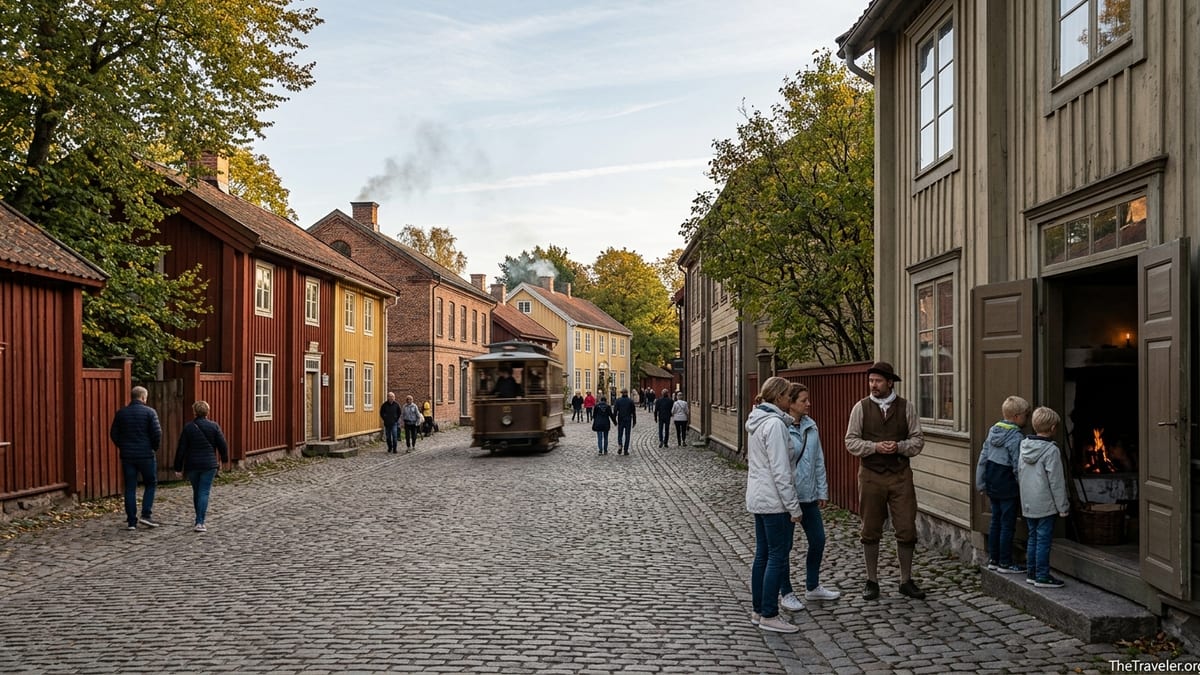
Most of us first meet history behind glass: coins mounted in neat rows, textiles pressed flat, labels printed in small type. Open air museums turn that model inside out. Buildings are the exhibits. Streets become galleries. Instead of walking past objects, you move through entire environments built or reconstructed to resemble another place and time. Costumed staff, working farms and functioning workshops add movement, sound and smell. The result is less like visiting a museum and more like slipping into a carefully researched historical film set where you are allowed to wander anywhere.
The concept is not new. In 1891, educator Artur Hazelius founded Skansen on the island of Djurgården in Stockholm, now widely regarded as the world’s first open air museum. He had dozens of historic wooden farmhouses, churches and town buildings from different Swedish regions taken apart, moved to Skansen and reassembled there to preserve a disappearing rural way of life. Today more than 150 historic structures spread across its hilltop park, from a Sami camp to a yellow-painted town quarter, all populated seasonally by staff demonstrating crafts and traditions.
That basic model has spread worldwide. In County Durham in northern England, Beamish Museum fills a 350-acre site with an early 20th-century pit village, a 1900s town street complete with tramway, a 1940s farm and more. In the United States, Colonial Williamsburg in Virginia recreates much of an 18th-century capital city, while sites such as Old Sturbridge Village in Massachusetts and Landrum’s Homestead & Village in Mississippi interpret rural life in later centuries. Each one uses architecture, landscape and performance to build a full-body encounter with the past.
The difference for travelers is visceral. A photograph of a steam tram can illustrate a guidebook. Riding an electric tram through Beamish’s cobbled high street while a conductor calls out the stops over the rattle of wheels gives you a sense of scale and speed that a photo never quite conveys. You begin to understand not just what things looked like, but how they felt and sounded.
Stepping Inside Other Centuries: Concrete Examples
At Skansen in Stockholm, the shift from spectator to participant happens quietly. You might start by stepping into a red-painted farmhouse from Dalarna where, in summer, a woman in 19th-century dress chops herbs on a wooden table. The room is warm from the tiled stove. Bunches of dried flowers hang from the rafters. Ask a question and she does not give you a lecture; she tells you what “her” family grows, how many children sleep in the box bed, how long it takes to walk to the nearest market. That first-person storytelling, rooted in research, helps you form a mental picture of rural Swedish life before industrialization that feels personal rather than abstract.
Later, you might find yourself in Skansen’s town quarter, where a working glassworks glows orange in the dim interior. The glassblower shapes a vase as quickly as a modern craftsperson, but he talks about 1890s wages, working hours and the hazards of the job. When he invites the group to feel the heat radiating from the furnace, the temperature difference over a few steps speaks more clearly than any wall text about industrial working conditions.
In England, Beamish achieves something similar with its 1900s town street. Walking into the Co-op grocery, you smell loose tea and soap instead of air conditioning. Behind the mahogany counter, a staff member in period dress wraps sugar in blue paper and talks about rationing during the First World War. Step back outside and you might be passed by a replica bus or a steam lorry, their engines echoing between brick buildings. It is an ordinary urban scene, but faithfully recreated for roughly the year 1913. Standing there, many visitors find it easier to grasp how modern that world already was, and how quickly it would be changed by war.
In the United States, Colonial Williamsburg creates a different sort of immersion. Here, you walk a grid of streets lined with more than 80 original and reconstructed 18th-century buildings across some 300 acres. Blacksmiths pound iron in smoky forges, coopers shape barrels, and in the courtyard of the Governor’s Palace, a guide might lay out the politics of the 1770s while you stand where real colonial governors once hosted receptions. Because it sits within a modern town, the experience includes the friction between past and present: you might leave a coffee shop, cross a busy street and seconds later be addressed by a costumed interpreter talking about royal authority and rebellion.
How Open Air Museums Change Your Sense of History
What surprises many travelers is how strongly these environments alter their perception of time. On paper, the difference between 1765 and 2025 is measured in dates. In an open air museum, that difference is experienced through your senses. At a working farm in Skansen or Beamish, the mud under your shoes and the smell of manure are immediate reminders of how physically demanding daily life once was. After watching a costumed farmer fork hay for half an hour, any text about subsistence agriculture reads differently.
Scale is another revelation. In photos, 18th-century buildings in Colonial Williamsburg can look grand. Walking through the cramped slave quarters behind some of those same houses, many visitors are struck by how little space was allowed for the people whose labor sustained the “big house.” Rooms that are barely wide enough for two bunk beds and a narrow chest tell a story about hierarchy and control more powerfully than statistics about plantation populations.
Time also feels thicker in these spaces. In a conventional museum, you might move quickly from an exhibit on medieval Europe to one on the Second World War. Open air museums, by contrast, tend to focus on a narrower slice of time, then allow you to inhabit that slice in detail. At Beamish’s 1940s farm, chickens scratch between vegetable rows while a staff member talks about wartime rationing and “dig for victory” campaigns. The conversation might turn to grandparents’ memories. Suddenly the Second World War is not a distant chapter but something that still echoes in living families.
This immediacy can foster empathy. When a costumed interpreter in Colonial Williamsburg introduces herself as an enslaved woman petitioning for her freedom and invites visitors to ask questions, the past becomes a dialogue rather than a monologue. You are no longer “looking at history”; you are in conversation with it. Many travelers find this both moving and unsettling, in productive ways.
Planning a Visit: Practical Tips and Realistic Expectations
Because open air museums rely heavily on live interpretation, timing matters more than at many conventional museums. At Skansen, for instance, many of the historic houses are only staffed and fully open during high season, typically from late spring through early autumn. Winter visits offer a beautiful Nordic atmosphere, Christmas markets and views over snowy Stockholm, but far fewer costumed interpreters. Before you go, check the seasonal schedule and daily program so you know which parts of the site will be active.
Scale is another practical consideration. Beamish covers several hundred acres, linked by heritage trams and buses, and Colonial Williamsburg stretches across a large historic district. It is easy to underestimate walking distances. Travelers with limited mobility should look into on-site transport options, which often include shuttle buses or accessible carriages on certain routes. Even if you are comfortable walking, plan footwear as you would for a city hike: expect cobbles, uneven flagstones and dirt paths rather than polished museum floors.
Ticketing can be more complex than simply “museum admission.” Colonial Williamsburg, for example, allows anyone to stroll its historic streets for free, but access to most interiors, trades workshops and special programming requires a paid ticket or pass. Package options combine entry with the nearby art museums or with neighboring historic sites such as Jamestown and Yorktown. Skansen tickets often include both the open air museum and the Nordic zoo, which keeps bears, moose and other Scandinavian animals. Prices fluctuate by season and age, so it is worth checking current rates and considering whether an annual or multi-day pass makes sense if you are staying longer.
Food and amenities are usually available on site, but they vary in style. At Beamish, you can eat fish and chips wrapped in paper in the 1900s town or have a more conventional cafe meal near the entrance. Colonial Williamsburg offers tavern-style dining in atmospheric 18th-century interiors alongside modern restaurants in the surrounding town. These can be highlights in their own right, though they also add to the overall cost of the day. Travelers on a budget might choose to picnic just outside the most immersive zones and then dive back into the past afterward.
Seeing the Stories Beneath the Costumes
As immersive as open air museums can be, they are still interpretations. Recognizing that makes the experience richer. Every site has chosen a particular period, region and set of stories to foreground. Skansen emphasizes pre-industrial rural Sweden, even though Stockholm itself was already a bustling city in the 19th century. Beamish largely focuses on the northeast of England between the early 1800s and the mid-20th century, with coal mining and heavy industry as major themes. Colonial Williamsburg frames the decades around the American Revolution and early republic.
This focus means some histories are highlighted while others are condensed or absent. In recent years, many open air museums have worked to expand whose stories they tell. At Colonial Williamsburg, for instance, programming now includes tours and performances that center Black experiences, women’s lives and the realities of slavery alongside more traditional narratives about patriot leaders and political debates. At Beamish, staff increasingly talk not only about mine owners and shopkeepers, but about domestic service, child labor and the roles of women in wartime factories.
Travelers can engage with these choices by asking interpreters direct questions. If a blacksmith is demonstrating 18th-century tools, you might ask what technologies were just beginning to appear that would change his work. When walking through a farmhouse at Skansen, ask whose voices are missing from the story: hired hands, Sami reindeer herders, urban workers who migrated to the city. At Beamish, a conversation about a 1910s street can easily broaden into a discussion of how the First World War reshaped British society.
This kind of curiosity not only deepens your visit but helps you carry its lessons elsewhere. Once you have seen how interpretive choices shape an open air museum, you may look differently at historic districts, film sets and even city tours. You start to ask: whose past is being preserved here, and why?
Making It Personal: Traveling With Your Own Questions
Open air museums offer excellent content for anyone, but they can feel especially transformative if you bring your own questions. A traveler with Scandinavian roots might go to Skansen specifically to understand what life looked like before ancestors left for America. Standing in a smoky timber farmhouse kitchen while someone bakes flatbread on a griddle gives texture to genealogical facts that previously lived only in family trees.
Parents traveling with children often find that open air museums create teachable moments that feel more like play than instruction. At Beamish, a ride on a tram or a chance to handle reproduction school slates in the Edwardian schoolroom can anchor conversations about how transportation and education have changed. In Colonial Williamsburg, watching a musket drill on the green may spark questions about weapons, warfare and why soldiers in the 18th century wore bright red or blue coats.
Adults, too, can use these places as frameworks for thinking about present-day issues. Listening to a costumed interpreter in Colonial Williamsburg discuss debates over taxation, representation and loyalty to the Crown often resonates with modern conversations about protest, political polarization and citizenship. At a 1940s farm in Beamish, discussions of wartime food shortages and ration books naturally lead to reflections on supply chains, sustainability and the fragility of modern abundance.
By aligning your visit with your interests, you make the museum not just a pleasant day out but part of an ongoing personal education. Before you go, consider what you want to learn: technological change, everyday domestic life, social inequality, environmental history. Then use the site’s rich sensory detail to pursue those threads.
The Takeaway
Leaving an open air museum at closing time can feel oddly disorienting. The costumed staff say goodnight and step out of character, the trams return to their depots, the last smoke drifts from chimneys and you walk back to a parking lot filled with modern cars. Yet something lingers. The ordinary objects of your own life, from a coffee mug to a phone, look slightly different after you have spent a day with hand-thrown pottery, quill pens and coal-fired machinery.
That shift in perspective is the lasting gift of these places. Skansen, Beamish, Colonial Williamsburg and countless smaller village museums across Europe, North America and beyond do more than preserve buildings. They create spaces where you can move through time with your whole body, seeing how people cooked, worked, argued, loved and endured in other centuries. History stops being a series of dates in a textbook and becomes a set of lived experiences that still echo in the present.
For travelers, visiting an open air museum is not merely an optional extra on an itinerary. It is a way to anchor a journey in human stories, to test grand historical narratives against the creak of a staircase, the weight of a handmade tool or the warmth of bread pulled from a wood-fired oven. In a world saturated with digital images and instant information, the chance to stand in a doorway and feel the draft under the threshold of a 200-year-old house is quietly radical.
Whether your path takes you to a Swedish hillside, an English coalfield or a Virginian colonial capital, stepping into these curated fragments of the past can change how you see both history and your own place within it. The past, it turns out, is not as distant as it first appears when you have walked its streets yourself.
FAQ
Q1. What exactly is an open air museum?
An open air museum is a cultural site where historic buildings and landscapes are preserved or reconstructed outdoors, often with costumed staff and working farms or workshops to show how people lived in a particular place and time.
Q2. How is an open air museum different from a regular museum?
Regular museums usually display objects indoors behind glass with explanatory labels, while open air museums let you walk through whole streets, farms or villages, interacting with buildings, trades and interpreters in a more immersive way.
Q3. Are open air museums suitable for children?
Yes, most open air museums are very family friendly, with animals, hands-on activities and outdoor space where children can move, ask questions and see history demonstrated rather than just read about it.
Q4. Do I need to join a guided tour, or can I explore on my own?
Many open air museums offer both options, so you can wander freely through streets and buildings while also joining scheduled talks, demonstrations or guided walks to add more context when it suits you.
Q5. How much time should I plan for a visit?
Because these sites cover large areas, plan at least half a day, and preferably a full day, especially at larger places like Skansen, Beamish or Colonial Williamsburg where there are multiple zones to explore.
Q6. Are open air museums open year round?
Some operate year round but with reduced programs in the colder months, while others are highly seasonal, so it is wise to check current opening hours and which parts of the site will be active when you plan to visit.
Q7. What should I wear and bring for a day at an open air museum?
Wear comfortable walking shoes and weather-appropriate layers, since you will spend a lot of time outdoors on uneven paths, and consider bringing water, sun protection or rain gear depending on the forecast.
Q8. Are open air museums accessible for travelers with limited mobility?
Accessibility varies, but many larger sites provide shuttle transport, accessible restrooms and adapted routes, though some historic buildings and cobbled streets may still pose challenges, so advance planning is important.
Q9. Can I interact with costumed interpreters, or are they just performing?
At most open air museums, costumed staff are specifically there to answer questions and start conversations, staying in character or stepping out of it as needed to explain the history behind what they are doing.
Q10. Are open air museums worth visiting if I am not a history buff?
Even if you are not deeply interested in dates and politics, open air museums can be rewarding for their atmosphere, architecture, food, landscapes and the chance to see everyday life from another era up close.