


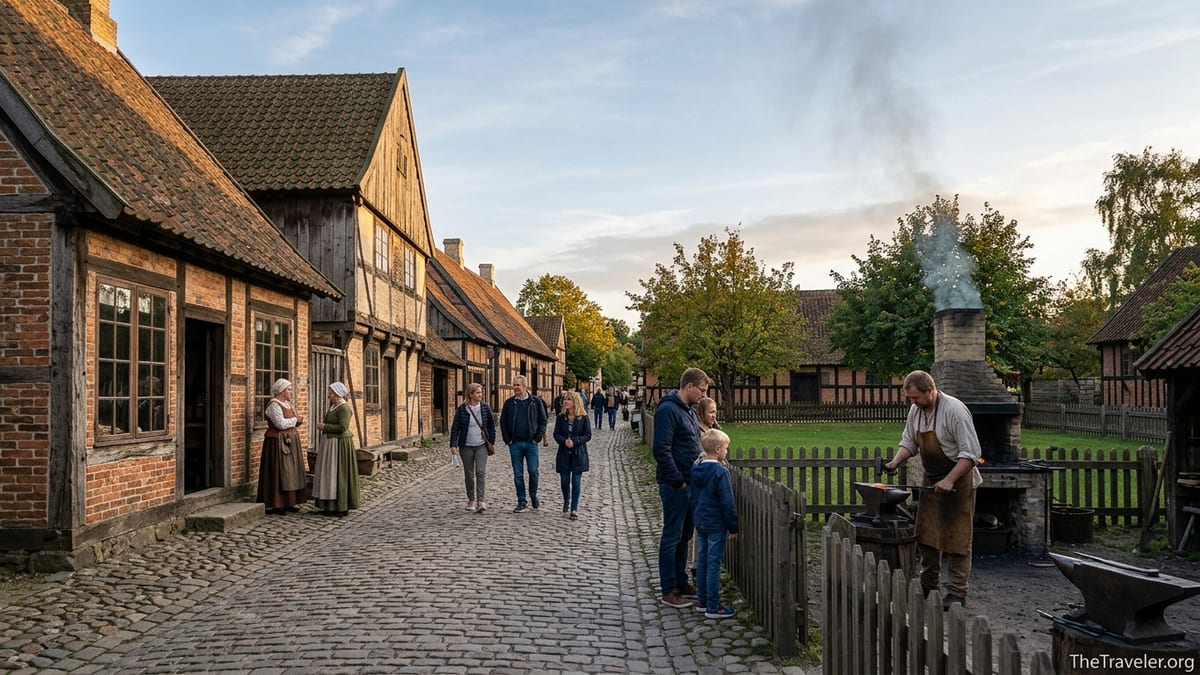
Step through the gate at an open air museum and the usual rules of museum-going fall away. There are no hushed galleries, few glass cases, and little sense of distance between visitor and past. Instead, you walk real streets, smell wood smoke from working hearths, and sometimes find yourself chatting with a blacksmith who answers as if it is still 1793. Around the world, open air museums and living history sites have become powerful ways to preserve not just old buildings and objects, but entire ways of life. Understanding how they came to be, and how they continue to evolve, can deepen any visit to these remarkable places.
Get the latest updates straight to your inbox!
From Outdoor Collections to Living Towns
The idea of gathering historic buildings outdoors for public viewing dates to the late 19th century, when industrialization was rapidly reshaping European societies. In Sweden, folklorist Artur Hazelius founded what is widely regarded as the world’s first major open air museum at Skansen in Stockholm in 1891. His goal was not only to save old farmhouses and workshops from demolition, but also to show how people in different parts of Sweden had lived before modern factories and railways spread across the landscape. Hazelius had entire wooden houses dismantled, moved to the island of Djurgården, and carefully reassembled to form a miniature Sweden under the open sky.
The idea caught on quickly. In Norway, similar efforts at Bygdøy outside Oslo gathered traditional farm buildings and a medieval stave church into a rural landscape that looked and felt centuries old. In both countries, visitors could wander from region to region in an afternoon, stepping into kitchens, barns, and lofts that had once stood in remote valleys. These early open air museums were largely about architecture and folk life: preserving vernacular buildings, tools, and interiors that were vanishing as cities grew and new materials like brick and concrete replaced timber.
Over time, the concept expanded from villages to entire towns. Denmark’s Den Gamle By, "The Old Town" in Aarhus, began in the early 20th century as a rescue project for a single historic merchant’s house, but soon grew into a full urban streetscape. Today, more than 70 historic buildings from around Denmark have been moved to the site and rebuilt, from half-timbered townhouses to modest corner shops. Walking its cobbled lanes, visitors experience not just one frozen moment but multiple eras of Danish city life, from the 1600s to the 1970s, all stitched together in a single open air setting.
By the mid 20th century, the model had crossed the Atlantic. In the United States, historic villages such as Old Sturbridge Village in Massachusetts and Greenfield Village in Michigan adapted European open air ideas to American narratives of frontier settlement, industrial innovation, and small-town life. The defining feature across all these sites, then and now, is the relocation or reconstruction of real buildings in a curated landscape that can be walked, touched, and experienced as a coherent environment rather than isolated exhibits.
What Makes an Open Air Museum “Living History”
Not every open air museum is a living history site, but many have moved steadily in that direction. At its core, living history means using people, performance, and everyday activities to interpret the past. Instead of simply looking at an 18th century loom, you might watch a costumed interpreter weaving on it, ask questions about the work, and hear about the social status of textile workers. This approach turns buildings into stages and streetscapes into immersive settings for storytelling.
Skansen provides a clear example. Beyond its 150-plus historic buildings, the museum employs craftspeople who bake bread in wood-fired ovens, tend heirloom gardens, and practice traditional trades such as glassmaking and leatherwork. Seasonal events mark holidays from Sweden’s pre-industrial calendar, complete with folk music, dances, and special foods. A summer visit might include seeing hay cut with scythes in a meadow, while a December trip could feature candlelit Advent celebrations inside creaking timber houses.
In Aarhus, Den Gamle By takes the concept further by populating different quarters of the museum town with characters from specific years. In the 1927 district, for instance, visitors might encounter a postman, a schoolteacher, or a shopkeeper going about their daily routines, speaking as if they live in that moment between the world wars. Around the corner, a 1970s street shows the shift to modern design and consumer culture, complete with record shops and advertising that older visitors may remember from their own youth.
In the United States, Colonial Williamsburg in Virginia is often described as the largest living history museum in the country. Spread across hundreds of acres, it presents a substantial portion of the 18th century capital of Virginia through reconstructed and preserved buildings. Costumed interpreters work as carpenters, printers, cooks, and political figures, while carriage drivers guide horses along dirt streets and military demonstrations echo with musket fire. The aim is not merely to display objects but to immerse visitors in the daily rhythms, work, and conflicts of a revolutionary-era town.
Why These Places Matter for Preserving Living Traditions
Traditional museums do an excellent job of preserving artifacts, manuscripts, and works of art, but they often struggle to convey intangible heritage: the skills, habits, and social rituals that once gave life to those objects. Open air museums and living history sites are vital precisely because they preserve both the tangible and intangible together. A farmhouse at Skansen is not only a structure; it is a setting where staff demonstrate how to light a clay fireplace, brew coffee over coals, or braid straw for roof thatching.
For travelers, this means learning through all the senses. At Bunratty Folk Park in County Clare, Ireland, visitors step out of a 15th century castle and into a recreated rural village, complete with thatched cottages, a schoolhouse, and a village street of shops. Beyond looking at interiors, you might hear the clang of a blacksmith’s hammer in the forge, smell turf smoke drifting from cottage chimneys, or taste soda bread baked according to family recipes passed down through generations. These experiences communicate aspects of Irish rural life that few written labels could fully convey.
Living history sites also serve as training grounds for endangered skills. At Colonial Williamsburg, tradespeople in the shoemaker’s shop, the wigmaker’s studio, and the gunsmith’s forge use historically informed methods to produce real goods, from leather shoes to brass hardware. Their work supports restoration projects on site and sometimes assists other museums and historic buildings. Similarly, open air museums in Scandinavia maintain expertise in traditional log-building, shingle-making, and timber framing that continues to inform conservation projects far beyond their own grounds.
Perhaps most importantly, these museums preserve social memory. Many visitors to Den Gamle By, for instance, are struck by exhibitions of mid-20th century apartments that replicate modest working-class interiors down to the magazines on coffee tables and notes on refrigerators. For older Danes, walking into these rooms can feel like visiting their grandparents’ homes. For younger visitors, it provides an intimate view of how ordinary people lived, cooked, furnished their rooms, and spent leisure time in eras that are technically modern but already slipping from everyday awareness.
How Open Air Museums Evolve Their Stories
As expectations about history and representation have changed, so have open air museums. Early sites often focused on nostalgic images of rural life or heroic national narratives, sometimes glossing over uncomfortable topics such as poverty, social inequality, or colonialism. In recent decades, many leading institutions have deliberately expanded their storytelling to include more complex and inclusive perspectives.
Colonial Williamsburg offers a good illustration of this evolution. For much of the 20th century, its interpretation centered on the political leaders of the American Revolution and the architecture of elite households and public buildings. Beginning in the 1980s, and with growing emphasis in the 21st century, the museum has worked to more directly interpret the experiences of enslaved people, free Black residents, women, and artisans whose labor underpinned the colonial economy. Today, guided programs tackle topics such as slavery, resistance, and the contradictions between ideals of liberty and the reality of bondage, using both reconstructed quarters and first-person performances.
In Europe, similar shifts are visible. At Skansen and related institutions, curators have reconsidered how to present minority cultures and regional differences without reducing them to quaint folklore. Den Gamle By, for example, has introduced exhibits on immigration, women’s work, and everyday urban life in the 20th century, making clear that history did not end when folk costumes disappeared from the streets. Some newer displays feature apartments from the 1970s and later, complete with plastic furniture, television sets, and contemporary music, inviting visitors to consider their own lifetimes as part of an ongoing historical story.
These changes influence practical details travelers notice on the ground. A visit to an open air museum today may include contemporary art installations responding to historic themes, discussions of climate change and heritage preservation, or community-sourced exhibitions that draw on local memories. Living history performances are often revised in consultation with historians, educators, and community representatives to ensure they balance engagement with accuracy and respect.
Planning a Visit: What Travelers Actually Experience
For travelers, open air museums can be among the most rewarding day trips in a region, blending outdoor exploration with cultural insight. They do, however, require a bit more planning than a quick stop at a city-center gallery. Many sites cover large areas, so comfortable walking shoes and weather-appropriate clothing are essential. At Skansen, for example, the hilly terrain and spread-out farmsteads mean you will easily walk several kilometers in a typical visit, often on gravel paths and uneven ground.
Ticket structures vary, but a traveler can expect entry fees broadly similar to other major museums or historic attractions in their region. In Scandinavia, adult admission to a flagship open air museum often falls in the range of what you might pay for a major art museum in a capital city, with discounts for children, students, and families. At Den Gamle By, seasonal tickets sometimes include evening events such as Christmas markets, which turn the old town into a candlelit maze of stalls, carols, and historic food stands. In the United States, sites like Colonial Williamsburg sell both day passes and multi-day tickets, reflecting the reality that seeing craft workshops, historic houses, and scheduled performances can easily fill more than one full day.
On the ground, the rhythm of a visit is shaped by live programming. Blacksmith demonstrations at Bunratty or cannon firings at Colonial Williamsburg happen at set times, usually posted on entrance boards and printed or digital schedules. Guided tours can offer helpful orientation, especially early in the day, freeing you to wander later on your own. Many travelers find that a mix of structured activities and unscripted exploration works best: attend a talk or demonstration every hour or so, then leave unplanned gaps for serendipitous encounters, such as stumbling on a costumed baker pulling loaves from a brick oven.
Practical services are generally well developed. Cafes at larger sites often serve regional dishes inspired by the periods on display, such as Swedish pea soup, Danish open sandwiches, or simple colonial-style stews made with seasonal vegetables. Gift shops lean heavily toward books, locally made crafts, and reproductions of historic household items: enamelware, wooden toys, or textiles woven in on-site workshops. For families, many museums provide interactive areas where children can try simple activities such as writing with quill pens, grinding grain, or dressing up in reproduction clothing under staff supervision.
Respecting the Past While Enjoying the Present
Although open air museums are designed for enjoyment, they also function as serious conservation sites and, in some cases, as places of memory. Travelers can help support that dual role through small but meaningful choices. Staying on marked paths, avoiding touching fragile surfaces, and respecting staff instructions around livestock or working machinery all protect vulnerable structures and landscapes. Even seemingly solid timber houses may have centuries-old details, such as carved doorframes or original paint layers, which can be damaged by unintentional contact.
It is also worth remembering that some stories interpreted in living history settings are painful or contested. At Colonial Williamsburg or at American frontier sites, discussions of slavery, displacement of Indigenous peoples, and warfare can be emotionally charged, especially for visitors whose communities were directly affected. Listening carefully, asking thoughtful questions, and allowing interpreters to guide conversations helps keep the space respectful while still engaging honestly with the past.
Photography is widely allowed, but travelers should be sensitive when capturing images of staff and other visitors. Many interpreters are happy to appear in photos, especially if asked politely, but constant close-range photography can make it difficult for them to interact with other guests. In more solemn areas, such as reconstructed slave quarters or memorial spaces, it may feel more appropriate to limit photography or focus on wide views rather than close-ups of individuals.
Finally, consider how your spending choices can support preservation. Purchasing locally produced goods in museum shops, choosing on-site cafes over external chains, or making small donations at the end of a visit all contribute to the ongoing maintenance of buildings and programs. For major sites that rely on seasonal tourism, these revenues help fund the careful, behind-the-scenes work of carpenters, conservators, curators, and researchers who keep the past accessible year after year.
The Takeaway
Open air museums and living history sites occupy a unique space between preservation and performance. Born out of 19th century anxieties about losing traditional ways of life, they have grown into sophisticated environments where architecture, landscape, and human storytelling combine. Places like Skansen in Stockholm, Den Gamle By in Aarhus, Bunratty Folk Park in Ireland, and Colonial Williamsburg in Virginia demonstrate how powerful it can be to step into recreated streets and working workshops rather than viewing artifacts from behind glass.
For travelers, these museums offer more than nostalgic escapes. They invite critical engagement with the past, from how rural communities adapted to industrial change to how colonial societies negotiated questions of freedom and inequality. By preserving not only buildings and objects but also skills, languages, and social habits, open air museums help ensure that history remains a living conversation rather than a distant, abstract subject. Arriving prepared to walk, listen, and participate, visitors can come away with a richer sense of how ordinary lives were once lived and how those lives still shape the world we inhabit today.
FAQ
Q1. What exactly is an open air museum?
An open air museum is a cultural site where historic buildings are displayed outdoors, often relocated from their original locations and arranged to form villages or townscapes visitors can walk through.
Q2. How is a living history museum different from a regular museum?
A living history museum uses costumed interpreters, working farms, crafts, and performances to show how people lived, rather than only displaying objects in cases or static rooms.
Q3. Which was the first major open air museum in the world?
Skansen in Stockholm, founded in 1891, is widely considered the first major open air museum, bringing together buildings and traditions from across Sweden on one site.
Q4. How much time should I plan for visiting an open air museum?
Plan at least half a day for smaller sites and a full day, or even two, for large complexes such as Colonial Williamsburg or extensive village-style museums.
Q5. Are open air museums suitable for children?
Yes. Many open air museums are highly family-friendly, with animals, hands-on activities, and outdoor space that allow children to learn history through play and exploration.
Q6. Do living history interpreters always stay “in character”?
Practices vary. Some sites keep interpreters strictly in character, while others allow them to shift between first-person performance and modern explanations depending on the program.
Q7. What should I wear and bring when visiting an open air museum?
Wear comfortable walking shoes and weather-appropriate layers, and consider bringing sun protection, a reusable water bottle, and a small backpack for maps and guidebooks.
Q8. Are open air museums open year-round?
Many operate year-round but may reduce hours or programs in colder months. Others are seasonal, so checking current opening times before travel is important.
Q9. Can I join in the crafts and activities?
Some museums offer supervised hands-on workshops, while others keep historic trades as demonstrations only. Check daily schedules or ask staff what visitors are allowed to try.
Q10. How do open air museums help preserve history beyond the buildings?
They safeguard traditional skills, regional customs, languages, and everyday practices by keeping craftspeople at work, marking historic festivals, and recording community memories alongside physical structures.