


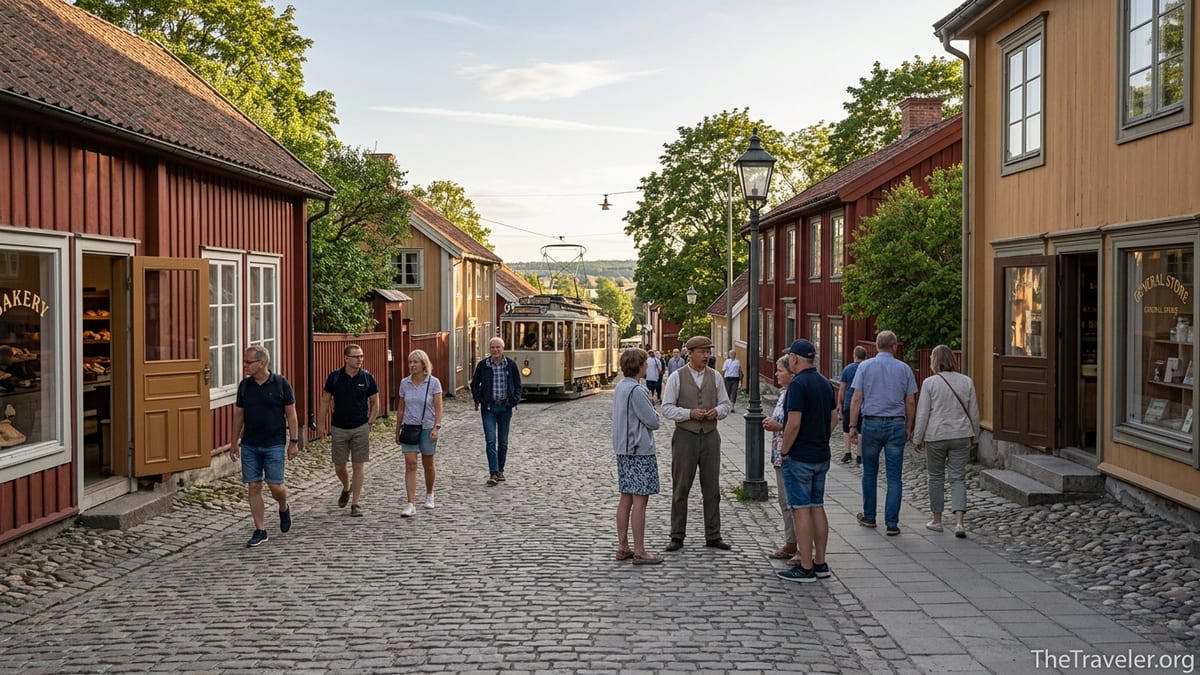
Step off the sidewalk and instead of walking into a marble lobby, you find yourself on a cobbled street, past a working bakery that smells of fresh rye bread, with a tram rattling by and costumed guides chatting in character. This is not a theme park, but a museum. Specifically, it is an open air museum, a type of cultural institution that invites you to wander through history outdoors, instead of quietly filing past glass cases. For travelers, understanding what makes these places unique can help you plan richer, more immersive cultural experiences on your next trip.
Get the latest updates straight to your inbox!
What Exactly Is an Open Air Museum?
The simplest definition of an open air museum is a museum where most of the collection is displayed outdoors, often in the form of historic buildings relocated from elsewhere and reconstructed on a large site. The focus is usually on everyday life, crafts, and architecture, rather than on paintings or small artifacts locked away in vitrines. Many open air museums are also “living history” sites, where staff in period clothing demonstrate traditional skills, from blacksmithing to baking, in real time.
One of the clearest examples is Skansen in Stockholm, widely regarded as the world’s first open air museum. Founded in 1891 on the island of Djurgården, Skansen gathers more than a hundred historic buildings from across Sweden, including farmsteads, townhouses, and a wooden church, and places them in a landscape that evokes different regions of the country. Visitors walk between them as if exploring a real village, while costumed interpreters explain how Swedes lived and worked from the 18th to the early 20th century.
Although architecture is central, open air museums are not simply collections of old houses. At Skansen, you might encounter smoke from a tar kiln, smell bread from a wood-fired oven, or watch glassblowers, all of which give a sense of historical atmosphere that is hard to achieve in a climate-controlled gallery. Similar approaches can be found at other leading open air museums, from Den Gamle By in Aarhus, Denmark, to St Fagans National Museum of History near Cardiff, Wales, where entire streets and farmyards are re-created outside.
For travelers used to traditional museums, this outdoor, experiential format can take a moment to adjust to. Instead of a curated path through rooms, you are handed a map and encouraged to wander. Exhibits are not just objects with labels, but layered environments that invite you to linger, listen, and often take part.
How Open Air Museums Differ From Traditional Museums
The most obvious difference is physical. Traditional museums usually occupy a single large building, perhaps with satellite galleries, and most of the collection is displayed indoors. In an open air museum, the “galleries” are streets, farmyards, and landscapes, and the walls are real facades, not white partitions. You move between exhibits in all kinds of weather, often along unpaved paths or cobbled lanes, and the museum’s boundaries can feel more like a small town than a single institution.
This has implications for scale and time. At Beamish Museum in County Durham in northern England, for example, the site includes a 1900s town, a 1910s colliery with pit village, a 1950s town, and rural areas representing the 1820s. Visitors travel between them on heritage trams and buses running through open countryside rather than hallways. It can easily take a full day to explore, similar to visiting a historic city center, rather than the two-hour slot many travelers allocate for a traditional art or history museum.
The way collections are presented also differs. In a city museum, you might view a miner’s lamp or a shop counter behind glass. At an open air museum, those same objects are used inside reconstructed buildings. At Beamish, visitors step into a fully stocked cooperative store where tins, scales, and ledgers form part of a working shop, staffed by interpreters who ring up purchases and talk about rationing or wages. Instead of encountering an isolated artifact, you experience it in its social context.
Finally, the relationship with visitors tends to be more participatory. Traditional museums increasingly experiment with interactive displays, but open air museums are built around sensory involvement. You might taste traditional pastries in a town bakery at Den Gamle By, help knead dough on a farm near Oslo, or try your hand at woodworking in a Czech skansen. This focus on lived experience means that interpretation is often delivered through conversation and performance rather than text-heavy panels.
Living History: When the Museum Comes Alive
Many open air museums describe themselves as “living history” sites, but that term has a specific meaning. It refers to institutions that do not merely display historic structures, but actively animate them with people, animals, and activities that approximate a period in the past. The result feels closer to walking onto a film set, except that the stories being told are real and grounded in research.
Den Gamle By in Aarhus is a particularly vivid example. This “Old Town” began in the early 20th century as a collection of historic urban buildings relocated to the city’s botanical gardens. Today, more than 75 buildings from around Denmark form several districts, including streets representing the 1860s, the 1920s, and even a 1970s quarter with a record store and a period apartment. Costumed interpreters work in shops, write letters in offices, and chat in dialect on doorsteps, providing a sense of daily life rather than just architectural detail.
In Wales, St Fagans National Museum of History gathers more than forty buildings from across the country, from humble cottages to a chapel and a village school. Here, living history might mean listening to a guide describe life in a two-room farmhouse during a rainstorm, or watching a traditional clog-maker demonstrate his tools. Seasonal events such as harvest celebrations or Christmas markets add another layer of immersion, drawing on local customs rather than generic “medieval fair” tropes.
Travelers should note that living history elements are often strongest on weekends and during peak visiting seasons. On a quiet weekday in early spring, you might find fewer costumed interpreters, but more space to explore interiors and photograph details. Checking the museum’s events calendar before you plan a visit can help you match your expectations with the level of activity on site.
Architecture, Landscape, and a Sense of Place
At their core, open air museums are about place. They preserve buildings that might otherwise have been demolished and reassemble them in a way that tells a regional story. This architectural focus is particularly clear at sites like Skansen and St Fagans, where each building has been dismantled at its original location, transported, and carefully reconstructed in a setting that resembles its native landscape.
At Skansen, visitors can stroll from a northern farmstead with sod roofs and fenced pastures to southern-style farmhouses surrounded by orchards, all within an afternoon. The museum’s hilltop position gives views over Stockholm, reminding travelers that this rural heritage survived alongside modern urban growth. Similarly, Den Gamle By sits surprisingly close to central Aarhus, bordered by busy roads and contemporary office blocks, yet inside the gates the streets are lit by period lanterns and lined with timber-framed houses.
The outdoor context allows for elements that would be impossible indoors. At Beamish, steam locomotives haul trains past fields, coal wagons line a colliery yard, and livestock graze in paddocks. The sounds of horses, machinery, and distant whistles mingle with birdsong. In Scandinavia, some open air museums include working mills, cultivated fields, and kitchen gardens, showing not only historic architecture but also historical land use and food production.
For travelers, this emphasis on landscape can be a double incentive. A visit to an open air museum often includes a pleasant walk through gardens or countryside, making it an appealing day trip for mixed groups where some members are more interested in fresh air than history. Families may find that children are happier exploring a maze of streets, paddling in a pond, or watching animals than following a set path through galleries.
Planning a Visit: Practical Differences Travelers Notice
Because open air museums are spread across large sites, planning your visit is a bit different than for a traditional museum. Distances between areas can be significant. At Beamish, it is common to rely on the internal tram and bus system to move between zones, while still expecting a fair amount of walking on sloping or uneven ground. At Den Gamle By and Skansen, surfaces range from gravel paths to cobbles and worn wooden steps, which can be challenging for visitors with limited mobility.
Weather is another practical consideration. Open air museums operate in all seasons, but your experience will change dramatically between a sunny August day and a wet November afternoon. In Scandinavia and northern Britain, winter visits can bring snow and short daylight, which may be atmospheric but also cold. Many travelers choose late spring or early autumn for more comfortable temperatures and fewer crowds. Carrying a lightweight rain jacket, wearing sturdy shoes, and packing layers will usually make the difference between a rushed visit and a relaxed exploration.
Ticket pricing often reflects the scale and operating costs of open air museums, which maintain large grounds, specialist staff, and frequently live animals. As of early 2026, adult day tickets at major sites such as Beamish, Skansen, or Den Gamle By typically fall in a moderate to upper range compared with city museums in the same region, with discounts for children, students, and families. Many offer annual passes that become good value even after two visits, a useful option if you are staying nearby for a longer period.
Food and services also matter more than at a short gallery visit. Open air museums usually include several cafes or historic-style eateries within the grounds. At Beamish, visitors can eat in a 1900s tea room or sample traditional sweets from a period confectioner, while Skansen offers both modern restaurants and simple kiosks near its playgrounds and animal enclosures. Planning a lunch stop inside the museum allows you to break up the day and experience another layer of the historical environment.
Why Open Air Museums Appeal to Modern Travelers
For many travelers, the main attraction of open air museums is the chance to step into history rather than merely observe it. Instead of reading about Welsh rural life on a panel, you can enter a low-ceilinged cottage at St Fagans, feel the warmth of the hearth, and listen to rain on slate. Rather than viewing a tram ticket in a display case, you can ride a restored tram at Beamish through a recreated town, hearing the conductor call out stops. These immersive moments are memorable in a way that static exhibits often are not.
Open air museums also lend themselves well to intergenerational travel. Grandparents may recognize objects and interiors from their own childhoods, especially in 20th-century sections like the 1970s street at Den Gamle By, while children can experience history through play and exploration rather than lectures. School groups are common on weekdays, and many museums design specific trails or activity books for younger visitors, making it easier for families to engage together.
The format aligns with broader travel trends toward experiential and “slow” tourism. Spending half a day or more in a single place, engaging with guides, craftspeople, and seasonal events, contrasts with rushing through multiple attractions. Open air museums often host traditional music performances, food festivals, or craft markets that attract locals as well as visitors, giving travelers a glimpse of contemporary culture alongside historical interpretation.
Finally, these museums can be an accessible introduction to national histories that might otherwise feel abstract. If you arrive in Denmark with only a vague picture of its past, an afternoon at Den Gamle By offers a concrete sense of how Danish towns evolved, how people heated their homes, what they bought in shops, and how interiors changed from the 18th century to the 1970s. For travelers who enjoy connecting places with stories, this grounded, everyday perspective is invaluable.
The Takeaway
Open air museums occupy a distinctive niche between traditional museums and historic city centers. They preserve original buildings and artifacts, but they arrange them in curated landscapes designed to tell specific stories about work, home, and community. They borrow tools from theater and education, using costumed interpreters, live demonstrations, and sensory details to make history tangible. For travelers, this means that a visit rarely feels like ticking off another museum; it feels like entering a different time and place.
When planning a trip, consider pairing a city’s main art or history museum with a nearby open air museum to gain both the big-picture narrative and the texture of everyday life. In Stockholm, that could mean combining the Nationalmuseum with Skansen; in Denmark, an archaeological-focused day at Moesgaard Museum near Aarhus followed by Den Gamle By; in Wales, Cardiff’s city museums plus St Fagans. The contrast will sharpen your understanding of the region and provide variety in pace and setting.
Be realistic about the time and energy required, dress for the weather, and arrive with curiosity rather than a checklist. Leave room in your schedule for unplanned conversations with guides and detours down side streets. The richest experiences at open air museums often come not from the major landmarks, but from small moments: a snatch of music, the feel of hand-planed wood in a workshop, or a story shared at the threshold of a modest cottage.
If you value travel that connects you to the lives of ordinary people across time, open air museums are worth seeking out. They offer a chance to wander through the past at your own pace, under changing skies, in environments where history is not only preserved but lived, if only for an afternoon.
FAQ
Q1. What is the main difference between an open air museum and a traditional museum?
An open air museum displays most of its collection outdoors in historic buildings and landscapes, often with costumed guides and working demonstrations, while a traditional museum usually presents objects indoors in galleries.
Q2. Are open air museums suitable for children?
Yes, most open air museums are very family friendly, with space to run, animals to see, and hands-on activities that help children engage with history through play rather than long texts.
Q3. How much time should I plan for a visit to an open air museum?
Plan at least half a day, and often a full day for large sites such as Beamish, Skansen, or Den Gamle By, as distances between areas and the number of experiences can be significant.
Q4. Do open air museums operate year-round?
Many major open air museums are open most or all of the year, but hours, open buildings, and living history programs may be reduced in winter, so it is wise to check seasonal schedules before visiting.
Q5. What should I wear when visiting an open air museum?
Comfortable walking shoes and weather-appropriate layers are essential, as you will spend much of your time outdoors on mixed surfaces, from gravel paths to cobbled streets and grassy areas.
Q6. Are open air museums accessible for visitors with limited mobility?
Accessibility varies by site. Many offer shuttle vehicles, step-free routes, and accessible toilets, but some historic buildings and steep or uneven paths can be challenging, so reviewing accessibility information in advance is important.
Q7. Is there usually food available inside open air museums?
Yes, most larger open air museums have cafes, kiosks, or historic-style eateries on site, allowing visitors to eat without leaving the grounds and often to sample traditional dishes.
Q8. Are open air museums more expensive than regular museums?
Ticket prices vary, but open air museums are often moderately priced to slightly higher than typical city museums, reflecting their large grounds, specialist staff, and maintenance of buildings and animals.
Q9. Can I visit an open air museum in bad weather?
You can, but your experience will be different. Many buildings provide shelter, yet moving between them will still involve being outside, so good rain gear and flexibility about what you see help in poor weather.
Q10. How can I find an open air museum near my destination?
Look for terms such as “open air museum,” “skansen,” “folk museum,” or “living history museum” in tourism brochures or local visitor information, and ask hotel staff or guides to recommend notable examples in the region.