


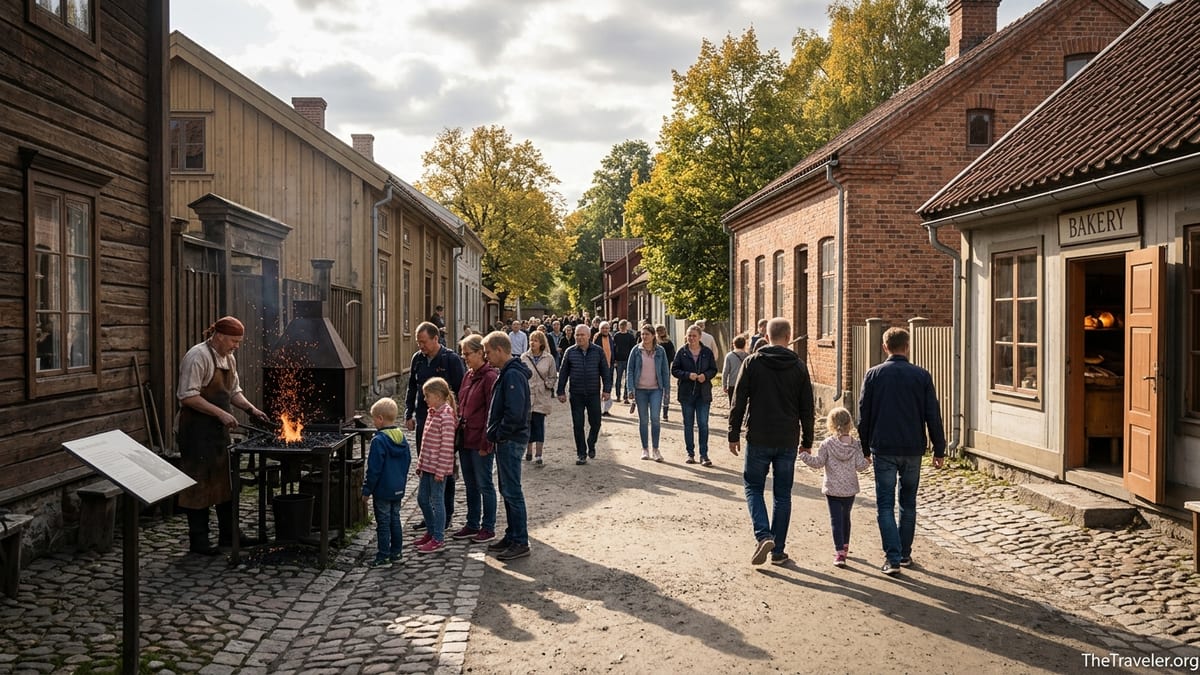
Across Europe and North America, open air museums are quietly doing something many traditional galleries struggle with: they make history feel close enough to touch. In places like Skansen in Stockholm, Den Gamle By in Aarhus, Blists Hill Victorian Town in England, and Jamestown Settlement in Virginia, visitors do not just look at heritage behind glass. They wander old streets, smell wood smoke from open hearths, watch craftspeople at work, and speak with costumed guides who inhabit other centuries. At a time when cultural education competes with screens and shrinking attention spans, these outdoor museums are proving that immersive, place-based experiences still have a powerful role to play.
Get the latest updates straight to your inbox!
From Cabinets of Curiosities to Living Streets
The idea of preserving the past outdoors is older than many travelers realize. Skansen in Stockholm, founded in 1891, is widely recognized as the world’s first open air museum. It brought historic wooden farmhouses, townhouses, and workshops from across Sweden to the island of Djurgården, arranging them in a walkable landscape where visitors could see how people actually lived and worked in different regions and eras. Instead of static glass cases, Skansen offered entire environments, complete with gardens, animals, and seasonal celebrations.
Today, visitors still cross Skansen’s entrance and find themselves in a Sweden-in-miniature: red-painted farmsteads from Dalarna, a country church with carved pews, a glassworks where craftsmen demonstrate traditional skills, and a zoo with Nordic wildlife. The museum’s mission explicitly links cultural heritage with education and sustainability, emphasizing that understanding past ways of living can inform more responsible choices in the present. A family strolling these paths is not simply sightseeing. They are encountering a layered story about how landscapes, livelihoods, and communities evolve over time.
Similar concepts appeared elsewhere in the 20th century. In Denmark, Den Gamle By in Aarhus opened in 1914 as one of the first museums to focus on town life rather than rural villages. Today its cobbled streets recreate Danish urban neighborhoods from the 18th, 19th, and 20th centuries. Visitors can step from a merchant’s house of the 1700s into a 1970s street complete with record shop, bakery, and apartments furnished with mid-century furniture. The result is a time-lapse you can walk through, making social change far more tangible than any textbook timeline.
Across the Atlantic, open air and “living history” museums followed a similar trajectory. Sites like Colonial Williamsburg and Jamestown Settlement in Virginia, or Plimoth Patuxet Museums in Massachusetts, turned early American history into immersive environments. Wooden palisades, reconstructed ships, and costumed interpreters offer visitors the chance to handle replica tools, watch musket drills, or board a 17th-century sailing vessel. The goal in all of these places is the same: to shift cultural education from abstraction to experience.
Why Being There Changes How We Learn
Open air museums matter because they anchor learning in place. Standing in a thatched farmhouse at Skansen or a Victorian street at Blists Hill in the Ironbridge Gorge of England, visitors absorb details that rarely make it into guidebooks: the low ceilings that forced people to stoop, the way smoke hangs in a room without a proper chimney, the sheer narrowness of a bed shared by several children. These embodied impressions can linger longer than dates or names memorized in a classroom.
Take Blists Hill Victorian Town, part of the Ironbridge Gorge Museum Trust in Shropshire. Here, an entire late 19th-century industrial community has been recreated, from brickworks and foundries to a schoolroom, sweet shop, and working pub. Costumed staff run a printer’s workshop, bake bread in coal-fired ovens, and operate steam engines. On busy days, children can exchange modern currency for replica Victorian coins to spend in the shops. For a ten-year-old who has only encountered the Industrial Revolution in a textbook, feeling the heat of the furnaces or hearing the clank of machinery can transform “industrialization” from a vague concept into something concrete and human.
Den Gamle By offers a different but equally powerful kind of immersion. Because it covers several centuries of city life, it allows visitors to sense continuity and change at the same time. You might step from an 1860s grocery store, with wooden barrels and paper-wrapped goods, into a 1920s apartment with an early radio, and then into a 1970s living room with patterned wallpaper and bulky television set. Younger visitors, used to streaming music on phones, can see how quickly everyday technologies have changed. Older visitors often recognize objects from their own childhoods, creating emotional bridges between personal memory and public history.
These emotional connections are critical. Research into museum learning consistently highlights that visitors remember experiences that feel personally meaningful. When a costumed educator at Jamestown Settlement shows how to plant corn using traditional tools, or when a Sámi cultural interpreter at Skansen explains reindeer herding and seasonal migration, history stops being anonymous. It becomes a story told by someone you have met, even briefly, on a path or inside a timbered house.
Global Heritage in Local Landscapes
Open air museums also play a uniquely important role in preserving vernacular architecture and intangible traditions that might otherwise vanish. Many of the wooden farmhouses at Skansen were physically moved from their original sites in the Swedish countryside, where modernization and changing land use threatened them. Similarly, Den Gamle By has rescued old townhouses and shops from across Denmark, reassembling them so that future generations can still walk through authentic interiors, not just look at archival photos.
In the Ironbridge Gorge, Blists Hill and its sister museums help protect what UNESCO calls the birthplace of the Industrial Revolution. Instead of preserving only a single monument, the Ironbridge Gorge Museum Trust manages a network of sites that together tell the story of ironmaking, ceramics, and engineering innovations. As you wander Blists Hill’s streets or visit nearby tile and china museums, you begin to see how geology, technology, and global trade all converged in this one valley. The open air environment connects these threads better than any isolated exhibit hall could.
In North America, open air sites often sit at the intersection of contested histories. Jamestown Settlement, near the archaeological remains of the first permanent English colony in North America, uses reconstructed forts, Powhatan Indian villages, and replica ships to explore the intertwined stories of Indigenous peoples, Europeans, and Africans. While interpretations continue to evolve, the outdoor setting allows the museum to stage demonstrations of agriculture, warfare, and daily life that confront visitors with both the ingenuity and the violence embedded in colonial history.
Other museums foreground living Indigenous or minority cultures. At Skansen, a Sámi camp with traditional dwellings and cultural programming highlights Sweden’s Arctic Indigenous heritage within the broader story of the nation. In Canada and the United States, various smaller open air sites are partnering with First Nations, Native American, and other communities to reframe narratives and include voices that were long marginalized. For travelers, this means that time spent in an open air museum is increasingly an opportunity to hear multiple perspectives rather than a single, celebratory story.
Hands-On Learning for Schools and Families
One of the quiet strengths of open air museums lies in their education programs for schools and families. Many of these institutions are deeply integrated into local curricula. In Aarhus, Den Gamle By regularly hosts school classes that spend a day “living” as children from different periods, attending lessons in historic classrooms, writing with ink pens, and taking part in chores appropriate to their chosen era. Teachers report that these role-playing experiences make subsequent discussions about social class, gender roles, or technological change far more vivid.
Blists Hill offers structured school visits where children might spend a morning in the Victorian classroom, complete with strict discipline and slate boards, before touring the industrial worksites. Rather than simply lecturing about child labor, educators can show how narrow streets, factory noise, and long working hours shaped the days of real families. For pupils who struggle with conventional learning, the chance to move, touch, and participate can be transformative.
In the United States, Jamestown Settlement and similar living history sites often design programs around key curriculum topics such as early colonial history, Indigenous cultures, or the transatlantic slave trade. Students may grind corn, try on replica armor, or help set up a tent in a military encampment. For many young visitors, these moments become anchor memories that later help them connect more abstract classroom content to a specific place and feeling.
Families traveling independently can tap into these educational strengths as well. Most large open air museums now offer seasonal calendars packed with workshops, themed weekends, and children’s activities. At Skansen, for example, midsummer festivals, Christmas markets, and traditional craft days give families a natural entry point into Swedish folklore and seasonal customs. Buying a simple snack from a historical bakery, listening to live folk music, or joining a dance on the grass all double as informal lessons in cultural history.
Tourism, Community, and Sustainable Futures
Open air museums are not just educational institutions. They are also economic and social anchors in their regions. Skansen ranks among Sweden’s most visited attractions, contributing significantly to Stockholm’s tourism economy while offering locals green space, concerts, and community events. Den Gamle By is consistently listed among Denmark’s top museums outside Copenhagen, drawing hundreds of thousands of visitors each year to Aarhus’s botanical gardens and nearby city center. In smaller destinations like the Ironbridge Gorge, the cluster of museums supports local hotels, cafes, and outdoor activities along the River Severn.
This tourism role comes with responsibilities. Many open air museums now emphasize sustainable practices, from conserving energy in historic buildings to managing visitor flows in sensitive landscapes. Skansen, for instance, pairs its cultural mission with a strong environmental focus, housing Nordic species in its zoo and hosting the Baltic Sea Science Center, which explores marine ecosystems and pollution. The message is that caring for heritage and caring for nature are intertwined tasks, not competing priorities.
Community engagement is equally important. Because open air museums often preserve local architecture and traditions, residents tend to feel a sense of ownership. Volunteers help restore buildings, run events, or share their own memories of life in the region. At Den Gamle By, exhibitions about 20th-century life frequently draw on donated objects and oral histories from Aarhus residents, making the museum a kind of living archive of the city’s collective memory. Travelers who visit these sites are effectively stepping into ongoing community conversations about identity and change.
For heritage travelers, there is a practical takeaway: choosing to spend time and money at open air museums often supports broader regional development goals. Entry tickets help fund conservation of fragile buildings and crafts. Cafes and gift shops frequently source products from local artisans or farms. Attending a regional festival day at a museum can be a way to meet locals, taste traditional foods, and understand the place at a deeper level than a quick photo stop at a famous monument.
Planning a Visit: What Travelers Should Know
For many travelers, the main barrier to visiting open air museums is not cost or interest, but simple awareness. People fly to Stockholm for the archipelago or to Aarhus for contemporary architecture without realizing that world-class heritage experiences sit within a tram or bus ride. In the UK, visitors to the Ironbridge Gorge might walk across the iconic iron bridge but miss the immersive world waiting up the hill at Blists Hill Victorian Town. In coastal Virginia, families focused on theme parks may not realize how close they are to Jamestown Settlement’s reconstructed fort and ships.
When planning an itinerary, it is worth checking tourism board listings or museum networks in advance and setting aside at least half a day, and ideally a full day, for a major open air site. Larger locations like Skansen, Den Gamle By, or Blists Hill can easily fill four to six hours, especially if you want to join guided tours or scheduled demonstrations. Many travelers find that arriving shortly after opening time gives them a quieter first hour to explore before day trips and school groups arrive.
Weather is another consideration. Because most of the experience takes place outdoors, visiting in comfortable seasons can make a significant difference. In Scandinavia, late spring to early autumn offers long daylight hours and active gardens. In the UK, packing waterproof layers and comfortable walking shoes is wise, even in summer. In Virginia, mid-season visits in spring or autumn often provide milder temperatures than the height of summer. That said, winter visits have their own charm. Skansen’s Christmas markets and Den Gamle By’s December streets, lit with candles and decorated windows, offer atmospheric experiences that would be impossible indoors.
Accessibility and practical services have improved markedly in recent years. Many open air museums now offer step-free routes, accessible toilets, and quiet spaces for visitors who may find busy, noisy environments challenging. Cafes cater to common dietary needs, and family-friendly facilities such as stroller rental or picnic areas are common. Checking the museum’s own information channels in advance can help you match your visit to your needs, whether that means choosing a quieter weekday or targeting a festival day packed with performances.
The Takeaway
In an era of digital everything, it might be tempting to assume that virtual reality or online archives could replace the need for physical heritage sites. Open air museums demonstrate the opposite. They show that learning about culture and history is profoundly shaped by where we stand, what we hear, and how a place smells and feels underfoot. Walking a cobbled street at Den Gamle By, watching sparks fly in a workshop at Blists Hill, or joining a seasonal celebration at Skansen reminds us that the past is not an abstract collection of facts but a lived reality that shaped today’s societies.
For travelers, these museums offer more than a diversion on a rainy afternoon. They are gateways into the layered identities of regions and nations, crafted with care by curators, educators, volunteers, and local communities. Visiting them means supporting the preservation of fragile buildings, crafts, and stories that might otherwise fade. It also means engaging with heritage in a way that is active, critical, and sometimes challenging, especially at sites that confront the difficult sides of colonialism, industrialization, or social inequality.
As cultural education debates continue in classrooms and policy circles, open air museums quietly provide a working model of what heritage learning can be: multisensory, inclusive, and rooted in real places. Whether you are planning a city break in Stockholm, a road trip through rural England, or a family holiday in coastal Virginia, leaving room in your itinerary for an open air museum can turn a journey into a deeper conversation with the past.
FAQ
Q1. What exactly is an open air museum?
An open air museum is a heritage site where historic buildings, streets, and landscapes are preserved or reconstructed outdoors, allowing visitors to walk through past environments rather than viewing objects in traditional indoor galleries.
Q2. How is an open air museum different from a theme park?
While both can feel immersive, open air museums are built around research, conservation, and education. Costumed staff and demonstrations are based on historical evidence, and the buildings themselves are often original structures moved or preserved in situ rather than sets built only for entertainment.
Q3. Are open air museums suitable for young children?
Yes, many are designed with families in mind. Children can run in outdoor spaces, handle replica tools, join craft workshops, and interact with costumed interpreters. Parents should be prepared for a lot of walking and, at some sites, uneven ground or cobbled streets.
Q4. Do I need to speak the local language to enjoy these museums?
Not necessarily. Major open air museums in Europe and North America usually provide signage, maps, and basic information in English as well as the local language. Guided tours or specific talks may be language-dependent, so checking schedules in advance helps if you want a tour in English.
Q5. How much time should I plan for a visit?
For small regional open air museums, two to three hours may be enough. Larger sites like Skansen in Stockholm, Den Gamle By in Aarhus, or Blists Hill Victorian Town in the Ironbridge Gorge can easily fill most of a day, especially if you want to attend scheduled demonstrations and take breaks at cafes.
Q6. Are open air museums accessible for visitors with limited mobility?
Many major sites have made significant efforts to improve accessibility, offering step-free routes, ramps, and accessible toilets. However, historic buildings and cobbled streets can still pose challenges. Reviewing the museum’s accessibility information in advance and contacting staff if you have specific needs is advisable.
Q7. What is the best season to visit an open air museum?
Spring through autumn generally offers the most comfortable weather and the fullest program of events, with gardens in bloom and more outdoor demonstrations. Winter visits can be very atmospheric, especially during Christmas markets or seasonal festivals, but may involve colder temperatures and shorter opening hours.
Q8. Are open air museums only about rural or pre-industrial life?
No. While many early open air museums focused on farmsteads and village life, newer or expanded sites now cover urban history, industrial heritage, and even late 20th-century neighborhoods. Den Gamle By’s 1970s street and Blists Hill’s industrial works are good examples of how these museums move beyond a purely rural focus.
Q9. How can I find open air museums when planning a trip?
Checking national or regional museum networks, tourism board listings, and city visitor guides is a good starting point. Searching for terms like “open air museum,” “living history museum,” or “heritage village” along with your destination’s name often reveals options that do not always appear in basic top-ten attraction lists.
Q10. Why should I prioritize an open air museum over another attraction?
If you are interested in understanding how local people actually lived, worked, and celebrated in the past, an open air museum offers a level of depth that many single-monument attractions cannot match. It also provides a flexible, often family-friendly environment where you can learn at your own pace while supporting the conservation of local heritage.