


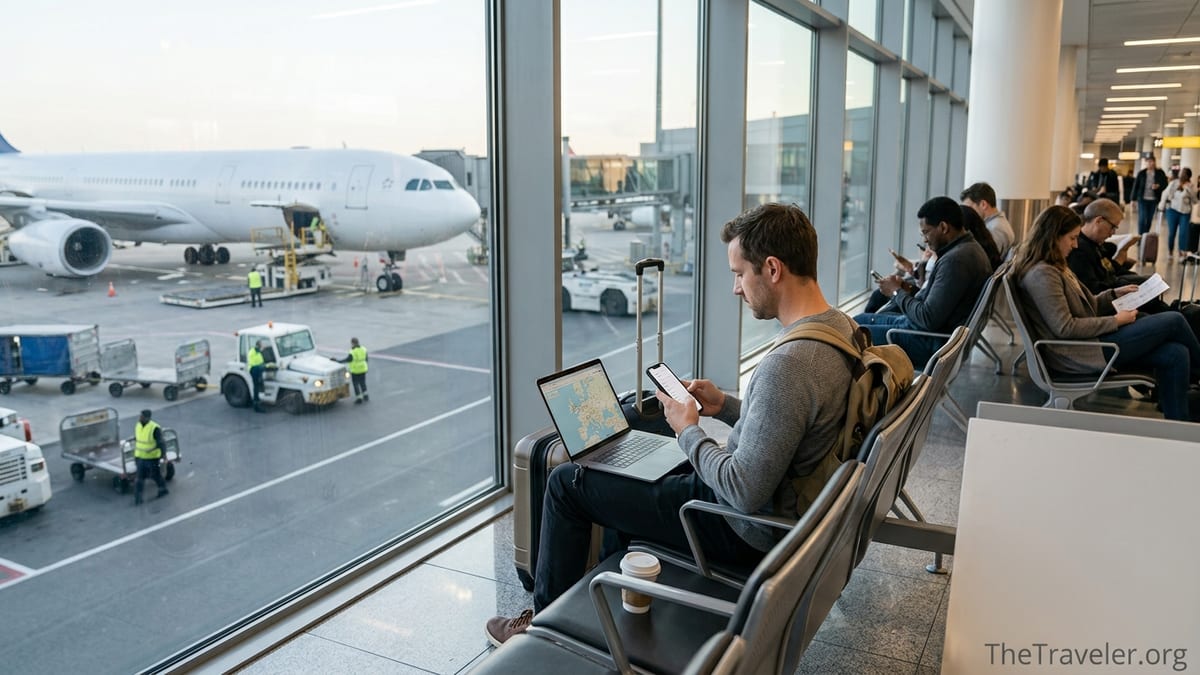
Every international traveler knows the feeling. You land after a long-haul flight, your phone switches to a foreign network, and a sinking worry sets in: Will roaming charges explode your bill, will the airport Wi-Fi actually work, and how are you supposed to order a ride or find your hotel with a loading screen stuck at 3 percent? Despite cheaper flights and easier visas, staying online abroad in 2026 is still one of travel’s most stubborn pain points. Saily, a relatively new eSIM-based data service spun out of Nord Security, is trying to change that by attacking the connectivity problem at its roots.
Get the latest updates straight to your inbox!
Why International Connectivity Is Still So Frustrating
On paper, international roaming has never looked better. Major US carriers now advertise "simple" global plans, and many hotels, cafes, and coworking spaces boast free Wi-Fi. In practice, travelers still get caught in the same traps: opaque roaming fees, patchy coverage, and the hassle of hunting for a local SIM after a red-eye flight. The result is a jarring contrast between the always-on life you have at home and the semi-offline limbo you endure the moment your passport is stamped.
Consider a common scenario for US travelers. An AT&T customer activating an International Day Pass can expect a flat daily fee around the cost of a modest restaurant meal, charged every single day the line registers use abroad, even for quick email checks. Similar day-pass models from Verizon and T-Mobile add up quickly on a two-week trip through Italy and Spain, where many people use their phones casually for maps, restaurant lookups, and messaging. The per-day convenience often disguises a bill that quietly climbs into the hundreds of dollars by the time you get home.
Local prepaid SIMs, once the budget-savvy alternative, come with their own friction. You might land at Bangkok’s Suvarnabhumi Airport at 11 p.m. to find the main kiosks closed, or arrive in a smaller Greek island airport with only one operator charging a premium. Physical SIM cards require you to swap out your regular number, keep track of a tiny piece of plastic, and navigate sign-up pages in a language you might not read. For many travelers, that is simply too much effort at the worst possible moment: jet-lagged and trying to find transport into town.
Public Wi-Fi is hardly a dependable backup. Airport and hotel networks are often congested, undersized, or heavily filtered. A traveler arriving in Mumbai or Istanbul late at night might watch their ride-hailing app time out repeatedly on the free airport Wi-Fi. Even when the signal works, open networks raise obvious security concerns for banking, work email, and private messaging. The industry has chipped away at these issues, but the connectivity problem remains very real on the ground.
The Rise of Travel eSIMs and Where Saily Fits In
Into this messy landscape step travel eSIM providers, which let you download a digital SIM profile onto a compatible phone and connect directly to partner networks abroad. Established names like Airalo and Holafly have shown that travelers are willing to buy data-only plans in advance if activation is painless and pricing is clear. Saily entered this space as a Nord Security spinoff, building on the same ecosystem that powers NordVPN, with the promise of combining connectivity and security in a single travel-focused app.
Saily’s basic proposition looks familiar at first glance. Through its app, available on current iOS and Android devices that support eSIM, travelers can choose local, regional, or global data plans that work across more than 150 countries and, according to some sources, over 200 destinations when including territories and regions. Plans are prepaid and data-only, meaning you keep your home number active for calls and SMS while using Saily purely for mobile data. This dual-SIM-style setup is particularly appealing for people who still rely on SMS codes for banking or two-factor authentication.
Where Saily attempts to differentiate is in simplicity and integrated protections. The app guides users through eSIM installation with step-by-step prompts, detects compatible devices, and centralizes all purchased plans in a clean interface. Because it shares infrastructure with Nord Security, Saily also bakes in privacy features such as encrypted DNS and optional VPN-style routing in some tiers, which is especially valuable on public Wi-Fi in airports, cafes, and train stations in cities like Paris, Tokyo, or Mexico City.
For a traveler flying from New York to Lisbon for a one-week city break, this setup removes several traditional steps. Rather than queuing at the arrivals hall kiosk or activating an expensive day pass, they can install a Saily Europe plan before departure, land with data ready to go, order an Uber or Bolt, and pull up Google Maps or Apple Maps without worrying about surprise SMS roaming fees from their main carrier.
Concrete Cost Problems Saily Tries to Solve
At the heart of the international connectivity problem is cost unpredictability. Traditional roaming charges are not just high; they are often unclear. A business traveler might assume “roaming included” means generous data, only to get throttled after a few gigabytes or face add-on fees for tethering. Another traveler using social media stories, cloud photo backups, and navigation lightly across multiple cities can unknowingly burn through the small chunk of premium-speed data bundled with a domestic plan.
Prepaid eSIMs like Saily address this by forcing clarity up front. In the app, a traveler planning a 10-day trip through France and Italy might see options such as 1 GB for a week at a single-digit dollar price point, 5 GB for a fortnight at a moderate price, or larger packs tailored for heavy users. While actual pricing varies by country and promotion, the principle remains fixed: you pay once for a set amount of data, valid for a defined number of days, with no ongoing subscription required on most standard plans.
Real-world examples show how that predictability changes behavior. A digital nomad bouncing between Chiang Mai, Da Nang, and Bali for three months may stack several regional Saily plans instead of relying on a US carrier’s international add-on. The upfront cost likely totals less than what a per-day roaming pass would charge for the same duration, and the nomad can pause usage by switching off the Saily eSIM between travel days, avoiding auto-billing traps.
Crucially, Saily also attempts to mitigate hidden data drains. Because it emphasizes security and offers tools akin to tracker and ad blocking in some configurations, it can reduce the amount of background data wasted on advertising, pop-ups, and telemetry. That is particularly helpful in destinations with slower or more congested networks, such as older 3G or crowded 4G infrastructure in parts of Southeast Asia or Eastern Europe, where unnecessary background downloads can quickly chew through a small data pack.
Real-World Connectivity: Where Saily Excels and Where It Struggles
No eSIM provider can fully eliminate the physical limitations of local networks, and Saily is no exception. Traveler reviews from tech outlets and independent blogs paint a nuanced picture. On the positive side, Saily has shown strong everyday performance in destinations such as Thailand, where users reported seamless 4G and even 5G connectivity in and around Bangkok and Chiang Mai, and in familiar tourist circuits across Europe, including Spain, Portugal, France, and Italy. In these places, a traveler relying on Saily for Google Maps, WhatsApp calls, and Instagram posts is likely to experience a smooth, home-like connection most of the time.
These accounts are not just theoretical. One traveler using Saily in Thailand described reliable service on the local True network, including on day trips outside the capital, where some legacy roaming plans still defaulted to slower partner networks. Another long-term tester took Saily through a 14-country route that spanned Japan, South Korea, various European Union states, Turkey, Mexico, and the United States, and recorded consistent 4G or 5G coverage in urban areas. In Europe, that level of reliability makes a concrete difference when you are trying to remotely work from a Lisbon coworking space in the morning and catch a video call from a Paris Airbnb in the evening.
The story becomes more complex in network-challenged locations. Traveler feedback from cities like Chengdu and parts of Kazakhstan mentions dropouts, slow speeds, or difficulty maintaining a stable connection. Similar reports exist for certain neighborhoods in major East Asian hubs, including parts of Tokyo or Hanoi, where even local SIMs can struggle with crowded towers or patchy in-building coverage. These experiences highlight a fundamental reality: Saily’s performance is tied to the quality and reach of its local partner networks, and those networks are uneven worldwide.
For practical trip planning, the implication is straightforward. A traveler heading to well-covered, tourism-heavy routes such as Western Europe, Japan’s major cities, South Korea, or Thailand can expect Saily to offer convenient and fast connectivity comparable to more established eSIM brands. Someone venturing into remote national parks, rural provinces, or second-tier cities off the main tourist trail should treat any eSIM, including Saily, as a helpful baseline but not a guarantee of constant, high-speed internet. Downloading offline maps for the Peloponnese, the Japanese Alps, or interior Mexico and keeping important booking details stored locally remains good practice.
Ease of Use: From Last-Minute Panic to Pre-Trip Setup
Another piece of the connectivity puzzle is timing. Many travelers historically waited until arrival to sort out their mobile data, which meant long queues at airport kiosks or fumbling through foreign-language instructions at a corner shop in Lisbon or Ho Chi Minh City. Saily tries to pull this planning forward. The app can be installed weeks before departure, allowing you to browse country-specific plans, check device compatibility, and even download the eSIM profile while still connected to your home Wi-Fi.
Because activation typically requires an active internet connection, setting things up in advance matters. Several testers have noted that trying to activate Saily only after landing can be tricky if the airport Wi-Fi is overloaded or if the app itself is restricted on local networks, which has occurred in some Indian city-center hotels. By contrast, a traveler who installs and activates their eSIM at home can simply toggle it on at the gate or in the air and be online the moment the plane taxis to the terminal.
This shift from reactive to proactive setup is particularly valuable for families and less tech-confident travelers. Imagine a couple from Chicago taking their retired parents on a Mediterranean cruise. Rather than explaining APN settings while standing by the baggage carousel in Rome, they could sit together a week before departure, open Saily on each compatible iPhone or Android phone, and walk through the same visual instructions. Once in port, everyone can independently use navigation apps, translation tools, and messaging without the children needing to become full-time IT support.
For remote workers, the ability to manage multiple eSIMs in a single interface is another advantage. A freelancer might maintain a domestic US plan, a Saily Europe plan, and an occasional regional Asia plan, switching between them inside the app instead of swapping plastic SIMs. That kind of flexibility directly addresses a long-standing pain point for people who move between Berlin, Bali, and Buenos Aires over the course of a year.
Security, Hotspotting, and the Modern Traveler’s Workflows
International connectivity is no longer just about checking in on social media. Many travelers now carry work with them, joining video calls from hotel rooms in Tokyo, uploading large design files from coworking spaces in Lisbon, or running cloud development environments from cafes in Medellín. In this context, the ability to tether a laptop to a phone’s data connection and to trust that connection’s security becomes crucial.
Saily’s support for personal hotspot on many of its plans is a concrete differentiator. Independent tests have shown travelers using Saily data to stream live tennis matches on laptops, conduct HD video calls, and upload batches of RAW photos from mirrorless cameras to cloud storage. For a wedding photographer flying to Mexico City for a weekend shoot, being able to plug a laptop into a mobile hotspot in a rental apartment instead of depending on unreliable hotel Wi-Fi can determine whether backups finish before the next day’s work.
Security-wise, Saily’s lineage from Nord Security provides an extra layer of reassurance. While it is not a full VPN service in and of itself, its architecture is designed to integrate cleanly with tools like NordVPN running over the same connection. Travelers connecting from airport lounges in Frankfurt or shared hostels in Hanoi can route their traffic through encrypted tunnels to protect against snooping on shared networks. Combined with tracking and ad-mitigation features in some tiers, this reduces both privacy risk and background data leakage.
The interplay between hotspotting and security also matters for professions that depend on confidentiality. A lawyer joining a client call from a cafe in Brussels, or a journalist filing stories from a hostel in Bogotá, may not be able to trust the venue’s Wi-Fi, but can instead rely on a Saily-powered private hotspot plus a VPN. That pairing does not make them invulnerable, but it removes several of the weakest links in the typical traveler connectivity chain.
How Saily Compares to Other eSIM Options
Travelers today are spoiled for choice when it comes to eSIMs. Airalo, for instance, offers a huge marketplace of local, regional, and global plans across more than 200 countries, and has built a strong reputation on breadth of coverage and competitive pricing. Holafly, by contrast, has focused heavily on unlimited data plans for specific destinations and rapid customer support via WhatsApp, which is especially attractive to people who do not want to monitor data usage closely.
Saily positions itself between these extremes. Its catalog is not yet as sprawling as the biggest marketplaces, but it covers the most popular destinations for US and European travelers, including much of Europe, East Asia, and North America, as well as many routes in Latin America and the Middle East. Prices vary by country but often sit in the same broad band as other mid-range eSIM providers, sometimes beating them in specific markets and lagging slightly in others. For example, a short-stay 1 GB, 7-day package in a Southeast Asian country might be priced at just a few dollars or local equivalent, while multi-gigabyte, multi-week options in parts of Europe or Japan cost more but remain below the typical cost of a two-week traditional roaming pass.
Where Saily stands out most clearly is user experience and security integration. Reviewers frequently highlight its uncluttered app design, straightforward plan selection, and consistent instructions for installing and switching eSIMs. Its link to Nord Security’s payment infrastructure allows travelers to pay with major credit cards, Apple Pay or Google Pay, and even certain cryptocurrencies. These small design choices collectively reduce the friction that once kept many travelers from trying eSIMs at all.
At the same time, Saily is not a silver bullet. Some alternative providers may offer stronger coverage or speeds in very specific countries, such as China, where connectivity can be complicated by regulatory constraints, or remote parts of Central Asia and Africa where only one local operator has meaningful coverage. Travelers with mission-critical connectivity needs often adopt a belt-and-suspenders approach: a primary eSIM like Saily, a backup from a second provider such as Airalo or ByteSIM, and, in very remote areas, a local physical SIM purchased on arrival.
The Takeaway
The international connectivity problem is not just about cost; it is about uncertainty at the worst possible moments. Landing in a new country without working data can transform a straightforward trip into a stressful scramble, whether you are trying to find an Airbnb in Barcelona’s Gothic Quarter or a hotel in the backstreets of Kyoto. Traditional roaming and ad hoc SIM purchases have chipped away at the issue but left millions of travelers with lingering doubts every time they cross a border.
Saily’s eSIM offering represents one of the clearest attempts yet to make global data feel as straightforward as using your phone at home. By pairing prepaid, destination-specific data packs with a polished app interface, support for hotspotting, and security features rooted in the Nord ecosystem, it tackles the problem across cost, convenience, and privacy. In mainstream destinations with strong local networks, that combination is already enough to give many travelers exactly what they want: the ability to step off a plane, order a ride, message loved ones, and pull up maps without thinking about their bill.
There are limits. Network quality still varies widely, and no eSIM can magically create 5G where only patchy 3G exists. Some destinations remain challenging, and travelers with highly sensitive or mission-critical needs may still want multiple layers of redundancy. Yet for the vast majority of international trips, from short European city breaks to months-long backpacking loops around Southeast Asia, services like Saily transform connectivity from a nagging worry into a solved problem you set up once and largely forget.
As more travelers grow comfortable with digital SIMs and as providers refine their coverage and pricing, the days of horror-story roaming bills and frantic airport SIM hunts should steadily recede. For now, Saily is one of the clearest signs that international connectivity is finally catching up to the rest of modern travel.
FAQ
Q1. What problem does Saily actually solve for international travelers?
Saily tackles the uncertainty and high cost of staying online abroad. Instead of relying on unpredictable roaming charges or scrambling for local SIM cards at airports, travelers can buy prepaid data plans in the Saily app, install an eSIM before departure, and land with mobile data ready to use in many countries.
Q2. How is Saily different from just using my carrier’s international roaming?
Traditional roaming from major carriers often charges a daily fee or high per-megabyte rates, which can quietly add up over a multi-week trip. Saily sells fixed-amount, fixed-duration data packs, so you know the cost in advance and can better control usage. It also lets you keep your home number active on your primary SIM while using Saily purely for data.
Q3. Do I need a special phone to use Saily?
You need a smartphone that supports eSIM, such as recent iPhone models and many newer Android devices from brands like Samsung, Google, and OnePlus. The Saily app checks compatibility before you buy a plan, so you can confirm your device is supported well before travel.
Q4. Can Saily replace Wi-Fi for remote work while I travel?
In many urban areas with strong 4G or 5G coverage, Saily can comfortably support email, cloud tools, video calls, and hotspotting to a laptop. Travelers have used it to stream sports, join meetings, and upload photos. In more remote areas or buildings with poor reception, you may still need to rely on fixed Wi-Fi as a backup.
Q5. Is Saily cheaper than buying a local SIM card abroad?
Local SIMs can sometimes be slightly cheaper in raw price, especially in countries with very low mobile data costs. However, they require time and effort to purchase and set up, and may involve language barriers. Saily often trades a small price difference for significant convenience, particularly for short trips or multi-country itineraries.
Q6. How reliable is Saily’s coverage worldwide?
Saily partners with local networks in more than 150 countries and many additional regions. Coverage and speeds are generally strong in popular destinations such as much of Europe, Japan, South Korea, Thailand, and North America. In some cities and remote regions, connectivity can be weaker or less consistent, reflecting the limits of local infrastructure rather than Saily alone.
Q7. Can I share my Saily connection with my laptop or tablet?
Yes, most Saily plans allow personal hotspot use, so you can tether a laptop or tablet to your phone’s data connection. This is particularly useful for remote workers who need to upload files, join video calls, or work securely from places where Wi-Fi is unreliable or untrusted.
Q8. What about security when using Saily on public networks?
Saily is part of the Nord Security family and is designed to work smoothly with tools like NordVPN. That combination lets you route your traffic through encrypted tunnels even when you are connected via public Wi-Fi in airports, hotels, or cafes, reducing the risk of snooping and data interception.
Q9. When should I install and activate my Saily eSIM?
It is best to install and activate your Saily eSIM before you leave home, while on a stable Wi-Fi connection. That way, your eSIM is ready to switch on as soon as your plane lands, and you avoid the frustration of trying to set everything up on congested or unreliable airport Wi-Fi.
Q10. Is Saily the only eSIM option I should consider?
No. Saily is one of several strong eSIM choices. Others, like Airalo, Holafly, or ByteSIM, may offer better pricing or coverage in certain destinations. Many frequent travelers carry a primary eSIM and at least one backup, along with the option of buying local SIMs in very challenging areas, to ensure they stay connected wherever they go.