


Choosing between Saily and Airalo can feel like splitting hairs. Both promise cheap roaming, instant activation, and global coverage on your existing phone. Yet once you look beyond the marketing, their strengths line up quite differently. For some travelers, Saily’s security-focused, app-first experience will be the better fit. For others, Airalo’s vast marketplace of local, regional, and global eSIMs will be hard to beat. This guide breaks down how each service really works on the road so you can match the right eSIM to your travel style, not just the cheapest headline price.
Get the latest updates straight to your inbox!
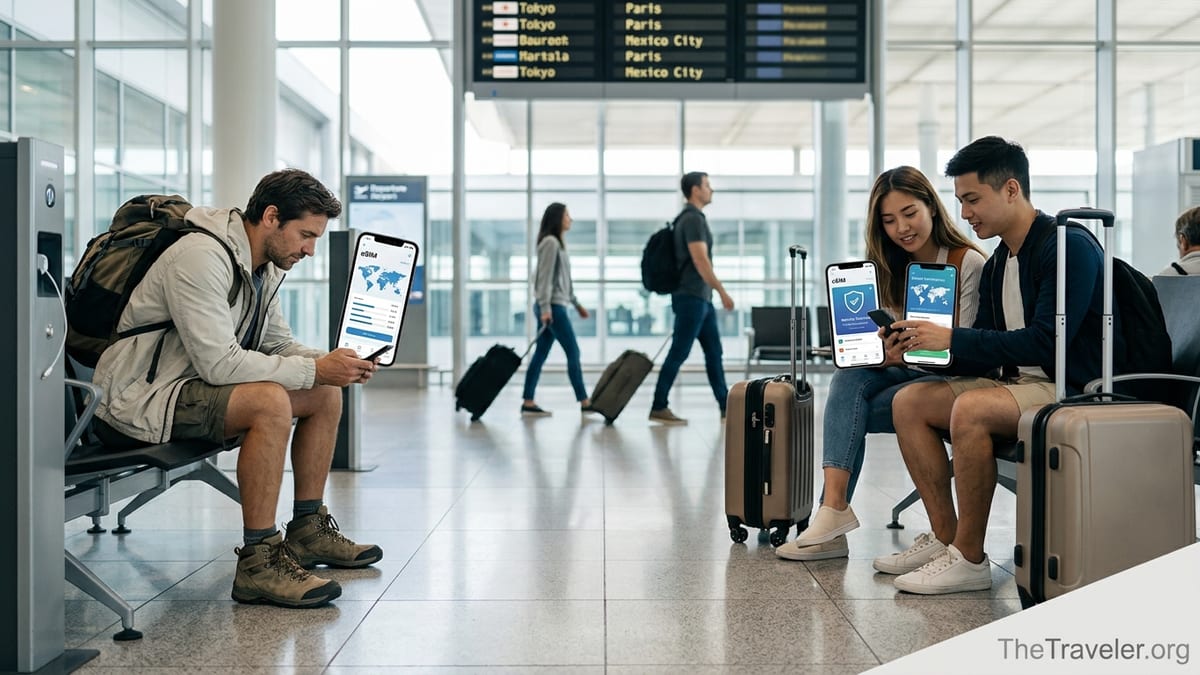
What Saily and Airalo Actually Are
Saily and Airalo both sell travel eSIMs: digital SIM cards that let you buy mobile data for another country without visiting a shop or swapping physical cards. You scan a QR code or install via app, your phone downloads a profile, and you connect to local partner networks abroad. No contracts, and in most cases you can keep your home SIM active for calls and SMS while using the eSIM for data.
Airalo, founded in 2019, is often described as the world’s first major eSIM marketplace. It aggregates hundreds of local, regional, and global data plans from carriers and wholesalers, with coverage in more than 200 countries and regions. Single-country eSIMs sit alongside regional bundles such as “Europe” or “Asia,” as well as global plans designed for round-the-world or multi-continent trips.
Saily is newer. Launched by Nord Security, the company behind NordVPN, it focuses on simplifying eSIM buying and layering in security tools. Reviews highlight that plans start around the low single digits in US dollars for small data packs and that Saily’s catalog covers over 200 destinations, with a global plan spanning 121 countries as of mid‑2026. Its pitch is less about being a marketplace and more about being a streamlined app with built-in protection features.
Both are aimed at travelers who would rather preload connectivity from home than haggle at airport kiosks or risk surprise roaming bills. Where they differ is in depth of coverage, pricing structure, and the kind of traveler they suit best.
Coverage and Where Each Service Works Best
From a pure map perspective, both providers now reach most popular travel destinations. Airalo’s global reach extends to more than 200 countries and regions, with regional bundles that cover, for example, much of Europe on a single eSIM, or large parts of Asia or Latin America without swapping plans mid-trip. Its global eSIM, which at the time of writing offers 5 GB valid for 60 days in around 159 countries, is aimed at people hopping between continents rather than staying in one region.
Saily’s catalog also spans 200‑plus destinations, but its flagship global plan covers 121 countries, with individual country and regional options filling in the rest. Tech reviews note that in dense tourist corridors such as Western Europe, the US, Japan, and Australia, Saily performs competitively. However, commentators often point out that Airalo and similar marketplaces sometimes have the edge in more remote or less touristed regions, thanks to a wider choice of underlying network partners.
In real life, this means a digital nomad doing a classic Europe rail loop from Lisbon to Berlin is unlikely to notice a big coverage difference between Saily and Airalo. Both will typically connect you to major networks in Spain, France, Germany, and Italy. But someone backpacking through parts of Central Asia or venturing far beyond capital cities in South America may find Airalo’s broader list of country-specific eSIMs offers more options if their first choice network is patchy.
If your travel is mostly big cities and established routes, coverage is essentially a tie. If you frequently detour into secondary towns or regions where infrastructure is weaker, Airalo’s roster of individual carriers and regional plans may give you a slightly better shot at strong, consistent signal.
Pricing in the Real World: Concrete Plan Examples
Both services price plans by destination, data amount, and validity, so there is no single “Saily vs Airalo” figure. Instead, what matters is how often you travel, how long you stay, and how much data you use. Airalo’s marketplace structure means costs per gigabyte vary a lot. Reports tracking Airalo prices in 2026 show that single-country eSIMs are usually the cheapest per GB, regional eSIMs cost a bit more, and global eSIMs sit at the top of the scale. A European regional plan might start around 4 to 5 US dollars for a small data allowance, while an Africa or Latin America regional eSIM might begin closer to the high single digits.
For instance, Airalo’s Europe regional bundles are often priced so a short city-break traveler could grab a low‑data, 7 to 10 day eSIM for roughly the cost of a couple of coffees, while someone planning a three-week rail pass could step up to a mid‑range package instead. In North America, regional plans typically start in the mid‑single-digit dollar range and scale with the amount of data, so a light user relying mostly on Wi‑Fi in cafes and hotels pays very little, while a remote worker streaming video meetings would move to a larger, clearly more expensive tier.
Saily takes a similar tiered approach but emphasizes granular data choices in each destination. Tech reviews from 2026 describe examples like 3 GB valid for 30 days in the US or the UK for under 10 dollars, with smaller 1 GB packs starting under 5 dollars in many countries. For travelers on tight budgets, that ability to buy just a few gigabytes for a full month can be compelling, especially if they mostly message, navigate, and occasionally browse rather than stream video.
When you compare specific destinations, sometimes Saily is cheaper for the same data and validity, and sometimes Airalo wins, especially when there is intense competition from multiple local carriers. That is why travelers who care about every dollar often check both apps before committing. In practice, short trips of under a week for light to moderate use will usually cost somewhere between the price of a fast-casual meal and a modest dinner out, regardless of which service you choose. Frequent long-haul travelers or remote workers who need dozens of gigabytes per month will see much bigger differences, and should compare plans very carefully.
App Experience, Ease of Use, and Security Tools
Installation and day-to-day use are where Saily and Airalo feel quite different. Airalo behaves like a store: you open the app, pick your destination or region, see a list of eSIMs, pay, and install. Each eSIM is tied to a specific country or bundle. On a six-week multi-country trip, you might end up installing more than one profile: for example, a regional Europe eSIM followed later by a Japan-only plan, then a global plan for a stopover in the Middle East.
Saily’s design centers on simplification. You install the Saily eSIM once, then add or top up data for new countries through the same profile instead of juggling a stack of separate eSIMs. This can be attractive for travelers who do not want to think about which profile is active on their phone or worry about accidentally disabling their home number. Reviews and user anecdotes frequently highlight that this “single eSIM, multiple trips” approach feels less fiddly, particularly on phones that have limits on how many eSIMs they can store.
Where Saily clearly differentiates itself is security. Built by Nord Security, Saily bundles tools like ad blocking, web protection, and virtual location features at no extra charge in its app. For a business traveler frequently connecting to hotel Wi‑Fi or airport hotspots, this combination may reduce the need for separate security apps. While it is not a full VPN replacement for everyone, travelers already used to NordVPN tend to appreciate the familiarity and extra guardrails around sketchy networks.
Airalo, by contrast, sticks to connectivity. Its value lies more in the breadth of plans and the transparency of which local operators each eSIM uses. This appeals to technically minded travelers who like to know which network they will be riding in Japan, Morocco, or Vietnam, and who prefer to pick security tools separately.
Speed, Reliability, and Real Travel Stories
Both Saily and Airalo depend on local carriers in each destination. That means your real-world performance will be shaped as much by the chosen partner network as by the eSIM brand itself. In popular destinations like Japan or major European capitals, you can find mixed anecdotes for both services. Some travelers report perfectly smooth experiences, with 4G or 5G speeds good enough to stream video on trains, while others mention patches of slow data indoors or in rural areas.
For example, it is not hard to find a traveler who used Airalo across Italy, France, and Germany for two weeks and never dropped below usable speeds, saving a few hundred dollars compared to their home carrier’s roaming package. Another will share that, in parts of rural Japan or mountainous regions, the specific network their Airalo eSIM used felt weaker than expected, even while locals on different carriers had better coverage. The same pattern appears in Saily reviews: smooth sailing for someone who spent a city-focused week in Tokyo, Barcelona, or New York, more complaints from travelers who pushed into less populated regions or relied on a weak hotel signal as their main connection.
Independent tech outlets note that in some off-the-beaten-path regions, marketplaces like Airalo and other competitors tend to have a slight advantage, simply because they can choose among more wholesale partners. Meanwhile, Saily leans on a curated set of networks that work well in mainstream destinations but may be less optimized for extreme edge cases. For most tourists sticking to known routes, the difference will be subtle, often invisible. For people driving into remote valleys or coastal villages, the type of local network matters more than the logo on the eSIM app.
It is also worth remembering that speed is only one piece of the reliability puzzle. Customer support responsiveness, clarity of setup instructions, and how quickly an issue is resolved often matter more than whether you got 80 or 120 Mbps on a hotel balcony. On that front, Saily emphasizes 24/7 in‑app chat, while Airalo offers support through its own channels; in both cases, experiences range from smooth resolution in minutes to occasional frustration when a problem is more complex.
Who Each Service Suits Best: Matching to Travel Style
Thinking in terms of travel styles makes the Saily vs Airalo choice clearer. Consider a solo backpacker spending three months zigzagging across Southeast Asia, then stopping in Europe for a festival. This traveler cares about keeping overall costs down, moving flexibly between countries, and having options in less touristed areas. Airalo’s combination of country-specific eSIMs and larger regional bundles could be a better match here, because it gives them the freedom to switch networks if one provider underperforms in a particular region.
Now imagine a family of four from the US on a two‑week holiday across London, Paris, and Rome. They want something simple they can all install before leaving home, with predictable costs and minimal tech friction. Saily’s single-profile setup, where you install once and then add data for each destination through the same interface, might feel less intimidating than managing multiple separate eSIMs for each family member in every country. The built-in security features are also reassuring for parents whose teenagers will be connecting to all kinds of hotel and cafe Wi‑Fi along the way.
A remote worker or digital nomad splitting time between New York, Lisbon, and Bali has another set of priorities: enough data for video calls, stable coverage in co‑working spaces and apartments, and predictable renewals. Either platform can work here, but the choice will hinge on which one offers better monthly or long-stay plans in their exact destinations. In some cities, Airalo’s local eSIM marketplace can surface particularly competitive offers from aggressive local carriers. In others, Saily’s region-wide or long-validity options could be easier to manage over several months without constantly swapping profiles.
If you are a security-conscious traveler already invested in Nord Security products, Saily’s integration might tip the scales. If you are a tinkerer who likes to pick specific networks, compare per‑GB prices across multiple carriers, and optimize for every country, Airalo will likely feel more natural.
How to Decide: A Simple Framework Before You Buy
Before committing to either Saily or Airalo for an upcoming trip, it helps to run through a short checklist. First, write down your actual itinerary: exact countries, approximate dates, and how long you expect to stay in each place. A week in one city suggests a different plan than ten countries in thirty days. Then, be honest about your data habits. If you mostly message, use maps, and browse lightly, a modest 3 to 5 GB pack for a week or more may suffice. If you plan to upload high‑resolution photos daily, stream music on long drives, or join video calls, you will need considerably more.
Next, check your device compatibility. Both Saily and Airalo work only on phones that support eSIM, and some handsets limit the number of active eSIM profiles at once. It is worth confirming this before buying multiple plans, especially if you intend to keep your home line active. Also check whether your home carrier allows turning off roaming charges while still receiving SMS, since that can affect how you juggle primary and travel data connections.
Finally, compare like for like inside each app: same country, similar data allowance, and similar validity period. For a 10‑day trip to Spain, for instance, pull up a Saily plan and an Airalo plan offering 3 to 5 GB over 10 to 15 days. Note the price difference, whether calls and SMS are included, and which local network each one uses if that information is visible. Do this for any multi-country segments as well. The decision often becomes obvious once you see the concrete numbers for your specific route.
Whichever service you pick, it can be smart to keep the other app installed as a fallback. If you arrive in a destination and find that speeds or coverage are worse than expected, being able to buy a competing eSIM on the spot gives you a low‑stress plan B without visiting a physical store.
The Takeaway
Saily and Airalo are both strong choices that have matured significantly by 2026. For most mainstream trips, either one will keep you online at a fraction of what traditional roaming packages cost. The key differences are not about whether they work at all, but about how much control you want, how often you travel, and where your personal comfort lies between simplicity and customization.
Choose Saily if you value a streamlined app, like the idea of installing a single eSIM once, and appreciate extra security features wrapped into the service. It suits families, occasional travelers, and anyone already familiar with Nord Security tools who wants a low‑friction way to stay connected in popular destinations.
Choose Airalo if you travel frequently, especially across multiple regions, and want maximum choice of local, regional, and global plans. Its marketplace style, broad coverage across more than 200 countries and regions, and detailed breakdown of which networks you will be using make it a strong fit for digital nomads, backpackers, and power users who fine‑tune every aspect of their connectivity.
If you are still undecided, there is no harm in starting small. Buy a modest eSIM for your first few days abroad from one provider, keep the other as backup, and see which experience feels more natural on the road. Your own travel style is the best guide to which eSIM will serve you better in the long run.
FAQ
Q1. Which is cheaper overall, Saily or Airalo?
Saily is often cheaper in some popular destinations for small to medium data packs, while Airalo can be more competitive in others, especially where it partners with aggressive local carriers. The only reliable way to know for your trip is to compare similar plans in both apps for the exact countries, data amounts, and validity you need.
Q2. Which eSIM has better global coverage?
Both cover more than 200 countries and regions. Airalo offers a wider variety of individual country and regional eSIMs, along with a global plan that spans around 159 countries. Saily’s catalog also exceeds 200 destinations, with its main global plan covering 121 countries and regional options available elsewhere. For most mainstream trips, coverage is comparable.
Q3. Do Saily or Airalo include calls and texts, or are they data only?
Most Saily plans are data only, and you keep using your home number for calls and SMS or rely on apps like WhatsApp. Airalo primarily focuses on data as well, but some of its regional and global packages include a limited amount of local calls and texts. Always check each plan’s details before purchase if voice minutes matter to you.
Q4. Which service is easier to use for non-technical travelers?
Many non-technical travelers find Saily’s “install once, add data as you go” approach less confusing than managing multiple separate eSIMs. Airalo is still straightforward, but because it offers many more individual plans, it can feel a bit like browsing an online store with lots of options. Both apps provide step-by-step installation guides.
Q5. Can I use Saily or Airalo for long-term stays or digital nomad life?
Yes. Both services offer plans with longer validity or that can be easily renewed. For long-term stays, it often comes down to which provider offers better monthly or high-data options in your specific destination. Some digital nomads use Airalo to take advantage of country-specific deals, while others prefer Saily’s simpler app and security features for multi-month use.
Q6. How do speeds compare between Saily and Airalo?
Speeds depend far more on the underlying local network than on whether you bought your eSIM from Saily or Airalo. In major cities and popular tourist areas, both typically deliver solid 4G or 5G performance. In remote or rural regions, you may see slower speeds or patchier coverage regardless of brand, which is why checking which local carriers each plan uses can be helpful.
Q7. Is it safe to rely solely on an eSIM when traveling?
For most travelers, relying solely on an eSIM is safe as long as their phone is eSIM-compatible and they install it correctly before or upon arrival. Many people now travel without physical local SIMs at all. That said, having offline maps, key documents downloaded, and a backup plan like access to airport Wi-Fi or a second eSIM provider can add peace of mind.
Q8. What happens if my eSIM stops working mid-trip?
If an eSIM stops working, the first step is to toggle airplane mode, restart the phone, and double-check cellular settings. If that fails, contact the provider’s support through the app. Both Saily and Airalo offer customer support to troubleshoot issues. In rare cases where the problem cannot be fixed quickly, many travelers simply purchase a second eSIM from another provider or a physical SIM locally as a fallback.
Q9. Can I keep my home number active while using these eSIMs?
Yes. On most modern phones, you can keep your home SIM active for calls and texts while using Saily or Airalo for data. This is a common setup for travelers who still need to receive banking codes or important messages on their regular number. Just make sure you understand your home carrier’s roaming policies so you do not accidentally incur high roaming data charges.
Q10. How far in advance should I buy a Saily or Airalo eSIM?
Many travelers buy and install their eSIM a day or two before departure to test that installation works and settings are correct. Most plans only start counting validity from the moment they first connect to a network in the destination country, not from the moment of purchase. Reviewing each plan’s activation rules before you buy ensures you can set everything up at home and land with data ready to go.