


Administrative speed is a critical operational factor for anyone considering relocation to Thailand, whether as an individual professional or as part of a corporate deployment. While Thailand has made visible strides in digitalization and regulatory reform, foreign residents and employers still encounter slow and unpredictable procedures that can affect work planning, compliance risk, and day-to-day productivity. Understanding where and why delays occur is essential for realistic relocation planning.
Overview of Thai Administrative Speed and Predictability
Thai public administration combines relatively modern legal frameworks with legacy bureaucratic habits. In comparative studies of regulation and ease of doing business, Thailand usually appears in the mid-range globally and in the upper tier within Southeast Asia, indicating that procedures are not among the world’s slowest but remain far from best practice in terms of simplicity and predictability. Surveys of businesses in recent years consistently highlight bureaucratic red tape and administrative burden as a key structural constraint, particularly for smaller firms and those without specialized local support.
For relocating individuals and companies, the pace of procedures is best described as uneven. Some processes are handled in days, especially where dedicated one-stop centers or digital platforms are in place, while others can extend to weeks or months because of layered approvals, in-person requirements, and office-by-office discretion. A single administrative goal, such as obtaining permission to work or updating status in a government database, can entail multiple separate interactions with different agencies, each with its own queues and processing times.
Predictability is often a bigger challenge than raw speed. Official guidelines may specify target timeframes that are shorter than what foreigners experience in practice, particularly outside Bangkok or during peak periods. Rules can be applied differently across provinces or even between counters in the same office, making it hard to plan schedules and project timelines with confidence. These characteristics mean that, for relocation decisions, buffer time rather than nominal processing days should guide planning.
It is also important to note that Thai administrative culture is generally process-driven rather than outcome-driven. Officials place strong emphasis on formal completeness of documents, stamps, and signatures. Even minor errors or deviations from local expectations can result in a file being set aside, restarted, or delayed without explicit explanation, which adds to perceived slowness for foreigners unfamiliar with local practice.
In-Person Queues and Office Workflows
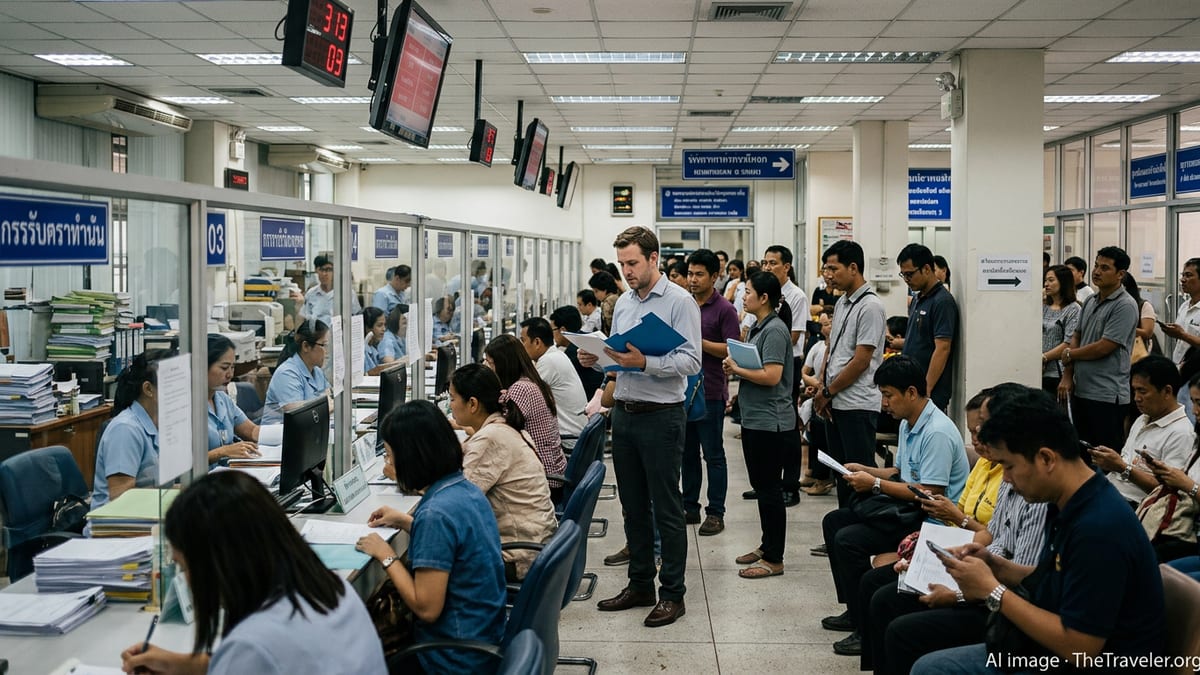
At the ground level, slow administrative procedures are often felt most acutely through in-person visits to government offices. Many key processes for foreigners, such as certain types of registration or reporting, still require physical presence at district offices, immigration branches, or labor offices. In high-demand locations, queues can form early in the morning, and applicants may spend several hours at an office even when the underlying transaction is brief once at the counter.
Waiting times vary considerably by location and timing. In major hubs like Bangkok, Chiang Mai, and Phuket, it is common for foreigners to report half-day or full-day visits for routine matters during busy seasons, especially at large immigration offices where hundreds of people may be processed each day. By contrast, some provincial offices with lighter volumes may complete similar procedures within an hour. The disparity means that relocation planning must be tailored to specific regional conditions rather than assuming a national norm.
Workflows inside offices are typically segmented, with applicants moving from reception to document checking, to fee payment, to final approval. Each step can generate a separate queue, and an incomplete document at any point may require reprinting, additional signatures, or a return visit another day. Offices may also rely on manual registers and paper files, which increases the chance of bottlenecks when staff are absent or when files need to be retrieved or moved between sections.
Foreigners who do not speak Thai or who are unfamiliar with typical document formats often experience longer effective processing times than local applicants. Staff may need more time to verify foreign-language documents, consult colleagues, or clarify issues, which adds to total time spent even when the formal procedure remains the same. This difference is particularly relevant for those relocating without corporate administrative support.
Digitalization Efforts and Their Practical Limits
Thailand has invested in digital government initiatives, including national digital identity tools and multiple online portals, with the stated aim of reducing administrative burden and service times. In international e-government assessments, Thailand sits around the middle of the global ranking, reflecting noticeable progress but also fragmentation and inconsistent implementation across agencies and regions. Some services, such as selected permits or notifications, are now accessible online and can theoretically be processed in a few working days or less.
In practice, digitalization has reduced slowness for certain processes but not eliminated underlying issues. New online platforms often operate in parallel with legacy paper-based systems during transition periods. Applicants may be instructed to input data electronically but still submit physical documents or appear in person for verification, which reduces the net time savings. Technical outages, heavy-traffic slowdowns, and interface changes without clear communication can also result in unexpected delays and repeated attempts to complete a task.
Online systems that handle high volumes of foreigner-related transactions, such as reporting obligations or some permit applications, have been known to suffer from intermittent downtime or long “pending” statuses during peak periods. Informal user reports describe processing times ranging from one to two days when systems work smoothly to more than a week when backlogs or technical problems arise. In some cases, if an online submission is not approved by a due date, individuals must revert to in-person visits to avoid non-compliance, effectively doubling the administrative effort.
A further practical limitation is that online services are rarely fully standardized nationwide. Certain provincial offices or specific categories of applications may not be fully integrated into national platforms, leading to requirements for localized procedures or manual handling even when a nominal online route exists. For relocating professionals, this means that digitalization should be viewed as a partial mitigant to slowness rather than a guaranteed solution.
Typical Timeframes for Common Foreign-Related Procedures
The actual speed of Thai administrative procedures affecting foreign residents depends heavily on the type of transaction, the applicant’s profile, and the location. However, broad indicative ranges can be described to support relocation planning, while emphasizing that these are approximate and subject to local variation.
For example, standard government guidance for certain types of work authorization historically referenced processing periods of roughly 7 to 10 business days in Bangkok for straightforward cases, with more complex or provincial cases potentially extending up to several weeks. Specialized one-stop service centers and recent e-work permit initiatives can reduce this to a few working days for eligible employers, but not all applicants qualify for these channels, and transitions to new systems may temporarily slow processing for some categories.
Reporting or registration obligations that recur periodically, such as residential address notifications, can range from a few minutes when accepted online to several hours when lines at local offices are long. Anecdotal evidence from foreign residents suggests that online submissions, when functioning, may be acknowledged within one to two days, while in-person visits in major cities may require half a day or more due to queuing and internal file handling. First-time or post-travel interactions are often more time-consuming than routine renewals because officials must check a broader set of documents.
Other administrative interactions, such as obtaining official certificates, registering contracts, or updating records in civil registries, can vary between same-day issuance and multi-week waits. Some district offices can produce basic certificates within a single visit if documents are in order, while more specialized records or corrections may involve internal review and multi-level signoff, stretching processing times significantly. These wide ranges underline the importance of generous time buffers in relocation timelines.
Structural Causes of Slowness in Thai Administration
Several structural factors help explain why Thai administrative procedures can be slow from a foreigner’s perspective. First, legislation and subordinate regulations tend to be detailed and prescriptive, requiring multiple supporting documents, signatures, and stamps. Even where digital tools exist, officials are often required to cross-check physical copies and ensure that each supporting item meets formal requirements, which naturally increases handling time per file.
Second, decision-making is frequently layered. Files may need initial screening at a front desk, technical review by a case officer, and final sign-off by a supervisor or committee. Each layer adds potential waiting periods, especially if supervisors are only available on certain days or if caseloads are unbalanced. In offices where senior officials are responsible for signing off large volumes of applications, queues can grow quickly.
Third, coordination among agencies is limited. A foreign resident or company may need to interact with several separate authorities for related matters, such as identity verification, labor permission, and address reporting. Data-sharing mechanisms between agencies are still developing, so each office may request overlapping information and conduct its own checks. This duplication not only increases total processing time but also multiplies the opportunities for delay when one element of documentation is missing or inconsistent.
Finally, administrative culture tends to penalize procedural risk more than delay. Officials may prefer to postpone a decision rather than approve a file that they feel is incomplete or ambiguous. This cautious approach can be particularly pronounced when dealing with foreigners, where perceived compliance risks and language barriers are higher. As a result, applications may sit in a “pending” status longer than applicants in more outcome-focused systems might expect.
Variation by Location, Office, and Individual Officer
One of the most significant practical challenges for relocating foreigners is the high degree of variation in administrative speed across Thailand. Central government regulations may be uniform on paper, but their interpretation and implementation differ from province to province and often between offices in the same city. Local workloads, staffing levels, and informal practices all influence how quickly files move through the system.
In Bangkok and other major urban centers, offices dealing with foreigners tend to be busier but also more familiar with complex international documentation. This can lead to faster handling of standard cases but also to longer queues and appointment wait times. In smaller provinces, queues may be shorter, yet staff may be more cautious with atypical documents, which can prolong individual case processing. Foreigners working in emerging industrial or resort areas often report mixed experiences that change over time as local offices adjust to increased demand.
Individual officers also exercise discretion in how strictly they apply document requirements, how they handle minor errors, and whether they are willing to provide informal guidance on correcting issues. Some officers may accept small discrepancies with a simple note or additional explanation, allowing a file to proceed without delay. Others may insist on perfect alignment with internal checklists, requiring reissued documents or new translations that extend timelines by days or weeks. From a relocation standpoint, this subjectivity increases uncertainty and complicates efforts to standardize internal company procedures.
This variation reinforces the importance of localized intelligence. Large employers and relocation providers often maintain office-specific playbooks detailing which documents are typically requested, which days are busiest, and how far in advance appointments should be booked. For individuals relocating without such support, gathering recent, location-specific information before initiating procedures can significantly reduce the risk of encountering unexpected slowness.
Mitigation Strategies for Dealing with Slow Procedures
Although the structural characteristics of Thai administration cannot be changed by individual applicants, there are practical strategies that can mitigate the impact of slow procedures on relocation plans. The first is conservative time budgeting. Rather than relying on best-case official timeframes, it is advisable to build in additional lead time for every major administrative step, especially those that are prerequisite for work commencement, school enrollment, or housing arrangements.
Second, meticulous document preparation helps reduce the risk of files being delayed or rejected. This includes ensuring that translations are prepared by recognized providers where needed, that all copies are clearly legible, and that signatures and dates are consistent across documents. A single missing page or unclear copy can trigger significant delays, particularly when supervisors are conservative in their reviews. Using checklists tailored to specific offices or relying on recent experiences from peers can materially reduce processing friction.
Third, where feasible, leveraging reputable local intermediaries can make a substantial difference. Thai-speaking HR staff, relocation consultants, or legal advisors often understand local expectations and informal practices, know when offices tend to be less busy, and can respond quickly to requests for additional information. Their familiarity with officers and internal workflows can sometimes prevent small issues from turning into multi-week delays.
Finally, staying informed about system changes is important. Thailand has been rolling out new digital tools and adjusting administrative rules regularly, particularly since 2024. During transition periods, some procedures may temporarily slow down as staff adapt to new systems. Conversely, some processes may become markedly faster once a new online portal stabilizes. Tracking these developments helps relocating individuals time key applications to avoid the most disruptive phases of change.
The Takeaway
Thai administrative procedures are characterized less by extreme lateness than by variability, complexity, and unpredictability. Foreigners relocating to Thailand can expect certain standardized processes to move quickly, particularly when supported by one-stop centers or mature online systems. However, many interactions with government still involve multi-step, documentation-heavy routines, in-person visits, and office-specific interpretations that can stretch timelines well beyond nominal targets.
For decision-makers evaluating relocation to Thailand, the practical implication is that administrative speed must be treated as a planning constraint rather than an afterthought. Project timelines, start dates, and resource allocations should incorporate generous buffers and allow for sequential rather than simultaneous processing of interdependent procedures. Organizations that invest in local expertise, structured document management, and conservative scheduling generally manage Thai administrative slowness effectively, while those that assume best-case processing often encounter avoidable delays.
Overall, Thailand’s bureaucracy is not an insurmountable obstacle to relocation, but it is a material operational factor. A realistic understanding of how slow Thai administrative procedures can be, why delays occur, and how they vary across locations is essential to turning a relocation plan into a workable reality.
FAQ
Q1. Are Thai administrative procedures always slow compared with other countries?
They are not always slow, but they are often more complex and less predictable than in high-performing systems, which makes delays more common for foreigners.
Q2. Which types of procedures are most likely to be time-consuming for foreign residents?
Procedures that require in-person visits, multiple supporting documents, and multi-level approvals, such as registrations and certain permissions, tend to be the slowest.
Q3. How much extra time should be built into relocation plans for Thai administrative steps?
Exact needs vary, but many organizations plan at least several additional weeks of buffer beyond official processing targets for critical steps.
Q4. Do online government systems in Thailand eliminate the need to visit offices?
Online systems reduce visits for some processes, but many still require at least one in-person appearance or document verification, so physical visits remain common.
Q5. Why do timeframes differ so much between different Thai provinces?
Differences in staffing, local workloads, and how regulations are interpreted locally create significant variation in speed and efficiency between provinces.
Q6. Does using a local agent or relocation provider make procedures faster?
It does not change formal rules, but experienced local support can prevent mistakes, navigate office-specific expectations, and reduce practical delays.
Q7. Are businesses affected by slow procedures more than individual expats?
Both are affected, but businesses feel it strongly when delays disrupt hiring, project launches, or regulatory registrations linked to operational timelines.
Q8. How often do administrative rules or systems change in Thailand?
Adjustments to forms, platforms, and requirements occur regularly, particularly in recent years, which can temporarily slow processes during transition periods.
Q9. Is Thai administrative slowness improving with recent digital reforms?
There are gradual improvements in some areas due to digitalization, but the overall experience remains mixed, with persistent variability and occasional bottlenecks.
Q10. What is the single most effective way to reduce the impact of slow procedures when relocating?
Building generous time buffers into all plans and preparing documents meticulously, ideally with localized guidance, is the most effective way to limit disruption.