


On my most recent trip to New York City, I did something that used to feel almost unthinkable: I did not stay in New York. I booked a waterfront hotel in Jersey City instead. What I expected to be a small compromise to save money ended up reshaping the entire rhythm, mood, and even scope of my visit. Staying across the Hudson did not make New York feel farther away. It actually made the city easier, calmer, sometimes cheaper, and in surprising ways, more memorable.
Get the latest updates straight to your inbox!
Discovering a Different Gateway to New York
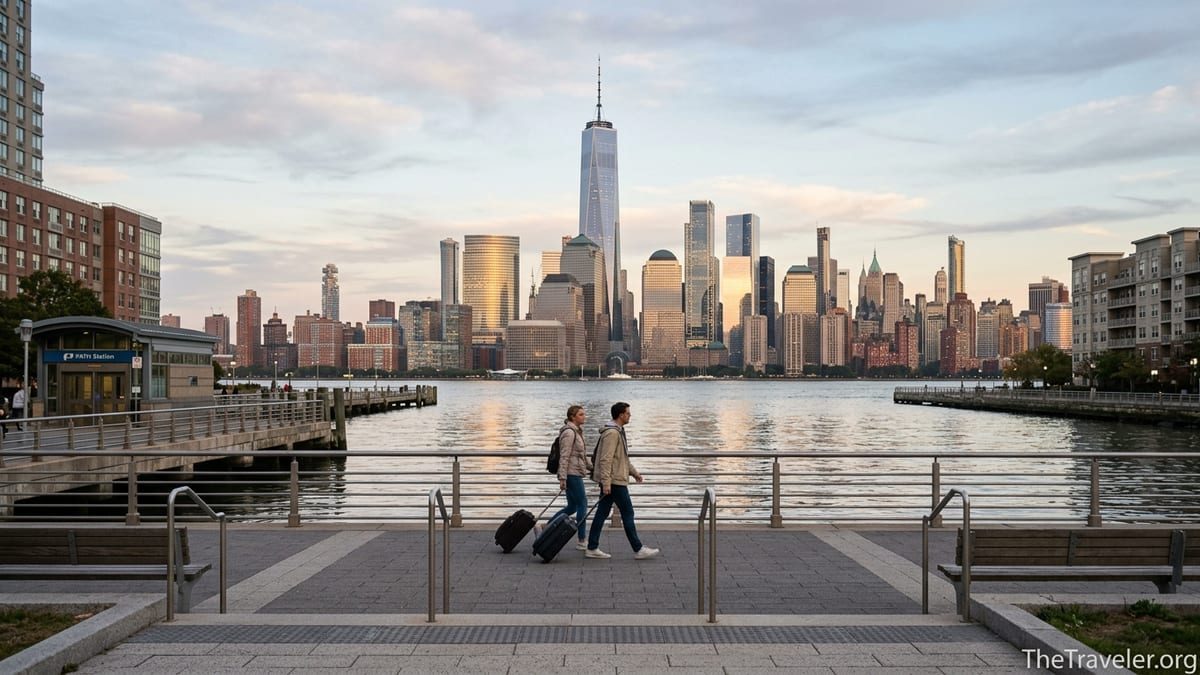
The first shock came within an hour of landing. Instead of dragging my suitcase through a crowded Midtown lobby, I stepped out of the Grove Street PATH station into a compact downtown that felt like a small city in its own right. Coffee shops spilled onto Newark Avenue, commuters streamed past, and the Manhattan skyline hovered just a few blocks away. It was clear immediately that this was not a “suburb” of New York. It was a front-row seat facing it.
I had booked a room near the Exchange Place and Newport corridor, where Jersey City’s PATH stations connect directly to lower Manhattan and Midtown. From Exchange Place, the PATH ride to World Trade Center regularly takes under 10 minutes, and trains run all day and night, so New York never felt out of reach. I could see the Freedom Tower across the water and be standing underneath it in less time than it takes to ride the subway uptown from the East Village.
That short, predictable commute changed how I planned my days. Instead of trying to cram every activity into one continuous Manhattan marathon, I let myself do New York in focused bursts. A morning in SoHo, an afternoon in the West Village, dinner in Koreatown, then back to a quieter waterfront where the crowds thinned and the city turned into scenery.
What surprised me most was how quickly the psychological barrier faded. After one day, “going into the city” felt no more complicated than switching subway lines. The Hudson River stopped being a border and became a reset button between two complementary experiences.
The Price Difference You Actually Feel
Like many travelers, I first looked at Jersey City because of price. Manhattan hotel rates in 2025 and 2026 have stayed high, especially around Midtown and Times Square, where standard rooms in recognizable chains often climb well above what many leisure travelers want to spend for a few nights. By contrast, the waterfront cluster in Jersey City near Newport, Exchange Place, and Paulus Hook routinely advertises competitive rates, especially on weekends and outside major holidays.
On my dates, a mid-range chain hotel near Bryant Park was coming in far above my budget for a standard king room. Across the river, several full-service hotels near the Newport PATH and the Hudson River waterfront were priced noticeably lower for similar room sizes, many including views of Manhattan. The final difference for a four-night stay was enough to cover airport transfers, multiple dinners, and a Broadway ticket.
Of course, you have to factor in the cost of commuting. The PATH fare is modest compared with taxis or ride-hailing, and because the system connects directly to key hubs such as World Trade Center and 33rd Street near Herald Square, you often only need one subway ride on top of it, or none at all if your plans are centered downtown. If you use a contactless payment method for both the PATH and the subway, changing systems becomes almost seamless.
Once I added up the hotel savings, the PATH fares, and a few strategic splurges on the ferry, it was clear that staying in Jersey City did not just trim the budget. It reallocated it. The money I was not spending on a room overlooking a Midtown avenue went toward experiences: a better restaurant in the East Village, an upgraded Broadway seat, and one perfect afternoon boat ride back to my hotel as the city turned gold in the late light.
Commuting Across the Hudson: Faster Than You Think
The biggest misconception about staying in Jersey City is that you will lose time commuting. In reality, the trip from the Jersey City waterfront to Manhattan can be faster and more predictable than traveling from one part of Manhattan to another. The PATH train is built for exactly this cross-river connection. Stations at Grove Street, Newport, Exchange Place, and Journal Square tie directly into lower Manhattan and Midtown, with frequent trains into the World Trade Center and 33rd Street corridors.
On a typical morning, I would walk five minutes from my hotel near Exchange Place, tap into the PATH, and be at World Trade Center in roughly 8 to 10 minutes. From there, the subway connections fan out through lower Manhattan: a quick ride to Tribeca, Chinatown, the Lower East Side, or Brooklyn. On another day, I took the Journal Square–33rd Street service into Midtown, emerging in the thick of Herald Square within a travel time that was no longer than staying in an outer Manhattan neighborhood and changing trains.
Evenings offered more options. If the PATH felt crowded or I wanted a different view, I walked to Paulus Hook or another nearby terminal and caught an NY Waterway or Liberty Landing ferry toward Battery Park City or Midtown. Depending on the route, the ride across the river is often around 10 to 15 minutes, with open decks and unobstructed skyline views. Ferries cost more than the PATH, but for a memorable return from a Broadway show or a sunset in Tribeca, that extra expense can feel justified.
There are trade-offs. Late at night, service can be less frequent, and weekend schedules sometimes change for maintenance, which means you have to check timetables rather than assume trains will appear every few minutes. But that is not so different from planning around subway work in New York. The crucial difference is that your ride home frequently involves a short, uncrowded walk along a quiet waterfront instead of pushing through packed sidewalks around Times Square.
Waking Up to the Skyline Instead of Inside It
One of the most unexpected advantages of staying in Jersey City was visual. In Manhattan, you are usually inside the skyline. From street level in Midtown or lower Manhattan, you feel the energy but rarely see the full shape of the city. In Jersey City, especially along the waterfront near Exchange Place, Paulus Hook, or Newport, you get a panoramic view of lower Manhattan, from the Statue of Liberty and Ellis Island up past One World Trade Center and the Battery.
Each morning, I grabbed coffee from a local spot off Grove Street and walked the few minutes to the Hudson River waterfront. Joggers passed on the promenade, office workers cut diagonally toward the PATH, and families pushed strollers past small playgrounds. Across the water, the towers of the Financial District caught the first bright light, the reflections shifting on the river. It felt like watching the curtain rise on the city I was about to enter.
At night, the effect reversed. Instead of closing my hotel curtains to shut out traffic noise, I left them open. The skyline became part of the room. Ferries slid across the river like silent shuttles, and the lit windows of Manhattan’s towers turned into a distant tapestry rather than a cluster of buildings pressing in from all sides. It was one of the rare times in New York when I felt close to the city yet physically detached from its constant motion.
That change in perspective altered my memories of the trip. When I think back on that week, I remember classic New York scenes: a packed subway platform at West 4th Street, a crowded bar in the East Village, the crush around Times Square at night. But I also remember standing alone at the end of a pier in Jersey City, with the skyline stretching left and right, as if the city were posing for a portrait just for me.
Food, Neighborhood Vibe, and Evenings Back “Home”
Another way staying in Jersey City changed my experience was what I did before and after my Manhattan days. Normally, staying in Midtown or lower Manhattan means waking up and going to sleep in areas dominated by offices, chain restaurants, and tourist-focused bars. Jersey City’s downtown, particularly around Grove Street and Newark Avenue, has a more residential feel, with a mix of independent coffee shops, bakeries, and restaurants that serve locals as much as visitors.
On my first morning, I skipped the hotel breakfast and walked along Newark Avenue, where a pedestrian-friendly stretch is lined with cafes, taco spots, and casual brunch options. Instead of competing with tourists clutching guidebooks, I stood in line behind office workers and families who clearly lived nearby. That subtle shift in clientele changed the way I interacted with the city. I asked the barista which PATH stop was best for reaching the West Village, and the answer came with the kind of practical tips you only get from someone who commutes that route every day.
Evenings followed a similar pattern. After nights in Manhattan, I would ride back across the river and often stop for a drink or dessert near Grove Street before heading to the hotel. One night, I had a late dinner at a small restaurant just off the pedestrian plaza, watching people drift through the square long after most Midtown office towers had gone dark. The energy felt young and local, less polished than some Manhattan neighborhoods but more relaxed, with the sense that people here were winding down from real days rather than chasing a sightseeing checklist.
Over several days, Jersey City stopped feeling like an overnight compromise and started feeling like the neighborhood I lived in, with Manhattan as the place I went for “work,” even if that work was visiting museums, walking the High Line, or catching a show. That emotional inversion may be the single biggest shift that came from not sleeping in New York itself.
Access to Classic Sights Without the Midtown Grind
One concern many travelers have about staying across the river is whether it will complicate visits to the major sights. In practice, most classic New York itineraries remain entirely feasible from Jersey City, often with less stress. From the Exchange Place or Grove Street stations, you can be at the World Trade Center and the 9/11 Memorial in minutes. From there, a short subway ride puts you in Tribeca, SoHo, or Greenwich Village. Continuing downtown takes you to the Staten Island Ferry, Wall Street, or the Brooklyn Bridge.
On one morning, I left my Jersey City hotel around 8:30 a.m., arrived at World Trade Center before 9, and walked north to explore Tribeca and the West Village, stopping for coffee and a pastry along the way. By lunchtime, I was in Chelsea, having reached it faster than if I had started from an uptown hotel. Another day, I took the PATH to 33rd Street and walked directly to the Empire State Building and then to Bryant Park, threading through the same Midtown grid I would have used if my hotel had been around Times Square.
For Brooklyn or Queens, I simply treated Jersey City as an extension of the subway network. Once I arrived in Manhattan via PATH, I transferred to the appropriate line and continued on my way. Traveling from Jersey City to Williamsburg, for example, meant taking the PATH to lower Manhattan, changing once, and arriving at my Brooklyn stop without any more complexity than going from the Upper West Side to Brooklyn.
The key difference was how I felt getting back at night. Instead of fighting my way through Midtown crowds or waiting for a late subway with other exhausted visitors, I took a single PATH ride home and stepped out into a calmer downtown with a smaller scale. The day’s images of Broadway, Central Park, and busy Manhattan streets stayed fresh, but the last scenes before sleep were quieter sidewalks, neighborhood bars, and the lights of New York reflected on the river.
The Trade-Offs: When Jersey City Might Not Be Ideal
Staying in Jersey City is not perfect for every traveler or every itinerary. If you are attending a multi-day conference in Midtown, have very early-morning commitments in Manhattan, or are traveling with someone who has limited mobility and wants to minimize transfers, being within a short taxi ride of your venue might still outweigh the savings or views across the river.
Families with young children, for example, may find the extra step of the PATH or ferry tiring at the end of busy days, especially if strollers and bags are involved. Late-night partiers who plan to stay in Manhattan bars or clubs until the early hours should pay close attention to updated PATH schedules and any overnight maintenance work that could affect service. While PATH operates around the clock, frequencies vary by line and time of day, and occasional delays can ripple through your evening plans.
Another consideration is mindset. If part of your dream is waking up and stepping straight onto a Midtown street before sunrise, or you simply want the feeling of emerging from your hotel into Times Square or Central Park, then staying across the river could feel like a compromise, no matter how efficient the commute. There is a kind of magic in walking out of a Manhattan lobby and immediately being within that dense, unmistakable city soundscape.
The good news is that the choice does not have to be permanent. Some travelers pair a few nights in Manhattan with a few nights in Jersey City, using the waterfront as a way to decompress after the most intense days. Others choose Jersey City specifically to avoid Midtown while still accessing it easily when they want to. What matters is recognizing that across the Hudson is no longer the fringe. It is a viable, even desirable base for seeing New York on your own terms.
The Takeaway
By the end of my stay, I realized that choosing a hotel in Jersey City had done more than adjust my budget. It had changed the shape and feeling of my New York trip. Instead of living inside the city’s constant push and pull, I entered and exited it each day, with the river as a brief buffer that made the city feel both accessible and intentional.
I still rode the subway during rush hour, still stood in line at crowded Midtown landmarks, and still felt that familiar New York fatigue by late afternoon. But each return to Jersey City gave me space and perspective: a quiet promenade, a skyline view that reminded me how extraordinary the city looks from the outside, and a neighborhood rhythm that belonged to residents rather than visitors.
If staying in Manhattan has always felt like an unquestioned default, it is worth reconsidering. A room in Jersey City does not mean giving up New York. It might instead give you a better vantage point on it, both literally and figuratively. New York remains as intense and exhilarating as ever. The difference is that, across the Hudson, you get to decide when to step into that intensity and when to watch it, glowing across the water, from a calm and comfortable distance.
FAQ
Q1. Is staying in Jersey City really convenient for visiting New York City?
Yes. With PATH stations at Grove Street, Newport, Exchange Place, and Journal Square linking directly to World Trade Center and Midtown, most visitors find getting into Manhattan straightforward and fast.
Q2. How long does it take to get from Jersey City to Manhattan?
From the Jersey City waterfront, PATH rides to World Trade Center are often under 10 minutes, and trips to 33rd Street in Midtown typically take only a few minutes more, plus any transfer time once you arrive.
Q3. Is it cheaper to stay in Jersey City than in Manhattan?
Often yes. Waterfront hotels in Jersey City commonly price below comparable Manhattan properties, especially in busy Midtown areas, though exact savings depend on season, demand, and specific hotel choices.
Q4. Will I spend a lot on transportation if I stay in Jersey City?
You will need to budget for PATH fares and any subways or occasional ferries, but many travelers find that the total cost still comes in lower than staying in a similarly comfortable hotel in central Manhattan.
Q5. Is Jersey City safe for tourists, especially at night?
Downtown Jersey City and the waterfront near PATH stations are active, commuter-heavy areas that feel generally safe, especially around Grove Street, Newport, and Exchange Place, though normal big-city awareness is still important.
Q6. Are there good restaurants and bars in Jersey City, or will I always eat in Manhattan?
Jersey City has a growing dining scene, particularly around Grove Street and Newark Avenue, with plenty of cafes, casual spots, and bars, so you can comfortably eat and go out on either side of the river.
Q7. Is it difficult to visit major sights like Times Square and Central Park from Jersey City?
No. You can ride the PATH to 33rd Street in Midtown and walk or take a short subway ride to Times Square, Bryant Park, or Central Park, much like you would from many Manhattan neighborhoods.
Q8. What is the best area of Jersey City to stay in for easy access to New York?
Many visitors choose the downtown waterfront near Newport, Exchange Place, or Paulus Hook, or the streets around Grove Street, because they combine short walks to PATH stations with direct views of the Manhattan skyline.
Q9. Are ferries from Jersey City to Manhattan worth using instead of the PATH?
Ferries are more expensive but offer fast travel times and exceptional views, making them a worthwhile option at least once or twice, especially for scenic rides at sunset or after an evening in lower Manhattan.
Q10. Who might be better off staying in Manhattan rather than Jersey City?
Travelers with very early commitments, limited mobility, or conferences based in Midtown, as well as visitors who specifically want to step straight onto Manhattan streets from their hotel, may still prefer staying in the city itself.