


The first time I clicked into my skis at Lake Louise Ski Resort, the Canadian Rockies were still waking up. A pale band of pink stretched over jagged peaks, the air felt almost weightless at 6,800 feet, and the Grizzly Gondola hummed to life below. By the time I eased into my very first run, I understood why skiers build entire winter traditions around this mountain. Lake Louise is not just big on paper; it is a place where a single descent can change the way you think about skiing, and where almost every visitor starts quietly planning their return before the day is over.
Get the latest updates straight to your inbox!
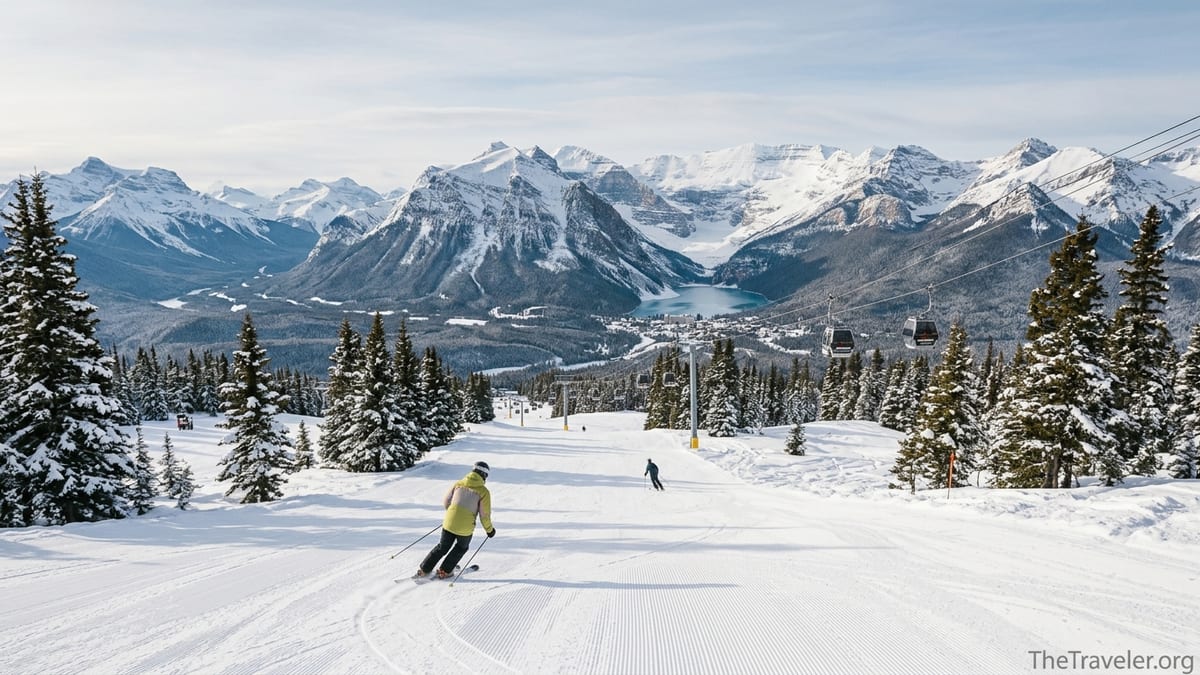
First Impressions From the Top of the World
For many first-timers, the Lake Louise experience starts with the Grizzly Gondola, a steady 14-minute ride that floats you from the base area to a mid-mountain perch above the Bow Valley. As the cabins climb, the resort’s 4,200 acres of terrain unfold in layers: gentle front-side groomers, plunging fall lines under the Glacier Express chair, and the famous back bowls that seem to pour straight out of the Continental Divide. On clear days, you can pick out the frozen mirror of Lake Louise itself tucked beneath Fairview Mountain, and that view alone is enough to make seasoned skiers fall silent.
Stepping off the gondola for my first run, what struck me was not the size of the place, but the calm. There was no blaring music, no rush of crowds. Skiers shuffled quietly toward their chosen routes while patrollers checked avalanche fences and signage. It felt more like slipping into a national park viewpoint than arriving at a busy resort, which makes sense: Lake Louise sits inside Banff National Park, and the sense of protected wilderness never fully recedes, even when you are carving down a freshly groomed green run.
Like many visitors, I was tempted to aim for the big, showpiece descents right away. Locals talk about laps off Top of the World chair or the steep pitches under Paradise like old friends. But Lake Louise excels at easing you into its scale. Clear trail maps at the gondola terminal highlight the easiest way down; green options like Wiwaxy, Pinecone Way and Eagle Meadows create natural escape routes from almost every lift. That means your first run can be exhilarating without being reckless, an introduction instead of an ordeal.
So I pointed my skis toward Wiwaxy, a long green that snakes down the front side. The snow was soft corduroy, groomed overnight, and the pitch never felt intimidating. Within minutes I was linking comfortable turns, stealing glances at the glacier-chiseled peaks opposite, and realizing that this was the sort of mountain where you can be both a little nervous and completely in love at the same time.
Why That First Run Feels Manageable, Even on a Giant Mountain
Lake Louise’s reputation is wrapped up in its expert terrain and World Cup racecourse, but the resort has quietly become one of the most forgiving big-mountain experiences in North America for newer skiers. The design is deliberate. On the front side, every major lift has a green-circle option back to the base, so nervous intermediates and progressing beginners are never stuck at the top wondering how to get down. Routes like Eagle Meadows feeding into Wiwaxy, or the gentle Deer Run from the Glacier Express, let you sample mid-mountain views without committing to steep pitches.
Before you even load the gondola, the Sunny Learning Area spreads out beside the base lodge. Here, covered carpets and a beginner chair serve short, wide slopes designed for first-day skiers and riders. In practice, this means you can spend your first morning mastering snowplow turns and stopping in a controlled, low-consequence environment, grab a hot chocolate at the Lodge of Ten Peaks, then graduate to the longer greens in the afternoon. Families often buy learning-area tickets for kids, while parents use full-day passes that allow them to roam farther afield.
On my own first run, the sign at the top of the gondola offered a helpful dose of reassurance: a large panel marked “Easiest Way Down” with arrows pointing clearly toward the green network. It is a small piece of mountain design, but for anyone who has ever been talked into the wrong trail at the wrong time, that clarity matters. It lets you relax enough to notice the crisp texture of the groomed snow, the way the light catches in the ice crystals, and the distant clatter of chairlift bullwheels across the valley.
Lake Louise’s snow can change quickly with the mountain’s exposure and elevation, but most first-timers encounter packed powder or soft groomers, especially from mid-winter through early spring. The resort’s size spreads people out naturally, so it is common to ski long sections of Wiwaxy or Pinecone Way without feeling crowded. When you do pull over to catch your breath, the pull-outs are often perched on skyline knolls with unobstructed views into Banff National Park, a reminder that you are not simply at a ski hill but on a mountainside that has been attracting mountaineers for more than a century.
The Moment the Scale of Lake Louise Really Hits You
Somewhere halfway down that first front-side run, Lake Louise reveals its true scale. You stop to rest your legs and look across the valley, and suddenly the map transforms into reality. To skier’s right, the Larch area peeks over the ridge, dotted with larch trees that blaze gold in autumn and hold snow in pillow-like drifts in winter. Straight ahead, the back bowls roll away in a series of amphitheaters toward the distant peaks of British Columbia. Trails like Men’s Downhill, where World Cup racers hit highway speeds each November, slice past your line of sight.
What keeps people returning is that this sense of immensity comes bundled with intimacy. On one trip, I shared a gondola cabin with a Calgary couple who have been skiing Lake Louise every winter weekend for more than a decade. They talk about “their” lines off Ptarmigan chair and “their” favorite tree stash near Larch, yet every season they still discover new variations: a traverse that leads to an overlooked glade, or a side hit that only forms under certain storm tracks. Even after your first run, it is obvious that you could ski here for years and still have corners of the map left to explore.
For visiting skiers on multi-day passes, that endless feel is part of the draw. A SkiBig3 ticket lets you mix days between Lake Louise, Banff Sunshine Village and Mt. Norquay, but many travelers end up shifting extra days back to Lake Louise once they have sampled the terrain. The back bowls, in particular, exert a magnetic pull. From the Summit Platter, you can drop into wide faces that stay cold and chalky long after a storm, then traverse back to the front side for a cruise to the base. It is the kind of lap that sticks in memory and becomes the story you tell when someone asks why you keep flying to Alberta every winter.
Even those who never leave the greens and easy blues still feel that big-mountain energy. Watching advanced skiers arc down steeper lines from the safety of a groomed cat track is its own form of inspiration. You see parents point out the runs they used to ski before kids, promising they will all explore them together one day. You overhear Australian visitors comparing Lake Louise’s open bowls to their favorite spots in New South Wales, and European guests marveling that a place this large can feel this uncrowded on a powder morning.
Practical Details That Make a First Visit Less Intimidating
The romantic side of Lake Louise is all peaks and powder, but the reason many travelers return has as much to do with logistics as with landscape. Getting there is more straightforward than the remoteness suggests. Most visitors fly into Calgary International Airport, then book a shared shuttle through regional operators or package providers that link directly to hotels in Banff and Lake Louise Village. In winter, scheduled coaches run several times daily, turning the two-hour drive along the Trans-Canada Highway into a hands-off journey where you can watch the mountains rise without worrying about snow tires.
Once in Banff or Lake Louise Village, complimentary ski shuttles operate throughout the core winter season for anyone holding a valid lift ticket or pass. In practice, that means you can step out of many hotels in Banff, load your skis under the bus, and arrive at the base area without ever touching a steering wheel. For families, this removes the stress of snowy roads and canyon driving. For solo travelers, it is a chance to swap tips with other riders over early-morning coffee cups as the bus climbs toward the resort parking lot.
Lift ticket prices change season to season and can vary by date, but as of recent winters many travelers report full-day adult tickets at Lake Louise falling in the general range of a mid-priced North American destination resort: not as eye-watering as some U.S. mega-resorts, but high enough that buying in advance usually makes sense. Multi-day SkiBig3 tickets often undercut the day-of window rate and include perks like ski shuttle access. Holders of major multi-resort passes such as Ikon and Mountain Collective can use their included days at Lake Louise, then pay discounted rates for additional skiing if they decide to extend.
Gear logistics are similarly forgiving. Rental shops operate at the base area and in both Banff and Lake Louise Village, so you can reserve modern skis or snowboards, switch equipment if conditions change, or upgrade after your first tentative day. For visitors who are trying skiing for the first time, that flexibility matters: you can start on easy-turning, beginner-friendly skis from a well-known brand and swap to something stiffer if you find your confidence growing faster than expected.
How Lessons and Local Guidance Shape That First Run
For many, the first run that makes Lake Louise feel special does not actually happen on day one. It arrives after a morning lesson when footwork, balance and timing finally click. The resort’s ski and snowboard school structures its groups around clearly defined ability levels, from first-timers through advanced off-piste riders. Entry-level classes usually begin in the Sunny Learning Area, using carpets and short lifts to build comfort before progressing to longer greens like Easy Street or Wiwaxy.
On a later visit, I joined an intermediate clinic that started with a slow lap down Eagle Meadows. Our instructor, a longtime local, pointed out subtle features: the way the snow stayed slightly drier on the skier’s-left side after overnight winds, the safety ropes marking entrances to steeper terrain, the patrol hut where avalanche forecasts were updated. When we reached the junction with Wiwaxy, he stopped the group and asked us to look up and down the valley. “You do not need to ski the whole mountain in one day,” he said. “The mountain will still be here when you come back.” It was the sort of grounded advice that sticks long after the technical tips fade.
That emphasis on pacing is echoed in how families use the resort. A common pattern is to enroll children in full-day programs based out of the learning area while adults explore farther afield. At lunch, everyone reunites at the Lodge of Ten Peaks or Whitehorn Bistro, trading stories about minor victories: a first ride on Glacier Express, a successful run without a single fall, an unexpected powder pocket in the trees. These shared milestones become part of a bigger narrative that brings people back year after year.
Private lessons can also reshape a first run. Travelers who only have a few days at Lake Louise often book a half-day guide to help them string together terrain that matches their level while still delivering the resort’s signature views. A good instructor might start with a warm-up on the front-side greens, then lead you to gentle blue runs off Larch chair for a different angle on the peaks. By the time your lesson ends, what was once just a confusing trail map has turned into a mental picture of bowls, ridges and secret cut-throughs.
Lake Louise in the Wider SkiBig3 Experience
Even if you come to Banff National Park with a SkiBig3 pass that allows you to split time between Lake Louise, Banff Sunshine and Mt. Norquay, it is often that very first Lake Louise run that anchors the trip. Sunshine, closer to Banff town, is known for its high alpine snowfields and long season. Norquay, perched almost directly above Banff, offers night skiing and quick laps. But Lake Louise combines sheer acreage, long vertical drop and postcard views in a way that feels different the moment you push off from the top of the gondola.
Many visitors set up in Banff for nightlife, restaurants and easier airport transfers, then designate one or two days for Lake Louise. After their first front-side lap, they often start rearranging plans. A group of friends I met from Texas, traveling on an Ikon Pass, had originally blocked three days at Sunshine and one at Lake Louise. After their first Wiwaxy-to-base run, they immediately shifted another day to Lake Louise, citing the “straight-out-of-a-travel-magazine views” and the sense of skiing through a real national park landscape rather than a commercial village.
Over multiple seasons, Lake Louise becomes the resort many skiers use to measure other destinations. A new powder day somewhere else is “good, but not quite like Louise.” A long groomer stateside is “fun, though shorter than Wiwaxy.” Even if you only ski easy terrain, the visual palette the resort gives you is hard to shake: turquoise glacial lakes glimpsed from the gondola, serrated peaks marching toward the horizon, the afternoon sun blazing off the snowfields above the back bowls.
On paper, the numbers help explain the loyalty: thousands of skiable acres, over a kilometer of vertical, four mountain faces. In practice, it is your own first run that does the convincing, the way the slope tilts just enough under your feet as the world opens up around you. Once you have felt that, it is difficult not to start planning how and when you will feel it again.
The Takeaway
My first run at Lake Louise Ski Resort was not heroic. It was a green circle winding gently down the front side, taken at a cautious pace with plenty of photo stops. Yet by the time I slid back to the base area, surrounded by the timbered lodges and the muffled clack of skis on snow, I finally understood why so many skiers build their winters around this place and return year after year.
Lake Louise manages a rare balancing act. It offers the scale and challenge that keep experts exploring for a lifetime, while its thoughtful trail design, extensive beginner zones and clear signage give newcomers the confidence to enjoy the same mountains without feeling in over their heads. Practical touches, from reliable shuttle buses to flexible lift ticket options and modern rentals, strip away much of the travel stress and let the landscape take center stage.
In the end, the magic of that first run is not about speed or difficulty. It is about the feeling of gliding through a vast, protected wilderness, with peaks and glaciers filling your peripheral vision and a perfectly groomed ribbon of snow beneath your feet. Once you have experienced that combination of beauty and ease, it is easy to see why Lake Louise does not just welcome visitors; it quietly turns them into regulars.
FAQ
Q1. Is Lake Louise Ski Resort suitable for first-time skiers?
Yes. The resort has a dedicated Sunny Learning Area with carpets and an easy chairlift, plus multiple green runs from the Grizzly Gondola and other front-side lifts, so beginners can access great views without tackling steep terrain.
Q2. Do I need a car to ski at Lake Louise if I stay in Banff?
No. During the main winter season, complimentary ski shuttles for lift ticket and pass holders run between many Banff hotels and Lake Louise, so you can reach the resort without driving in winter conditions.
Q3. How challenging is the Wiwaxy run for a newer skier?
Wiwaxy is a long green run with a consistent, gentle pitch. It is well suited to skiers who are comfortable making linked turns on beginner slopes and want to try a longer descent without strong exposure or sudden steep sections.
Q4. When is the best time of winter to plan a first trip to Lake Louise?
Conditions are usually most reliable from mid-December through March, when the base is well established and trails across the front side, Larch and many back bowls are typically open. Late January and February often provide a good balance of snow quality and daylight.
Q5. Are there lessons specifically for adults who have never skied before?
Yes. Lake Louise Ski Resort offers adult group and private lessons targeted at complete beginners. These usually start in the learning area, focusing on basic movements and control before progressing to short green runs when you are ready.
Q6. How expensive are lift tickets at Lake Louise compared with major U.S. resorts?
Exact prices vary by date and season, but recent winters have seen full-day adult tickets generally below the highest rates at some marquee U.S. mega-resorts. Booking multi-day passes in advance or using a SkiBig3, Ikon or Mountain Collective pass can reduce the per-day cost.
Q7. Can non-skiers still enjoy the mountain with skiing friends or family?
Yes. Non-skiers can ride the sightseeing gondola in winter on specific products when available, relax in the base lodges, enjoy the views from outdoor decks on sunny days, and then meet skiing companions for lunch or après at the resort.
Q8. What should I expect from the weather on my first visit?
Temperatures can be very cold, especially in mid-winter, with wind chill making it feel colder at higher elevations. Layered clothing, a proper face covering, and good gloves or mittens are essential. Sunny days can feel much warmer on sheltered slopes.
Q9. Is Lake Louise a good choice for mixed-ability groups?
Yes. Because almost every front-side lift offers an easy way down alongside steeper options, strong skiers and cautious beginners can ride the same chair, then each choose terrain that suits them and regroup at the bottom.
Q10. How many days should I plan to ski Lake Louise on a first trip?
Many visitors find that two or three days is enough to sample the main front-side and Larch terrain and get a taste of the back bowls. If you also want to ski Banff Sunshine and Mt. Norquay, a week in the SkiBig3 region allows a more relaxed pace with rest days and sightseeing.