


For years, Jersey City has worn a slightly backhanded compliment: a more affordable place to sleep while you play in New York City. Spend even a weekend here in 2026, though, and that label feels outdated. With a booming skyline, a fast‑maturing dining scene, waterfront parks that frame Manhattan like a postcard, and neighborhoods that still feel lived‑in rather than curated, Jersey City has grown into a destination in its own right, not just the cheaper side of the Hudson.
Get the latest updates straight to your inbox!
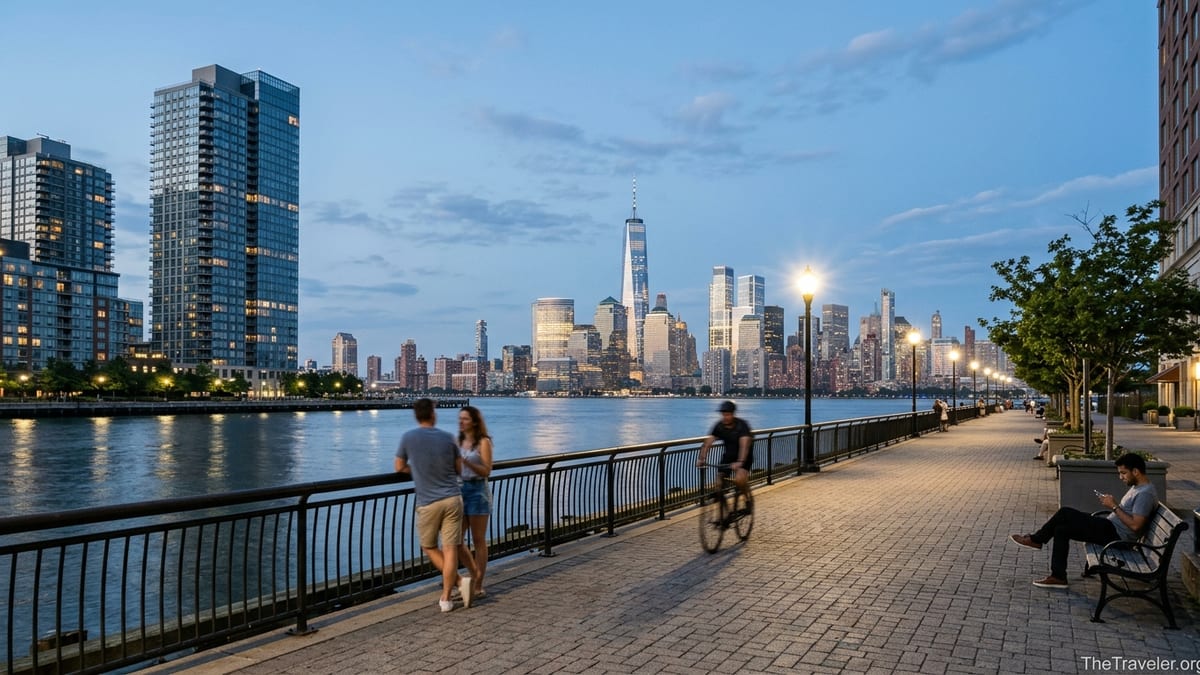
A Waterfront Skyline That Faces, Not Follows, Manhattan
Stand on the Hudson River waterfront at Exchange Place at sunset and it is obvious that Jersey City is not simply New York’s backstage. Glassy residential and office towers now line the river, creating a skyline that faces Lower Manhattan across the water rather than disappearing behind it. In recent years, Jersey City has ranked among the New York region’s leaders in new apartment construction, with thousands of units rising along the waterfront and into neighborhoods like Journal Square. That development has pushed median rents here close to big‑city levels, an indication that residents are choosing Jersey City for more than just savings.
For travelers, the effect is striking. You can walk the Hudson River Waterfront Walkway from the towering Newport residential complex down past Harborside and Exchange Place to the Colgate Clock and feel like you are moving through a continuous modern riverfront district. Benches and small lawns face the World Trade Center and the Financial District across the water, making this one of the best, and still relatively uncrowded, places in the region to watch the sun set behind the Manhattan skyline.
Crucially, Jersey City’s waterfront is built at a human scale. Instead of a wall of highways, you get playgrounds, bike paths and promenades that link directly into residential streets. Locals use the waterfront to jog before work, walk dogs late at night, or let kids run on the small piers, and visitors can slip into that everyday rhythm within minutes of stepping off the PATH train. The experience feels different from Manhattan’s more heavily touristed West Side waterfront, even if the views are equally dramatic.
And if you want a structured event rather than a quiet stroll, the city has leaned into its riverfront geography. Annual festivals and fireworks over the Hudson now use the skyline as a backdrop, reinforcing that the river is not a border where New York ends but a shared stage where Jersey City plays a leading role.
Neighborhood Energy That Is Distinctly Its Own
Beyond the water’s edge, Jersey City’s appeal comes from neighborhoods that do not try to copy Manhattan block for block. Downtown around Grove Street, 19th‑century row houses line side streets, and low‑rise brick buildings hold independent coffee shops, bakeries and bars at street level. Instead of chain‑heavy blocks, you get a patchwork of small businesses that skew more local than corporate, a noticeable contrast with many of Midtown’s more homogenized corners.
The centerpiece of this urban fabric is Newark Avenue Pedestrian Plaza, a car‑free stretch that runs west from Grove Street PATH station. Officially turned into a pedestrian mall in the mid‑2010s and later expanded, it has evolved into one of Jersey City’s main social living rooms, with cafe tables spilling into the street, families pushing strollers in the early evening, and a mix of commuters and residents lingering over drinks after work. On a summer night, the sound here is not honking taxis but overlapping conversations from outdoor tables.
Move a few stops on the PATH and the texture shifts again. Journal Square, historically a transit and shopping hub, is in the middle of a vertical building boom, with new residential towers rising around classic landmarks like the Loew’s Jersey Theatre. Farther south and west, neighborhoods such as Bergen‑Lafayette and the Heights still feel more residential and creative, with corner bodegas, Dominican eateries and small galleries in former industrial spaces. For visitors, that means you can experience several different versions of urban North Jersey without leaving the city limits.
What ties these neighborhoods together is a sense that they are primarily built for people who live here. You see it in weekday rhythms: parents walking kids to school, office workers grabbing coffee before heading into the PATH, seniors lingering on stoops. That lived‑in quality is part of what differentiates Jersey City from parts of Manhattan that have tipped heavily toward tourism and daytime office flows.
A Restaurant and Nightlife Scene Growing on Its Own Terms
If you still think of Jersey City food as dollar slices and diners, the current restaurant scene will surprise you. Editors at statewide magazines now regularly include Jersey City in roundups of New Jersey’s most compelling places to eat, highlighting everything from serious ramen at Ani Ramen in downtown to inventive pan‑Chinese cooking at Yuan in the Newport area. You can move from a cocktail bar on Newark Avenue to handmade noodles a short walk away without ever crossing the river.
Newark Avenue Pedestrian Plaza doubles as the city’s informal restaurant row. Along just a few blocks you will find vegetarian pub food and natural wines at Pet Shop, retro‑inspired cocktails at newer lounges like Left Bank Downtown, and casual spots for tacos, kebabs and pizza. On warm evenings, tables fill up quickly, and the line between indoor and outdoor space blurs as doors stay open and guests drift between venues. Price points here are often lower than in Manhattan, but the ambition in the glass and on the plate keeps pace.
Outside downtown, the diversity expands further. Along West Side Avenue and in Journal Square, South Asian restaurants serve everything from Gujarati thali to Pakistani barbecue, reflecting the city’s large Indian and Pakistani communities. In the Heights, intimate Italian and Latin American restaurants tuck into residential blocks. Visitors who are willing to leave the immediate PATH area are rewarded with meals that feel like neighborhood discoveries rather than destinations engineered for social media.
Nightlife follows a similar pattern: Jersey City does not try to out‑club Manhattan, but it does offer a growing web of bars, music venues and speakeasy‑style lounges that draw both locals and New Yorkers. White Eagle Hall, a restored early‑20th‑century building downtown, now functions as a mid‑size concert venue and arts space, hosting touring bands, comedy shows and community events in a hall small enough that you can actually see the stage from the bar. Smaller bars scattered through the downtown grid host DJ nights, trivia and live jazz without the velvet ropes or high cover charges of Manhattan hot spots.
Cultural Depth Beyond the Postcard View
Part of what makes Jersey City feel like more than a New York adjunct is its own layered history and cultural institutions. Long before it became shorthand for “across the river,” this was a major port and industrial center. Rail lines once converged on the waterfront, and immigrant communities from Europe, Latin America and Asia settled in the row‑house streets behind them. Today, that heritage shows up in everything from family‑run bakeries to bilingual signage and festivals that celebrate Indian, Filipino, Caribbean and Latin American cultures.
The city has invested in cultural programming to match that diversity. Annual events along the waterfront and in public squares bring together local performers, food vendors and cultural organizations, turning places like Exchange Place Plaza into open‑air stages. The city’s Office of Cultural Affairs has highlighted a growing roster of festivals, including a large Fourth of July event that uses the Hudson River and Manhattan skyline as a backdrop for concerts and fireworks.
Smaller‑scale spaces matter too. Galleries and artist studios occupy old warehouses in areas like the Powerhouse Arts District, while community arts centers host everything from spoken‑word nights to kids’ art classes. These are not high‑profile cultural landmarks designed to pull in bus tours, but they do give travelers who seek them out a window into what people here create and care about when no one is watching.
Even the library system reflects Jersey City’s effort to serve residents while inviting visitors in. Branches double as community hubs, and a newer branch in the Communipaw‑Lafayette area has been set up as an innovation and STEAM space with tools like 3D printers and media labs. For travelers who stay longer than a quick weekend, these public spaces underscore that Jersey City is building its own civic infrastructure rather than simply leaning on New York’s.
Green Space and Liberty State Park’s Front‑Row Seat
Few places capture Jersey City’s unique position better than Liberty State Park. Sprawling along the harbor just south of downtown, it offers sweeping views of the Statue of Liberty, Ellis Island and the Lower Manhattan skyline. Unlike Battery Park on the New York side, Liberty State Park often has space to breathe. Locals set up picnic blankets on wide lawns, kids play on waterfront playgrounds, and cyclists cruise along car‑free paths with the skyline as a constant companion.
For visitors, the practical appeal is equally strong. Ferries to the Statue of Liberty and Ellis Island depart directly from the park, allowing you to visit these headline attractions while basing yourself in Jersey City rather than Lower Manhattan. The park also connects to neighborhood streets in Bergen‑Lafayette, where converted row houses and new cafes are beginning to cluster within walking distance of the waterfront.
Closer to downtown, smaller parks and plazas knit together everyday life. Van Vorst Park, with its tree‑lined paths and playground, feels like a compact counterpart to Manhattan’s Gramercy Park, but it is fully public and ringed by brownstones instead of co‑ops. Hamilton Park offers tennis courts, a dog run and shaded benches framed by historic row houses. On summer weekends, you are as likely to stumble on a community fundraiser or kids’ sports practice as on a group of visitors consulting a guidebook.
Because Jersey City’s green spaces are anchored in residential areas rather than business districts, they rarely feel like obligatory detours. You encounter them simply by walking from a cafe to the PATH or from dinner back to your hotel. That organic integration makes it easy for travelers to slip into local routines, whether that means a morning jog in Hamilton Park or a late‑afternoon stroll through Liberty State Park before dinner.
Access, Transit and the Value Question
None of Jersey City’s growth would matter to visitors if it were difficult to reach. Instead, the city is wired tightly into New York’s transit system. From Grove Street or Exchange Place, PATH trains reach Lower Manhattan in roughly 10 minutes, and the ride from Journal Square to Midtown’s 33rd Street station typically runs well under half an hour. Ferries from the waterfront offer another fast link, especially during weekday commuting hours.
For many travelers, that connectivity raises a fair question: if rents and hotel prices in Jersey City have climbed, does it still make sense to stay here instead of Manhattan? The answer increasingly hinges less on pure savings and more on what kind of experience you want. Hotel rates near the waterfront are often a bit lower than comparable rooms in Lower Manhattan, but the real value lies in being able to step out your door into a downtown that is busy but not overrun with tourists, then commute into New York for specific museums, shows or meetings.
Transit within Jersey City itself is a work in progress. The Hudson‑Bergen Light Rail connects waterfront neighborhoods, the Heights and the West Side, making it relatively easy to explore beyond the PATH corridor without a car. Buses fill in gaps inland. Sidewalk life is strong in downtown and around the pedestrian plaza, though cyclists and e‑bikes on narrow streets can feel chaotic to pedestrians unused to urban riding habits. Visitors who stay aware of traffic and use crosswalks will find that most of the city is comfortably walkable in good weather.
As with any city adjacent to a global capital, prices reflect proximity. You will not find the deep discounts some travelers still expect when they hear “New Jersey.” Coffee, cocktails and tasting menus can run close to Manhattan levels. But the trade‑off is that you are buying into a city with its own identity, where a 10‑minute train ride replaces a 45‑minute subway trek across the East River, and where you can end the night at a neighborhood bar rather than a tourist‑packed mega pub.
The Takeaway
Jersey City no longer fits neatly into the role of New York’s cheaper little sibling. Its waterfront skyline stands toe‑to‑toe with Lower Manhattan, its neighborhoods hum with their own rhythms, and its restaurants and bars attract diners who could just as easily cross the river the other way. Liberty State Park offers some of the region’s most expansive views of the harbor and the Statue of Liberty, while downtown plazas and parks give everyday structure to local life.
For travelers, that means Jersey City works both as a strategic base for exploring New York and as a destination worth exploring on its own terms. You can spend the morning at a museum in Manhattan, the afternoon biking along the Hudson in Jersey City, and the evening eating ramen, biryani or vegetarian pub food within a few blocks of your hotel. The city’s appeal lies not merely in what it costs, but in how it lets you experience the New York region from a different, and increasingly confident, point of view.
FAQ
Q1. Is Jersey City still significantly cheaper than staying in New York City?
Prices in Jersey City have risen with new development, so it is not a bargain basement alternative. Hotels and dining are often somewhat cheaper than comparable options in Manhattan, but the bigger advantage is access to a lively local scene and quick transit rather than deep discounts.
Q2. How long does it take to get from Jersey City to Manhattan?
From downtown Jersey City, PATH trains typically reach the World Trade Center in about 10 minutes and Midtown’s 33rd Street station in under 30 minutes. Ferry services from the waterfront can be even faster for certain routes during commuting hours.
Q3. Which Jersey City neighborhood is best for first‑time visitors?
Most first‑time visitors choose Downtown around Grove Street and the waterfront. This area offers easy PATH access, the Newark Avenue Pedestrian Plaza, a dense cluster of restaurants and bars, and straightforward connections to Liberty State Park.
Q4. Is Jersey City safe to walk around at night?
Downtown, the waterfront and the main stretches of Newark Avenue are generally busy and feel comfortable into the evening, especially around the pedestrian plaza and PATH stations. As in any city, it is wise to stay on well‑lit streets, be aware of your surroundings and use licensed transit late at night if you are unfamiliar with the area.
Q5. What makes Jersey City’s waterfront different from New York’s?
Jersey City’s waterfront runs directly along residential and mixed‑use neighborhoods, with promenades, small parks and playgrounds linking straight into local streets. You get unobstructed views of Manhattan while spending time in spaces that feel more like neighborhood parks than major tourist attractions.
Q6. Can I visit the Statue of Liberty and Ellis Island easily from Jersey City?
Yes. Ferries to the Statue of Liberty and Ellis Island depart from Liberty State Park in Jersey City. Many visitors find it convenient to stay downtown, take a short ride or walk to the park, and board ferries there rather than leaving from Lower Manhattan.
Q7. What kind of food can I expect in Jersey City?
Jersey City’s dining scene is notably diverse. In a single weekend you might eat ramen downtown, South Asian curries in Journal Square, Latin American dishes in the Heights and vegetarian pub food or modern Chinese along the waterfront, often at prices slightly below similar meals in Manhattan.
Q8. Do I need a car to explore Jersey City?
No. Most visitors rely on the PATH, Hudson‑Bergen Light Rail, ferries and walking. A car can be useful for reaching more distant parts of New Jersey, but parking in dense neighborhoods is limited and often paid, so many travelers choose to stay car‑free.
Q9. How does the nightlife in Jersey City compare to New York?
Jersey City’s nightlife is smaller in scale but increasingly sophisticated. You will find cocktail bars, live‑music venues, speakeasy‑style lounges and busy restaurants, particularly around Newark Avenue and the waterfront, without the intense crowds and high cover charges of New York’s biggest districts.
Q10. Is Jersey City a good base for longer stays in the New York area?
Yes. For travelers planning a week or more, Jersey City offers quick access to Manhattan plus a calmer home base with parks, local restaurants and neighborhood amenities. Many visitors appreciate being able to dip into New York’s intensity during the day and return to a city that feels more residential and less tourist‑driven at night.