


Before you start planning any European trip around ETIAS, you must first confirm two things on the official ETIAS website. As of 24 November 2026, the European Commission states that ETIAS is not yet operational and applications are not being collected. The launch date will be announced several months in advance. You must therefore check, shortly before you travel, that ETIAS has actually gone live and that online applications are open. You must also verify that you are not in one of the explicit exemption categories such as beneficiaries of the EU–UK Withdrawal Agreement or holders of certain EU residence cards, who should not apply for ETIAS at all and instead travel using their existing rights.
Get the latest updates straight to your inbox!
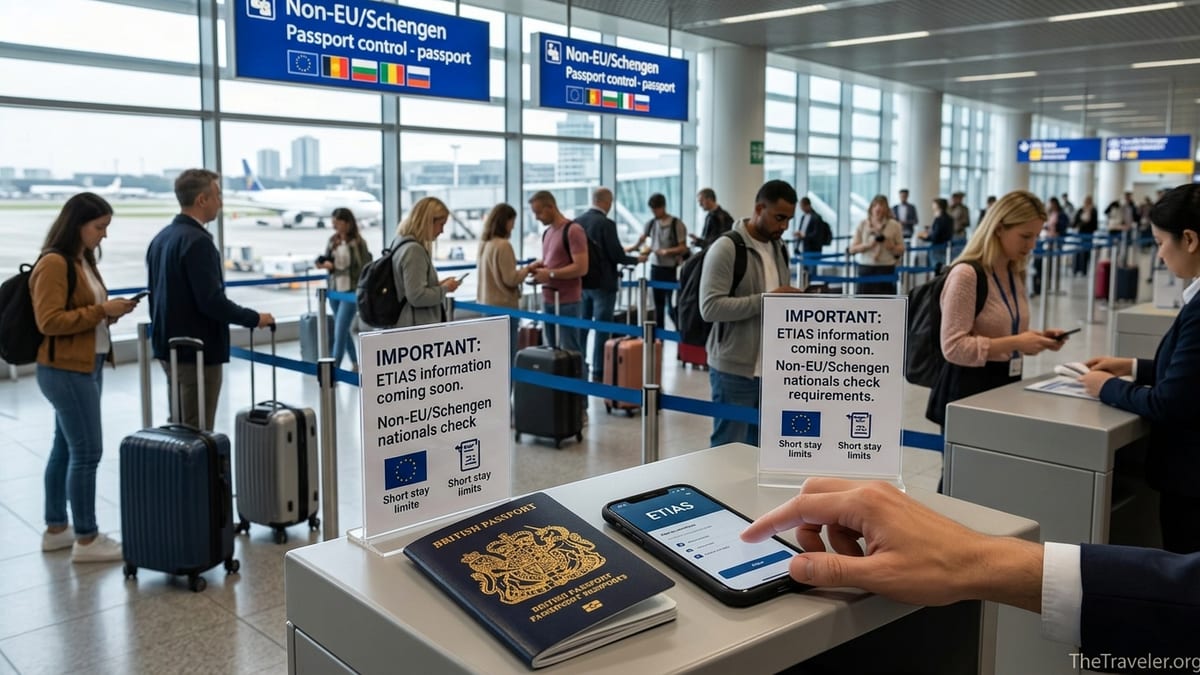
Understanding ETIAS and its current status
ETIAS, the European Travel Information and Authorisation System, will become an online pre‑travel check for nationals of visa‑exempt countries such as the United Kingdom who wish to visit most EU and associated Schengen states for short stays, usually up to 90 days in any 180‑day period. It is not a visa, but once it is in force you will normally need an approved ETIAS to board transport to the participating countries and to cross their external borders for tourism, family visits or short business trips.
According to the latest official timeline, ETIAS is expected to start after the EU’s Entry/Exit System is fully in use. The European Commission and partner agencies have confirmed that ETIAS has been delayed several times and that, as of November 2026, no exact start date has been set. The official ETIAS FAQ clearly states that ETIAS is not yet operational, that applications are not being collected, and that the specific start date will be announced several months in advance through the official channels. Any website currently offering to sell an ETIAS is therefore acting without EU authorisation and should be avoided.
When ETIAS does go live, it will initially run alongside a transitional period during which some travellers may be allowed to enter without it, even though applications are already available. The exact length and conditions of this grace period will be set in implementation rules and must be checked close to departure. Until the European Commission confirms that ETIAS is in force for your nationality and your route, you should plan your trip using the existing rules for visa‑free entry and the standard 90‑days‑in‑180 limit recorded through passport stamps and the Entry/Exit System.
The most important habit to develop is to consult the official ETIAS website and FAQ each time you are planning a new trip. Treat everything that follows in this guide as an outline of how ETIAS is designed to work, and always verify current details against the live information on the day you apply.
Checking whether you need ETIAS at all
Before you start an application, you must confirm that ETIAS applies to you and that you are not in an exempt category. ETIAS is aimed at travellers who are nationals of countries that enjoy visa‑free short‑stay access to the Schengen area and certain associated European states. For British citizens travelling on a UK passport once ETIAS is active, that will normally mean that an ETIAS authorisation is required for holidays, family visits and short business trips, provided they do not fall into a specific exemption.
The official ETIAS FAQ explains that some groups will not need ETIAS. These include EU, EEA and Swiss citizens travelling on their EU or Swiss passports, holders of national long‑stay visas or residence permits issued by a Schengen state for that state’s territory only, and certain other categories that may be listed in EU law or national guidance. In particular, UK nationals and their family members who are recognised beneficiaries of the Withdrawal Agreement, and who hold appropriate residence documentation from an EU or EEA state under that agreement, are generally treated as exempt from ETIAS for travel connected with their residence rights. They should travel with their passport and residence card rather than applying for ETIAS, but they must always verify this against the latest official information because the exact treatment is technical and may evolve.
If you are a non‑EU national living in the UK, for example on a long‑term UK visa or with settlement status, do not assume that UK residence changes your ETIAS position. What matters is your passport nationality and whether that nationality is listed among those who will require ETIAS and are currently visa‑exempt. If your nationality already requires a Schengen visa for short stays, you will not need ETIAS at all, but you will continue to need a visa instead. Conversely, if your nationality is visa‑exempt, you may need ETIAS once it starts, even if you live permanently in the United Kingdom.
Critically, do not apply for ETIAS if you will be travelling as an EU, EEA or Swiss citizen on your EU‑issued passport. ETIAS is not designed for EU citizens and you could create confusion by trying to apply. Dual nationals should match their travel document to the correct rules: for example, a British–Italian dual national who chooses to travel on an Italian passport would not use ETIAS, while the same person travelling only on a British passport might need ETIAS once it is live.
Where and how to apply when ETIAS goes live
Once ETIAS is active, applications will be accepted only through two official channels: the official ETIAS website and the official ETIAS mobile application developed under the authority of the European Commission and eu‑LISA, the EU agency that manages large‑scale justice and home affairs systems. National authorities, airlines, travel agents and commercial intermediaries must all direct travellers back to this single official system. There is no paper application form and no requirement to visit an embassy or consulate for a standard ETIAS request.
The official ETIAS site explains that the application process will be entirely electronic. You will be required to complete an online form, provide passport and biographical details, answer a set of background questions and pay a fee where applicable. The system will then automatically screen your information against several European and international security and migration databases, as authorised by EU law. Most applications are expected to be processed automatically and relatively quickly, though some may require manual review by an ETIAS National Unit in one of the participating states.
Travellers are strongly encouraged to use only the official site or mobile app. The European Commission and several national foreign ministries repeatedly stress that there is only one official ETIAS website and that any other site offering “guaranteed ETIAS approval” or charging inflated fees is not part of the system. Third‑party services may offer to help you complete the form, but they cannot influence the outcome and may expose your personal data unnecessarily. For security and clarity, the safest practice is to apply directly yourself.
Because ETIAS is linked electronically to your passport, you will need to have that passport in front of you when you apply. The passport must be valid for the required period of stay and must belong to a nationality that is both visa‑exempt and covered by ETIAS. If you plan to renew your passport soon, it is usually better to renew first and then apply for ETIAS on the new passport, as an ETIAS linked to an old passport will not transfer to the new one.
Information you will be asked to provide, including EU family links
The ETIAS application form, as described in the official regulation and guidance, collects several categories of information. These include your personal details, such as your name, date of birth, nationality and gender; your passport details, including number, issuing country and expiry date; details of your current home address and means of contact; and basic information about your intended trip, including your first country of entry. You will also have to answer a series of questions related to security, migration risk and public health, for example about certain criminal convictions, past stays in war zones, and any recent serious infectious diseases, in line with the latest legal text.
For British travellers and other non‑EU nationals who are family members of EU, EEA or Swiss citizens, there is a specific section of the ETIAS form that becomes relevant. The official ETIAS FAQ explains that travellers who declare that they have a family member who is a citizen of a country requiring ETIAS, or who is a third‑country national enjoying free movement rights under EU law, will be asked for extra information. This typically includes personal data of the EU or EEA citizen or equivalent, details of the nature of the family relationship such as spouse, registered partner, child or dependent parent, and confirmation whether you are accompanying or joining this family member in a member state other than the family member’s own country of nationality.
This additional family information is essential because EU free‑movement law gives certain rights to non‑EU family members when they are accompanying or joining an EU citizen who is exercising free movement in a host state that is not their own. ETIAS needs to identify when these special rules apply, so that the decision on your travel authorisation and the explanation attached to it correctly reflect your status. When you see this section of the form, you should answer it carefully and truthfully. Have ready the details of your EU family member’s full name, date of birth, nationality and, where relevant, their residence status in the host country.
Guidance on the official website stresses that this part of the application concerns only family members of EU, EEA or Swiss citizens who are travelling to or residing in a country other than that citizen’s own country of nationality. It does not normally apply to family members accompanying a citizen back to that citizen’s home state, where different rules may apply, nor to more distant relatives who do not qualify as core family under EU free‑movement law. Because these distinctions are technical and can change, you must consult the current “What you need to apply” and “Do I need ETIAS” pages each time to check what information is requested in your situation.
Fees, processing times and validity of ETIAS
The core ETIAS regulation adopted by the EU provides for a standard application fee, which has been widely publicised as 7 euros for most paying applicants. Since 2024, however, official updates and briefings have indicated that this amount is likely to be revised upward, with a planned fee of around 20 euros for many adult travellers once ETIAS is operational. At the same time, the EU has consistently signalled that certain age groups and categories of travellers will be exempt from paying, such as children and older adults, in line with the legal text. The precise fee and exemptions will only be definitively known when the Commission updates the ETIAS website at launch, so always check the “Fees” section immediately before applying.
Payment will be made online at the end of the application, using commonly accepted electronic payment methods such as credit and debit cards. You should ensure that your payment card is authorised for international online transactions and that you complete the payment step within the time allowed. The official systems will not process your application until the fee, if due, has been successfully received, and they will not ask you to pay by bank transfer to a personal account or through informal channels.
Once submitted, most ETIAS applications are expected to be processed automatically within a relatively short time, often within minutes, provided there are no hits against security or migration databases. However, the regulation allows for applications to be set aside for manual review by an ETIAS National Unit where further checks are needed. In such cases, published guidance suggests that processing can extend to several days or, in more complex cases, significantly longer. Because of this, official advice is that you should apply sufficiently in advance of your planned trip rather than waiting until the last moment. You should consult the live FAQ for the latest recommended minimum lead time once ETIAS is operational.
When approved, ETIAS authorisation will normally be valid for several years, up to a maximum set in the regulation, and will allow multiple short stays within the usual 90‑days‑in‑180‑days rule across the participating countries. However, ETIAS is electronically linked to the passport with which you applied. If your passport expires, is replaced, or you change nationality and begin travelling on a different passport, you will usually need to apply for a new ETIAS. You must always travel using the same passport that is registered on your ETIAS approval, and you should carry that passport physically even though the authorisation is stored electronically.
How EU family ties affect the decision to apply
Being a family member of an EU, EEA or Swiss citizen can affect whether you should apply for ETIAS in the first place. EU free‑movement law and associated agreements grant certain non‑EU family members derived rights of entry and residence when they accompany or join their EU family member in a host country other than that family member’s own country of nationality. In many such cases today, those family members either enter visa‑free or use a simplified visa process, depending on their nationality and documentation.
ETIAS is designed to work alongside these rights without undermining them. The official ETIAS FAQ makes clear that when a traveller indicates in their application that they are a family member of a citizen of an ETIAS country or of a third‑country national with comparable free‑movement rights, the system will ask for details of that relationship. This allows the authorities to understand whether the person is travelling under standard visitor rules or under free‑movement rules. It also triggers specific information in any decision notification about what evidence must be carried at the border to prove family status.
If you truly meet the conditions of an exempt family member with a qualifying residence card issued under EU free‑movement or Withdrawal Agreement rules, you may not need ETIAS at all once it goes live. In those circumstances, the correct approach is usually to travel with your valid passport and your residence card or other proof of status and to be ready to demonstrate that you are accompanying or joining your EU family member where the law requires it. Official Commission guidance and national authorities stress that applying for ETIAS when you are not required or eligible, such as as an EU citizen on an EU passport, is unnecessary and may create confusion without adding any legal rights.
On the other hand, if you are a British citizen partner of an EU national and you do not hold a residence card from an EU state, you will generally be treated in the same way as other British visitors for the purposes of ETIAS when it begins. In this situation, you should expect to require ETIAS for short stays, but you should still answer the family‑member questions accurately in the application so that your record reflects your connection and the authorities can provide the correct information about your rights at the border.
Planning the timing of your application and your trip
Once ETIAS is operational, careful timing will be essential for British travellers, particularly those travelling with or to EU family members. Although many ETIAS applications are expected to be decided quickly, there is no absolute guarantee of instant approval. Technical problems, database hits or random checks can all result in an application being diverted for manual review, which may take several days or longer. The official FAQs will set out recommended timeframes, but a cautious traveller should consider applying well in advance of their first planned ETIAS‑covered trip.
If your application is approved, your ETIAS authorisation will be valid from the date of issue and remain valid, in most cases, for several years, or until your passport expires or is cancelled, whichever comes first. That means you can use the same authorisation for multiple trips, provided each visit respects the 90‑days‑in‑180‑days rule and other conditions of stay. For families who travel to Europe regularly, it can be useful to coordinate passports and ETIAS validity so that parents and older children hold authorisations that expire at similar times, simplifying future planning.
You should also consider the wider border regime when planning. From late 2025, the Entry/Exit System has been recording entries and exits of non‑EU nationals at many external Schengen borders, replacing or supplementing passport stamps. ETIAS works on top of this, providing pre‑travel screening rather than affecting the day‑to‑day calculation of your 90‑day allowance. You should still keep careful track of your time spent in the Schengen area, particularly if you make frequent short trips from the UK.
Where EU family ties are involved, remember that some journeys may fall under different legal frameworks depending on the route and purpose. For example, a British spouse accompanying their French partner to France is in a different legal position to the same couple travelling together to Spain where the French citizen is exercising free movement. Once ETIAS is in place, these nuances will continue to matter. Always check your planned itinerary against current official guidance so that you apply for ETIAS only when appropriate and carry the right supporting documents when you rely on family‑member rights instead.
Families travelling together from the UK: mixed statuses, different rules
Many trips from the UK to Europe now involve families whose members hold different passports and statuses. When ETIAS goes live, each person in such a group may face different requirements, and it is crucial to assess them individually rather than assuming that the rules for one traveller automatically apply to all.
Consider a typical UK‑based family where one parent is a British citizen, the other is an EU citizen, and the children may be British, EU, or dual nationals. The EU citizen parent travelling on an EU passport will not use ETIAS at all, because EU citizens retain their right to enter and reside in their own and other member states under EU law. The British parent, by contrast, is likely to require ETIAS for short visits once the system is active, unless they also hold an EU residence card granting an exemption in specific circumstances. A child who is an EU citizen will follow the same pattern as the EU parent, while a child who is solely British will generally follow the British parent’s pattern.
Non‑EU spouses and partners who are not British or EU but live in the UK add another layer. If such a spouse holds a passport from a country that already needs a Schengen visa, they will not be eligible for ETIAS and must continue to apply for a visa, even if other family members use ETIAS or travel visa‑free. If they hold a passport from a visa‑exempt country covered by ETIAS and do not have an EU residence card conferring an exemption, they will probably require ETIAS on the same basis as the British spouse. In all these cases, any existing residence cards, Withdrawal Agreement documents or free‑movement residence permits must be checked against official ETIAS guidance to determine whether an exemption applies.
Dual‑national children require particularly careful handling. A child who is both British and an EU citizen might travel entirely on the EU passport, in which case no ETIAS would be needed, or they might travel on the British passport and become subject to ETIAS once it is live. The choice of passport can affect not only ETIAS but also which queue the child should join at border control and which rights they can claim. Parents should decide this in advance and ensure that tickets and airline records match the passport that will be used at the border.
When planning as a family, it is sensible to map out each person’s nationality, passport, residence status and relationship to any EU citizens involved, then check each profile against the official “Do I need ETIAS” tool and related FAQs. Only once you are confident of each traveller’s category should you begin any ETIAS applications. This avoids unnecessary fees and protects the rights of those who should be travelling under EU free‑movement or Withdrawal Agreement rules instead.
Troubleshooting: if ETIAS is refused or not issued in time
Even with careful preparation, some travellers will encounter problems once ETIAS is active. The official framework anticipates that a small proportion of applications will be refused, either automatically where clear grounds exist or after manual review by an ETIAS National Unit. In such cases, the applicant will receive an electronic notification explaining, in general terms, the reason for refusal and the member state responsible for the decision. This notification will also set out information on appeal procedures, which will follow the national law of the state that took the decision, as required by the ETIAS regulation.
If your ETIAS application is refused, your options will include submitting an appeal to the designated authority in the relevant state, and in some circumstances resubmitting an application if the refusal was based on fixable issues such as mistakes in the data provided. However, serious grounds related to security, public health or migration risk may not be easily overcome, and you should not expect a second application to be approved automatically simply because additional information is provided. The exact appeal steps, deadlines and required documents will be described in your refusal notification and in the official ETIAS FAQ and must be checked carefully at that time.
Another risk is that ETIAS approval is delayed and not issued before your planned departure. The official guidance emphasises that you should not book non‑refundable travel relying on same‑day ETIAS approval, because manual checks can extend processing times beyond what you expect. If your application remains pending close to your trip, you may need to consider changing your travel dates, rerouting to destinations not covered by ETIAS, or cancelling the trip altogether. Airlines and carriers will be required to verify ETIAS status before boarding once the system is mandatory, so you are unlikely to be allowed to travel without it to participating countries.
Where EU family relationships are involved, a refusal or delay in ETIAS does not automatically extinguish any underlying rights you may have under free‑movement law or the Withdrawal Agreement, but in practical terms you may still be denied boarding or entry if you cannot meet the carrier’s or border authority’s requirements at that moment. If you believe that a refusal conflicts with rights you hold as a family member of an EU citizen or as a Withdrawal Agreement beneficiary, you should seek guidance from the responsible member state’s authorities or from specialised legal advice, using the appeal channels set out in your decision.
Conclusion: map your status, then apply with care
For British citizens and non‑EU family members in the UK, ETIAS adds a new layer of pre‑travel administration when visiting much of Europe, but it does not replace the underlying legal frameworks that already govern your rights. The safest and most efficient approach is to begin every trip plan by checking two points on the official ETIAS website: first, whether ETIAS is actually live and collecting applications for your nationality and route; and second, whether you fall into an exemption category such as an EU citizen, a Withdrawal Agreement beneficiary, or the holder of a qualifying EU residence card.
Once you are sure that ETIAS applies, prepare your application by gathering your passport, basic personal details, travel plans and, where relevant, complete information about any EU or EEA family members you will accompany or join. Use only the official website or mobile app, be honest and consistent in your answers, and apply far enough in advance to allow for possible manual review. Remember that ETIAS will be linked electronically to the passport you use, that changing passports usually means applying again, and that each member of a family group may face different requirements depending on their nationality and residence status.
Above all, treat ETIAS as one piece of a wider legal picture. Carefully mapping your own and your family’s status against current EU rules, then cross‑checking that map with up‑to‑date official ETIAS guidance, will help you decide whether to apply, how to complete the form, and what documents to carry. By following this structured approach, British travellers with EU family connections can minimise surprises at the border and continue to enjoy short trips to Europe with confidence once ETIAS finally comes into force.