


As of November 2026, the European Travel Information and Authorisation System (ETIAS) is not yet operational and the European Union is not accepting travel authorisation applications. Any website claiming that it can already issue an approved ETIAS must not be treated as an official EU service, regardless of how professional it looks or how high it appears in search results.
Get the latest updates straight to your inbox!
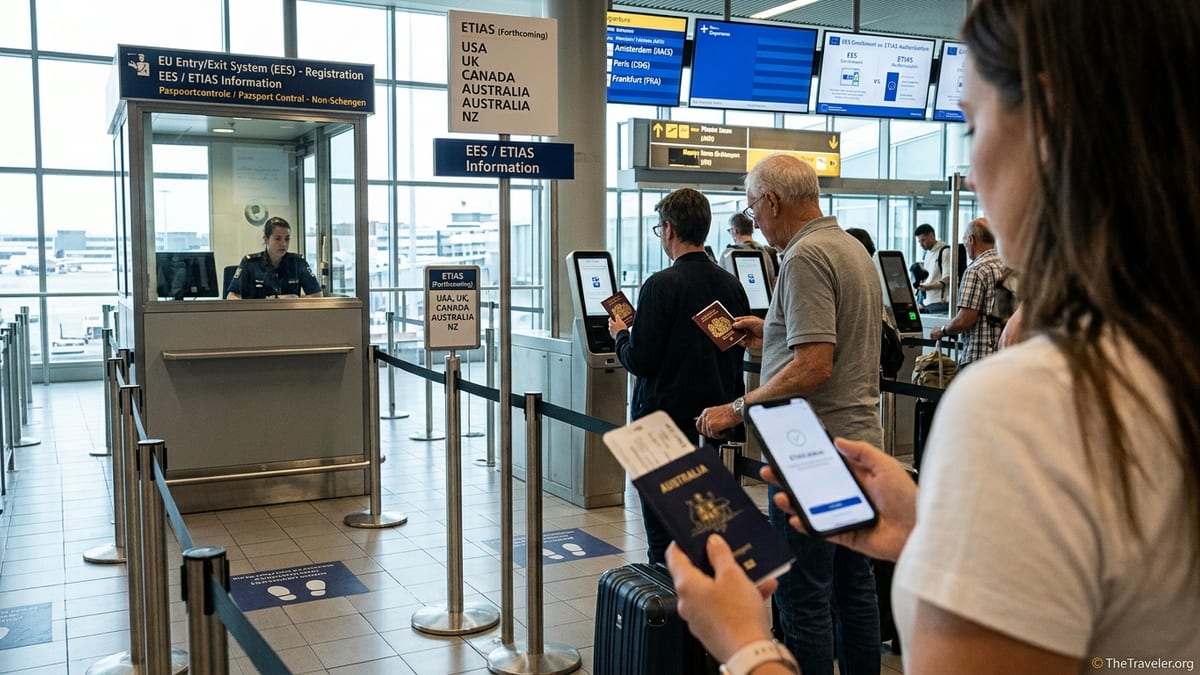
ETIAS today: status check, timing and who it will affect
ETIAS is a forthcoming EU travel authorisation that will apply to many non‑EU citizens who currently visit the Schengen Area visa‑free, including most British, American, Canadian and Australian travelers. It will require an online application and a small fee before departure, in a similar way to the United States ESTA system or Canada’s eTA. However, despite years of publicity and many delays, ETIAS has not yet launched. The European Commission and Council have both confirmed that there is no operational start date in force as of November 2026, and recent public statements indicate that ETIAS is now expected to become a focus for 2027 rather than late 2026.
This delay has created a confusing environment where hundreds of unofficial websites present themselves as if ETIAS were already running. Some of these sites use government‑style branding, countdown clocks or phrases such as “Apply now for your mandatory ETIAS visa” to push travelers into paying for a product that does not yet exist. Travelers planning 2027 trips to Spain, France, Italy, Greece or other Schengen destinations regularly report encountering such sites when they search for “ETIAS application” or “visa for Europe” and are unsure whom to trust.
The European Union has been clear that when ETIAS does launch, it will announce the start date several months in advance so that airlines, tour operators and travelers can prepare. That means there will be no surprise overnight switch. If you have a trip booked in early 2027, the safest practice is to monitor official EU announcements and your own government’s travel‑advice pages, rather than relying on aggressive marketing messages or sponsored search results from private companies.
Once operational, ETIAS will generally be required for short stays of up to 90 days in any 180‑day period in the Schengen Area for visa‑exempt visitors. That covers, for example, a US tourist flying to Paris for two weeks, a British couple on a cruise docking in Barcelona and Civitavecchia, or an Australian backpacker entering Europe through Amsterdam and traveling overland to Germany and Austria.
ETIAS versus the EES biometric border system
One major source of confusion is the EU Entry/Exit System, usually abbreviated to EES. Unlike ETIAS, EES is already operational. Since 10 April 2026, non‑EU nationals entering the Schengen Area for a short stay have been gradually registered in EES at many airports, seaports and land borders. This system records the traveler’s identity data, the details of their passport or other travel document, and biometric information such as fingerprints and facial images, then logs each entry and exit electronically.
From a traveler’s point of view, EES registration typically takes place when you physically arrive at the border. For example, a Canadian tourist landing at Madrid Barajas or a British visitor arriving in Rome Fiumicino may be directed to a kiosk where they scan their passport, have their fingerprints taken and look into a camera. Afterward, a border guard confirms the information and allows them to proceed. This process replaces manual passport stamps and helps enforce the “90 days in any 180‑day period” rule.
ETIAS, on the other hand, is a pre‑travel authorisation. When it is live, you will apply online before your trip, pay the relevant fee and receive an electronic approval linked to your passport. Holding an ETIAS approval will be one of the conditions for boarding a plane, ferry or long‑distance coach bound for the Schengen Area, but it will not replace the border check itself. You will still be subject to EES registration and to questioning by border guards on arrival.
This distinction is crucial for consumer protection. If a website tells you that you are “completing EES” by filling in an online form from home, that is misleading. EES enrollment happens at the border and never involves paying an online fee. Likewise, an EES registration on a previous trip does not mean you already have ETIAS, and there is currently no legitimate way to “pre‑enroll” for ETIAS through an app or website operated by a private company.
The official ETIAS portal, fees and who is exempt
The European Union has designated a single official portal for ETIAS information and, in future, for applications. This portal sits on the EU’s central travel information domain under the ETIAS section. All genuine EU websites share a limited set of domain endings that identify the European institutions, including addresses that end in europa.eu. On a typical browser, you can view the full domain name by clicking or tapping the address bar and confirming that the core part of the address includes europa.eu immediately before the first single forward slash.
Security indicators can help but are not sufficient on their own. The official ETIAS site uses HTTPS encryption, which most browsers show with a padlock icon. However, fraudulent and unofficial services can also obtain HTTPS certificates cheaply or for free. Treat HTTPS as a basic requirement for any site that handles your passport and payment card details, but do not assume the padlock alone proves that the site belongs to the European Union. Always combine this with checking the exact spelling of the europa.eu domain and looking for clear statements that the site is an official EU institution.
In October 2025 the European Commission announced that the standard ETIAS application fee would be 20 euros. Earlier EU communications, and many older factsheets still circulating online, mentioned a 7 euro fee. That lower figure is now outdated. The change was justified in part by a desire to align ETIAS with similar programs, such as the 21 US dollar cost of ESTA or the approximate 7 Canadian dollar charge for an eTA. The new 20 euro fee has been reflected in more recent ETIAS information packs and FAQs produced for the travel industry.
The EU has also confirmed important exemptions. No fee will be charged for applicants under 18 or over 70, and certain family members of EU citizens who fall under free‑movement rules will also be exempt when applying through the official system. Even when no fee is due, these travelers are still expected to apply for and hold a valid ETIAS authorisation once the scheme begins, unless they are EU citizens themselves or hold a residence permit or long‑stay visa that exempts them from ETIAS entirely.
Who will need ETIAS and who will not
ETIAS is designed for travelers who are currently allowed to enter the Schengen Area without a visa for short stays. This includes citizens of the United States, Canada, the United Kingdom, Australia, New Zealand, Japan, South Korea and several dozen other countries and territories. After launch, a US citizen flying from New York to Lisbon for ten days, a British family driving from Dover to Calais for a summer holiday in Brittany, or a Canadian cruise passenger visiting Greek islands on a Mediterranean itinerary will, in principle, need ETIAS approval before starting their trip.
By contrast, nationals of Schengen and wider EU or EFTA countries, such as France, Germany, Italy, Spain, Ireland, Sweden, Norway or Switzerland, will not need ETIAS for travel within the area. Their right to move and reside is based on EU treaties and national law, not on visa exemption. Similarly, third‑country nationals who already hold a valid long‑stay visa or residence permit issued by a Schengen state, for example a US citizen with a French residence card or an Indian national with a German work‑residence permit, are not expected to need ETIAS when traveling in accordance with the conditions of that permit.
Beneficiaries of EU free‑movement rights, such as non‑EU spouses of EU citizens traveling together or to join their partner, enjoy a partially different legal status. The EU has indicated that certain qualifying family members will be exempt from paying the ETIAS fee, provided they can document the family relationship with the EU citizen. For instance, a Moroccan spouse of a Spanish national living in Morocco but visiting Spain for holidays may fall under this category. Nevertheless, they could still be required to obtain an ETIAS travel authorisation once the system is active, so it is critical to verify the exact rules closer to launch.
Travelers who now need a Schengen visa, such as most citizens of India, China, South Africa or Nigeria, will not become eligible for visa‑free entry because of ETIAS. Their process will remain based on applying for a visa in advance through consulates or external service providers like VFS Global or TLScontact. ETIAS does not replace visas and does not change which nationalities require them; instead, it adds an additional layer of screening for those who are already visa‑exempt.
Application data, passport rules and processing expectations
Although applications are not yet open, the EU has described in official documentation the kind of information ETIAS will collect. Applicants will complete an online form or use an official mobile application to provide personal details such as full name, date and place of birth, nationality, home address, contact email and phone number, along with passport information including number, issuing country, issue date and expiry date. They will also answer security and background questions related to previous travel, criminal convictions and past immigration issues.
Travel document rules will be central to ETIAS validity. The authorisation will be electronically linked to a single passport, not to the traveler as a person in the abstract. If you renew your passport, your ETIAS approval will not transfer automatically and you will need to apply again using the new document once applications are possible. EU sources indicate that a successful ETIAS will generally be valid for up to three years, or until the passport expires if that happens sooner, whichever comes first.
Processing times have been discussed only in general terms. EU statements and comparisons with systems such as ESTA suggest that many applications should be decided within minutes, as automated checks cross‑reference multiple security and migration databases. However, some applications will be flagged for manual review, for instance if the applicant’s details match or resemble an entry in a security alert system or if answers to the background questions raise concerns. In those cases, the decision could take several days or more, depending on the nature of the review and the workload of the national authorities designated to handle ETIAS cases.
Because ETIAS is not yet functioning, all timelines remain provisional. The only safe planning assumption is that travelers should not leave an ETIAS application until the day before departure once the system launches. If you are used to obtaining an ESTA or Canadian eTA a few hours before heading to the airport, you will need to adjust your habits for ETIAS and treat it as a task to complete well in advance, perhaps at the same time as you book flights or accommodation.
How ETIAS scam and overcharging websites operate
Even before launch, ETIAS has become a lucrative target for scammers and high‑fee intermediaries. Travelers report finding sponsored search results on popular search engines for sites that use names such as “etias‑europe‑official.com” or “eu‑etiasvisa.org”, often placed above the genuine EU information pages. These sites typically mimic the visual style of government portals, copying EU flags, circular emblems and formal language. Some instruct users to “act now” because “quotas are limited” or claim that “new European visa rules are already in effect”, even though ETIAS does not yet exist in practice.
Fees are a major red flag. With the official charge set at 20 euros, any site that currently demands 60, 70 or 100 euros per person and suggests that it is collecting the “official EU fee” is misrepresenting its role. In consumer‑protection forums there are concrete examples of people who paid around 60 euros to sites using the word “official” in the domain name, only to discover in the fine print that most of that sum was a “service fee” and that no travel authorisation could actually be issued yet because the EU system was still offline.
Some fraudulent websites invent additional urgency or obligations to pressure users. Typical tactics include stating that “airlines will refuse boarding without ETIAS from next month” when no date has been confirmed, or sending follow‑up emails implying that failure to complete a half‑finished application within 24 hours will result in being “blacklisted” from Europe. Others collect unnecessary data such as scans of the applicant’s physical passport, selfies, or even social‑media identifiers under the pretext of “enhanced security checks”, sharply increasing the risk of identity theft.
The most dangerous category consists of websites that already invite users to “submit your ETIAS application now” for 2027 travel, gathering passport numbers, dates of birth and full card payment details into private databases. Because the official ETIAS infrastructure is not yet running, these sites cannot possibly deliver what they promise. At best, they will store your details and submit an application on your behalf years later, charging high mark‑ups for a process that will be designed to be simple and cheap. At worst, they may misuse or resell personal data and card information.
Official service versus third‑party assistance
Once ETIAS goes live, travelers will be able to apply directly through the official EU portal and, eventually, through an official mobile application managed by the European Union. These channels will charge only the 20 euro fee where applicable, will not impose additional “processing” or “government liaison” charges and will present clear privacy policies rooted in EU data‑protection law. Communications about your application, such as confirmation emails or notifications of a decision, will come from verified EU institutional domains rather than generic commercial addresses.
Alongside this official route, there will almost certainly be a market for legitimate third‑party intermediaries. These may include private visa‑assistance agencies, some travel agencies, and specialist online platforms that offer to complete ETIAS forms on your behalf, correct basic errors and remind you about expiry dates. Similar services already exist today for ESTA and various electronic visas. When they are honest, such intermediaries clearly label themselves as private companies, explain that the application could be made more cheaply directly with the government and disclose their service fee as separate from the official charge.
The consumer‑protection challenge lies in distinguishing helpful assistance from misleading or abusive practices. A transparent intermediary might, for example, charge a family in Toronto an extra 25 Canadian dollars per person to handle the process in addition to the official 20 euro fee, while clearly stating on its homepage that it is not an EU authority and linking to guidance from the European Commission. A deceptive operation, on the other hand, might bundle a 100 euro “all‑inclusive ETIAS package” that quietly includes a 20 euro official fee only if and when ETIAS actually launches, while keeping the remaining 80 euros as pure margin and obscuring its non‑official status.
Travelers who are comfortable completing online forms and paying by card do not need any intermediary for ETIAS. The official system is being designed to be self‑service, mobile‑friendly and available in multiple languages. If you do choose a third‑party helper, do it for convenience rather than out of fear. Never allow marketing slogans such as “avoid rejection” or “limited slots” to push you into overpaying, and insist on clear invoices that separate the official EU fee from any service charges.
Practical checks before you pay or share documents
Before entering payment details or uploading identity documents to any ETIAS‑related website, carry out a series of straightforward verification steps. First, check the address bar letter by letter. Genuine EU pages run on the europa.eu domain, not on addresses ending in .com, .net, or other country codes controlled by private registrants. Watch for subtle misspellings like europaa or extra hyphens placed to mimic official wording. If you clicked on a sponsored result from a search engine, close it and instead type the known EU domain directly into your browser.
Next, look for clear institutional identification. Authentic EU pages will mention bodies such as the European Commission or Directorate‑General for Migration and Home Affairs, using neutral, descriptive text rather than sales pitches. They will provide information about ETIAS, its legal basis and its expected impact, and will avoid exaggerated promises or fear‑based warnings. In contrast, a questionable site may focus heavily on countdown timers, “guaranteed approval” offers or emotional testimonials. Treat any claim that you must apply “today” to avoid being barred from Europe as a warning sign.
On the payment page, pay attention to currency, total amount and the name displayed in the card‑processing window. As applications are not yet open, no site should be charging a fee presented as the “official ETIAS payment” today. After launch, the genuine charge should be 20 euros where payable, not 50 or 80 euros. If your card is about to be billed in another currency at a suspiciously high exchange rate, or the merchant name looks unrelated to travel or government services, consider abandoning the transaction and applying directly through the official EU system instead.
Finally, be extremely cautious about uploading scans or photos of your physical passport. While the official system may ask you to scan the machine‑readable zone of the passport using your phone’s camera to speed up data entry, it will explain this process in detail and secure it under EU data‑protection rules. Random commercial sites that insist on full‑page passport images, selfies holding the passport next to your face or copies of other ID, such as driver’s licences, are increasing your exposure if their security practices are weak or dishonest.
If you have already paid a suspicious ETIAS website
Many travelers only realise they have been dealing with a dubious ETIAS operator after they have submitted their information and seen a large, unexpected charge on their card statement. If this happens to you, act quickly but methodically. Start by taking screenshots of the website’s key pages, including the homepage, pricing table, terms and conditions and any confirmation messages or emails you received. Save digital receipts and any correspondence that promises a specific outcome, such as “your ETIAS has been approved”, as these may be useful later when disputing the transaction.
The next step is to contact your bank or card issuer. Explain that you may have been misled into paying for a service that could not be provided, because the EU has not yet opened ETIAS applications. Ask whether they can place a temporary block on further charges from the same merchant and what options you have to dispute the payment. Depending on the card network and your local consumer‑protection laws, you may be able to initiate a chargeback if the service was misrepresented or never delivered.
You should also assume that the personal data you entered may be compromised. If you created a password on the suspect site, change that password anywhere else you used it, starting with email accounts and online banking. Monitor your card statements carefully over the following months for small test transactions as well as larger charges. In some jurisdictions, you can place a fraud alert or credit freeze with major credit bureaus if you are particularly concerned that your identity details could be abused.
Finally, consider reporting the incident to relevant authorities. In the European Union, that may include national consumer‑protection agencies, cybercrime reporting portals or data‑protection authorities where the site claims to be based. Outside the EU, contact your own national fraud reporting service; for instance, US travelers can submit complaints through the Federal Trade Commission’s online portal, while UK residents can report scams to Action Fraud. When making a report, include the website address, any contact emails or phone numbers it used, the amount paid and copies of your correspondence. These reports help regulators and law‑enforcement agencies identify patterns and, in some cases, shut down particularly harmful operations.
Eligibility overview, common questions and staying up to date
To understand your likely future obligations under ETIAS, it may help to think in terms of broad nationality categories as currently described by EU sources. Visa‑exempt non‑EU nationals, including citizens of countries such as the United States, Canada, the United Kingdom, Australia, New Zealand, Japan and South Korea, will generally need ETIAS approval for short stays in the Schengen Area once the system launches. Nationals of countries that already require a Schengen visa today will continue to apply for visas through consulates and will not use ETIAS for those short‑stay visits.
EU and Schengen‑associated citizens, including residents of France, Germany, Spain, Italy, Poland, Sweden, Norway, Iceland and Switzerland, will not require ETIAS when traveling with their national passports or ID cards. Third‑country nationals who hold valid long‑stay visas or residence permits issued by Schengen states are currently expected to be exempt from ETIAS for travel within the conditions of those documents. Some family members of EU citizens who benefit from specific free‑movement provisions may also enjoy fee exemptions when applying through the official portal.
Several practical questions arise repeatedly. First, ETIAS is not a visa. It does not guarantee entry, does not change how long you can stay under the 90‑days‑in‑180‑days rule and does not allow you to work or live in Europe long‑term. It is a travel screening and authorisation system that must be obtained in addition to any other requirements, such as having a passport valid for at least three months beyond the intended stay, proof of onward travel or evidence of sufficient funds.
Second, there is no mechanism yet to apply one ETIAS “on behalf of a whole family” with a single fee. The EU has signalled that each traveler, including children, will need an individual application, though parents or guardians will be able to submit forms on behalf of minors. Payment will be collected per application, with fees waived only for those who meet age‑ or status‑based exemptions. Refund rules are likely to resemble those of other electronic authorisation systems, which generally do not refund fees when an application is refused, but exact details should be confirmed once the final ETIAS regulations and user terms are published.
Finally, because launch has been delayed multiple times and the fee has already changed from the earlier 7 euro plan to the current 20 euros, travelers should build a habit of checking official information close to departure. Before publishing any travel advice, tour operators, travel writers and bloggers should confirm the latest ETIAS status directly with EU institutional sources rather than relying on older press releases or third‑party explainer articles. Ordinary travelers can do the same by consulting government travel advisories in their home country and comparing them with EU announcements.
Conclusion: verify before you apply
ETIAS will eventually become a routine part of planning a leisure break in Paris, a business trip to Frankfurt or a family road trip through Italy and Slovenia. When that day comes, it should be no more complicated than requesting an ESTA for a visit to New York or an eTA for a stopover in Toronto. In the meantime, the gap between public awareness and the system’s non‑operational status has created fertile ground for misunderstandings, inflated “service packages” and outright fraud.
As of November 2026, the essential facts are simple. ETIAS is not yet live. The European Union has not opened any channel, website or mobile application through which you can obtain a valid ETIAS travel authorisation. The official EU information portal uses a europa.eu address, explains clearly that applications are not being accepted and will announce the launch date well in advance. Any other website that claims to issue an approved ETIAS today, or that charges you an “official” fee now for travel in 2027, is at best a private intermediary and at worst a scam.
To protect yourself, always start from trusted institutional sources, double‑check website addresses, scrutinise payment pages and be wary of invented urgency. If in doubt, pause and seek a second opinion from your national travel‑advice service, a reputable travel agent or directly from EU information channels. ETIAS is intended to make European travel safer and more predictable, not more stressful. With a careful eye and a healthy dose of skepticism toward unofficial sites, you can safely navigate the pre‑launch environment and be ready to use the official system once it finally opens.
Last checked for accuracy: November 11, 2026. Always verify the current ETIAS launch status and fee structure with official European Union sources before publication or planning travel.