


More news on this day
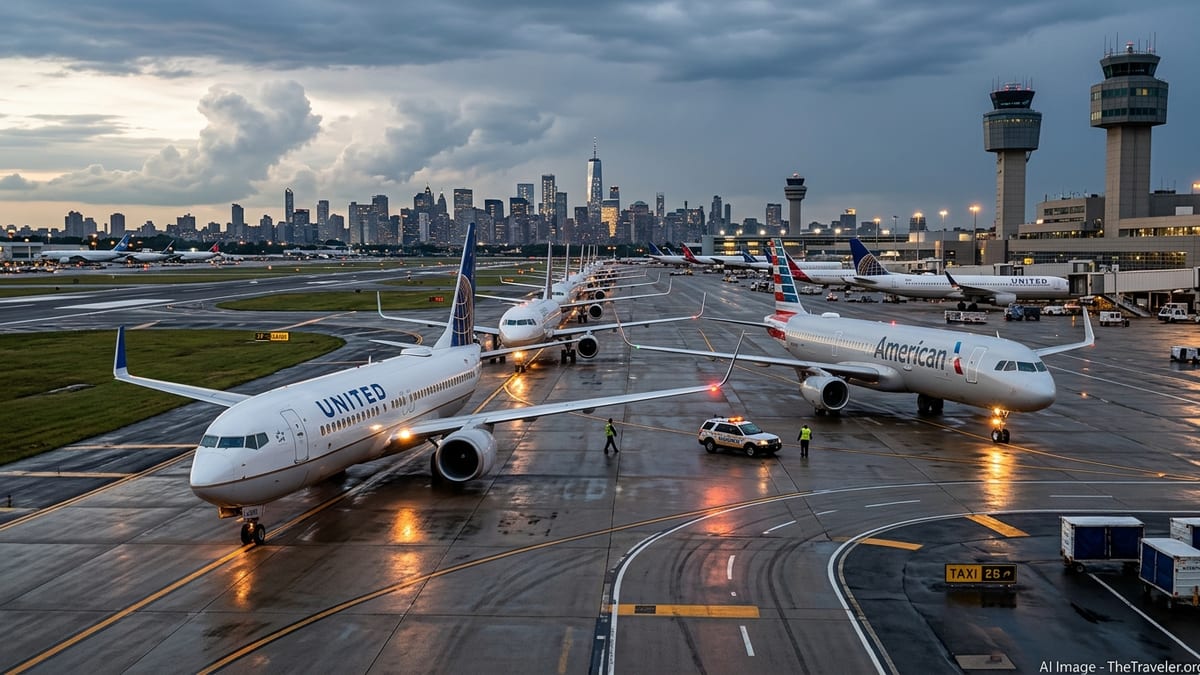
Flights linked to New York City’s largest airports accounted for one in four of the United States’ longest tarmac delays in September 2026, according to newly released federal figures that highlight how disruptions in the region’s constrained airspace continue to ripple through travel across the country.
Get the latest news straight to your inbox!
What the latest federal data show about September’s longest tarmac delays
The U.S. Department of Transportation’s November 2026 Air Travel Consumer Report, released on 19 November, compiles operational statistics for September 2026, including incidents that breached federal limits for “extended” tarmac delays. These are defined as more than three hours on the tarmac for a domestic flight, or more than four hours for an international flight, between pushback and takeoff or between landing and deplaning at a U.S. airport.
According to the report, 16 individual flight segments crossed those thresholds in September. Four of them involved services operating to or from New York’s John F. Kennedy International Airport or Newark Liberty International Airport, meaning New York area gateways accounted for 25% of all extended tarmac delays recorded nationwide that month, a disproportionate share given their slice of overall U.S. traffic.
The same report shows that extended tarmac delays remain rare when set against the scale of U.S. aviation. Carriers reported hundreds of thousands of scheduled flights in September, while DOT logged 103 consumer complaints that specifically referenced tarmac delays. Not all of those complaints involved events long enough to qualify as “extended” under the rule, but together they underline that long onboard waits, while uncommon, are still a recurring problem for some passengers.
How the 21 September airspace outage drove New York’s worst delays
The concentration of New York related incidents in the September statistics coincides with a serious disruption on 21 September 2026, when a communications failure at the Federal Aviation Administration’s Philadelphia Terminal Radar Approach Control facility affected traffic flows across a wide swath of Northeast airspace.
FAA statements and contemporaneous reporting describe a circuit failure at the Philadelphia TRACON that severed both a primary and a backup line, degrading the radio and radar systems used to handle arrivals and departures for several major airports. The FAA responded by halting or heavily restricting arrivals into Newark Liberty, JFK, Philadelphia International and several smaller fields, while Boston Logan and Washington-area airports also reported delays as traffic was rerouted and capacity cut.
During the outage window, some transatlantic arrivals bound for Newark and JFK diverted to alternate airports when holding patterns near New York became unsustainable. One United Airlines flight from London Heathrow to Newark on 21 September diverted to New York Stewart International Airport in the Hudson Valley, where, according to DOT’s dataset, passengers waited for approximately four hours and 25 minutes on the tarmac before being able to deplane. Flight tracking records confirm the diversion and extended ground time, placing the incident among the most severe tarmac delays logged anywhere in the United States that month.
Other extended tarmac delays highlighted in the federal report also occurred on or around 21 September and involve aircraft that were either rerouted away from the New York area or held on taxiways as traffic management programs throttled arrivals and departures. While the Air Travel Consumer Report lists the date, route, any diversion point and the longest delay segment for each flight, it does not assign fault between airlines, airports and the FAA, nor does it detail all operational decisions behind each delay.
On-time performance at New York airports compared with national figures
The tarmac delay statistics sit alongside broader punctuality data that show New York’s main commercial airports continuing to lag many other large U.S. hubs on reliability. Separate figures released by the Bureau of Transportation Statistics for September 2026 indicate that, nationwide, roughly three quarters of arriving flights reached the gate within 15 minutes of schedule, the standard generally used in the industry to define an on-time arrival.
Within that national picture, the three primary New York area airports all sit in the lower half of the rankings for major hubs. BTS and derived analytics services report that JFK recorded on-time performance for roughly seven in ten departures and arrivals in September, while Newark scored somewhat higher but still short of the best-performing hubs. LaGuardia’s average delay figures and percentage of on-time operations were weaker than either Newark or JFK over the same period, reflecting its particular congestion and weather exposure.
These numbers vary slightly depending on whether analysts look at departures or arrivals and exactly which subset of flights they include, but they consistently place JFK, Newark and LaGuardia behind some inland hubs with more flexible runway layouts and fewer weather-driven constraints. The figures for September also capture the impact of the 21 September outage, which produced rolling delays and cancellations that took days to fully clear from airline schedules in the region.
Structural features of the New York airspace help explain why disruptions there so often have outsized consequences. Three major commercial airports sit within a relatively compact area, each operating under tight runway and taxiway configurations compared with sprawling multi-runway hubs elsewhere in the country. Seasonal thunderstorms, coastal storms and winter icing conditions frequently reduce usable runway capacity or force controllers to increase the spacing between aircraft. When those constraints intersect with some of the highest passenger demand levels in the United States, even a localized technical failure, such as the Philadelphia TRACON outage, can cascade into extended delays and diversions.
How the U.S. tarmac delay rules work and what they require from airlines
Extended tarmac delays are governed by a specific U.S. Department of Transportation rule that first took effect in 2010 and has since been refined. Under the current framework, airlines operating domestic services from or to a U.S. airport generally may not keep passengers on a stationary aircraft on the tarmac for more than three hours without offering them an opportunity to deplane. For international flights arriving at or departing from the United States, the limit is four hours.
Those time limits apply to both U.S. and foreign carriers while they are on U.S. soil. The rule also sets conditions for passenger welfare during prolonged waits. After two hours on the tarmac, airlines must provide adequate food and drinking water, ensure that lavatories remain operational and offer reasonable access to medical care if needed. Carriers are additionally required to ensure that, subject to safety, security and air traffic control constraints, they begin moving the aircraft to a point where passengers can get off before hitting the three or four hour thresholds.
The regulations explicitly recognize that in some cases deplaning is not immediately possible or safe, for example during severe weather, when airport personnel cannot access the movement area, or when air traffic control advises that attempting to return to a gate would significantly disrupt operations. Airlines therefore have some latitude to keep passengers onboard when safety or ATC direction demands it, even if doing so risks crossing the limits, but they must be able to justify those decisions to regulators.
Carriers serving the United States must maintain written contingency plans for lengthy tarmac delays at each U.S. airport on their route maps and file them with DOT, updating them periodically. The department’s Office of Aviation Consumer Protection can open enforcement cases and impose civil penalties if it concludes that an airline failed to follow its plan or violated the tarmac delay rule without a valid exemption. The November 2026 Air Travel Consumer Report lists the flights that exceeded the time limits in September, but it does not state which, if any, are currently the subject of enforcement investigations.
Wider operational pressures on U.S. airlines in 2026
The September tarmac delay data also sit within a year of broader strain across the U.S. airline system. Federal statistics for the first nine months of 2026 show elevated levels of cancellations and delays compared with the same period in 2025, reflecting both a busier schedule as demand rose past pre-pandemic levels and a series of high-impact disruptions in government and airline systems.
In addition to the 21 September communications failure affecting the Northeast, the FAA ordered a separate nationwide pause in most departures on 13 November 2026, following instability in upgraded systems used by air traffic controllers. That ground stop, which lasted several hours, triggered thousands of additional delays and cancellations, although its impact falls outside the September-focused data in the current Air Travel Consumer Report. Several carriers have also reported their own technology outages in 2026, including failures in automated dispatch and weight-and-balance tools that temporarily forced a reversion to manual processes and slowed departures.
These technical incidents add to the familiar weather-related challenges of operating in the New York region. Summer thunderstorms that form along the East Coast corridor, low ceilings in autumn and early winter, and snow or freezing rain events can all cut runway throughput at JFK, Newark and LaGuardia. When schedules are already running close to the limits of what the airspace can accommodate, each of these shocks can produce backlogs that take many hours, or occasionally days, to unwind.
For passengers, the result is a travel environment in which the average flight still operates close to schedule, but the consequences of being caught in the minority of heavily disrupted days can be severe. The cluster of extended tarmac delays and widespread cancellations around 21 September is one example of how quickly normal operations can deteriorate when a critical node in the system falters.
What travelers using New York airports should do now
For travelers planning trips through JFK, Newark or LaGuardia in the coming months, the latest federal data carry several practical implications. First, the figures confirm that multi-hour tarmac delays of the kind highlighted in the Air Travel Consumer Report remain unusual compared with the overall volume of flying. Most passengers will never experience a delay long enough to trigger the DOT rule.
At the same time, the fact that New York related services accounted for a quarter of all extended tarmac delays in September underscores the vulnerability of the region when major disruptions occur. Travelers who are routing critical connections through New York, especially during peak holiday periods or seasons prone to thunderstorms or snow, may want to build longer connection times into their itineraries, particularly when linking an inbound domestic flight to the last long haul departure of the day.
Passengers can also reduce some of the uncertainty by monitoring operational information more closely. The FAA’s public status dashboards show when ground stops or broader delay programs are in place at specific airports, while airlines and airport operators typically provide near real-time updates on diversions, gate changes and lengthy delays via mobile apps, text alerts and social media channels. Ensuring that contact details in reservations are current, enabling app notifications and checking flight status before leaving for the airport can create more options if a problem emerges.
Looking ahead, the Department of Transportation and the FAA have both highlighted ongoing projects to modernize air traffic control systems, increase redundancy in critical communications infrastructure and expand data-sharing with airlines. Carriers, for their part, continue to adjust schedules and refine their contingency plans for irregular operations. Those efforts are aimed at reducing the likelihood and duration of events like the 21 September outage and the associated tarmac delays. For now, however, the latest federal statistics confirm that New York’s constrained airports remain a key pressure point in the U.S. air travel network, and one that travelers may wish to factor into their planning when deciding where and how to connect.