


More news on this day
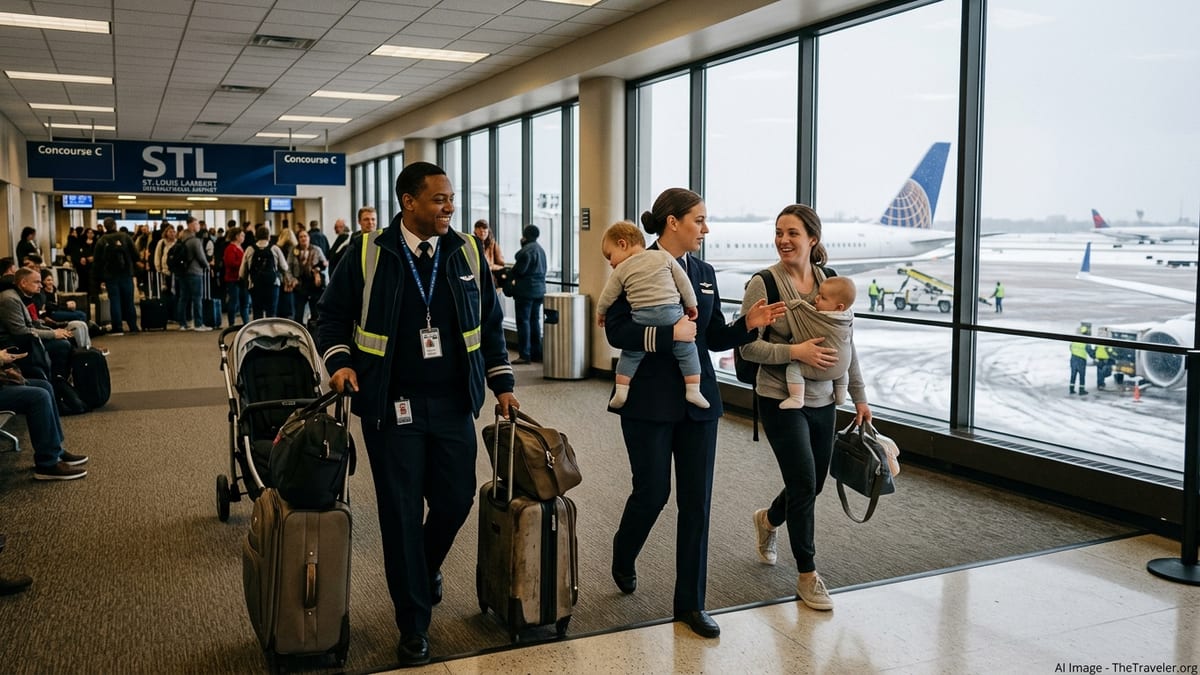
A United Airlines crew in St. Louis is drawing national attention after a photo showing pilots and off-duty flight attendants carrying a stranded mother’s sleeping toddlers and luggage went viral over Thanksgiving weekend, offering a rare moment of calm and compassion during a holiday travel period already disrupted by an FAA ground stop and a major Midwest snowstorm.
Get the latest news straight to your inbox!
What Happened On The Tarmac In St. Louis
The incident occurred at St. Louis Lambert International Airport during the busy Thanksgiving travel period, after a nationwide ground stop and winter storm combined to snarl air traffic and strand passengers across the United States. According to local station First Alert 4 in St. Louis, the mother had been attempting to travel with three young children, including approximately 2-year-old twins and a baby, when her journey was disrupted by cascading delays that stretched to roughly 24 hours.
By the time the family finally reached St. Louis, the woman had reportedly run out of diapers and was juggling a baby, two sleeping toddlers and multiple bags on her own. Fellow traveler Dixie Lynn captured the moment that followed: two cabin crew members each carrying one of the sleeping twins down the jet bridge, while a uniformed captain walked behind them with the family’s luggage. The image was later shared on social media and then picked up by local and national outlets.
First Alert 4 reports that there were no bystanders involved in the moment caught in the picture. Instead, the assistance appears to have been initiated entirely by airline staff who saw the mother’s situation at the end of a long day of delays. Information about the family’s origin or final destination has not been made public, and the mother has not been identified.
Off-Duty Crew Members Stepped In After A 24-Hour Ordeal
Subsequent coverage by outlets including Hoodline, Wisevoter and other news aggregators has clarified that the two flight attendants who carried the toddlers were not working that particular flight. They were commuting home to St. Louis after their own assignments when they noticed the mother struggling to manage three children and her belongings following the extended delay.
According to those reports, one of the off-duty flight attendants first offered to help with the children and then asked the captain on duty to assist with luggage once it became clear how much the passenger was carrying. The captain agreed and helped with bags while the attendants carried the twins, allowing the mother to focus on her infant and navigate the jet bridge safely after what sources describe as roughly a full day in transit and in the airport.
The accounts published so far are based on interviews with Dixie Lynn and statements from United Airlines. Neither the airline nor local media have released the names of the crew members involved, and United has declined interview requests for the staff, citing internal policies around media access for employees. As a result, some details, such as the precise flight number, the route, and the children’s exact ages, remain unconfirmed, though all available reports are consistent on the broad outline of events.
How United Airlines And Social Media Responded
United Airlines has publicly acknowledged the incident and the employees involved. Lynn told First Alert 4 that the airline contacted her after the photo spread online and confirmed it had identified the crew members. United did not specify whether any formal recognition such as awards or commendations would follow, but the carrier did offer an enthusiastic endorsement of the episode, telling the station that it “loves” the story of its staff assisting the family.
The airline also referenced the St. Louis crew in a broader social media message about its response to the nationwide ground stop and difficult holiday operating conditions. In a recent Instagram post reflecting on staff performance during the disruptions, United highlighted “the flight crew in St. Louis who jumped in to help a mom traveling with her three children,” noting that two flight attendants carried the toddlers, another crew member helped with the baby, and pilots took the luggage. That account aligns closely with Lynn’s description, though public news reports have not independently identified a third crew member holding the baby in the viral image.
First Alert 4 reports that the original photo reached tens of thousands of people across social platforms within roughly a day of publication. Aggregated reprints and secondary coverage have further extended its reach, though exact audience numbers are not available. Comment sections on local news sites and airline-focused social media posts have been filled with messages from parents and frequent travelers describing the crew’s actions as a bright spot amid a frustrating travel week. Some commenters have contrasted the episode with widely reported disputes and confrontations in air travel, framing it as an example of cooperation rather than conflict.
Set Against A Difficult Holiday Travel Week
The moment in St. Louis unfolded during a particularly strained period for U.S. aviation. In mid-November, the Federal Aviation Administration instituted a nationwide ground stop that temporarily halted new domestic departures while officials addressed a technical issue. United, which is based in Chicago and operates a significant network across the Midwest, was among the airlines most affected and has publicly acknowledged the disruption in its corporate communications.
At the same time, a major Thanksgiving snowstorm swept through parts of the Midwest, including Missouri and Illinois, knocking out power to tens of thousands of homes and complicating road access to airports. Local coverage in the St. Louis area has documented numerous storm-related impacts, including damage to businesses, power restoration efforts and travel delays. Although the specific itinerary of the mother in the viral photo has not been detailed, reports consistently describe her ordeal as part of this wider pattern of delay affecting travelers to and from St. Louis over the holiday weekend.
For families traveling with small children, extended delays can have especially practical consequences. Diapers, formula, snacks and changes of clothes that would typically suffice for a standard journey may not stretch to cover an unplanned overnight wait at the airport. In the St. Louis case, Lynn told reporters that the mother had run out of diapers by the time the crew intervened. That detail underscores a common piece of advice from family travel experts and consumer advocates: when traveling during peak periods or in winter, it is prudent to pack extra supplies in carry-on bags in case of prolonged disruptions.
What This Means For Parents And Travelers
While the St. Louis episode captures a discrete moment rather than a statistically documented trend, it does illustrate a dynamic that many parents encounter when flying with young children: formal airline policies around delays and rebooking typically operate alongside informal, person-to-person assistance from crew and fellow passengers. In this case, there is no indication that the helping hands were part of a structured assistance program. Instead, they appear to have been a spontaneous response from crew members who recognized how strained the traveler was after nearly a full day of disruption.
For travelers, especially those flying with infants and toddlers during busy seasons, the story offers several practical takeaways. First, extended delays are more likely during peak holidays and in winter, when both airspace congestion and weather can affect operations. Booking longer connection times, traveling with more than the minimum number of diapers or snacks, and keeping essential items in carry-on rather than checked bags can create a margin of safety if plans unravel. Second, communicating with gate agents and crew about specific needs, such as running low on baby supplies or facing a long overnight wait, can sometimes prompt informal assistance like priority boarding, extra water or access to quieter seating areas, even when formal compensation policies are fixed.
For its part, United has emphasized in public statements that it expects heavy holiday traffic around Thanksgiving and has highlighted the efforts of its staff in coping with the ground stop and storm-related complications. However, the airline’s formal guidance continues to direct customers experiencing major delays toward established channels such as rebooking tools in its mobile app, airport customer service desks and call centers. The kind of individualized support captured in the St. Louis photo remains dependent on the initiative of individual crew members rather than a guaranteed service.
What Travelers Should Watch For Next
As of November 29, 2026, no additional formal programs or policy changes have been announced by United in direct connection with the St. Louis incident. The airline’s recent public communications focus primarily on restoring normal operations after the FAA ground stop and managing high Thanksgiving passenger volumes. Travelers should not assume that similar personal assistance will automatically be available on future flights, even though many crew members routinely go beyond their core safety and service duties.
Passengers planning year-end or early 2027 trips through St. Louis or other major hubs are advised to monitor weather forecasts and airline notifications closely, particularly during peak travel windows around the December holidays. Checking flight status in airline apps, confirming gate information regularly and allowing additional time for connections can reduce the likelihood of being stranded overnight. Families with infants and toddlers may wish to budget space in carry-on bags for at least an extra day’s worth of diapers, wipes and basic snacks in case of prolonged disruptions similar to the one that affected the mother in the viral photo.
The St. Louis episode is likely to remain most significant as a widely shared example of how individual decisions by front-line aviation workers can affect the travel experience. For now, it stands as a snapshot of one crew’s response to a difficult holiday travel period rather than a signal of systemic change. Travelers can reasonably expect that airlines will continue to focus on operational reliability and standard passenger support policies, while hoping that, in moments of exceptional strain, someone on board will be willing and able to lend a hand.