


More news on this day
Fresh federal data released around the 13 November 2026 nationwide ground stop confirm that, despite a rare telecommunications failure that briefly froze departures across the United States, weather-related constraints on airspace and airport capacity still account for the majority of serious, system-driven delays faced by U.S. air travelers over multi‑year periods.
Get the latest news straight to your inbox!
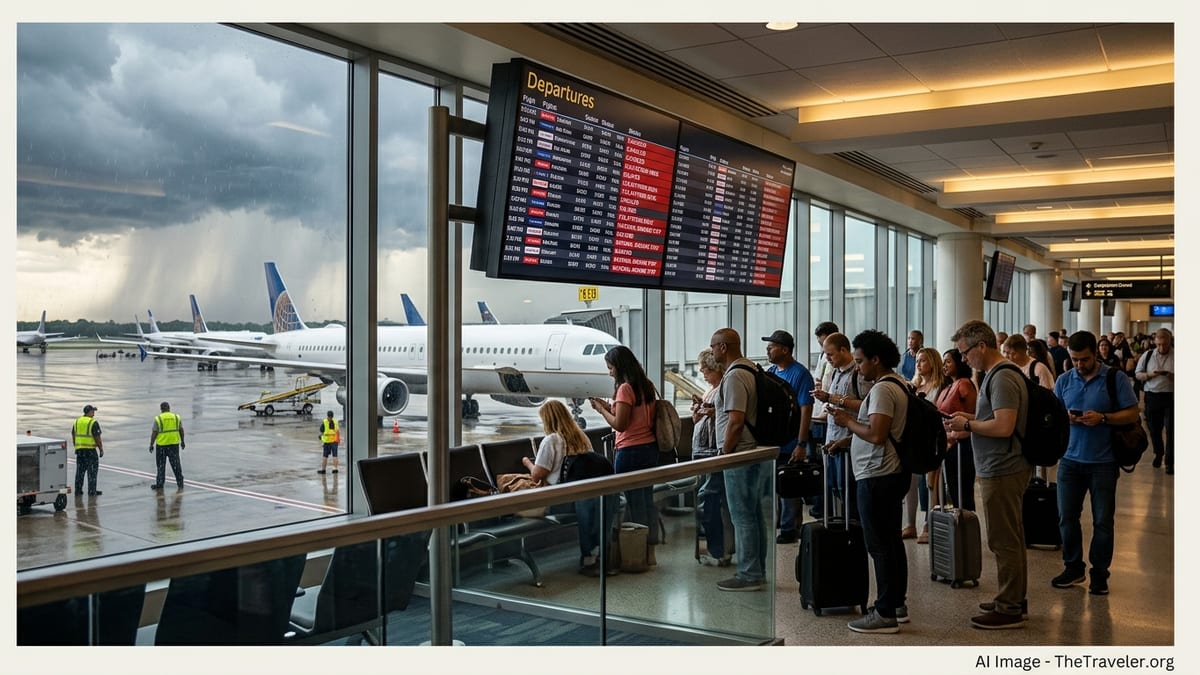
OPSNET data reaffirm weather’s dominant share of system-driven delays
The Federal Aviation Administration’s Operations Network, or OPSNET, remains the primary official source for understanding when the National Airspace System itself forces significant delays. In a NextGen weather frequently asked questions document that summarizes finalized OPSNET “delay by cause” data from June 2017 through May 2023, the FAA reports that weather was responsible for 74.26 percent of system-impacting delays longer than 15 minutes in cases where traffic managers had to reduce flows because the airspace or airports could not safely accommodate the planned schedule.
OPSNET applies a specific, comparatively narrow definition to these events. Reportable delays are logged when air traffic control detains instrument flight rules traffic for 15 minutes or more at the gate, on the taxiway, on the runway or in airborne holding specifically due to constraints in the airspace or at airports, as defined in FAA orders. Within that framework, each delay is assigned a primary cause such as Weather, Volume, Runway or Taxiway, Equipment or Other, with second-level descriptors including thunderstorms, wind or low ceilings attached to individual records.
Causes that lie outside air traffic management decisions, such as airline maintenance, crew scheduling, ground handling, security screening or passenger processing, are explicitly excluded from OPSNET’s system-impacting categories. That exclusion means the 74 percent share for weather reflects only those delays that originate in the capacity of the airspace and airports themselves, rather than combining them with issues under airline control.
The NextGen weather FAQ, which the FAA continues to reference in 2026 training and outreach materials, remains the most recent consolidated publicly available multi‑year OPSNET summary using this methodology. It highlights convective thunderstorms, low ceilings, visibility restrictions and strong or shifting winds as the main meteorological factors that reduce usable capacity along busy routes and at large hubs. While the agency continues to modernize its data systems, it has not yet released a newer long-run breakdown using the same approach, and officials still cite the 74 percent figure when explaining the structural role of weather in system performance.
How DOT on-time statistics spread weather across several categories
Most travelers encounter delay information not through OPSNET but through the U.S. Department of Transportation’s Bureau of Transportation Statistics, which publishes monthly on-time performance reports for major domestic airlines. These tables assign each flight that arrives 15 or more minutes late to one of five primary causes: Air Carrier, National Aviation System, Weather, Late-arriving Aircraft or Security.
BTS technical documentation clarifies that the National Aviation System category covers a broad mix of conditions, including non-extreme weather, airport operations, heavy traffic volume and air traffic control constraints. By contrast, the separate Weather category is reserved for extreme or unusual meteorological events, such as major winter storms or hurricanes, that directly disrupt operations. Routine summer thunderstorms, periods of low cloud or fog, reduced visibility and some wind-related constraints are therefore typically coded under National Aviation System rather than appearing in the smaller Weather column.
The Late-arriving Aircraft category further disperses the visible role of weather. When a flight departs late because its inbound aircraft arrived behind schedule, airlines must record the cause as Late-arriving Aircraft, even if the original disruption several legs earlier stemmed from thunderstorms or low ceilings at another airport. As a result, weather-triggered congestion can ripple through schedules for many hours while being recorded in public BTS tables primarily as Late-arriving Aircraft.
Finalized BTS summaries through 2023 and preliminary analyses of 2024 data show that roughly one in five scheduled domestic flights arrived at least 15 minutes late, with National Aviation System, Weather and Late-arriving Aircraft together accounting for a majority of recorded delay minutes. BTS does not attempt to calculate a single combined “all-weather” share, and its documentation notes that cause codes describe proximate triggers rather than full chains of events. Read alongside OPSNET’s system-delay statistics, though, the figures are consistent with the conclusion that capacity reductions linked to storms, low ceilings and other weather phenomena remain the leading source of serious, system-driven delays in U.S. air travel when measured over several years.
What is now confirmed about the 13 November 2026 nationwide ground stop
Against that backdrop of predominantly weather-related disruption, the nationwide ground stop on Friday 13 November 2026 was a rare example of a non-weather problem briefly affecting much of the U.S. air traffic system at once. In a detailed question-and-answer document published on 15 November 2026, the FAA confirmed that it ordered a nationwide ground stop after instability appeared in its internal telecommunications network, raising concerns about the reliability of the communications and radar data that controllers use to maintain safe separation between aircraft.
According to the FAA’s timeline, echoed in a Congressional Research Service brief and subsequent congressional correspondence, the nationwide ground stop lasted for approximately 4 hours and 45 minutes and primarily affected scheduled commercial departures. While radar and radio services were not completely lost, the agency reports that exceptions were limited during the event to medical, law-enforcement and other emergency flights, which were authorized case by case while engineers worked to restore stable service.
Federal officials now trace the disruption to work on the FAA Telecommunications Infrastructure network, the private backbone that links air route traffic control centers, approach control facilities and numerous remote radio sites. L3Harris Technologies, which operates the network under contract, has been replacing thousands of older copper-based connections and associated routers with fiber and newer internet protocol equipment from Juniper Networks, now owned by Hewlett Packard Enterprise.
The FAA’s Q&A and related Senate letters describe technicians installing a Juniper router at a remote radio communications facility near El Dorado, Arkansas, on 13 November 2026, when abnormal network traffic began to propagate across the system. The agency’s initial investigation identifies that site and a radar facility near Amarillo, Texas, as potential origins of excessive data that flooded sections of the legacy infrastructure, some of which is still running on hardware approaching 25 years old. Officials state that the resulting load interfered with time-sensitive messaging needed to route data between en route centers and associated sites, triggering the nationwide ground stop order.
In its mid-November updates, the FAA confirms that it has paused further installation of the Juniper router models implicated in the outage while investigators analyze logs, replicate fault conditions and review configuration details. A notice published on 17 November states that the functionality of the originating routers has been disabled and that additional Juniper deployments will not resume until further testing and any required mitigations are complete. Senators on the Commerce Committee have requested joint technical briefings with the FAA, the Department of Transportation, L3Harris and Juniper, along with documentation on test procedures and safety assessments for routers already in service.
As of late November 2026, both the FAA and the Department of Transportation report that they have found no evidence that the outage resulted from a cyberattack, while noting that this assessment could change if new information emerges. Public summaries from the agencies and contractor statements instead describe an interaction between a network upgrade and existing infrastructure that generated excessive internal traffic. Lawmakers are seeking additional clarity on how the FAA oversees the modernization program, how configuration changes are approved and what safeguards exist to prevent a localized fault from again prompting a nationwide halt to departures.
How the telecom failure contrasted with typical large-scale weather disruption
For travelers, the pattern of disruption on 13 November 2026 differed noticeably from days dominated by major storms. Because the trigger was a sudden telecommunications failure rather than an advancing weather system, there was essentially no public lead time. Airlines and airports began referencing a “nationwide ground stop” and “FAA systems issue” in the early afternoon Eastern time as the order took effect, and many passengers discovered the problem only after reaching the airport or boarding their aircraft.
Real-time flight tracking reviewed in subsequent coverage shows aircraft that had already pushed back or begun taxiing being held away from departure runways, with some flights returning to gates as the ground stop continued. With departures frozen from many origins, aircraft and crew rotations quickly diverged from planned schedules. FAA figures indicate that operators canceled roughly 12,500 flights on 13 November, including more than 9,000 cancellations at the largest airlines, with many additional departures facing long delays as the network restarted in stages.
The disruption did not end when the ground stop was lifted. Major carriers reported continuing knock-on effects on 14 and 15 November as they worked through crew duty-time limits, aircraft positioning and maintenance requirements. Passenger advisories issued by several airlines over that weekend urged travelers to monitor flight status frequently and, where possible, use rebooking tools before heading to the airport, reflecting the scale of the recovery effort.
By contrast, significant winter storms or large lines of organized summer thunderstorms generally provide one to three days of reliable forecast warning. When those forecasts show a high probability of substantial capacity reductions at key hubs or along major corridors, airlines increasingly respond by issuing advance travel advisories, waiving certain change fees and thinning schedules on the most exposed days. Those proactive measures cannot eliminate delays or cancellations but can reduce the number of passengers caught by last-minute disruption.
There was no comparable opportunity to trim schedules ahead of the 13 November outage. From the traveler’s perspective, the result was an abrupt nationwide pause in departures, followed by several hours of limited information and then an uneven recovery as restrictions were lifted facility by facility. In multi‑year statistics, however, the incident appears as a sharp but isolated spike of non-weather-related disruption layered on a much larger and more regular background of weather-driven delays.
How aviation weather forecasting shapes daily traffic decisions
On days when telecommunications and other critical systems are functioning normally, the process that turns a band of storms or an area of low cloud into manageable delays begins with specialized National Weather Service forecasts. The Aviation Weather Center produces nationwide charts, bulletins and advisories highlighting hazards such as thunderstorms, icing, turbulence, low ceilings and reduced visibility that can affect usable altitudes, preferred routes and approach and departure procedures at major airports.
Within each of the FAA’s Air Route Traffic Control Centers, meteorologists in Center Weather Service Units refine these national products for their local airspace. They focus on when and where forecast conditions are likely to intersect key arrival and departure corridors, whether crosswinds may force a switch to less efficient runway configurations, and when ceiling or visibility thresholds for high-capacity parallel approaches may be crossed. Their analyses, which increasingly use probabilistic tools to describe the likelihood of different scenarios, feed into the FAA’s Air Traffic Control System Command Center in Virginia.
The Command Center maintains a rolling national traffic plan, typically extending several hours to a day ahead, that integrates forecast constraints with expected demand derived from filed flight plans and historical patterns. Regular strategic planning discussions bring together FAA facilities, airline operations centers, cargo carriers and business aviation representatives, and when cross-border flows are a factor, neighboring service providers such as Canada’s air navigation authority.
When weather-driven constraints begin to materialize and reduce capacity, the FAA applies formal Traffic Management Initiatives to align demand with what the system can safely support. Available tools include Ground Delay Programs, Ground Stops, Airspace Flow Programs, miles-in-trail spacing requirements and structured reroutes around saturated sectors. Policy guidance instructs traffic managers to choose the least restrictive measure likely to restore balance, recognizing that each option carries different implications for fuel burn, crew duty times and passenger disruption.
For passengers, Ground Delay Programs are among the most visible of these tools. They are typically used when forecast arrivals at a specific airport are expected to exceed the safe arrival rate for an extended period because of weather or other constraints. In those cases, software assigns controlled departure times to inbound flights at their origin airports, taking into account predicted arrival capacity, runway availability and known en route bottlenecks. Travelers may therefore see departure times repeatedly adjusted in airline apps even when local weather appears calm, because the constraint sits at their destination or along the planned route.
Weather-related Ground Stops are generally shorter and more acute. They halt or sharply limit departures bound for particular airports or regions when near-term arrival capacity cannot be reliably predicted, as can occur when a thunderstorm line temporarily blocks all approach paths, visibility falls below landing minima or crosswinds shift rapidly during heavy snow or ice. Often these Ground Stops remain in effect only long enough for new information to become available or a cell to pass, after which traffic managers may transition to a Ground Delay Program or Airspace Flow Program that allows more predictable spacing of flights.
What the latest data and the November outage mean for travelers
For travelers planning U.S. flights into the 2026–2027 winter season and beyond, current OPSNET and BTS figures point to a consistent message: routine weather remains the factor most likely to cause substantial system-driven delays on any given day. Thunderstorms, low ceilings, visibility restrictions and wind shifts continue to limit capacity along busy corridors and at major hubs far more frequently than rare, technology-related incidents such as the 13 November telecommunications failure.
Passengers who wish to gauge their own exposure can consult historical on-time statistics for specific routes and airports in publicly accessible BTS databases, which detail the share of flights arriving late by cause category over selected periods. These data sets show, for example, how the mix between National Aviation System, Weather, Late-arriving Aircraft and Air Carrier causes varies across seasons and between different hubs. Some airlines and airports supplement these federal resources with their own performance dashboards and with alerts when forecasts indicate a high likelihood of disruption on particular days.
On itineraries that connect through airports with a history of weather-related constraints at certain times of year, adjusting departure times or connection lengths can modestly improve the prospects of an on-time arrival. Choosing earlier flights, allowing more time between connections or selecting routings that avoid hubs expected to sit under major storm systems on a given day are all strategies that travelers can consider once forecasts firm up. No schedule change can remove all risk, and recent BTS statistics show that cancellation rates for U.S. domestic flights have remained in the low single digits as a share of scheduled services even in years with significant storms and isolated technology incidents.
In the wake of the November telecommunications failure, travelers interested in the resilience of the system can follow ongoing updates from the FAA, the Department of Transportation and congressional committees. As of late November 2026, the FAA has paused further installation of the Juniper routers linked to the outage, is working with contractors and manufacturers on detailed technical testing and has been asked to provide lawmakers with more information on oversight of the broader telecommunications modernization program. Any resulting changes are expected to focus on reducing the chance that a single network modification could again trigger a nationwide ground stop, while parallel aviation weather initiatives continue to concentrate on improving forecasts and traffic management tools for the far more frequent delays driven by atmospheric conditions.