


If you signed a Bluegreen Vacations contract and your stomach dropped the moment you got back to your hotel room or home, you are far from alone. From Bass Pro Shops kiosks to preview centers in Orlando or Branson, thousands of travelers every year sit through high-pressure sales pitches and later wonder how to unwind what they just agreed to. The good news: in many situations, you can cancel legally and cleanly. The bad news: the path out is full of expensive "exit" companies and bad advice that can leave you worse off than when you started.
Get the latest updates straight to your inbox!
First, Understand What You Signed With Bluegreen
Bluegreen Vacations sells vacation ownership interests, often in the form of a points-based timeshare in the Bluegreen Vacation Club. You might have signed at a sales office connected to a resort in Orlando, Myrtle Beach, the Wisconsin Dells, or during a getaway promotion offered through partners like Bass Pro Shops or Cabela’s. The paperwork you took home is not just a brochure. It is a stack of legally binding documents governed by state timeshare and real estate laws, usually in the state where the resort or sales center sits.
In a typical Bluegreen transaction, you sign a purchase agreement, a public offering statement or disclosure booklet, financing documents if you took out a loan with the developer, and acknowledgments about key terms. Somewhere in that stack is a section titled along the lines of “Right of Rescission” or “Cancellation of Purchase Agreement.” That paragraph, which many buyers skim over at the table, becomes the single most important clause if you decide to back out later the same day or week.
For example, an owner who bought at a Bluegreen preview center in Peoria, Arizona later posted the exact rescission clause from their contract, spelling out their right to cancel by midnight of the tenth calendar day after signing. Another buyer who signed at a resort near Orlando found a similar clause but with a shorter state-specific period. These are not favors from the company. They are state-mandated rights that Bluegreen is required to honor if you follow the instructions precisely.
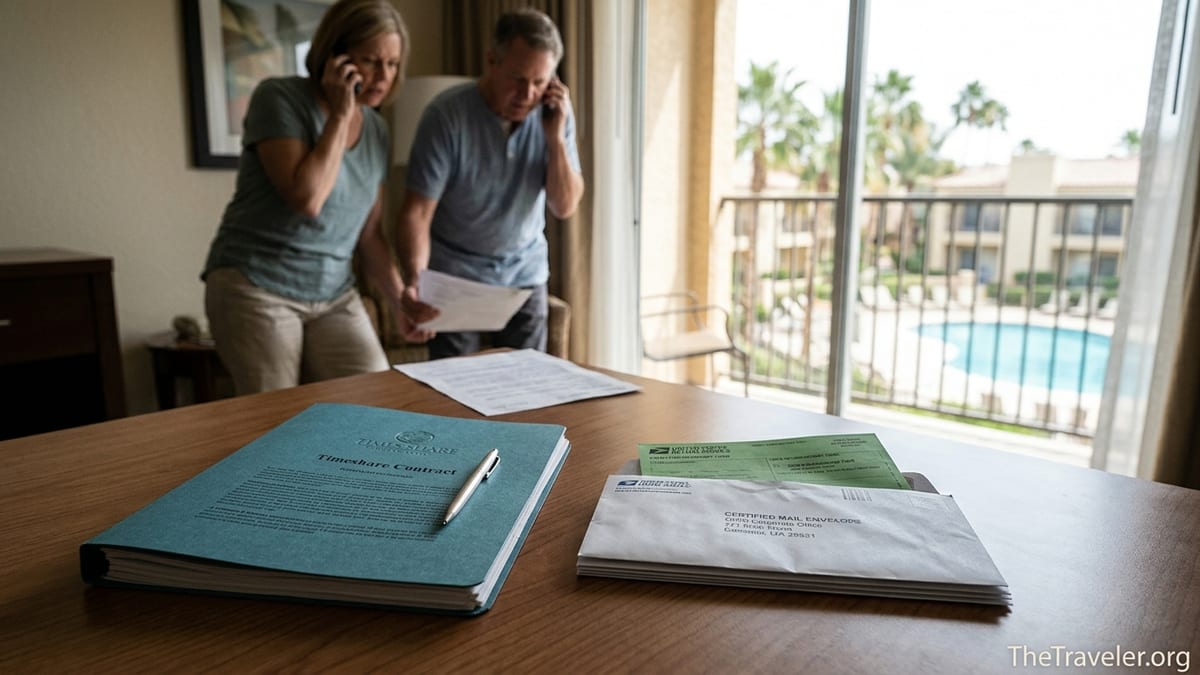
Before you call anyone or sign anything else, sit down with the contract you received at closing. Clear a table, grab a highlighter, and look for pages with headings like “Purchaser’s Right to Cancel,” “Notice of Cancellation,” or state-specific notices that mention the name of the state where you signed, such as Florida, Missouri, or South Carolina. Your next steps depend almost entirely on what is written there.
Rescission Windows: Your Short, Powerful Right to Cancel
Every U.S. state that regulates timeshares requires a cooling-off period, known as a rescission period. During that short window, you can cancel your Bluegreen purchase for any reason or no reason at all. You do not have to prove misrepresentation, medical issues, or financial hardship. You simply have to cancel the right way, on time. Miss that window and your options become much narrower and often more expensive.
The length of the rescission period is set by the state where you signed, not by Bluegreen. For instance, Florida’s timeshare law gives buyers up to 10 calendar days from the date they signed or received all required documents, whichever comes later. Other popular states for Bluegreen sales, such as South Carolina or Tennessee, may have shorter periods, sometimes around 5 to 7 days. An Arizona buyer on a travel forum shared contract language giving them 10 days from the purchase date to rescind. These are examples, not guarantees; you must verify the exact number of days in your own contract and the governing state statute.
Travelers often underestimate how strict these timelines are. A couple who purchased during a weekend trip to Branson described panicking on Reddit about whether they could still cancel after driving home to another state. They discovered that as long as their written notice was sent within the stated number of calendar days and to the exact address in the contract, they were protected, even if Bluegreen received the envelope a day or two later. That subtle difference between the “mail-by” deadline and the “received-by” date can be critical, and the contract itself usually clarifies which standard applies.
If you are anywhere close to that deadline, treat it like catching an international flight. Do not wait for a return call from customer service. Do not rely on a salesperson’s assurance that they will “take care of it on Monday.” The only thing that protects you is a cancellation letter sent exactly as your contract requires within the rescission window.
How to Use Your Rescission Right: Step‑by‑Step
Exercising your right to rescind a Bluegreen contract is usually straightforward, but only if you follow the written instructions precisely. Most Bluegreen contracts require a written notice of cancellation sent to a specific address, often something like Bluegreen Vacations Unlimited, Attn: Cancellations, at a corporate or Orlando-area office. One traveler who purchased a promotional vacation package, for example, found language requiring them to mail a written cancellation to an Orlando address listed under a “Cancellations” heading. If you send your notice anywhere else, such as a resort front desk or general customer service address, Bluegreen may argue you did not comply.
A basic rescission letter does not need to be emotional or detailed. Owners and consumer advocates often recommend including four elements: your full name and contact details exactly as they appear on the contract; the contract number and purchase date; a simple statement that you are exercising your legal right to rescind and cancel the agreement in full; and a request for written confirmation and a full refund of any deposits or down payments. For example, one owner shared wording along the lines of: “This letter is to inform you that we are exercising our right of rescission to cancel our timeshare contract purchased on [date] at [location], contract number [X]. Please confirm this cancellation in writing and refund all monies paid.”
Just as important as what you write is how you send it. Many owners choose certified mail with return receipt or another trackable postal service so they have proof of both the mailing date and delivery. On online forums, Bluegreen buyers who successfully rescinded stressed that their peace of mind came from a green postal receipt or tracking confirmation showing the letter reached the cancellation address within the legal timeframe. If you are still on property when you decide to cancel, you can ask whether the contract allows hand delivery, but even then, demand a stamped, signed receipt and still consider mailing a duplicate via certified mail to the address listed.
After you send the letter, save copies of everything: the signed notice, the mailing label, the receipt, and screenshots of your tracking showing when it was delivered. Keep these documents for at least a couple of years. Most buyers who rescind correctly receive confirmation letters and refunds of deposits within a few weeks, but if there is any dispute later, your paper trail will be far stronger than a vague memory of a phone call with a sales manager.
Out of Time? Realistic Exit Options After Rescission
If your rescission period has expired, walking away from a Bluegreen timeshare becomes more complicated, but not always impossible. At this stage, the law treats your purchase like any other binding real estate or financing agreement. You may owe a balance on a developer loan, annual maintenance fees, taxes, and special assessments. Some owners consider simply stopping payments, but that strategy carries serious risks: damage to your credit, collection calls, and potential legal action for foreclosure or breach of contract.
Instead, start by contacting Bluegreen directly and asking about any in-house surrender or “deed-back” programs that may be available to owners in good standing. These programs change over time and often have eligibility criteria, such as being current on all fees and having paid off your loan. While Bluegreen’s public-facing materials generally emphasize the benefits of ownership, internal owner services departments sometimes have pathways for long-time owners to exit in an orderly way, particularly if the interest has little resale value and the company prefers to take it back rather than chase delinquent accounts.
Some owners also turn to the resale market. Online timeshare marketplaces and owner forums are full of Bluegreen points and deeds offered for a nominal price or even for free, with the seller willing to pay closing costs just to be rid of ongoing maintenance fees. That reality should be a wake-up call for anyone who was told in the salesroom that their purchase was an “investment” that would appreciate. Resale can be a way out, but you must watch for scammers here too, such as fake buyers who demand upfront “closing fees” or “transfer taxes” that never lead to a completed sale.
In certain cases, especially where there is strong evidence of misrepresentation or where you are facing aggressive collections, consulting a licensed attorney who regularly handles timeshare disputes in the state where your contract is governed can be worthwhile. A local consumer law or real estate attorney can review your specific documents, explain your exposure, and help you navigate options such as negotiated settlements, loan restructuring, or, in extreme cases, bankruptcy. Many offer low-cost initial consultations, which is usually far less expensive and safer than sending thousands of dollars to a generic national “exit” firm.
Timeshare Exit Scams: Red Flags and Real Cases
The moment you search online for phrases like “cancel Bluegreen timeshare” or post a question in a travel forum, you may find yourself targeted by companies promising to get you out of your contract “guaranteed” for hefty upfront fees. Federal and state authorities have repeatedly warned that many of these businesses operate almost exactly like the high-pressure salesrooms owners are trying to escape, only this time the product is an expensive service rather than a vacation package.
In one recent enforcement action highlighted by the U.S. Department of Justice and the State of Wisconsin, a major timeshare exit operation was hit with a judgment exceeding 140 million dollars and permanently barred from marketing exit services. The court found that the company had lured mostly elderly owners with promises to “cancel” their contracts while instructing them to stop paying their timeshare obligations. Many customers ended up with ruined credit, collection lawsuits, and no actual cancellation. Bluegreen itself has sued several marketing and law firm combinations that, according to court filings, allegedly collected large fees while misleading owners about their legal status and diverting payments away from the developer.
On the consumer side, Bluegreen owners have reported being told at so-called “consultations” or seminars that the only way out was to pay an exit company five figures, sometimes close to the price of the original timeshare. One owner posted that they were quoted around 10,000 dollars by a firm that claimed it would “work with Hilton” to resolve their Bluegreen contract, even though they were already current on payments and could potentially have pursued an in-house solution. Others describe being advised to ignore bills and correspondence from Bluegreen while the exit firm handled everything, only to later discover foreclosure or credit damage had already occurred.
Typical red flags include guarantees of results regardless of your situation, pressure to sign a contract during a single phone call, instructions not to speak with Bluegreen directly, and requests for large upfront payments before any work is done. Some firms use official-sounding names or mention trade groups to appear legitimate, but enforcement cases show that even polished operations can be deceptive. If a company’s strategy seems to consist mainly of sending a couple of letters and then telling you to stop paying, you are taking on enormous risk while they pocket your fee.
Questions to Ask Before You Pay Anyone to Help You Exit
If you are outside the rescission period and considering professional help, approach the decision as carefully as you would hiring an attorney for any other major legal matter. Start with the simplest, lowest-cost resources: your own contract, Bluegreen’s owner services department, and reputable consumer organizations. The Federal Trade Commission’s guidance on timeshares and related scams, for example, outlines common schemes and suggests checking with your state attorney general or local consumer protection office about complaints before hiring any resale or exit firm.
If you decide you still need outside assistance, ask specific, written questions. For a law firm, that might include: Are the attorneys licensed in the state governing my Bluegreen contract, and can I confirm that with the state bar? Will you represent me directly in any dispute, or are you mainly sending letters? How are fees structured: flat fee, hourly, or contingency? What is the realistic range of outcomes and timelines you have seen with other Bluegreen owners? A legitimate attorney should be willing to answer these questions plainly and send you an engagement agreement that clearly describes the scope of work.
For non-lawyer exit companies, be even more cautious. Ask whether they ever tell clients to stop making payments, and if so, what they do to protect clients from foreclosure or credit damage. Request a breakdown of all fees, including any “document preparation” or “closing costs,” and whether those are refundable if they are unable to achieve a specific result. Check how long they have been in business under their current name and address, and look up their complaint history with agencies like the Better Business Bureau and state regulators. If the salesperson resists these questions, rushes you, or dismisses your concerns as “negative reviews from people who didn’t follow instructions,” you are getting a clear signal to walk away.
Meanwhile, do not overlook simpler and safer paths that cost you little or nothing: listing your interest for transfer on owner-to-owner platforms, asking Bluegreen directly about any formal surrender processes it recognizes, or consulting with a local attorney for a one-time review. By grounding your decisions in verifiable information rather than fear and urgency, you reduce the chance of paying twice for the same mistake.
What to Verify in Your Bluegreen Contract Before Making Any Move
Every Bluegreen timeshare deal is built on a specific written contract, and that contract is the authority that courts, regulators, and Bluegreen itself will rely on. Before you mail a rescission letter, list your interest for sale, or sign up with any exit service, take the time to confirm a few critical details in black and white. Doing this homework can save you thousands of dollars and months of stress.
First, pinpoint the official “date of execution” and the governing law. Look for a signature page that lists both your signature date and the sales agent’s, as well as a clause stating something like “This agreement shall be governed by the laws of the State of Florida” or another state. That state’s statute determines your rescission period and many of your rights. Next, find the exact rescission clause and cancellation instructions, including the mailing address, whether hand delivery is allowed, and whether the deadline is based on the postmark date or the date of receipt. Owners who got into trouble after trying to cancel often discovered they had mailed to the wrong address or relied on a phone conversation instead of the written process.
Then, review your financial obligations. Identify the principal balance on any loan, the interest rate, the schedule of monthly payments, and the current amount of annual maintenance fees. Contracts or owner documents may also mention special assessments for major repairs or upgrades. Reading the fine print here clarifies what you are actually trying to escape. Many owners realize that their total long-term cost over 10 or 20 years can easily run into the tens of thousands of dollars, especially with rising fees, which can sharpen the case for pursuing a legitimate exit.
Finally, check whether your contract or Bluegreen’s owner materials refer to any internal surrender, relinquishment, or “owner solutions” programs. Even if details are vague, a mention that such options “may be available” is a signal to contact owner services directly and ask what requirements apply. When you call, take notes of dates, names, and summaries of what you are told, and follow up in writing via email or certified mail so there is a record. The more organized and informed you appear, the harder it is for anyone, whether Bluegreen or an outside firm, to mislead you about your choices.
The Takeaway
Canceling a Bluegreen Vacations contract is not about clever loopholes or magic phrases. It is about understanding your legal rights, acting quickly when you are within the rescission period, and making calm, informed decisions once that short window has closed. For many travelers who bought in Orlando, Branson, Myrtle Beach, or through a Bass Pro Shops promotion, the first and best option is almost always to exercise the state-mandated right to rescind by sending a simple written notice to the precise address and by the precise deadline listed in their contract.
If you are past that stage, your focus shifts to minimizing long-term damage rather than chasing easy promises. That can mean negotiating directly with Bluegreen about in-house exit options, exploring low-cost resale or transfer channels, or consulting a qualified local attorney for tailored advice. What it should not mean is paying thousands of dollars to unproven exit firms that guarantee outcomes they cannot deliver while telling you to ignore your existing obligations.
Ultimately, the most powerful tools you have are information and documentation. Read your contract carefully. Keep copies of everything you send or receive. Verify claims made by salespeople, exit companies, or even well-meaning strangers online against official sources and state law. With a clear head and a paper trail, you can navigate your way out of a regretted Bluegreen purchase or avoid falling into a deeper and more expensive trap.
FAQ
Q1: Can I cancel my Bluegreen timeshare the day after I signed?
If you are still within your state’s rescission period, you almost certainly can. The exact number of days is set by the law of the state where you signed and is spelled out in your contract’s “Right of Rescission” section. If you act within that window and send a written cancellation notice exactly as instructed, Bluegreen is required to honor it.
Q2: Where do I find the cancellation address for my Bluegreen contract?
The correct address appears in the rescission or cancellation clause in your purchase documents, often under a heading such as “Notice of Cancellation.” It might list a specific department like “Attn: Cancellations” at a corporate or Orlando-area office. Do not rely on a verbal address from a salesperson or a generic customer service page; always follow the written instructions in your contract.
Q3: Is sending a cancellation email or calling customer service enough?
Usually not. Most Bluegreen contracts require a written letter sent by mail or hand delivered to a specific address. Some may accept fax or other methods, but only if the contract says so. A phone call or email alone is risky because it may not meet the formal requirements and leaves you without solid proof if there is a dispute.
Q4: What happens if I miss the rescission deadline by a day or two?
Once the rescission period expires, Bluegreen is generally not legally required to cancel your contract just because you changed your mind. You can still call owner services and ask for help, but you have lost the automatic right to walk away. At that point, your options usually involve resale, negotiated surrender, or legal advice rather than simple cancellation.
Q5: Are all timeshare exit companies scams?
Not all, but enough have been sued by regulators and developers that extreme caution is warranted. Many charge large upfront fees, guarantee results they cannot control, or tell owners to stop paying their obligations, which can lead to foreclosure and credit damage. Before hiring any firm, research complaints, understand exactly what they will do, and consider talking to a licensed local attorney instead.
Q6: Will Bluegreen let me give my timeshare back?
In some situations, yes, particularly if you are current on your loan and fees and your ownership has little resale value. Programs and criteria change over time, and details are not always heavily advertised. The only way to know is to contact Bluegreen’s owner services department, ask about any deed-back or surrender options, and request written information on eligibility.
Q7: Can I sell my Bluegreen points or deed on the resale market?
Often you can, but resale prices for timeshares, including Bluegreen, are typically very low compared to what you paid the developer. Many owners list their interests for a nominal amount or even for free, hoping a buyer will take over maintenance fees. If you pursue resale, avoid anyone who demands upfront fees for “marketing” or claims they already have a buyer lined up but need money to complete the deal.
Q8: Is it safe to just stop paying my Bluegreen loan and fees?
Generally no. Failing to pay can lead to collection efforts, negative credit reporting, and potential foreclosure on your timeshare interest. While some exit companies suggest this as a tactic, you bear the consequences, not them. Always understand the legal and credit risks and consider speaking with a consumer law attorney before deliberately defaulting.
Q9: Do I need a lawyer to cancel during the rescission period?
In most cases you do not. The rescission process is designed to be simple: you send a written notice to the correct address within the allowed number of days. Many owners handle this entirely on their own with a short letter sent by certified mail. You might consult a lawyer if your situation is unusual, but for a straightforward, timely rescission, it is usually not necessary.
Q10: How long does it take to get my money back after I rescind?
Timelines vary, but many owners report receiving refunds of their deposits or down payments within a few weeks after Bluegreen processes their cancellation. Your contract or state law may specify a maximum timeframe for refunds. Keep your mailing receipts and any written confirmation from Bluegreen until the refund clears, and follow up in writing if there are delays.