


Landing at Zanzibar’s Abeid Amani Karume International Airport, many travelers assume that renting a car will be as straightforward as in Europe or North America. In reality, driving in Zanzibar has its own rules, paperwork quirks and on-the-ground realities, from mandatory local permits and frequent police checkpoints to surprise speed bumps on coastal roads. This guide explains exactly how car rental from the airport works, what documents you really need, what to expect on the roads, and when hiring a car is genuinely worth it compared with taxis or private transfers.
Get the latest updates straight to your inbox!
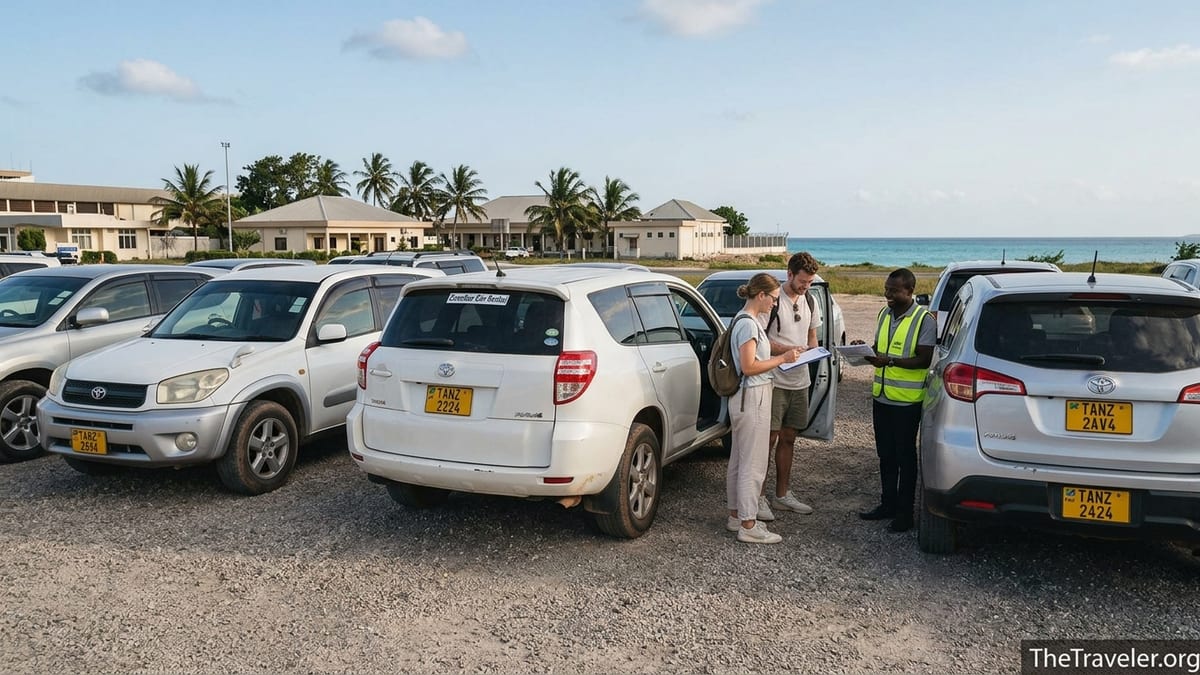
Car rental at Zanzibar Airport: what to expect on arrival
Abeid Amani Karume International Airport, a short drive from Stone Town, is the main gateway for visitors arriving in Zanzibar. Car rental is available directly at the airport, but it does not look like the large, branded halls you might know from big European hubs. Instead, you will find a mix of local operators and international brokers using meet-and-greet desks or individual agents waiting in the arrivals area with printed signs.
Typical airport-focused companies include local brands such as ZanDrive Car Rental and Kibe Car Rental, along with vehicles arranged through airport taxi cooperatives that also offer self-drive hire. Some global booking sites aggregate about eight to ten suppliers serving the airport, with small SUVs and compacts often starting around the equivalent of 25 to 35 US dollars per day in the low season for basic insurance and unlimited mileage. Prices usually rise in July and August and over Christmas and New Year.
Most rentals begin with a representative meeting you in the arrivals hall and walking you to the car park outside Terminal 2 or 3. You will complete a one or two page paper contract, present your passport and driving licence, and either pay by card or, more commonly, in cash in US dollars. The car will often be a used, island-hardened vehicle such as a Toyota RAV4, older Toyota Ist, or similar compact SUV with automatic transmission and air conditioning.
Fuel policies are often informal. A common pattern is receiving the car with a quarter tank and being told to return it with “the same or a bit more.” Inspect the vehicle carefully for existing scratches, cracked bumpers and worn tyres, and take date-stamped photos or a short video walk-around in the car park before you sign anything. This is particularly important on Zanzibar where many cars are older and cosmetic damage is common.
Licences, Zanzibar driving permits and IDPs explained
To drive legally in Zanzibar as a visitor, you need three elements to line up: a valid licence from your home country, often an International Driving Permit, and a Zanzibar-specific temporary driving permit. Your home licence proves that you are qualified to drive, the International Driving Permit is often used as a translation and regulatory formality, and the Zanzibar permit is a local requirement that police will look for at checkpoints.
Many reputable airport rental companies now handle the Zanzibar temporary permit for you if you book in advance. A typical arrangement in 2026 is that you send a photo of your licence and passport by email or messaging before arrival. The rental company then obtains a local permit from the traffic authorities for a fee often quoted between 10 and 30 US dollars per driver, which is added to your rental bill. When you meet the agent at the airport, they hand you a laminated paper or card showing your details and the permit validity dates.
If your licence is not in English or is written in a non-Latin alphabet, such as Cyrillic or Arabic, an International Driving Permit issued in your home country before travel is highly recommended and may be compulsory under some rental terms. Even if your licence is in English, several car hire contracts for Zanzibar still list an International Driving Permit as a condition, and the cost and effort to obtain one at home is small compared with the disruption of being refused a rental car at the airport.
Police on the island are most interested in seeing your Zanzibar permit, original driving licence and passport copy. A common real-world scenario is being stopped just outside Stone Town on the road to Paje and asked for “all papers.” Drivers who can immediately present the Zanzibar permit together with their licence and rental contract usually continue within a couple of minutes. Those without the local permit risk a fine and in some cases pressure to pay on the spot, which you should politely resist by asking for a formal receipt or electronic ticket.
Insurance, deposits and protecting yourself financially
Insurance terminology in Zanzibar can be confusing, particularly when booked through global comparison sites that use European or North American wording. Most airport rentals include third-party liability insurance as standard, and many advertise “full insurance” or “full CDW,” but this does not always mean zero excess. Excesses in practice can range from around 300 to 800 US dollars depending on vehicle class and company policies.
Some local rental outfits keep things informal and do not take a traditional credit card pre-authorisation. Instead they may rely on your passport details, a cash deposit of 100 to 200 US dollars, or simply the understanding that you are liable for damage not caused by normal wear and tear. This can work smoothly, but it also places more weight on your initial inspection. For example, a traveler renting an older RAV4 at the airport might find minor dents and a cracked rear light already present; note these in writing on the contract and capture them clearly in photos before driving away.
Windshield cracks, damaged tyres and underbody scrapes from speed bumps are some of the most common issues disputed when returning a car in Zanzibar. Consider asking explicitly at handover whether windscreen and tyre damage are covered, and at what excess. If you are booking through an international broker that offers refundable excess insurance, keep all paperwork and any police or incident reports so you can claim later if necessary. In the event of an accident, most rental contracts instruct you to call the company first, then wait for police to arrive to file a short report.
Travelers who are not comfortable with these risk levels sometimes choose a chauffeur-driven arrangement instead of self-drive. Many airport-based companies offer the same vehicles with a driver for a daily rate that is only modestly higher, often 50 to 80 US dollars per day excluding fuel. In that case the renter is not personally responsible for navigating insurance complications or handling roadside incidents, as the vehicle is driven by someone who knows both the roads and the local procedures.
Road conditions, traffic and practical driving realities
The main tourist roads across Zanzibar are paved and, on the surface, appear straightforward. The route from the airport and Stone Town to beach areas such as Nungwi and Kendwa in the north or Paje and Jambiani on the east coast is mostly sealed tarmac, generally in fair condition. However, the island’s driving environment is defined less by potholes and more by speed bumps, narrow carriageways, and mixed traffic that includes dala-dala minibuses, bicycles, motorbikes and pedestrians sharing the same space.
Speed bumps are particularly important to understand. Almost every village along the main roads uses raised humps to slow traffic, and these are not always painted or well signposted. It is common, for example, to leave the outskirts of Stone Town at 70 km/h, enter a village where the official limit drops to 50 or 30 km/h, and encounter a series of high speed bumps that could easily damage the suspension or exhaust of a rental car if taken too quickly. A practical rule drivers often adopt is to assume there is a bump whenever you see buildings on both sides of the road, and to slow down accordingly even before you see a sign.
In some rural stretches, the tarmac narrows and the edges can crumble into dirt, especially after heavy rain. On the smaller roads leading to individual beach resorts, you may find a final section of unsealed track with ruts, puddles and coral rock. A compact SUV with a bit of ground clearance is often a better choice than the absolute cheapest small hatchback, particularly in the rainy seasons when standing water can hide deep holes. Night driving outside Stone Town is not recommended, as street lighting is limited and you will often encounter unlit bicycles, pedestrians and animals on the road.
Traffic within Stone Town itself is a different challenge. Streets are narrow, one-way systems can be confusing, parking is tight and local drivers are assertive. Many visitors choose to collect their rental car at the airport, drive directly out to their beach accommodation, and avoid driving into the oldest parts of Stone Town altogether. If you want to explore the historic quarter, it is usually easier to park on the edge of town or pay for a taxi for that portion of your trip.
Police checkpoints, fines and how to handle stops
Police checkpoints are a regular feature of driving in Zanzibar, especially on the main roads linking the airport, Stone Town and popular beach areas. It is entirely normal to be stopped several times in a single day of driving, particularly if you are moving between the north and east coasts. Uniformed officers typically stand either just outside villages or near prominent junctions, sometimes holding a handheld speed gun or simply waving vehicles to the side.
When you are signaled to stop, pull over calmly, keep your seatbelt on until the vehicle is fully stationary, and greet the officer politely. You will usually be asked for your driving licence, Zanzibar temporary permit, and any insurance or rental documents. Having these ready in a single folder, with a photocopy of your passport’s photo page, makes the interaction much smoother. Some travelers mention carrying two copies of everything and handing over the duplicates while keeping the originals in a separate wallet, but this is a personal preference rather than a formal rule.
Occasionally, visitors report being accused of minor infractions such as speeding just before a reduced speed limit sign, or not indicating when pulling over, and then feeling pressured to pay an on-the-spot “fine” in cash. To protect yourself, drive conservatively, especially near villages and checkpoints, and use indicators early and clearly. If an officer claims you have committed an offense, respond respectfully and ask to see the official written fine or electronic ticket. In Tanzania, traffic fines should be documented and paid through formal channels, not as cash handed directly to the officer. A calm insistence on a receipt usually encourages a legitimate process or, in some disputed cases, leads to you being waved on.
Reputable rental companies often brief their customers on these realities when handing over the car. It is common to be advised, for instance, to call the rental office if a situation at a checkpoint becomes confusing. A local staff member can sometimes speak directly with the officer in Swahili and reassure them that your papers are in order. It is also helpful to know that having a local, licensed driver transporting tourists without the correct permits can create more serious issues than a routine tourist self-drive, which is another reason many visitors stick with established airport-based firms instead of informal car hires from individuals.
Resort access, parking and using a car on the island
Most beach resorts and guesthouses across Zanzibar are built around the assumption that many guests will arrive by taxi or transfer, but they generally welcome self-drive visitors as well. Properties along the Nungwi and Kendwa strip, on Paje and Jambiani beaches, and on the quieter Michamvi Peninsula typically have small on-site parking areas or adjacent roadside parking. These are often unpaved, sandy lots shaded by palm trees, but they are functional and usually free for guests.
Security at resorts is usually handled by guards at the entrance gate. When you arrive with a rental car from the airport, expect to stop briefly at the gate while a guard notes your registration plate and asks which room or booking name to record. It is sensible to remove valuables from sight, lock your car and avoid leaving bags or camera equipment in the vehicle overnight, even though theft from parked cars is not widely reported at established beach properties.
If you are staying in Stone Town, parking becomes more of a consideration. Some boutique hotels and guesthouses in or near the historic quarter do not have dedicated parking and rely on public or street spaces. In this case, it can be easier to park at your hotel on the outskirts, such as near the airport road, and use local taxis or tuk-tuks to reach the narrowest parts of town. A common pattern is to rent a car from the airport for the days you are exploring the island, then return it before spending a couple of car-free days in Stone Town at the end of your trip.
Using a rental car to explore beyond the main resort areas can be rewarding. Self-drive visitors often report pleasant days visiting the Jozani Forest, stopping at spice farms inland, and detouring to quieter beaches that are less served by fixed-price taxi routes. Having your own car makes it easier to start early in the morning, take impromptu photo stops, and carry snorkelling gear or surfboards without worrying about space in a taxi.
Is renting a car in Zanzibar worth it?
Whether a rental car from Zanzibar Airport is worth it depends on your itinerary, your comfort with foreign driving conditions and how much independence you value. For a classic one-week beach holiday at a single resort, many visitors are perfectly content with airport transfers and occasional taxis or organized excursions. In this scenario, a private transfer from the airport to Paje, for example, might cost around 30 to 50 US dollars each way, and you can walk to restaurants along the beach without needing a car every day.
For a more exploratory trip with multiple bases, a rental car quickly becomes attractive. Consider a couple flying into Zanzibar for ten days, planning three nights in Nungwi, four nights in Paje and three nights in Stone Town. If they rely entirely on taxis, they would pay separately for the airport to Nungwi transfer, Nungwi to Paje, Paje to Stone Town, and Stone Town back to the airport, plus local rides to activities. The cumulative cost can easily approach or exceed the total price of renting a small SUV for the entire period, especially if they enjoy impromptu trips to nearby villages and viewpoints.
Another factor is your tolerance for police checkpoints and informal interactions. Drivers who are used to driving in places like Bali, Thailand or rural Morocco generally find Zanzibar manageable once they adjust to left-hand traffic and the rhythm of speed bumps and villages. Travelers who are nervous about being stopped by police or who strongly dislike negotiation or ambiguity often feel more relaxed hiring a car with driver instead, letting a local handle any discussions with authorities while they stay focused on the scenery.
Seasonality also plays a role. During peak holiday periods, last-minute private transfers from the airport can be harder to arrange at short notice, which makes having your own vehicle more convenient. In the heaviest rains, some smaller roads become muddy or develop deep puddles, so those who are not confident in these conditions may opt to limit self-driving to the main tarmac routes or to rely on professional drivers who navigate those roads daily.
Practical tips to make self-drive smoother
A handful of practical steps can make renting a car at Zanzibar Airport far less stressful. First, book with a reputable company that clearly includes the Zanzibar driving permit in the rental process and confirms this in writing before you arrive. Send scans of your licence and passport details well in advance so the permit is ready on the day, and carry both digital and printed copies of your booking confirmation to the airport.
Second, keep your documents organized in a slim folder in the glove compartment: your home licence, any International Driving Permit, the Zanzibar permit, a copy of your passport and the car rental contract. At checkpoints, you can hand this folder over rather than rummaging through bags. Consider storing emergency contact numbers for your rental company and your hotel on your phone and written on a card in the car.
Third, adopt conservative driving habits from the moment you leave the airport. Keep to or below posted limits, slow down in all villages even if you do not immediately see a speed bump, and use indicators early. Avoid driving after dark outside town if possible, and plan your daily routes so you are back at your resort or in Stone Town before nightfall. This not only reduces risk but also lets you enjoy the island’s beaches and sunsets without worrying about late returns.
Finally, remember that Zanzibar has a relaxed island rhythm. Traffic can feel chaotic at first, but most drivers are not aggressive; they are simply weaving around obstacles at low to moderate speeds. A patient, unhurried approach behind the wheel, combined with respect for local rules and a willingness to ask your rental company for advice, will go a long way toward ensuring your airport car rental adds freedom to your trip rather than stress.
The Takeaway
Renting a car at Zanzibar’s airport can be an excellent way to explore the island on your own schedule, connecting Stone Town, spice farms and remote beaches without depending on tour timetables. The key is to treat the process as distinct from a standard European or North American rental: accept that you will need a Zanzibar driving permit, prepare thoroughly with the right documents and insurance, and drive with heightened awareness of speed bumps, villages and checkpoints.
For itineraries involving multiple bases and day trips, the flexibility and potential savings often outweigh the hassle of a few roadside stops and the learning curve of local traffic. For simple fly-and-flop beach breaks, prepaid transfers and taxis may be easier and only marginally more costly once you factor in rental, fuel and time spent at checkpoints. Understanding these trade-offs before you land at Abeid Amani Karume International Airport will help you make a clear decision that matches your travel style.
With realistic expectations, a carefully chosen rental company and a calm approach to interactions with police and other drivers, self-drive in Zanzibar is both feasible and rewarding. You will gain access to less-visited stretches of coast, small roadside eateries and impromptu photo stops that are hard to reach any other way, turning your rental car into a practical tool for discovering the island beyond the resort gates.
FAQ
Q1. Do I really need a Zanzibar driving permit if I already have an International Driving Permit?
Yes. The International Driving Permit supports your home licence, but the Zanzibar temporary driving permit is a separate local requirement that police expect to see at checkpoints, alongside your original licence and passport copy.
Q2. Can I arrange the Zanzibar driving permit myself at the airport?
In theory you can apply directly with local authorities, but in practice most visitors find it far easier to have a reputable rental company arrange the permit in advance and hand it to you when you collect the car at the airport.
Q3. Is it safe to drive from Zanzibar Airport to beach areas like Nungwi or Paje?
For confident drivers, the main roads from the airport to Nungwi, Kendwa, Paje and Jambiani are generally safe in daylight. The main risks are unmarked speed bumps, mixed traffic and occasional police checkpoints, so driving slowly and attentively is essential.
Q4. Do I need a 4x4 vehicle for Zanzibar’s roads?
You do not usually need a full 4x4 for the main tarmac routes between the airport, Stone Town and major beach resorts. However, a compact SUV with higher ground clearance is helpful for rougher access tracks and during the rainy season when puddles and ruts are more common.
Q5. How often will I be stopped at police checkpoints?
Experiences vary, but it is common to be stopped several times on a full day of driving between Stone Town and the coasts. Most checks are brief document inspections, provided you have your Zanzibar permit, licence and rental papers ready.
Q6. What should I do if a police officer asks for cash on the spot?
Stay polite, avoid confrontation and ask for an official written fine or electronic ticket instead of paying cash directly. If you feel unsure, call your rental company and, if possible, let a local staff member speak to the officer to help clarify the situation.
Q7. Is parking easy at beach resorts and hotels?
Most beach resorts and many hotels offer free on-site or adjacent parking areas, usually simple sandy lots with basic security. In Stone Town, parking can be tighter, so confirm options with your accommodation in advance or consider using taxis within the historic centre.
Q8. Are scooters a good alternative to renting a car from the airport?
Scooters are available in some resort areas, but riding one from the airport or on main roads can be risky due to traffic, speed bumps and limited lighting. For most visitors, a car offers better protection and comfort, especially for airport transfers and longer distances.
Q9. What type of fuel do rental cars in Zanzibar use and how do I pay?
Most rental cars run on petrol. You can refuel at service stations on main routes by telling the attendant how much you want to spend or which level to fill to, then paying in cash, usually in Tanzanian shillings and sometimes in US dollars at stations near tourist areas.
Q10. When is renting a car in Zanzibar not worth it?
If you are staying at a single beach resort, planning only a few organized excursions and feeling anxious about checkpoints or unfamiliar driving conditions, the convenience of airport transfers and taxis usually outweighs the benefits of self-drive for a short stay.