


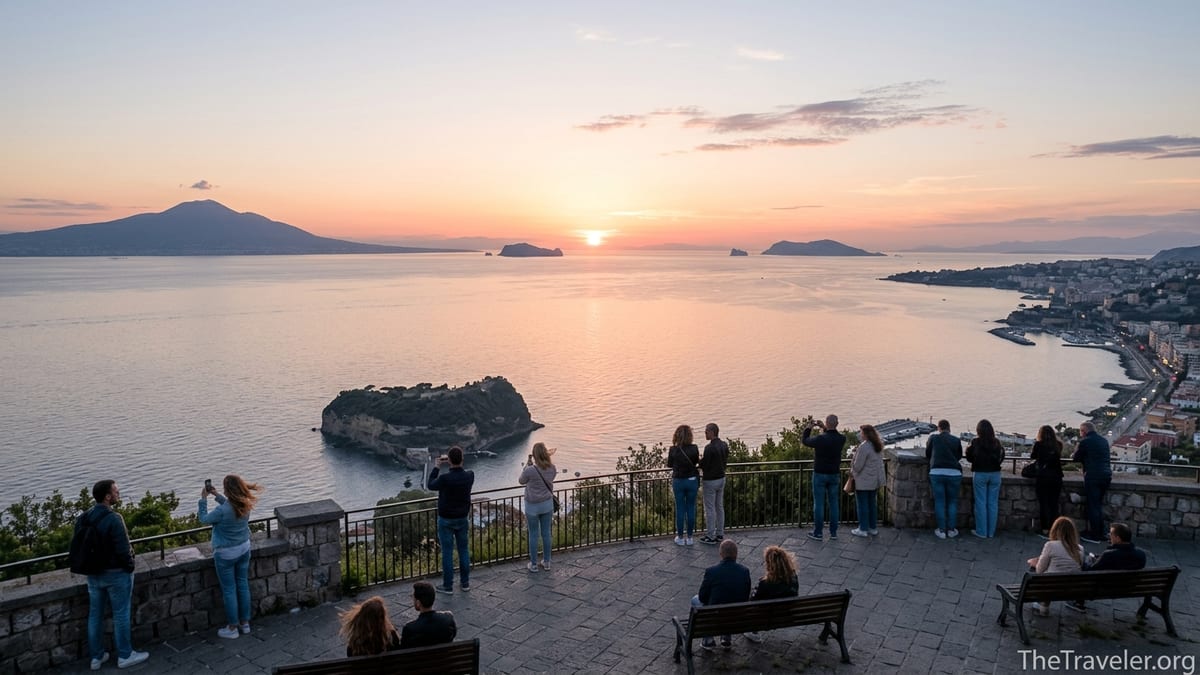
High above the Bay of Naples, Parco Virgiliano offers one of the city’s most sweeping sunset panoramas, with the islands of Capri, Ischia and Procida floating on the horizon and Mount Vesuvius turning purple in the fading light. This quiet park in the Posillipo district is not as famous as the historic center or the seafront promenade, but for many locals it is the best place in Naples to watch the sun go down. Here is how to experience Parco Virgiliano in 2026 for unforgettable coastal views, from when to arrive and where to stand to how to reach it on public transport.
Get the latest updates straight to your inbox!
Understanding Parco Virgiliano and Its Unique Viewpoint
Parco Virgiliano, sometimes called the Park of Remembrance, sits on the Posillipo hill at roughly 150 meters above sea level, about the height of a 40 to 45 story building. Instead of one single terrace, the park is laid out as a series of broad, paved belvederes stepping down the cliff edge. Each terrace frames a different slice of the coastline: west toward the Phlegraean Fields, south toward Capri and the open Tyrrhenian Sea, and east back to the urban sprawl of Naples and Vesuvius. This layered design means you can move a few meters and completely change the atmosphere of your sunset.
The park’s position on the Posillipo headland lets you look not only across the Bay of Naples but also into the smaller bay of Trentaremi and the islet of Nisida just below. On a clear evening you can often trace the line of the Sorrento Peninsula as it tapers toward Punta Campanella, then see the outline of Capri to the left and the bulk of Ischia farther to the right. The effect is that you feel suspended over a complex, three dimensional seascape rather than staring at a single flat horizon.
Historically, this ridge was appreciated by 19th century travelers who came for the “Posillipo view,” and in 1931 it was formalized into a remembrance park with monumental staircases and geometric planting. Today it feels less like a manicured garden and more like an everyday neighborhood park with dog walkers, teenagers on scooters and families with strollers. That local feel is part of its charm. Even in high season, you are more likely to hear Neapolitan dialect around you than a chorus of tour groups.
For a traveler used to viewpoints like Castel Sant’Elmo or the waterfront at Via Caracciolo, Parco Virgiliano offers a different perspective. You are no longer looking up at Vesuvius from sea level but looking across and slightly down over the city and the industrial shoreline of Bagnoli and Pozzuoli. The sweeping perspective makes it easier to understand the geography of the region and to put famous sites like the islands, the amphitheater of Pozzuoli and the volcanic craters of the Phlegraean Fields into context.
Best Time to Visit for Sunset and Typical Opening Hours
Parco Virgiliano is a public municipal park and, as of 2026, entry is free. Official information from the municipality indicates typical closing times around 21:00 on weekdays and 22:00 on Saturdays and Sundays for much of the year, with last entry about 30 minutes before closing. Hours can shift seasonally and the park may close early in high winds or storms because it is so exposed, so always check the latest Comune di Napoli notices once you are in the city or ask your accommodation to confirm the day before you plan to visit.
For the best sunset experience, aim to be inside the park at least 40 to 60 minutes before the actual sunset time. In June and early July, when sunset can be close to 20:30, that means arriving by around 19:30. In shoulder seasons like late April, May, September and early October, sunset falls more around 19:00 to 19:30, so planning to enter by 18:15 gives you time to explore the terraces before the colors change. In winter, when sunset is as early as 16:30 to 17:00, it becomes important to double check that the park is operating on its winter schedule so you are not caught outside the gates.
The light at Parco Virgiliano changes quickly because of the layered coastline. On hazy summer days, the sun often sinks into a soft pastel band over Procida and Ischia, which can make for atmospheric, slightly muted photos. In winter and early spring, the air is usually clearer, and you can see sharper outlines of Capri’s cliffs and the snowless cone of Vesuvius turning deep orange. Locals often say that the best weeks for long distance visibility here are between late October and early December and again in March, when humidity is lower.
If you want to combine sunset with a relaxed picnic or a slow stroll, consider arriving a full two hours before sunset. That allows time to find a bench, adjust to the wind, and possibly move viewpoints as the sun drops. It also avoids the small crowd that sometimes forms on the main western terrace in the last 15 minutes of light when people rush in from nearby cafes and bus stops.
Reaching Parco Virgiliano: Public Transport, Taxi and Parking
Parco Virgiliano is located in the Posillipo district, with one of the main entrances on Viale Virgilio and another commonly used access point near Via Tito Lucrezio Caro. From the historic center or Napoli Centrale railway station, expect at least 40 to 60 minutes travel time, depending on traffic and waiting times. The park sits in an upscale residential area that is not directly on a metro line, so you need to combine the metro or regional train with a bus or taxi.
One common public transport route starts from the Line 2 metro or regional trains at Napoli Campi Flegrei station. From there you walk a couple of minutes to Piazzale Tecchio and catch a bus heading up toward Posillipo. Routes vary, but in practice many visitors and locals report using bus 140 or similar coastal lines that terminate near the Posillipo headland. Typical single tickets cost around 1.80 euros and are valid across buses and metro for a limited time, provided you validate them on boarding. Tickets are sold at station kiosks, tabaccherie and via local apps such as UnicoCampania.
Another option is to take a taxi or an app based car from the historic center or Chiaia waterfront. In 2026, a metered taxi from Piazza del Plebiscito or Via Toledo to Parco Virgiliano often runs in the region of 18 to 25 euros in normal traffic, and less from the closer Mergellina seafront. Agree that you are going to “Parco Virgiliano a Posillipo” so the driver does not confuse it with the smaller Parco Vergiliano near Mergellina, which is a different site dedicated to the poet Virgil. For sunset, consider asking your driver to drop you on Viale Virgilio close to the main gate, where there is usually a modest cluster of people heading inside.
If you are driving, note that streets around Posillipo can be narrow and parking inconsistent. There are some blue paid spaces along Viale Virgilio and adjoining residential streets, but they fill quickly on warm weekend evenings when local families come for a stroll. It is wise to arrive earlier, around two hours before sunset, to give yourself time to find a legal spot. Keep valuables out of sight, as you would in any urban area, and expect to walk uphill or downhill for a few minutes between your car and the park entrance.
For those staying in neighborhoods like Vomero or Chiaia, combining the funicular or metro with a taxi for the final stretch can be an efficient compromise. For example, you might ride the metro to Mergellina station in the late afternoon, have a coffee along the seafront, then hail a taxi for the 10 to 15 minute drive up to Parco Virgiliano in time for sunset, avoiding the need to decipher multiple bus lines.
Finding the Best Terraces and Framing the Coastal Views
Once inside Parco Virgiliano, resist the urge to stop at the first viewpoint. The beauty of the park is that each terrace serves up a different panorama, and the most captivating spots for sunset are usually along the western and southwestern edges. Walk straight ahead from the gate, then follow the paved paths that slope gently toward the sea, watching for gaps in the low stone walls where smaller terraces open out.
For a classic sunset framed by Capri, head to one of the lower western terraces where the view stretches unobstructed over the open sea, with the island appearing as a long, flat silhouette. From here the sun usually sets slightly to the right of Capri in summer and closer to the island in spring and fall, providing backlit outlines that photographers love. If you look down, you will see the curving coastline of the Posillipo cliffs and, farther below, the small island of Nisida connected by a causeway, with the remains of Bagnoli’s former industrial zone beyond.
To appreciate the contrast between Naples’ urban core and the natural coastline, continue along the pathways that curve toward the southeast. Some of these terraces angle back toward the historic center, giving you a wide view of Vesuvius, the city’s dense buildings and the arc of the bay from Mergellina to Castel dell’Ovo. These spots are excellent for visitors who want a single image summarizing the city: sea in the foreground, the tight fabric of Naples in the middle distance, and Vesuvius as a backdrop.
If you are visiting earlier in the afternoon, take time to explore one of the higher terraces that look inland toward the Phlegraean Fields and the town of Pozzuoli. In clear light, you may be able to pick out the large amphitheater of Pozzuoli and the curved coastline toward Baia and Bacoli. As the sun begins to lower, many visitors walk back to the western terraces for the final show, making this a good moment to decide whether you prefer an unobstructed horizon or a more complex composition including coastal curves and islands.
Practical Tips for Comfort, Safety and Photography
Because Parco Virgiliano stands high on an exposed headland, it can feel significantly windier and cooler than the streets of central Naples, especially outside midsummer. In April, October or on any breezy evening, bring an extra layer, even if you spent the afternoon in a T shirt on the seafront. Locals often show up with light jackets or hoodies, and you will see families wrapping children in sweatshirts once the sun dips below the horizon.
Footwear matters more than many visitors expect. While the main paths are paved and generally flat, some terraces are reached via gentle slopes, and you will likely wander back and forth to check different views. Comfortable trainers or walking shoes are preferable to sandals with slick soles. This is especially true if you stay until the park begins to close and need to walk back out in dimmer light or along slightly uneven surfaces near benches and low walls.
For photography, a smartphone is more than capable of capturing Parco Virgiliano’s drama, but a few simple habits improve your results. Arrive early enough to experiment with compositions while the sun is still higher, then switch to focusing on color and silhouettes once it drops. Turning on HDR mode can help balance the bright sky and darker foreground, although some travelers prefer to underexpose slightly to keep the colors rich. If you use a dedicated camera, a wide angle lens in the 24 to 35 millimeter range on a full frame body lets you include sea, islands and foreground walls in the same frame without distortion.
Tripods are not commonly used here except by serious hobbyists, and space can be limited on the more popular terraces, so be considerate if you decide to set one up. Many visitors simply brace their phone on the top of the stone wall for stability during the final two minutes of light. As with any public park, keep an eye on your belongings, especially camera bags and jackets draped over benches when you are distracted by the view. The area is generally considered safe and is frequented by local families, joggers and dog walkers, but the usual big city awareness is still sensible.
Combining Parco Virgiliano with Food and Neighborhood Wandering
Sunset at Parco Virgiliano pairs naturally with an early evening aperitivo or simple meal. While there are no restaurants inside the park itself, the Posillipo district around Viale Virgilio and Via Tito Lucrezio Caro has a scattering of cafes, pizzerias and neighborhood bars. A common routine for locals might be to grab a slice of pizza al taglio or a paper cone of fried seafood from a small takeaway on Via Manzoni or Via Posillipo, then carry it into the park for a casual picnic on a bench.
If you prefer to sit down before or after your visit, look for small trattorias and wine bars within a 10 to 15 minute walk of the park gates. Many have outdoor tables along quiet streets where you can sample local dishes like spaghetti alle vongole or frittura di paranza. Prices away from the seafront are often a bit lower than on the waterfront promenades; for example, a margherita pizza in this area might cost in the region of 6 to 8 euros, with house wine by the glass around 4 to 5 euros. It is worth asking the staff if they know the current park hours that day, as waiters and baristas in the area are used to guests timing their meals around sunset visits.
For coffee lovers, consider stopping at a bar near Mergellina or along Via Caracciolo in the late afternoon, then heading up to Parco Virgiliano by bus or taxi. This gives you a sense of the city’s relationship with the sea at ground level before you see it transformed from above. Another appealing combination is to explore the waterfront in Bagnoli or the pier area known as pontile di Bagnoli earlier in the day, then make your way up to the park in time for the golden hour to watch the same coastline from a radically different angle.
After sunset, when the park begins to empty and the sky darkens, some travelers choose to walk partway down the hill toward Via Posillipo and find a bar for a final drink. From certain bends in the road you still catch glimpses of the illuminated bay and the chain of streetlights along the coast. If you plan to return to the historic center late in the evening, it is usually more comfortable and faster to use a taxi rather than multiple buses, especially if you do not speak Italian or are traveling with children.
The Takeaway
Experiencing Parco Virgiliano at sunset is less about ticking off a single viewpoint and more about inhabiting a high, wind washed ridge where sea, islands, volcano and city all line up in shifting layers. With free entry, easily accessible terraces and a genuine local feel, it offers one of the most rewarding low cost experiences in Naples. The key is to plan your timing around the light and the park’s opening hours, arrive with enough margin to explore several terraces, and prepare for cooler, breezier conditions than you might expect from the city streets below.
Whether you take the bus up from Campi Flegrei, share a taxi from the seafront or drive carefully through Posillipo’s residential lanes, reaching the park is part of the adventure. Once there, you can trace the shapes of Capri, Ischia and Procida on the horizon, look back across Naples to Vesuvius, and understand in a single sweep of the eyes why this city has fascinated visitors for centuries. With a little forethought about transport, clothing and where you will eat before or after, Parco Virgiliano can become one of the most vivid memories of your time in the Bay of Naples.
FAQ
Q1. Is there an entry fee for Parco Virgiliano?
As of 2026, entry to Parco Virgiliano is free, and there are no turnstiles or ticket booths at the main entrances, although hours and rules can occasionally change.
Q2. What are the current opening hours of Parco Virgiliano?
Information from the municipality indicates typical closing around 21:00 on weekdays and 22:00 on Saturdays and Sundays, but seasonal variations apply, so check locally just before your visit.
Q3. How early should I arrive before sunset?
For a relaxed experience, try to enter the park 40 to 60 minutes before sunset, or up to two hours early if you want time to explore terraces and settle on your favorite viewpoint.
Q4. What is the best season for clear coastal views?
While summer offers warm evenings and soft pastel skies, locals often find late autumn and early spring provide the clearest long range views of Capri, Ischia, Procida and the Sorrento Peninsula.
Q5. Can I reach Parco Virgiliano by public transport from central Naples?
Yes, you can combine the metro or regional trains to a station such as Napoli Campi Flegrei with a bus heading up toward Posillipo, typically using a single integrated ticket valid across both legs.
Q6. Is it safe to visit Parco Virgiliano at sunset?
The park is generally considered safe and is popular with local families, joggers and dog walkers, but you should use normal big city precautions and keep an eye on your belongings, especially as it gets dark.
Q7. Are there places to eat near the park?
There are several cafes, pizzerias and small trattorias within walking distance in the Posillipo area, where you can have a meal or aperitivo before or after your sunset visit.
Q8. Can I bring food and drinks into Parco Virgiliano?
Picnicking is common, and many locals bring snacks, water and soft drinks, but you should avoid glass bottles near terraces, take your litter with you and respect any posted local regulations.
Q9. Is Parco Virgiliano suitable for children and strollers?
The main paths are paved and relatively gentle, making the park accessible for strollers and families, although parents should keep children away from low walls and terrace edges, especially in windy conditions.
Q10. Are there toilets and other facilities in the park?
Basic public facilities, such as toilets and a small playground, are usually available, but their condition and opening times can vary, so it is wise to use restrooms before arriving and not rely solely on park services.