


Few cities stage their scenery as dramatically as Naples. Mountains, sea, islands and chaotic streets all seem to tumble into each other, and nowhere is that drama more intense than from two of the city’s finest viewpoints: Parco Virgiliano on the Posillipo headland and Castel Sant’Elmo high above the center in Vomero. Both promise a sweeping panorama of the bay and Mount Vesuvius. Yet the experiences they deliver, and the emotional impression they leave, are very different. Choosing between them can shape how you remember Naples itself.
Get the latest updates straight to your inbox!
Two Viewpoints, Two Very Different Naples
Stand on the terraces of Parco Virgiliano and you are at the city’s edge, where Naples dissolves into cliffs and sea. The park rides the crest of the Posillipo promontory, about 150 meters above the water, with a chain of terraces stepping down toward views of Capri, Ischia, Procida and the curve of the Sorrento and Amalfi coasts. On a clear afternoon the light feels Mediterranean-wide, open and breezy. Families push strollers along tree-lined paths, teenagers linger on benches with takeaway pizza, and dogs chase footballs on the gravel. It is Naples at its most leisurely.
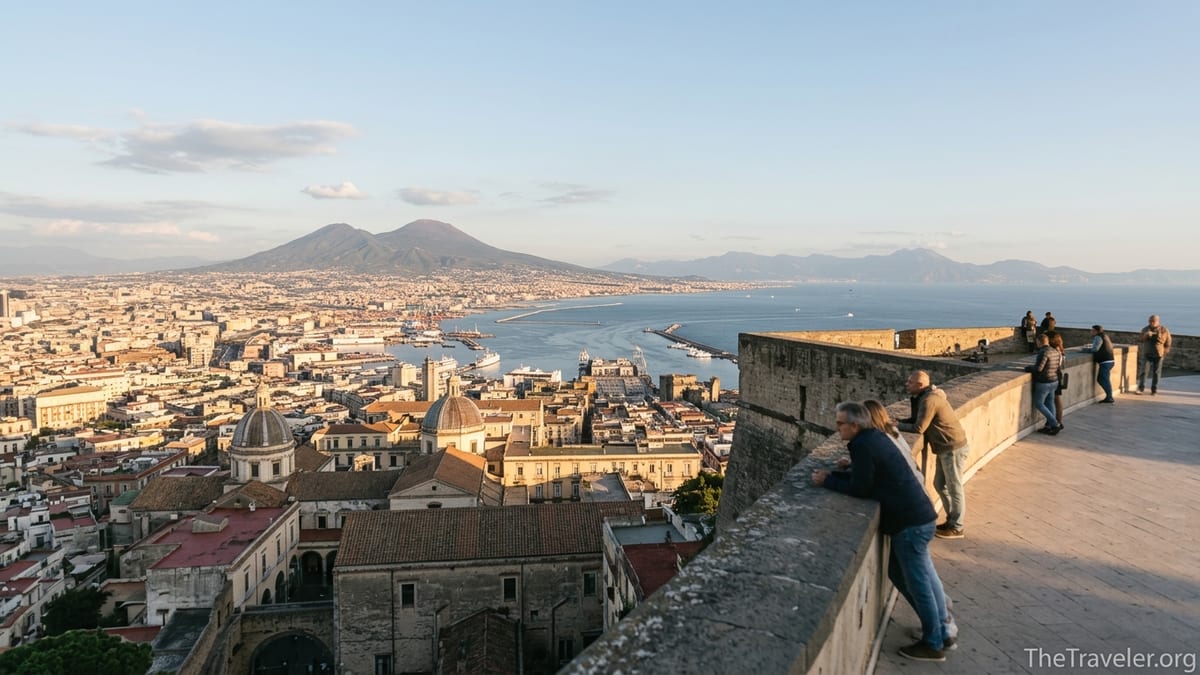
Castel Sant’Elmo, by contrast, sits almost directly above the historic center on Vomero hill. The fortress terrace looks down onto the dense grid of Spaccanapoli, the port cranes and the funnel of Via Toledo, with the bay and Vesuvius behind like a stage backdrop. You reach it by funicular from Montesanto, Chiaia or the Spanish Quarter, popping up into an elegant residential district of cafes and boutiques before following signs to the castle. The feeling is more vertical and urban than at Parco Virgiliano, as if you are hovering over the city rather than escaping it.
Both viewpoints frame the same volcano and the same arc of coastline, but the lens through which you see them could not be more different. One is a neighborhood park at the shoreline of the city’s imagination, the other a historical stronghold that once defended the streets at your feet. Deciding which leaves a bigger impression largely depends on whether you are seeking Naples as a lived-in landscape or as a dramatic urban theater.
What You Actually See From Each Viewpoint
At Parco Virgiliano, the view unfolds in layers from west to east. Immediately below the cliffs are the rocky inlets of Gaiola and Trentaremi, and the curve of Gaiola Underwater Park. To your right the industrial shoreline of Bagnoli and the old Italsider steelworks contrast sharply with the blue of Pozzuoli Bay and the low ridge of Monte di Procida. Farther out, the islands of Procida and Ischia sit like stepping stones across the water, while on particularly clear days you can trace almost the entire Campanian coastline in a single slow turn of the head.
If you pivot toward the city from one of the central terraces, Vesuvius is framed behind the inner curve of the Bay of Naples: the port, the downtown skyline and Castel dell’Ovo stand tiny below. This is where sunset at Parco Virgiliano becomes memorable. The volcano’s silhouette darkens, ferries pull white wakes across the bay, and the streetlights of Naples and Pozzuoli flicker on together. It is not the structured, postcard-perfect composition you get from a castle bastion. It feels instead like an enormous balcony onto an entire region.
From Castel Sant’Elmo, the view is tighter and far more focused on the city itself. The walkable ramparts give you 360 degrees, but most visitors drift to the southeast side overlooking the centro storico. From here the straight line of Spaccanapoli slices the old city like a ruler, church domes rise from the density, and the port and cruise ships lie almost directly below. Vesuvius still dominates the distance, but now it looms over an intricate model of Neapolitan life: traffic on Via Marina, trains pulling in and out of the main station, and ferries turning toward Capri.
Because of this proximity, photographs from Castel Sant’Elmo feel almost architectural. Wide-angle shots capture Vesuvius, the bay and an orderly patchwork of tiled roofs and cupolas. Telephoto lenses can isolate details such as the green copper dome of the Galleria Umberto or the masts in the yacht harbor. At Parco Virgiliano, the camera naturally seeks horizons, islands and coastline, and even smartphone photos have a sweeping, wide-screen quality. Both are beautiful, but one centers the city while the other centers the landscape around it.
Atmosphere: Park Stroll vs Fortress Terrace
The emotional tone of each place is where many travelers decide which view lingers in their memory. Parco Virgiliano functions first as a neighborhood park. Entry is free, the paths are lined with pine and tamarisk trees, and there are playgrounds, kiosks and fitness areas. On warm evenings you are more likely to queue behind local children for a ride on the swings than to overhear tour groups. The park’s terraces are interspersed with lawns and shaded benches, so you can move back and forth between the views and quieter corners for reading or a picnic.
This everyday quality can make Parco Virgiliano especially powerful if you have already spent time in the busy centro storico. After a morning of threading through Via dei Tribunali and dodging scooters in the Spanish Quarter, walking into the park’s open horizon can feel like a deep breath. Travelers often comment that it is the first place in Naples where they hear mainly Italian, and where they can watch evening rituals like grandparents taking grandchildren for gelato without the overlay of tourism. The impression it leaves is one of belonging, as if you have stepped for a moment into the city’s private living room.
Castel Sant’Elmo, on the other hand, wears its monumentality on its sleeve. You enter through stone corridors that open onto a huge star-shaped bastion, with the city tumbling down the hill below. There is a ticket office at the entrance and a small elevator for those who prefer not to climb to the roof level. Even before you reach the upper terrace, the thick walls and sharp angles of the fortress emphasize that you are inside a historic military structure. This lends weight to the view. You do not simply look at Naples; you see it from the vantage point of centuries of rulers who controlled the city from precisely this perch.
The terrace itself can feel surprisingly calm, especially in the late afternoon outside peak season, when the crowds thin and the wind off the bay picks up. Yet the presence of museums within the complex, along with explanatory panels and occasional exhibitions, gives the visit an undeniably cultural tone. Many travelers pair Castel Sant’Elmo with the nearby Certosa di San Martino monastery and its museum, turning the outing into a half-day immersion in art and history. The memory here is of a curated encounter with Naples: beautiful, but framed.
Practicalities: Opening Hours, Tickets and Getting There
Parco Virgiliano is operated as a municipal park and, at the time of writing, is open daily with extended hours in the longer-light months. Typical posted times are from early morning until around 9 p.m. on weekdays and about 10 p.m. on Saturdays and Sundays, though exact seasonal schedules can shift slightly and are usually updated on city information boards near the entrance. Entry is free. For travelers watching their budget, this makes the park one of the best cost-free panoramas in Naples, particularly if you bring your own snacks or pick up takeaway pizza or sfogliatelle from a bakery in Posillipo on the way.
Reaching Parco Virgiliano without a car requires modest planning. From the city center, the most straightforward route is to reach the Mergellina or Piazza Sannazaro area, then take a bus that climbs toward Posillipo and the park entrance, followed by a short uphill walk. Travel time from the historic center can easily reach 45 minutes to an hour, depending on traffic and connections, and buses in the Posillipo area can be somewhat irregular. Many visitors choose to use a licensed taxi or ride-hailing-style transfer from central neighborhoods like Chiaia or the seafront, which typically costs the equivalent of a mid-range restaurant meal for two. Renting a scooter for the day is another common Italian solution, though it demands comfort with Naples traffic.
Castel Sant’Elmo is both more central and more structured. Managed by the Italian culture ministry, it charges an admission fee that is generally in the low double digits in euros for adults, with reduced rates for some age groups and occasional free-entry days tied to national cultural initiatives. Tickets can usually be bought on site, and combined tickets with the Museo del Novecento or nearby San Martino complex are sometimes available. Because the castle opens in the morning and closes in the early evening, timing your visit around sunset in winter months requires checking current hours in advance.
Getting to Castel Sant’Elmo is straightforward and, in many ways, an enjoyable part of the experience. Three historic funicular lines connect lower Naples with Vomero. From the Spanish Quarter or Piazza Augusteo you can ride the Chiaia funicular; from Montesanto you take the line of the same name; from Piazza Amedeo and the seafront area of Chiaia there is the Centrale funicular. All whisk you up the hillside in a few minutes on a standard city ticket. Once at the top, it is a short, clearly signposted walk through the pleasant Vomero streets to the castle’s entrance. For travelers with limited time or mobility, this ease of access often tips the scales in favor of Sant’Elmo.
When to Go: Light, Crowds and Weather
At both viewpoints, timing your visit to the right time of day can dramatically change the impression you take home. At Parco Virgiliano, the magic hours are late afternoon to sunset. Midday light can be harsh on the water and haze sometimes blurs distant islands in summer, but as the sun lowers behind Ischia and Procida, the cliffs of Posillipo take on gold tones and the outlines of Capri and the Sorrento Peninsula sharpen. Locals often arrive in these hours precisely to watch the sky shift through oranges and pinks before strolling home for dinner. In winter, the sun sets earlier and the air is clearer, which can produce crisp blue and violet seascapes if you are dressed warmly enough for the wind on the terraces.
Crowding at Parco Virgiliano tends to concentrate around weekends and local holidays, especially in spring and early autumn when outdoor activities peak. Even then, the park’s size and multiple terraces mean you can usually find a quiet corner by walking just a few minutes farther than most day-trippers. Early mornings are particularly calm and lend themselves to jogging, photography and bird-watching, as seabirds ride thermals along the cliffs.
Castel Sant’Elmo’s light is most flattering from late morning to mid-afternoon if you want sun on the fronts of buildings and the volcano. In the very early morning, the city can still be shaded by the hills to the east, and in the hours before sunset much of central Naples lies in partial shadow while Vesuvius and the bay behind it glow. Both conditions have their own appeal for photographers, and the fortress walls offer plenty of space to move around and adjust compositions as the sun arcs across the sky.
Visitor numbers at Sant’Elmo are linked to both time of year and cruise schedules. On days when large cruise ships are in port, the castle can see a mid-afternoon spike as organized excursions arrive from the city center. Shoulder-season weekdays, on the other hand, can feel surprisingly quiet. If you want the terrace largely to yourself, consider arriving soon after opening time, especially outside high summer. In poor weather, the fortress is still worth visiting for its architecture and exhibitions, whereas Parco Virgiliano’s appeal drops sharply in heavy rain or strong wind.
Which View Leaves a Bigger Impression, and For Whom?
For first-time visitors on a short stay, Castel Sant’Elmo often delivers the more immediately striking impression. Its terrace presents Naples in a single, digestible picture: the historic center, the port, Vesuvius and the curve of the bay all laid out like a relief map beneath your feet. The route there, via the funicular and the pleasant streets of Vomero, fits neatly into a day that might also include shopping, a visit to Certosa di San Martino, and dinner in a pizzeria on the hill before gliding back down to the center. If you are introducing someone to Naples and want one view that says “this is the city,” Sant’Elmo is hard to beat.
Parco Virgiliano, however, can leave a deeper mark on travelers who are curious about how Naples fits into its wider landscape. Looking out from the park, you do not only see a city and its volcano; you see an entire volcanic region of headlands, islands, craters and inlets, from Pozzuoli to Capri. The industrial remains of Bagnoli below, the green slopes of the Phlegraean Fields beyond and the distant ribbon of the Amalfi Coast all tell fragments of the region’s history in a single sweep of the eyes. For photographers, hikers and anyone who loves slow, contemplative views, this broader horizon can be unforgettable.
There is also a question of mood. If you respond to quiet, everyday spaces and want to feel, briefly, like a resident rather than a visitor, Parco Virgiliano’s mix of dog walkers, playgrounds and teenagers leaning on railings may linger longer in your memory. If you are drawn to grand, almost theatrical viewpoints that give a sense of mastery over the city, Castel Sant’Elmo’s fortress terrace will likely satisfy more deeply. Many seasoned travelers who know Naples well will tell you that the ideal answer is not to choose, but to experience both on different days, using them as complementary lenses on the city.
For families, accessibility and logistics might tilt the balance. Castel Sant’Elmo’s elevators, paved ramps and proximity to cafes and toilets can make it easier with small children or older relatives. Parco Virgiliano has paved paths and is officially marked as broadly accessible, but the uphill approaches from bus stops, the wind on the terraces and the relative scarcity of nearby indoor retreats mean planning ahead with snacks, water and layers is wise. Solo travelers and couples, meanwhile, often appreciate Parco Virgiliano for its romantic sunsets and less touristic feel, especially if they have already ticked off the main city viewpoints.
The Takeaway
If your time in Naples is limited and you can visit only one viewpoint, Castel Sant’Elmo is the more efficient and emblematic choice. It is easy to reach by funicular, provides commanding views over the historic center and bay, and combines naturally with cultural visits to nearby museums and churches. You will come away with images and memories that match the classic mental picture of Naples: a dense, energetic city gathered around its volcano and sea.
If you have a spare afternoon or evening and crave a slower, more expansive encounter with the region, Parco Virgiliano may ultimately leave the stronger emotional impression. The park invites lingering rather than ticking off sights, and its broad horizon reveals how Naples nestles within a chain of islands, cliffs and volcanic fields. Watching the sun sink behind Ischia while the city glows to your left can make you feel not just like a spectator, but like a temporary participant in local life.
The most rewarding itinerary for many travelers is to treat the two viewpoints as a pair of bookends. Begin your stay with Castel Sant’Elmo to grasp the layout of the city from above, then end it at Parco Virgiliano, when the neighborhoods and islands you are looking at have become familiar names and memories. Taken together, they turn Naples from a chaotic blur on a map into a coherent, deeply textured place that is as much about sea and sky as it is about crowded alleys and baroque churches.
FAQ
Q1. Is Parco Virgiliano free to visit?
Yes, Parco Virgiliano is a municipal park and entry is free, although you will need to budget for transport or a taxi to reach the Posillipo headland.
Q2. How much time should I plan for Castel Sant’Elmo?
Most visitors spend about 1.5 to 2 hours at Castel Sant’Elmo, allowing time to reach the terrace, walk the ramparts, take photos and briefly explore the interior spaces.
Q3. Which viewpoint is better if I have only one day in Naples?
If your time is very limited, Castel Sant’Elmo is usually the better choice because it combines easily with sightseeing in the historic center and offers a concise, iconic panorama of the city.
Q4. Can I watch the sunset from both Parco Virgiliano and Castel Sant’Elmo?
Yes, both offer excellent sunset views, but you should check current opening hours for Castel Sant’Elmo, since seasonal closing times may mean you cannot always stay until the sun is fully down.
Q5. Which viewpoint is more suitable for families with children?
Both can work for families, but Castel Sant’Elmo’s easier access by funicular, on-site facilities and more compact layout can be simpler with small children or older relatives.
Q6. Is public transport to Parco Virgiliano reliable?
Public buses to Posillipo run regularly but can be subject to traffic and occasional gaps, so many visitors allow extra time or choose taxis or scooter rentals instead of relying on tight schedules.
Q7. Do I need to book tickets in advance for Castel Sant’Elmo?
Tickets are often available on site without advance booking, but during peak holiday periods and major events buying ahead or arriving early in the day can help avoid queues.
Q8. Which spot is better for photography enthusiasts?
Castel Sant’Elmo excels for detailed cityscapes and architectural shots, while Parco Virgiliano is ideal for wide seascapes, island views and atmospheric sunset photography.
Q9. Can I combine either viewpoint with other nearby sights?
Yes, Castel Sant’Elmo pairs naturally with the Certosa di San Martino and a stroll through Vomero, while Parco Virgiliano combines well with a coastal walk or a visit to the Posillipo shoreline below.
Q10. If I am afraid of heights, will I still enjoy these viewpoints?
Both viewpoints have solid railings and spacious terraces, but Castel Sant’Elmo feels less exposed, whereas some terraces at Parco Virgiliano sit close to high cliffs and may feel more vertiginous.