


Lemmenjoki National Park in Finnish Lapland is one of Europe’s largest roadless wilderness areas, but it is also surprisingly accessible for hikers and curious gold seekers. Between the wide river valley, lonely fells, open wilderness huts and living gold rush history, it offers a very different experience from more crowded Nordic parks. This guide explains how to plan a trip built around hiking, small-scale gold panning and quietly absorbing Arctic nature, with concrete details to help you turn a map of northern Finland into a real journey.
Get the latest updates straight to your inbox!
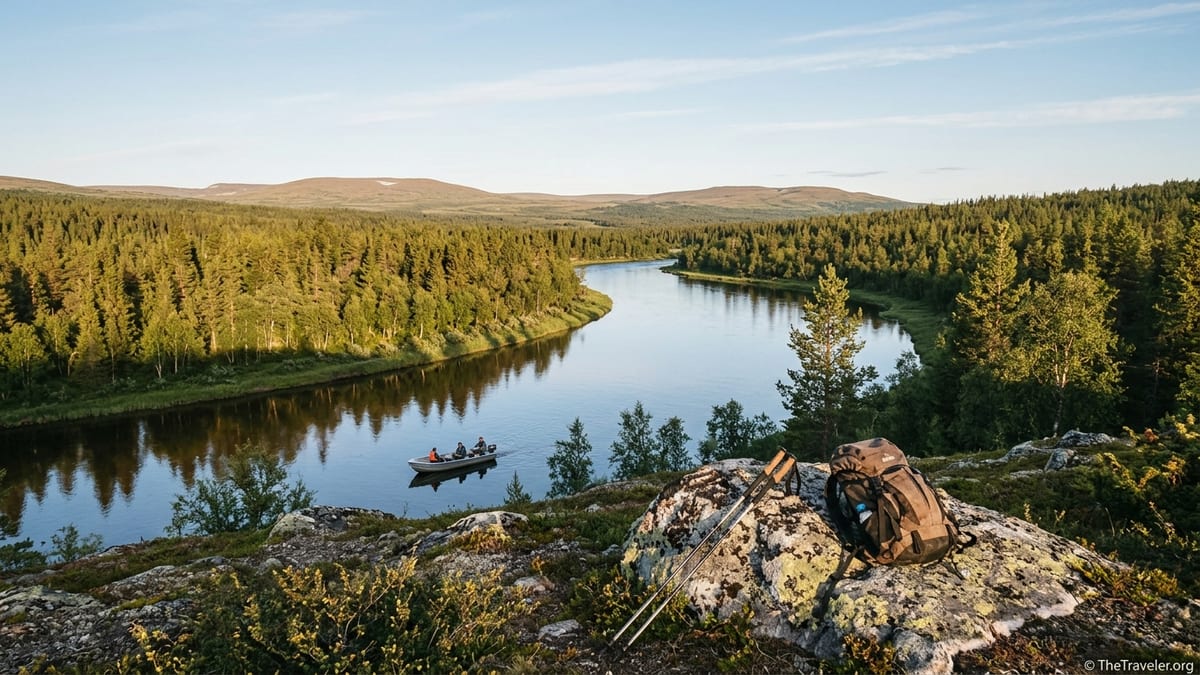
Understanding Lemmenjoki: Europe’s Quiet Gold Wilderness
Lemmenjoki National Park lies in northern Lapland, roughly a 90-minute drive from the village of Inari and about four hours from Rovaniemi in summer. It is Finland’s largest national park, with more than 2,800 square kilometres of fells, river valleys, spruce and birch forest and bog. Much of this area has no roads or permanent settlements. For visitors, that remoteness translates into long stretches of trail where you may not see anyone for hours, even in July, especially once you leave the main river corridor.
What makes Lemmenjoki unusual is that it is both a protected wilderness and an active gold-mining landscape. Hand-dug claims and old dredging sites survive in the upper Lemmenjoki valley, and you can still walk past working claims where prospectors use shovels and pans under special permits. Heavy machinery has been largely phased out inside the park, and modern regulations restrict prospecting to traditional, small-scale methods, so you are more likely to hear the clink of a shovel than the rumble of an excavator.
The park is managed by Metsähallitus, the Finnish state forestry and parks agency. In practice that means well-marked core routes, maintained open wilderness huts, and clear rules about fire, camping and gold panning. Ahead of your trip, it is worth checking the official national parks information pages for any seasonal restrictions, such as closures around nesting sites or temporary rules affecting the goldfields. Signage on-site is typically in Finnish and English, with some Sami place names that appear on maps and waymarks.
Most first-time visitors base themselves in Njurkulahti, a tiny river village with a gravel parking area, a simple camping ground and small family-run operators offering boat transports, cabins and meals. From here, boat trips run up the Lemmenjoki River to Ravadas Falls and the gold area in summer, and most popular hiking routes either start or pass close by.
Planning Your Trip: When to Go, Permits and Budget
The main hiking and gold panning season in Lemmenjoki runs from late June to early September. In early June snow patches can still linger on the fells and river levels may be high, which complicates crossings. July and early August bring the warmest temperatures, long daylight and the midnight sun, but also mosquitoes in the forests and bogs. By late August and early September bugs drop off, nights grow darker, and the birch forests turn yellow and orange. That late-summer period is ideal if you want a better chance of northern lights during clear nights while still having mostly dry ground.
For most visitors, no special hiking permit is required. You can walk the marked trails and use open wilderness huts free of charge, following posted rules. Gold panning is different. Recreational panning on commercial claims is only allowed with the claim holder’s permission, usually on a paid guided tour. If you ever considered applying for your own gold panning permit in the park, the process runs through Finland’s mining authority and Metsähallitus, and is designed for long-term prospectors, not casual visitors. For travel planning purposes, assume you will pan only at supervised, legal gold panning sites as part of an organized experience.
Costs in Lemmenjoki are in line with remote Lapland rather than Helsinki. A basic riverside camping place near Njurkulahti with access to toilets and a simple shelter is typically priced in the region of 20 to 30 euros per night for a small tent or car, while simple cabin accommodation with shared facilities can range from about 70 to 120 euros per night depending on season and amenities. A return boat trip from Njurkulahti to Ravadas Falls and back, including a stop at the falls, is commonly priced somewhere around 50 to 80 euros per adult, with additional cost if you continue deeper into the gold area or include guided gold panning.
Transport is one of the bigger line items to budget. There is no train to Lemmenjoki; most visitors fly to Ivalo or Rovaniemi, rent a car and drive to Njurkulahti via Inari. In summer 2026, typical compact car rentals from Ivalo for a week have hovered around 400 to 600 euros before fuel, depending on booking timing and provider. A more budget-conscious approach is to use long-distance buses to Inari, then arrange a local taxi or pre-booked transfer to Njurkulahti, though this limits your flexibility once in the area.
Key Hiking Routes: From Day Walks to Multi-Day Wilderness
Lemmenjoki’s trail network separates into a more developed recreation zone along the lower river and a true backcountry section where paths are rougher and less marked. For many visitors, starting with one or two well-known routes gives a good introduction without committing to a full wilderness trek.
The Lemmenjoki Nature Trail, often called Lemmenjoen luontopolku, is an easy half-day loop of around 4 to 5 kilometres that starts near the Njurkulahti parking area. It is a good choice on your arrival day or in poor weather, with modest climbs, information boards about local flora and Sami culture, and several viewpoints over the river and surrounding fells. Underfoot you can expect a mix of forest path, plank boardwalk over wet areas and some rocky sections.
Stronger hikers gravitate toward the Joenkielinen loop, a roughly 16 kilometre route that climbs the Joenkielinen fell for wide views over the Lemmenjoki valley and adjacent wilderness. On a clear July afternoon you can see far into the Norweigan border fells. The ascent is steady but not technical, although the trail can be stony and exposed on top. Allow a full day, especially if you want to linger for photos or break for a long lunch around the treeline. In poor visibility or high winds, be prepared with warm layers and navigation basics, as the openness of the fell can be deceptive.
For a multi-day experience, the classic choice is the Kultareitti or Gold Trail, which connects Njurkulahti with the upper Lemmenjoki goldfields on a rough loop of about 60 kilometres, with several open wilderness huts along the way. Many hikers stretch this into three to five days, spending nights in huts such as the Ravadasjärvi hut or tent camping near designated fire sites. On this route you move from river valley forest to more open country, passing both historic and current gold claims. In peak summer, some hikers report meeting working prospectors near established claims, so it is important to stay on the marked trail and respect all fenced or signed areas.
Wilderness Huts, Camping and Arctic Overnight Culture
One of Lemmenjoki’s greatest assets for hikers is its network of open wilderness huts. These simple log structures, managed by Metsähallitus, usually contain wooden bunks, a table, benches and a wood-burning stove. Many have a dry toilet and a firewood shed nearby, often with an axe and saw available. Use is free and first-come, first-served, and the unwritten rule is that no one is turned away in bad weather. That said, you should always bring your own tent or tarp in case a hut is already full when you arrive late.
An example is the Ravadasjärvi open wilderness hut, located near the Ravadas Falls area and reachable by a long day’s hike or a combination of boat and foot travel. In high season you might share the hut with Finnish families, German backpackers and solo hikers from as far as Japan or the United States. Conversations tend to revolve around route conditions, reindeer sightings and whose boots are the most saturated after bog sections. Evenings usually centre on the stove: collecting and cutting wood, melting snow or boiling river water in early season, and drying socks on improvised lines.
Wild camping is generally permitted in much of Lemmenjoki under Finland’s Everyman’s Rights, but in the recreation zone of the park camping may be restricted to designated areas around huts and official campsites. In practice many hikers pitch tents on dry ridges or beside small lakes, keeping a respectful distance from huts and staying off fragile vegetation. Fires are allowed only in established fireplaces and usually only when there is no forest fire warning in effect. Gas stoves are the safer and more reliable option for cooking, especially in late summer when restrictions are more common.
Compared with many other parts of Europe, overnight life here is quiet and low-key. There are no staffed mountain lodges with restaurants. Instead, bring your own food from Inari or earlier in your journey, and think in terms of dried meals, porridge oats, cheese, smoked reindeer or salami and plenty of snacks. In late August blueberries can still be found along some trails, and on certain bog edges you may see cloudberries, though picking enough for a dessert requires time and a keen eye.
Experiencing Gold Panning the Right Way
Lemmenjoki’s gold rush peaked in the mid-20th century, but small-scale prospecting continues under modern rules that strive to balance cultural heritage, environmental protection and local livelihoods. For visitors, the most accessible window into that world is a guided gold panning excursion arranged by local operators based around Njurkulahti and nearby Menesjärvi. On a typical half-day trip, a boat carries you upriver past forested banks and abandoned dredges to a working claim, where the claim holder or guide explains the basics before you try panning in a controlled area.
The process is simple but surprisingly physical. You shovel gravel and sand into a pan, immerse it in water and swirl it so that lighter material washes away, leaving heavier minerals behind. Genuine gold flakes, when they appear, are tiny: more glitter than nugget. On many tours, any minuscule gold you find is collected at the end and presented in a small vial or glued into a souvenir card to take home. Prices for these experiences vary, but you can expect a combined boat and gold panning tour to cost somewhat more than a straightforward boat trip to the falls, reflecting the specialist nature of the activity and time spent at the claim.
Independent gold panning within the park is not simply a matter of walking to a riverbank with a pan. Prospecting on state land requires a formal permit issued by the Finnish mining authority, and within Lemmenjoki National Park such activity is limited to specific areas where gold panning is considered part of the cultural landscape. Heavy machinery is tightly controlled or prohibited in most zones, and environmental conditions such as water quality and erosion are monitored. As a visitor, respecting these restrictions is part of protecting a fragile valley that has already seen one intense wave of extraction.
An interesting complement to the hands-on panning is to walk portions of the gold field on the Gold Trail and look for subtle traces: old sluice remains, rusting metal, or cabins tucked close to creeks. Some information boards along the route explain the history of Lemmenjoki’s gold rush and how it shaped local villages. When you combine this context with a short stint at a working claim, the valley feels less like untouched wilderness and more like a place where human effort and nature have been negotiating terms for decades.
Arctic Nature: Seasons, Wildlife and Sami Culture
Beyond gold and hiking, Lemmenjoki is above all an Arctic ecosystem in motion. In June, the park wakes rapidly. Migratory birds arrive on the bogs and river islands, cloud and ground temperatures can differ by more than ten degrees, and reindeer herds move through the birch woods, leaving hoofprints in damp ground. By July the forest canopy is fully out, and the undergrowth hums with mosquitoes in still conditions, though breezy ridges and open fells are often almost bug-free by comparison.
Wildlife sightings are usually subtle: a glimpse of a moose at a river bend near dusk, the distant silhouette of a golden eagle circling over a ridge, or a curious Siberian jay landing near your lunch stop in the spruce zone. Larger carnivores like brown bear exist in the park but are rarely seen; most visitors never encounter them directly. Instead, expect to collect smaller moments: the sound of reindeer bells carried across a valley, or the sudden quiet that falls when you leave the river and step into a mossy side ravine.
Lemmenjoki is also Sami homeland. Place names, reindeer herding routes and sacred sites are layered into the landscape in ways that are not always obvious to an outsider. In the village of Inari, the Siida Sami Museum and Nature Centre offers a useful introduction before you head into the park, with exhibits on traditional livelihoods, clothing, seasonal movements and how Sami communities relate to land and water. Spending a half-day there on your way north gives context to details you will later see on the trail, from reindeer fences to shaped poles used in older herding practices.
Respect for local culture is as important as environmental care. If you encounter working reindeer herders or pass by corrals, keep your distance and move quietly. Do not cross fences or disturb marked structures even if they seem unused. In conversations with local guides, you may hear different perspectives on gold mining and tourism, which are valuable reminders that this landscape is both a national park and a living homeland rather than a purely recreational backdrop.
Practical Tips for a Safe and Rewarding Visit
Weather in Lemmenjoki can shift rapidly, even in midsummer. A day that starts at 18 degrees Celsius under blue sky can end with cold rain and wind on the fell tops. Pack a reliable waterproof shell, light insulating layers, hat and gloves even for July. Footwear should balance support and drainage: many experienced hikers choose mid-height hiking boots or trail shoes with quick-drying socks, accepting that boggy sections will get feet wet and planning frequent sock changes rather than relying on total waterproofing.
Navigation is straightforward on marked routes near Njurkulahti but becomes more demanding deeper into the park. Carry a printed Lemmenjoki outdoor map or relevant topographic sheets, not just a smartphone app, and know how to use them with a compass. GPS devices are helpful but batteries drain faster in cold and under constant tracking. River crossings on established trails are usually bridged, but occasional fords can be calf- or knee-deep early in the season; trekking poles are useful here, and sandals or neoprene socks can make repeated crossings more bearable.
In terms of safety, mobile phone coverage is limited once you leave the main valley, and even there it can be patchy. A small satellite communicator or personal locator beacon is worth considering if you plan a solo multi-day hike. Leave your route plan with someone reliable and sign guestbooks in wilderness huts when you pass through; they provide a valuable paper trace in case of emergency. Tap water from huts and many streams is generally considered safe by local hikers when taken away from grazing areas, but international visitors often prefer to filter or boil water as a precaution.
Finally, take your time. Many travellers try to squeeze Lemmenjoki into a single night on a fast Lapland road trip between Rovaniemi and Nordkapp. While a quick boat to Ravadas Falls and back is memorable, the park reveals itself more fully over three to five days: slow mornings making coffee on a hut porch, late-evening walks under the midnight sun, and maybe a small glass vial with a few flecks of gold in your pocket as a tangible reminder that beneath all that quiet moss, the river is still at work.
The Takeaway
Lemmenjoki National Park rewards travellers who are willing to go a little farther and move a little slower. It blends accessible marked trails with one of Europe’s last large roadless wilderness areas, layers a living gold rush story onto a protected Arctic valley, and offers a style of travel built around simple huts, small boats and your own two feet. With realistic expectations about distances, costs and conditions, and with respect for both the environment and Sami culture, you can craft a journey that feels far from the usual Nordic tourist circuit.
Whether your focus is hiking the Gold Trail, trying your hand at supervised gold panning or simply sitting quietly above the Lemmenjoki River as reindeer move across a distant slope, this park offers space and time in rare abundance. Plan carefully, pack for changeable weather, and leave room in your itinerary for unhurried days. Lemmenjoki is not a place to tick off; it is a place to inhabit, if only for a short northern summer.
FAQ
Q1. Do I need a permit to hike in Lemmenjoki National Park?
No special hiking permit is needed for marked trails or using open wilderness huts, but you must follow park rules on camping and fires.
Q2. Can I gold pan on my own in Lemmenjoki?
Independent gold panning requires a formal permit and is limited to specific areas, so short-term visitors should join guided panning tours instead.
Q3. What is the best time of year to visit Lemmenjoki for hiking?
Late June to early September offers the most reliable conditions, with late August and early September popular for fewer insects and autumn colours.
Q4. How do I get to Lemmenjoki without a car?
You can take a long-distance bus to Inari and then pre-book a local taxi or transfer to Njurkulahti, though you will have less flexibility once there.
Q5. Are the wilderness huts heated and do I need to pay for them?
Open wilderness huts are free, unstaffed and heated by wood stoves that you operate yourself; you must collect firewood and share space considerately.
Q6. Is Lemmenjoki suitable for beginner hikers?
The shorter nature trails near Njurkulahti are suitable for beginners, but longer routes like the Gold Trail require good fitness, navigation skills and self-sufficiency.
Q7. What wildlife might I see in the park?
Common sightings include reindeer, birds such as Siberian jays and occasional moose, while large predators like bears are present but rarely seen.
Q8. Can I see the northern lights from Lemmenjoki?
Yes, from late August onward, clear dark nights can bring aurora displays, especially away from village lights and on open fell tops.
Q9. Are there shops or restaurants inside the national park?
Services are minimal; bring food from Inari or earlier. Near Njurkulahti you may find a small camping kiosk or guesthouse meals, but nothing deep in the park.
Q10. Do I need to worry about mosquitoes in summer?
In June and July mosquitoes can be intense in forest and bog areas, so bring repellent, long sleeves, and consider a head net for comfort.