


Deep in Finnish Lapland, two vast national parks promise some of Europe’s wildest trekking: Lemmenjoki National Park and Urho Kekkonen National Park. Both offer roadless fells, reindeer trails and true silence, yet the experience on the ground is remarkably different. If you only have time for one serious wilderness adventure, which should you choose? This guide compares them side by side so you can match the park to your skills, expectations and travel style.
Get the latest updates straight to your inbox!
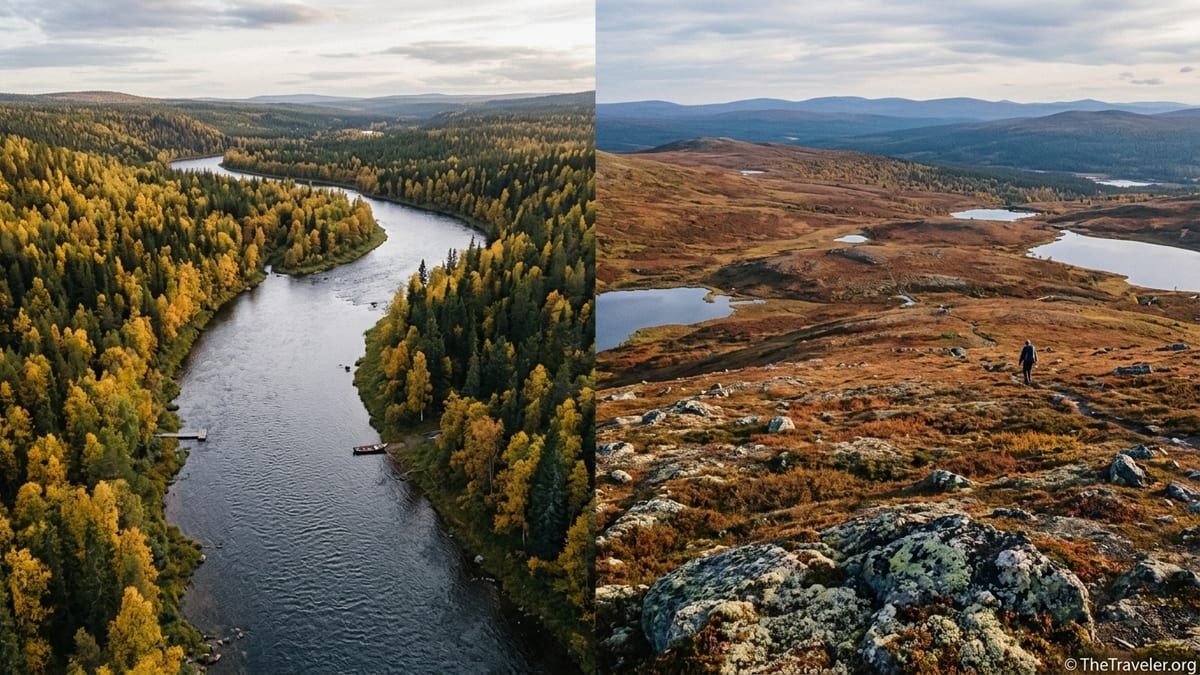
Getting Your Bearings: Two Giants of Finnish Lapland
Lemmenjoki and Urho Kekkonen are among Finland’s largest protected areas, and both sit well north of the Arctic Circle. Lemmenjoki sprawls across a huge river valley west of the town of Inari and pushes toward the Norwegian border, with one of Europe’s largest roadless backcountry zones. Urho Kekkonen, slightly smaller but still massive, stretches east from the resort village of Saariselkä toward the Russian border, a broad wedge of fells, forests and mires.
For most travelers, geography and gateways are the first big difference. Lemmenjoki’s main access point is the tiny village of Njurgalahti, about a 45 minute drive from Inari. You are quickly beyond phone signal and formal infrastructure once you step onto the Lemmenjoki River trail. Urho Kekkonen, by contrast, is tightly linked to Saariselkä and nearby Kiilopää fell center, which offer hotels, cabins, supermarkets, gear rental shops and a well-staffed visitor center at the edge of the park.
That contrast shapes the overall feel. Lemmenjoki rewards those who want to disappear into a quiet river valley with sporadic services such as seasonal riverboats and a few gold-mining camps. Urho Kekkonen lets you walk directly from a supermarket in Saariselkä onto a marked fell route, yet continue for a week or more through open country using a network of wilderness huts and saunas. Both are genuine wilderness experiences, but they start from very different bases.
In practice, visitors often decide based on how independent they want to be. If your idea of a perfect trip is stocking up for 5 to 7 days in Inari, then seeing no shops, roads or villages until you hike back out, Lemmenjoki fits naturally. If you prefer an infrastructure safety net with the option to bail back to a bus stop, pub or hot shower after a tough route, Urho Kekkonen is usually the better match.
Landscape & Atmosphere: River Canyon vs Fell Country
Lemmenjoki’s personality is defined by water and forest. The broad Lemmenjoki River winds between spruce and birch-clad slopes, with side valleys and gentle fells rising higher as you walk inland. A classic experience is to take a riverboat from Njurgalahti into the park toward Ravadas Falls, then continue on foot into quieter reaches where the river narrows and the forest thins. The atmosphere is intimate: mossy trails, slow water, the occasional roar of a waterfall, and the distant clank of gold-mining gear if you pass an active claim.
Urho Kekkonen feels more open and sweeping. Near Saariselkä you quickly reach rounded fells with long views over tundra-like hilltops and wide valleys carved by rivers like the Suomujoki and Luirojoki. Farther east, toward peaks such as Sokosti, you get long days walking above the treeline with big skies, scattered lakes and extended marshes in the lowlands. Many hikers remember the dramatic contrast between bare, windy fell crests and the sheltered green of river corridors where huts and campfire sites cluster.
In Lemmenjoki, the narrow river valley can feel like its own enclosed world. Even when the park is busy in high summer, it rarely feels crowded because many people stay around the boat landings and Ravadas Falls. Once you hike beyond those, it is common to go a full day seeing only a handful of people, especially outside the peak of July and early August. Wildlife sightings tend toward reindeer, birds of prey and forest birds; brown bears and wolverines live in the area but are seldom seen.
In Urho Kekkonen, the use pattern is different. Day hikers concentrate on fell circuits near Kiilopää and Saariselkä, while multi-day trekkers spread out across valleys leading to popular destinations like Luirojärvi Lake. You might share a hut or sauna with several parties in high season, but step away from main lines and you can still find full days of solitude. The openness of the terrain adds to the feeling that you are traveling through a big, continuous landscape rather than a single valley.
Trail Networks, Huts and Route Planning
For route planning, Urho Kekkonen has the clear advantage in infrastructure. Around Saariselkä and Kiilopää there are marked summer and winter trails, with signposts and boardwalks in the boggiest stretches. Farther into the park the routes are mostly unmarked on the ground but well described in Metsähallitus trail brochures and Finnish topographic maps, and over time “social trails” have formed where people commonly walk. A network of more than a dozen open wilderness huts, plus reservable huts and lean-tos, gives structure to multi-day traverses and hut-to-hut loops.
A typical first multi-day route in Urho Kekkonen might run from Kiilopää to Luirojärvi and back in 3 to 5 days, staying in huts such as Suomunruoktu and Luirojärvi. You carry your own food and stove, but the huts provide bunks, wood-burning stoves and basic cookware. Some, like Luirojärvi, also have a public wilderness sauna where you can wash and warm up in the evenings. This setup makes it possible to travel lighter, especially outside the coldest months.
Lemmenjoki’s trail network is looser and less standardized. There are marked routes near the river, including a maintained path to Ravadas Falls and circular day hikes from Njurgalahti, but once you push further into the backcountry, navigation relies heavily on map, compass and GPS. There are wilderness huts in and around the park, but far fewer than in Urho Kekkonen, and many routes assume that you will camp in between rather than hop from hut to hut. Open shelters exist, yet you cannot count on one every 15 to 20 kilometers.
This means that Lemmenjoki suits hikers comfortable planning their own itineraries and reading Finnish topographic maps, while Urho Kekkonen can more easily support semi-planned explorations. A traveler might arrive in Saariselkä, buy a 1:50,000 hiking map from an outdoor shop, chat with visitor center staff, then sketch a 4-day loop that takes in fell tops and one or two saunas. Attempting the same with Lemmenjoki usually demands more pre-trip research and self-reliance.
Access, Services and Costs on the Ground
Both parks are technically free to enter, but access and on-the-ground services have practical cost implications. Urho Kekkonen is particularly straightforward for international visitors. From Ivalo Airport you can take a scheduled bus to Saariselkä or Kiilopää in about 30 to 40 minutes, often timed with flight arrivals. Saariselkä itself is built around tourism, so everything from hostels and mid-range hotels to glass-roofed igloo suites is available, alongside cafés, a supermarket, gear rental outlets and guiding companies.
In real terms, this might look like flying into Ivalo on a Saturday, catching the bus to Saariselkä, overnighting in a simple cabin for roughly the price of a business hotel in a mid-sized European city, buying gas canisters and freeze-dried meals at the supermarket on Sunday morning, and walking directly from town to the park boundary that afternoon. If you need to bail out early, you can often return to the road network within a day’s hike.
Lemmenjoki feels more expensive in time and logistics rather than daily prices. Reaching Njurgalahti usually involves renting a car from Ivalo or Rovaniemi, or arranging a private transfer from Inari. Accommodation options in the immediate area tend toward small guesthouses, cabins and family-run tourism businesses rather than large hotels. Since resupply options are very limited once you are at Njurgalahti, most visitors buy all their provisions in Inari or even further south before arriving.
On the water, seasonal riverboat services up the Lemmenjoki can be a notable line item in the budget. A return trip to Ravadas Falls for a family or small group can cost the equivalent of a decent restaurant meal per person in northern Europe, and extra stops at gold-mining sites or deeper drop-offs further upriver add to the price. On the other hand, you can save money by walking the riverside trail instead of taking a boat and by wild camping rather than using any paid accommodation near the edge of the park.
Signature Experiences: What Each Park Does Best
If you picture Lemmenjoki, think riverboats sliding between forested banks, waterfalls plunging into rock pools, and the unusual juxtaposition of wilderness with small-scale gold prospecting. Many visitors join day or half-day programs that combine a boat journey with a guided visit to a working claim where you can try gold panning in tubs or shallow side channels. Others stay in simple cabins and do multi-day hikes that link the main river with lesser-known valleys and plateaus, returning along ridges with views toward Norway.
Beyond the gold, Lemmenjoki excels at slow immersion in a single, coherent landscape. A typical 4 to 5 day trek might start with a riverboat drop-off, continue on faint paths along tributaries, involve a couple of nights of tenting on dry ridges, and then rejoin the main river. Evenings are spent beside campfires, with the river’s sound in the background, and in late August or September you might see the first northern lights flickering above the valley.
Urho Kekkonen’s signature experiences are more varied. One classic is a hut-to-hut crossing to Luirojärvi Lake, ringed by fells and home to a popular wilderness sauna. Another is a multi-day fell traverse between Kiilopää and Raja-Jooseppi near the Russian border, staying in huts that sit beside rivers like the Suomujoki. In summer and early autumn, hikers speak fondly of evenings spent sharing the sauna with strangers who, after one or two days of hiking, start to feel like trail companions.
In winter, Urho Kekkonen is also a major destination for Nordic ski touring, something Lemmenjoki sees on a smaller scale. Marked ski routes radiate from Saariselkä and Kiilopää, with many of the same wilderness huts used as overnight bases. This makes the park a logical choice if you want a combined ski resort and backcountry experience, staying in a hotel or rental apartment and heading out on 2 to 4 day tours without needing a tent in most conditions.
Difficulty, Safety and Who Each Park Suits Best
Neither Lemmenjoki nor Urho Kekkonen should be considered an “easy” destination in the sense of manicured, alpine-style hut trails. Weather in Lapland can turn quickly even in July, with cold rain, strong wind and poor visibility on the fells. Mosquitoes can be intense in early summer, and boggy terrain is physically demanding. However, the way risk is managed feels different between the two parks.
Urho Kekkonen is more forgiving for intermediate hikers. The combination of marked approach routes, well-known unmarked tracks, numerous wilderness huts and the proximity of Saariselkä makes it easier to adjust plans if conditions deteriorate or someone in your group is struggling. If a 5-day loop proves too ambitious, you can usually cut a corner to reach a road or settlement. English is widely spoken in tourist businesses, and visitor center staff are used to helping international travelers match routes to experience levels.
Lemmenjoki demands a higher level of self-sufficiency from the outset. Once you leave Njurgalahti and, if used, step off the riverboat, you commit to whatever distance lies between you and your next realistic exit. Trails can be rough, muddy and in places unclear, especially after heavy rain or in shoulder seasons before maintenance crews have made their rounds. Phone signal is intermittent at best away from the main river. For solo hikers or those without solid navigation skills, this makes route choice more consequential.
As a rule of thumb, Urho Kekkonen suits: first-time Lapland hikers who already have some backpacking experience elsewhere; people who like the idea of wilderness huts and saunas; and mixed groups where some want big days on the fells while others might prefer shorter hut-to-hut stages. Lemmenjoki suits: patient, self-reliant trekkers who enjoy quieter, less structured environments; those drawn to river landscapes and the cultural layer of Sámi reindeer herding and gold prospecting; and photographers or writers who want a slower, more contemplative trip rather than constant movement.
Seasonality, Weather and When to Go
Timing your visit matters more in Lapland than in many other European hiking regions. In both parks, the main hiking season runs from roughly late June to late September, depending on snowmelt and the first autumn storms. Lemmenjoki’s boat services on the river typically operate only in the snow-free months, so if you want that riverboat plus hiking combination you need to aim squarely for summer.
July brings the warmest temperatures and longest days but also the highest mosquito numbers and the most visitor traffic on the most popular routes. Even then, “busy” in Lemmenjoki and Urho Kekkonen is modest by the standards of central European national parks; it mainly means finding other parties at popular huts or along the Ravadas Falls trail. August often offers drier trails, slightly cooler temperatures and fading insect numbers, making it a favorite for longer treks.
September is the coveted ruska season, when birch forests and fells turn bright yellow and red. In both parks, this is a spectacular time for photography and walking, but nights are cold and early snowfall on higher ground is not unusual. Many services, including some riverboats in Lemmenjoki and guided activities in Saariselkä, wind down toward the end of the month.
Winter transforms the equation entirely. Urho Kekkonen’s groomed ski tracks, marked winter routes and open huts make it a feasible destination for experienced Nordic skiers from about February to April, while Lemmenjoki is far more of an expedition area requiring full winter camping skills or guided support. Travelers who primarily want to ski, chase northern lights and enjoy a mix of backcountry and resort comforts generally find Urho Kekkonen the more practical choice.
The Takeaway
If you are trying to decide “which is better,” the real question is: better for whom and for what kind of trip? In terms of pure infrastructure, ease of access and variety of experiences across seasons, Urho Kekkonen National Park usually wins. It offers hut-to-hut trekking, fell traverses, wilderness saunas, marked ski routes and a direct link to the services of Saariselkä, all within one large, coherent wilderness.
Lemmenjoki National Park excels in a different way. Its long, quiet river valley, sense of remoteness, and unusual mix of wilderness with small-scale gold prospecting create a distinctive atmosphere that rewards slower, more self-contained journeys. For experienced backpackers comfortable with fewer huts, rougher trails and a stronger need for navigation skills, Lemmenjoki can feel more like a true escape.
For a first Lapland adventure where you want to balance remoteness with safety nets such as huts, visitor centers and easy public transport, Urho Kekkonen is the safer recommendation. For a second or third trip, after you have already fallen in love with the north and want a deeper, quieter dive into river wilderness, Lemmenjoki may well be the park that stays with you longest. In the end, neither is objectively “better,” but understanding their differences means you can choose the one that best matches your ambitions, skills and sense of adventure.
FAQ
Q1. Which park is better for first-time visitors to Lapland?
Urho Kekkonen is generally better for first-timers because access from Ivalo Airport to Saariselkä is straightforward, trail information is abundant, and the network of wilderness huts and marked routes makes route planning and safety more manageable.
Q2. Do I need a car to visit Lemmenjoki or Urho Kekkonen?
You can visit Urho Kekkonen without a car by flying into Ivalo and taking a bus to Saariselkä or Kiilopää. For Lemmenjoki, a rental car or arranged transfer to Njurgalahti is highly practical, as public transport connections are more limited and schedules less frequent.
Q3. How difficult are the hiking trails in each park?
Trails in both parks can be boggy, rocky and physically demanding. Urho Kekkonen offers more options on established routes that many intermediate hikers can handle, especially near Saariselkä. Lemmenjoki’s backcountry feels more committing, with rougher paths and longer distances between shelters, making it better suited to experienced trekkers.
Q4. Can I rely on wilderness huts, or should I bring a tent?
In Urho Kekkonen you can plan hut-to-hut itineraries, but carrying at least a lightweight emergency shelter is wise in case huts are full or plans change. In Lemmenjoki, huts and shelters are too sparse to form a complete hut chain, so a proper tent and full camping setup are strongly recommended for multi-day trips.
Q5. Is gold panning really possible in Lemmenjoki?
Yes, small-scale gold prospecting is part of Lemmenjoki’s character. Visitors typically join organized trips run by local operators, which might combine a riverboat journey with a demonstration and a chance to try hand panning in a controlled setting, using traditional tools rather than mechanized equipment.
Q6. What is the best season to hike in these parks?
The main hiking season is from late June to late September, when trails are largely snow free. July offers long days but more insects, August balances warmth with fewer bugs, and September brings spectacular autumn colors and cooler conditions. Outside this window, conditions shift toward ski touring rather than hiking, especially in Urho Kekkonen.
Q7. Are guided tours available, or do I need to go independently?
Both parks have guiding options, but Urho Kekkonen offers a broader range, including day hikes, ski tours and multi-day hut trips starting from Saariselkä or Kiilopää. In Lemmenjoki, guided experiences often focus on riverboat excursions, gold panning and shorter hikes, while longer treks are usually done independently or with specialist operators.
Q8. How wild is the wildlife, and is it dangerous?
Both parks host reindeer, birds of prey and various forest animals, with bears and wolverines present but rarely seen. Encounters with large predators are uncommon, and incidents are very rare. The main “hazards” for most visitors are weather, terrain and navigation rather than wildlife, provided basic food storage and camp hygiene are observed.
Q9. Can I see the northern lights in Lemmenjoki or Urho Kekkonen?
Yes, both parks lie well within the aurora zone. You have the best chance of seeing northern lights from roughly September to March on clear, dark nights. In autumn, hikers in tents or huts may catch them incidentally, while in winter many visitors base themselves in Saariselkä and combine day tours into the park with evening aurora watching.
Q10. If I can only choose one, which park should I pick?
If you value infrastructure, flexible route choices and the option to combine wilderness with resort comforts, choose Urho Kekkonen. If you prioritize a quieter river wilderness with fewer people, minimal infrastructure and a strong sense of remoteness, and you have the skills to handle it, Lemmenjoki will likely be more rewarding.