


Landing at Dublin Airport, most visitors are surprised by how quickly they can be in the heart of the city. The airport is only about 10 km north of the centre, but there are several very different ways to cover that short distance, from fast express coaches to budget city buses and convenient taxis. This guide walks you through each option with up to date 2026 information so you can choose what works best for your time, budget, luggage and arrival time.
Get the latest updates straight to your inbox!
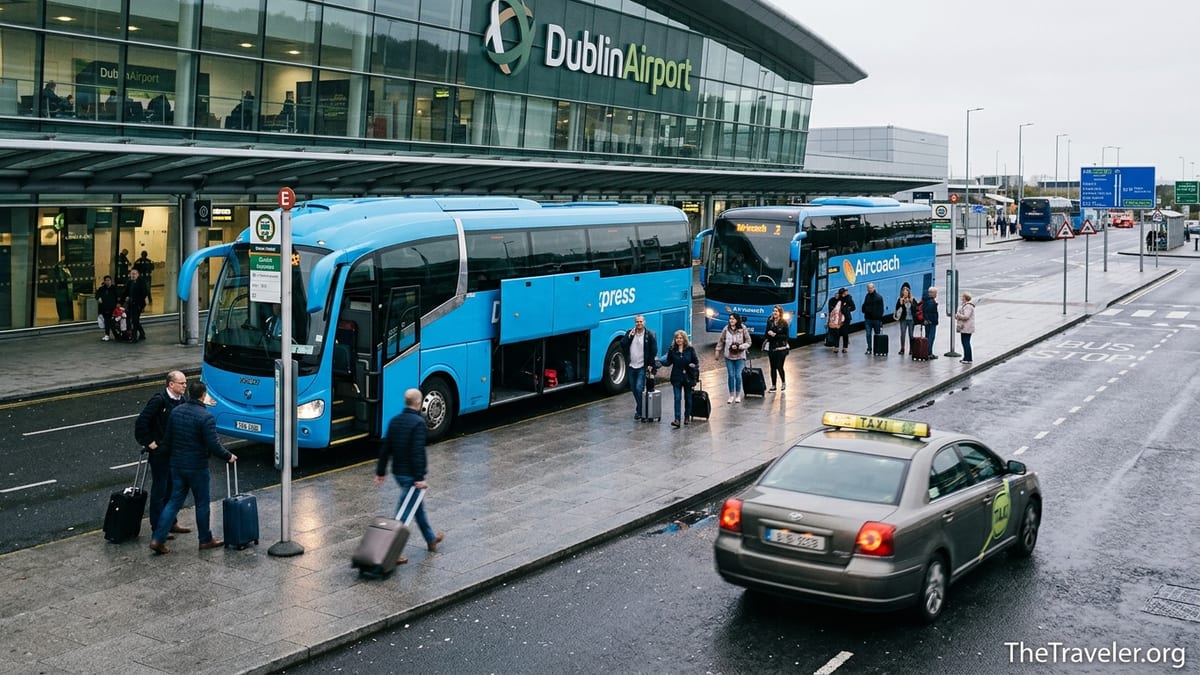
Understanding Your Main Options
Dublin Airport is served by two dedicated express coach companies, Dublin Express and Aircoach, as well as regular Dublin Bus routes, licensed taxis and a growing number of prebooked private transfer services. All of these depart from right outside the terminals and all will get you into the city centre, but they differ significantly in price, comfort and how straightforward they are for first time visitors.
Most short stay leisure travellers choose one of the express coaches. These run frequently throughout the day, have luggage holds for suitcases and stop at convenient locations such as O’Connell Street, Temple Bar and Heuston Station. Typical one way adult fares booked online are around 8 to 10 euro per person, which makes them good value for solo travellers and couples.
Budget conscious visitors, especially those staying longer in Dublin, sometimes use the standard Dublin Bus routes 16 or 41 instead. These are true city buses, used mainly by commuters, and cost roughly the standard city fare of a little over 2.50 euro if you pay the driver in cash or use a Leap card. The trade off is a slower, more crowded journey and less space for luggage.
If you prioritise convenience over cost, taxis and private transfers are the easiest door to door option, particularly if you arrive late at night or are travelling with children or several large bags. A metered taxi from the official rank to a typical city centre address usually costs in the region of 30 to 40 euro in 2026 depending on traffic and time of day, while prebooked private transfers quote fixed prices per vehicle.
Dublin Express: Fast Coach Into the City
Dublin Express operates several routes between Dublin Airport and the city, including services 782 and 784. Coaches pick up directly outside both Terminal 1 and Terminal 2 and run to central stops such as George’s Quay near Tara Street Station, Aston Quay alongside O’Connell Bridge, and Heuston Station. The fastest advertised journey time between the airport and the city is around 15 to 20 minutes in light traffic, though at busy peak hours you should allow closer to 40 minutes.
If you buy your ticket online in advance you usually get the best fare. As of mid 2026, typical online prices for a one way adult ticket are a little under 10 euro, with a small saving on returns. At the airport you can also buy tickets from machines or staff at the coach stops, or directly from the driver at a slightly higher walk up fare. Families should look out for child and sometimes family fares that reduce the overall cost.
Dublin Express coaches are designed for air travellers, so there is a proper luggage hold under the coach for large suitcases and space inside the coach for smaller bags. There is no additional fee for a standard amount of luggage, though if you are travelling with outsized sports equipment it is sensible to check the operator’s conditions in advance. On board you can expect free Wi Fi and comfortable coach style seating, which makes this an easy option after a long flight.
One advantage of Dublin Express is its coverage of the south and west of the inner city. For example, if you are staying near Temple Bar, Christchurch, the Guinness Storehouse or Heuston Station, the 782 and 784 will drop you within a short walk of these areas. That can save you a taxi fare or a long walk with suitcases from O’Connell Street. Services start in the very early morning, shortly after 3 am in some cases, and run until around half past midnight, which covers almost all flight arrivals.
Aircoach: 24 Hour Service and Southside Stops
Aircoach is another long established operator linking Dublin Airport and the city. Its main airport route for visitors is the 700, which runs between the airport and southside areas such as O’Connell Street, Trinity College, Kildare Street, Leeson Street, Ballsbridge and Leopardstown. The 700 operates 24 hours a day, which makes it one of the most reliable late night public transport options from the airport into the central area.
In 2026, Aircoach’s pricing is broadly similar to Dublin Express. Online fares for a single adult ticket typically sit around the 7 to 9 euro mark depending on promotions and flexibility, with slightly higher prices if you buy at the airport or on board. Some fares allow you to use your ticket on any departure within a set time window, which is useful if your flight is delayed or you clear immigration faster than expected.
Like Dublin Express, Aircoach vehicles are full size coaches with underfloor luggage holds, making them well suited to travellers with large or multiple suitcases. You handle your own bags at both ends, placing them in the hold at the airport and retrieving them at your stop in the city. The coaches are equipped with Wi Fi and air conditioning as standard, and most journeys between the airport and central stops such as O’Connell Street, Trinity College or Kildare Street take 25 to 35 minutes in moderate traffic.
Aircoach is particularly convenient if you are staying in central or south Dublin. For example, hotels around St Stephen’s Green, Merrion Square, Ballsbridge or the Docklands are often within five to ten minutes’ walk of a route 700 stop. For late night arrivals after midnight, the 24 hour timetable means you can almost always rely on a coach within a reasonable wait, although overnight frequencies are lower than during daytime hours.
Dublin Bus: Cheapest but Slowest Option
The regular city bus routes 16 and 41 connect Dublin Airport with the city centre and northern suburbs. Route 41, in particular, runs 24 hours a day between the airport and Lower Abbey Street in the city centre, which is a short walk from O’Connell Street and the main shopping area. These buses are used mainly by commuters and local residents, so they can be busy at peak times, but they offer the lowest cost way into town.
As of mid 2026, the standard adult fare on these routes is in line with Dublin’s normal city fares, just over 2.50 euro if you pay the driver in cash or tap a Leap card. For a solo traveller arriving in the middle of the day, that means you can get from the airport to O’Connell Street at less than a third of the cost of an express coach and a fraction of the price of a taxi. There are no luggage surcharges, although very large or numerous bags can be difficult to manage on a crowded double decker bus.
The main downside is journey time and comfort. The 16 and 41 routes make many intermediate stops through residential areas such as Santry and Drumcondra, and in daytime traffic it is common for the trip into the city centre to take 45 to 60 minutes. You need to keep your luggage with you in the seating area or at the front of the bus, which can be awkward if the bus is busy. There are also no on board toilets, and Wi Fi cannot be guaranteed on every vehicle.
Despite this, Dublin Bus remains a good option if you are arriving on a tighter budget or staying near one of its intermediate stops. For example, if you have booked a guesthouse in Drumcondra or on the north side of the city, the 41 may drop you very close to your door with no need to change buses. Just remember that you must signal the driver to stop and press the bell in good time before your stop, as there are many along the route.
Taxis and Private Transfers: Door to Door Convenience
Official taxis are available 24 hours a day from the signed rank just outside the arrivals areas of both terminals. All are licensed and metered, and the fare is based on time and distance under a national tariff that was last revised in late 2024. In practice, a typical journey from Dublin Airport to a hotel near O’Connell Street or Temple Bar in 2026 costs in the region of 30 to 40 euro, depending on traffic, time of day and any small extras such as additional passengers or luggage surcharges allowed under the tariff.
For example, a couple arriving at 7 pm on a Friday and taking a taxi to a hotel near Trinity College might see a fare of about 35 euro, plus a small airport pick up supplement. The same trip at 11 am on a quiet weekday could be a few euro cheaper, while a late night ride after midnight when higher tariff rates apply will usually sit towards the upper end of the 40 euro range. Travel time is usually 20 to 30 minutes in light to moderate traffic, but can be longer in the weekday evening peak or if there are incidents on the main approach roads.
Private transfer companies, which you prebook online before travel, offer a fixed price per vehicle for the same journey. For a standard car that carries up to three passengers with luggage, quotes in mid 2026 for airport to city centre transfers often fall between 45 and 60 euro depending on the operator and any extras such as meet and greet in the arrivals hall. For larger groups, a prebooked minivan can become good value, with prices that compare favourably to booking two separate taxis.
Taxis and private transfers are particularly useful if you are arriving late at night when you are tired, have small children or elderly relatives with you, or are staying somewhere that is not close to an express coach stop. They are also the simplest option if you are carrying bulky or valuable items that you would rather not juggle on and off buses. Ride hailing apps do operate in Dublin, but in 2026 these apps dispatch regular licensed taxis rather than unmetered private hire cars, so the fare levels remain broadly similar to picking up a cab from the official rank.
Late Night and Early Morning Arrivals
Dublin has improved its late night transport in recent years, but options are still more limited between about midnight and 4 am. If your flight lands after 23:00, it is worth checking both your scheduled landing time and how long you might need for passport control and baggage claim. A coach that looks convenient on the timetable can be easy to miss if your flight is delayed by even 30 minutes.
For late night public transport, the two most reliable options as of summer 2026 are Aircoach route 700 and Dublin Bus route 41. The Aircoach 700 offers a 24 hour service linking the airport with key central and southside stops such as O’Connell Street, Trinity College and Ballsbridge. Frequencies drop overnight, but a coach usually appears at least once or twice an hour, which is helpful if you land around 01:00 or 02:00.
The Dublin Bus 41 also runs around the clock between the airport and Lower Abbey Street, giving budget travellers a true 24 hour option at standard city fares. A traveller landing at 00:30 on a weekday, for example, could expect to clear immigration by 01:00 and board a 41 into town shortly after, arriving on Lower Abbey Street perhaps 30 to 40 minutes later. From there, many central hotels and hostels are within a 5 to 15 minute walk.
If you land after about 01:00 and have heavy luggage or are heading to an address beyond walking distance of the bus stops, a taxi is usually the simplest and safest choice. At that hour the roads are generally quiet, so travel time into the city can be as little as 20 minutes. The late night tariff may push the fare closer to 40 euro, but for two or three people splitting the cost the convenience is often worth it compared with waiting outside for a bus on a cold or wet night.
Choosing the Right Option for Your Budget and Luggage
When deciding how to get from Dublin Airport to the city centre, think about three main factors: how many people are travelling, how much luggage you have and what time your flight arrives. The same route can be excellent value for one traveller at noon but make less sense for a family of four arriving at midnight. Running a quick mental comparison before you land can save both money and hassle.
For solo travellers and couples arriving between early morning and late evening, Dublin Express and Aircoach strike a good balance of price, journey time and comfort. A pair of adults paying roughly 9 euro each to get directly to a central stop such as Aston Quay or O’Connell Street will usually find the coach cheaper than a taxi but far quicker and easier than a standard city bus. If you are staying near one of the express coach stops, you can often walk straight to your hotel without further transport.
For larger groups of three or more adults, the economics shift. A family of four arriving at 18:00, for example, would pay around 32 to 36 euro in total on an express coach at typical 2026 fares, which is very close to the price of a single taxi to the same central hotel. In that situation, choosing a taxi may add only a few euro to the total transport cost but deliver door to door convenience and a shorter walk with bags, especially in bad weather.
If your budget is tight and you are comfortable with a slower trip, the Dublin Bus 16 or 41 remains unbeatable on price. A solo backpacker paying just over 2.50 euro to reach O’Connell Street, and perhaps transferring onto another city bus using a Leap card, will spend less than the cost of a single drink in Temple Bar. The trade off is that you need to be organised with your luggage, watch stop names on the in bus displays and accept a less comfortable ride.
The Takeaway
Dublin Airport is fortunately close to the city centre, and you have a range of reliable ways to cover the short distance. Express coaches like Dublin Express and Aircoach offer a comfortable middle ground: faster and more luggage friendly than regular buses, much cheaper than taxis, and with stops placed where tourists most often stay. For most first time visitors arriving in daytime, one of these services will feel simple and stress free.
Standard Dublin Bus routes 16 and 41 are the clear budget choice, using the same tickets and fares as local commuters. They are slower and less tailored to visitors, but for a solo traveller or anyone staying along their routes they can be a sensible way to cut costs, especially if you are spending several days in the city and will buy a Leap card anyway.
Taxis and private transfers sit at the top of the comfort scale, with a price tag to match. A door to door ride from the airport to a central hotel usually costs between 30 and 40 euro in 2026, which can make sense if you are sharing the fare, arriving late at night or carrying heavy luggage. For families and groups, the cost per person can be surprisingly competitive with express coaches, especially on rainy evenings when a short walk makes a big difference.
Ultimately there is no single best option, only the one that fits your particular trip. Think about your arrival time, how much you want to spend, where exactly your accommodation is located and how much you want to carry your bags. With that in mind, Dublin’s mix of coaches, buses and taxis makes getting from the airport to the heart of the city one of the easier parts of any visit.
FAQ
Q1. How long does it take to get from Dublin Airport to the city centre?
The quickest trips by taxi or express coach can take around 20 minutes in light traffic, but at busy times you should allow 40 minutes or more. Standard city buses often take 45 to 60 minutes because they make many intermediate stops.
Q2. What is the cheapest way to get from Dublin Airport to Dublin city centre?
The cheapest option in 2026 is usually the regular Dublin Bus routes 16 or 41, which charge the standard city fare a little over 2.50 euro when paying cash or using a Leap card. Express coaches and taxis cost more but are faster and more comfortable.
Q3. How much does a taxi from Dublin Airport to the city centre cost?
Most trips from the airport to central areas such as O’Connell Street, Temple Bar or Trinity College cost in the region of 30 to 40 euro in 2026, depending on time of day, traffic and the exact address.
Q4. Do Dublin Express and Aircoach include luggage in the ticket price?
Yes, both Dublin Express and Aircoach are designed for air passengers and include normal luggage in the ticket price. You can place larger suitcases in the underfloor hold and keep smaller bags with you on board at no extra charge.
Q5. Can I pay for airport buses with card, or do I need cash?
Express coaches like Dublin Express and Aircoach accept card payments online and at the airport, and often on board. Regular Dublin Bus services still accept cash on the bus, but paying with exact coins or using a Leap card or contactless payment is strongly recommended.
Q6. What are the late night public transport options from Dublin Airport?
After midnight, the most reliable public options are Aircoach route 700 and Dublin Bus route 41, both of which run 24 hours and serve the city centre. Frequencies are lower overnight, so check the latest timetable close to your travel date.
Q7. Is it worth prebooking a private transfer instead of taking a taxi?
Prebooking can be worth it if you want a fixed price, are travelling as a group, or prefer a named driver meeting you in the arrivals hall. For solo travellers or couples with light luggage, taking a taxi from the rank is usually simpler and sometimes cheaper.
Q8. Which option is best if I am staying in Temple Bar?
Both Dublin Express and Aircoach have stops within a short walk of Temple Bar, making them good choices during the day. A taxi becomes more attractive late at night or if you have heavy luggage, since it will drop you directly outside your accommodation.
Q9. Can I use a Leap card on buses from Dublin Airport?
Yes, you can use a Leap card on regular Dublin Bus services such as the 16 and 41, paying the standard city fare. Leap cards are not valid on most private express coach services, which sell their own tickets.
Q10. What should I do if my flight is delayed and I miss my booked coach?
Many express coach tickets allow some flexibility, letting you board the next available service if there is space. If your ticket is tied to a specific departure, speak to staff at the airport stop, who can usually help you rebook or advise on the next options.