


More news on this day
Major US airlines are moving quickly in 2026 to add more high-yield seats at the front of the plane, expanding business and premium economy cabins and reconfiguring fleets as they chase growing demand from leisure and corporate travelers willing to pay extra for comfort and privacy.
Get the latest news straight to your inbox!
Premium Seats Become a Core Revenue Strategy
Publicly available financial filings and investor materials show that premium cabins have shifted from a niche product to a central pillar of US airline strategy. Delta Air Lines has highlighted in recent reports that revenue growth from its premium products, including Delta One, First Class and Delta Premium Select, has outpaced main cabin performance, underscoring the higher yields available at the front of the aircraft.
United Airlines has followed a similar path. Company disclosures indicate that the carrier offered a record 27.4 million premium seats in 2025, with premium cabins representing roughly 12 percent of all seats flown. United has told investors that premium demand continues to outperform economy, justifying further investment in lie-flat business suites and expanded premium economy on both new deliveries and retrofitted aircraft.
American Airlines is also reshaping its widebody and long-haul narrowbody fleet around premium revenue. Offering more business and premium economy seats on new Boeing 787-9 and Airbus A321XLR aircraft is framed in corporate materials as a way to increase average fares and improve customer satisfaction on key long-haul and transcontinental routes. Across the three largest US carriers, publicly available plans point to a common goal: more seats that generate significantly higher revenue per passenger than standard economy.
Industry watchers note that this premiumization trend aligns with broader shifts in travel behavior. Many travelers now mix leisure and work on the same trip, and a portion of that market appears willing to trade up for extra space, privacy and better onboard amenities. Airlines are using this willingness to pay to help offset higher operating costs and investment in new aircraft technology.
New Business Suites and Premium Cabins Take Center Stage
On the product side, 2026 is shaping up as a pivotal year for hardware upgrades in US premium cabins. United has begun rolling out its new “United Elevated” interior on Boeing 787-9 aircraft, featuring Polaris Studio suites with privacy doors, enlarged work and dining spaces and bigger inflight entertainment screens. United’s own investor materials describe these suites as roughly a quarter larger than the current Polaris seats, with exclusive food and beverage options targeted at high-yield business travelers.
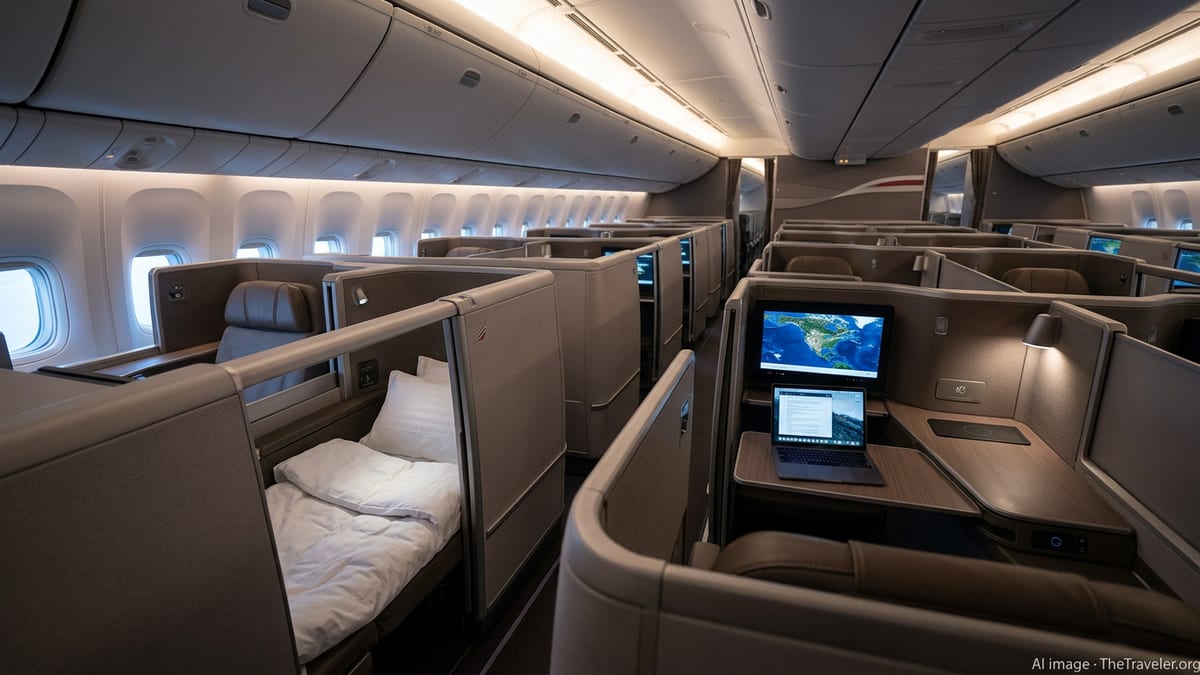
American Airlines is pushing forward with its Flagship Suite concept on both widebody and single-aisle aircraft. The airline’s Boeing 787-9 jets introduced the new suite in 2025, followed by Airbus A321XLR aircraft configured with a three-cabin layout that includes Flagship Suites, premium economy and standard economy. Independent product reviews from aviation and travel outlets describe fully flat beds with direct aisle access and closing doors on these A321XLRs, effectively bringing a long-haul business product to single-aisle transcontinental and transatlantic flights.
Delta’s modernization program is also heavily focused on premium experiences. According to the carrier’s recent proxy and corporate updates, more than 800 aircraft are expected to receive a refreshed interior design over the next several years, with upgraded Delta One suites, reworked First Class and a reimagined Delta Premium Select cabin. The airline promotes these cabins as offering more personal space, enhanced soft products and an improved digital experience through upgraded inflight entertainment and fast Wi-Fi.
Even outside the Big Three, premium products are being emphasized. Alaska Airlines, for instance, continues to market its Premium Class seating and has detailed plans to expand high-speed satellite connectivity across its fleet beginning in 2026, improving the onboard experience for passengers who pay extra for more legroom and early boarding.
Single-Aisle Aircraft Go All-In on High-Yield Customers
A defining feature of the current premiumization wave is the shift of high-end products onto narrowbody aircraft. American’s Airbus A321XLR exemplifies this trend. The jet is configured with a relatively small overall seat count but a high proportion of business and premium economy seats, allowing the airline to serve long-haul routes with a cabin layout that mirrors, on a smaller scale, its long-haul widebody Flagship Suite and premium economy offerings.
United is taking a comparable approach on new narrowbody variants like the Airbus A321neo Coastliner and planned A321XLR operations. Company communications and enthusiast reports detail layouts that include lie-flat Polaris seats and United Premium Plus sections on aircraft that historically would have offered only domestic-style first class and standard economy. This transition effectively turns select single-aisle jets into long-range premium aircraft suited to lucrative transcontinental and thinner international routes.
For airlines, putting more premium seats on narrowbodies offers several advantages. It allows carriers to deploy smaller aircraft on routes that may not support a large twin-aisle jet while still capturing high-yield corporate and affluent leisure demand. It also creates more consistency across the network so that travelers paying for premium cabins can expect similar products regardless of aircraft type.
Travel industry analysts note that this strategy aligns with current aircraft technology. Longer-range narrowbodies such as the A321XLR make it economically viable to offer private suites and premium economy on city pairs that previously would not have had such high-end options, particularly secondary European markets and long overwater routes from the United States.
Cabin Segmentation and Upgrades Reshape the Middle of the Plane
Alongside top-tier business suites, US carriers are intensifying their focus on the “middle” of the aircraft. Premium economy and extra-legroom sections are expanding as a bridge between standard economy and full lie-flat business products. American’s Premium Economy cabin, now widely available on Boeing 787-8 and other long-haul aircraft, offers larger seats, enhanced dining and additional amenities, and can be purchased outright or accessed via upgrades using cash or loyalty miles.
Delta Premium Select serves a similar role between Delta One and main cabin. Updated product descriptions emphasize more recline, adjustable leg and foot rests and improved catering compared with standard economy. The airline positions this cabin as a practical compromise for travelers who value comfort and service but may not need or wish to pay for a full suite.
United’s Premium Plus has also become a key part of its cabin hierarchy, and investor materials and customer reports describe strong take-up rates that at times exceed the initially planned capacity of these cabins. Enthusiast accounts highlight frequent use of upgrade instruments and elite-status benefits to move passengers from economy into Premium Plus and, in some cases, onward into Polaris when space permits, illustrating how these segmented cabins work together to yield-manage the front half of the aircraft.
Budget-conscious travelers still face denser layouts in standard economy, but airlines argue that the proliferation of premium options gives customers more choice. From a revenue perspective, each additional row of premium economy or extra-legroom seating represents a chance to monetize demand from passengers who will pay a moderate premium to avoid the tightest seats.
What Premiumization Means for Travelers in 2026
For US travelers in 2026, the premiumization of air travel presents a mixed picture. On one hand, passengers booking business class and premium economy on the largest carriers are seeing tangible improvements in hardware, service and connectivity. Suites with closing doors, upgraded bedding, more personalized dining and reliable high-speed Wi-Fi are increasingly standard on new and refurbished aircraft, both widebody and narrowbody.
On the other hand, the concentration of investment at the front and in the middle of the cabin raises questions about the trajectory of standard economy. While large screens and improved entertainment are being introduced in many main cabins, overall seat density often increases as airlines carve out space for more premium seats. This dynamic may leave economy passengers with less personal space even as the front of the plane becomes more luxurious.
Loyalty program members stand to benefit from the trend, as airlines structure upgrade paths to fill premium cabins and reward high spend. Publicly available program details from American, Delta and United describe multiple ways for elite members to use miles or certificates to move into premium economy or business seats, particularly on long-haul and premium transcontinental routes.
As 2026 progresses, the common thread across the US airline industry is clear. Hardware investments, fleet plans and cabin configurations increasingly point toward a future where the front and middle of the aircraft are the primary battlegrounds for differentiation. For travelers prepared to pay extra or leverage loyalty benefits, that means more choice and higher comfort. For airlines, it represents a calculated bet that premiumization will remain a durable source of revenue in the years ahead.
United Airlines 2025 earnings and fleet update
Delta Air Lines premium cabin and interior investment update
NerdWallet: Inside American Airlines’ A321XLR premium configuration