


Landing at Milan Malpensa can feel overwhelming, especially if it is your first time in northern Italy or you are arriving after a long-haul flight. Malpensa sits about 50 kilometers northwest of downtown Milan, so choosing the right transport into the city makes a real difference to your budget, timing and stress level. This guide breaks down the main options from Malpensa Airport to central Milan, compares costs and journey times, and recommends the best choice for different types of travelers, from solo backpackers to families and business travelers.
Get the latest updates straight to your inbox!
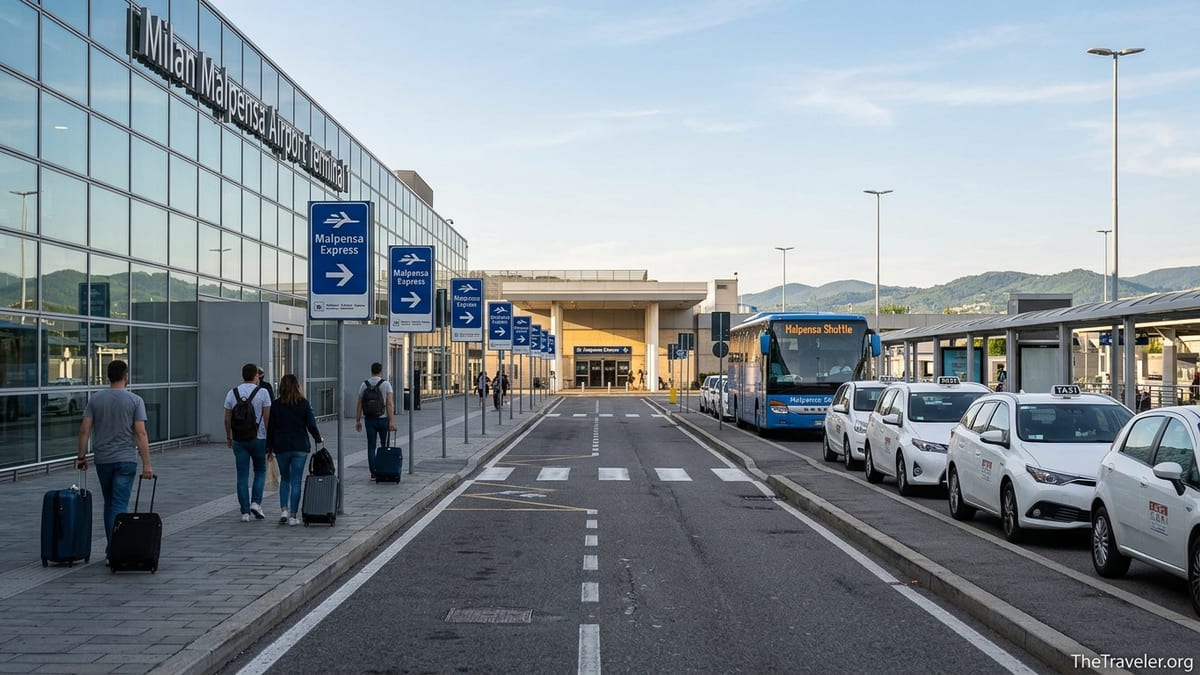
Understanding Your Options From Malpensa
Malpensa has two terminals, T1 and T2, and both are linked to Milan by a dedicated airport rail line, several competing bus services, official taxis and a range of private transfer companies. The main destination in the city for most visitors is Milano Centrale railway station, the large hub where you connect to the metro, high-speed trains and regional lines. Some travelers, especially business visitors, prefer to arrive at Milano Cadorna or Porta Garibaldi stations, which are closer to certain business districts and popular neighborhoods.
The Malpensa Express train is the flagship rail service, operated by Trenord. It runs from both terminals to Milano Centrale and Milano Cadorna, usually every 15 minutes when you consider all departures combined. A one way adult ticket to Milano Centrale is currently listed at about 15 euros per person, with a journey time of roughly 50 minutes depending on the specific train. Families can use special products such as a family ticket that covers two adults and two children for a reduced combined price, which is particularly useful in school holiday periods.
Alongside the train, there are several direct coach services running from Malpensa to Milan Centrale, including well-known brands such as Malpensa Shuttle, Malpensa Bus Express and Autostradale. These buses are frequent, often every 20 to 30 minutes during the day, and generally cost a bit less than the train per person, with fares around 10 euros for a one way adult ticket bought on the day. They are slower than the Malpensa Express in heavy traffic, but they drop you directly outside Milano Centrale without any changes.
If you prefer door-to-door service, official white Milan taxis are available outside the arrivals areas. They operate with regulated tariffs and a fixed airport-to-city rate, which is typically in the range of 100 to 120 euros from Malpensa to central Milan for the vehicle, regardless of the number of passengers. Private transfer companies and limousine services charge more, often around 150 to 200 euros for a standard sedan, but include pre-booked pickup, name-board service and sometimes extras such as child seats or bottled water.
Malpensa Express: Fastest and Most Reliable Into the City
For most independent travelers, the Malpensa Express train offers the best balance of speed, reliability and cost. Trains run from early morning to around midnight, connecting both Terminal 1 and Terminal 2 with Milano Cadorna and Milano Centrale. According to current timetables, there are around 146 daily services covering the various airport-to-city routes, with the combined service to Milan city stations running roughly every 15 minutes at peak times. The distance from Malpensa Terminal 1 to Milano Centrale is about 49 kilometers, and the journey typically takes around 50 minutes end to end.
A standard one way adult ticket from Malpensa to Milano Centrale currently costs about 15 euros when purchased from official machines or counters. There are also discounted same day return fares around 25 euros if you go into the city and back to the airport on the same date. Payment is simple: you can buy paper tickets and validate them, use the official app, or use Pay&Go contactless where available by tapping a contactless bank card at the turnstiles in stations like Milano Centrale, Milano Cadorna, Porta Garibaldi, Bovisa and the Malpensa terminals.
In real terms, a couple arriving at Terminal 1 and heading to a hotel near Milano Centrale might spend about 30 euros total on two Malpensa Express tickets and be at the station platform in under an hour, regardless of highway traffic or rain. If their hotel is near Cadorna, Brera or the Magenta district, they can use the Cadorna route instead, which is also well connected to Metro lines 1 and 2. Business travelers often appreciate that the train is relatively quiet, with space to work, power sockets on many carriages and the ability to avoid any risk of being delayed in motorway congestion.
The main limitations of the Malpensa Express relate to luggage and last-mile connections. While there are luggage racks and overhead shelves on board, managing multiple large suitcases on and off the train can be tiring, especially if you then have to navigate the metro system or a crowded station concourse. Travelers staying in neighborhoods that are not directly on the metro lines, such as parts of Navigli or Isola, will need an additional taxi or tram, which adds both cost and complexity.
Airport Buses: Budget Friendly and Simple
Airport coach services between Malpensa and central Milan are a strong option for budget-conscious travelers and those who prefer a simple point-to-point transfer without managing train platforms. Several companies run similar routes, notably Malpensa Shuttle, Malpensa Bus Express and Autostradale. Buses stop outside both Terminal 1 and Terminal 2 and usually terminate on the east side of Milano Centrale, close to Via Sammartini, just a short walk from the main station hall and metro entrances.
Typical one way adult fares hover around 10 euros, with online booking sometimes a little cheaper and return tickets discounted. For example, a solo backpacker buying a same day ticket at the airport can expect to pay roughly 10 euros to reach Milano Centrale, saving about 5 euros compared with the train. A family of four might save 20 to 25 euros compared with buying four separate Malpensa Express tickets, although they should compare against any family train deals before deciding.
Journey times by bus are more variable than the train. In light traffic, especially late evenings or early mornings, the ride between Malpensa and Milano Centrale can take about 50 to 60 minutes. During rush hour or on rainy days, it can easily stretch to 75 minutes or more due to congestion on the A8 motorway and city streets. Buses do, however, provide underfloor luggage storage, which can be easier if you are carrying large suitcases or bulky sports equipment like skis or bicycles in travel cases.
Many travelers appreciate that buses run very late and very early, covering time bands when train frequency may be reduced. A traveler landing around midnight, for instance, might find that the last Malpensa Express of the night has already departed but can still board a Malpensa Shuttle or Malpensa Bus Express coach scheduled around that time. Tickets can typically be bought both online in advance and on the spot at airport counters or directly from the driver, which is handy if your flight is delayed and you prefer to keep plans flexible.
Taxis and Private Transfers: Door-to-Door Convenience
For small groups, families with young children or travelers arriving very late with heavy luggage, taxis and private transfers can be worth the extra cost. Official Milan taxis are white, with a roof sign and meter, and queue outside the arrivals halls at both terminals. From Malpensa to central Milan, there is a regulated fixed airport-city rate, typically around the 100 to 120 euro range for the whole vehicle depending on the exact address and any extras allowed under the local regulations. The advantage is that you walk straight out of the terminal, get into a waiting cab and are taken directly to your hotel door, with no need to change transport or manage stairs.
To understand cost dynamics, imagine a group of four adult friends staying in an apartment in the Navigli district. If they chose the Malpensa Express to Milano Centrale at about 15 euros per person, then added a short taxi ride from Centrale to Navigli for perhaps 15 to 20 euros, their total might be around 75 to 80 euros. Splitting an official airport taxi straight from Malpensa to Navigli for roughly 110 euros means they pay only slightly more overall, but they avoid handling suitcases through the station and save 20 to 30 minutes of transfer time.
Private transfer services and limousine companies cater to travelers who want to pre-book and lock in a set price, often with meet-and-greet in the arrivals hall. A typical quote from a reputable Milan-based chauffeur service for a standard sedan from Malpensa to a central Milan hotel is in the ballpark of 150 to 200 euros in 2026, sometimes more for premium vehicles or large vans. These services often include waiting time if your flight is delayed, professional English-speaking drivers and optional extras such as child safety seats, which can be difficult to guarantee in a standard taxi queue.
The main downside is cost, especially for solo travelers and couples. A business traveler alone heading to a hotel near Porta Nuova might pay almost ten times the price of a bus ticket in exchange for a 45 to 60 minute door-to-door ride, depending on traffic. If your flight arrives in the middle of the day and you are comfortable managing your luggage, the Malpensa Express plus a short metro or taxi ride into Porta Nuova will be considerably cheaper while still reasonably fast.
Cost, Time and Luggage: How the Options Compare
When comparing Malpensa transfer options, it helps to think in three dimensions: cost per person, total journey time door to door and how easy it is to handle your luggage. No single mode scores best on every metric, which is why different travelers often choose different solutions even on the same flight.
On cost alone, airport buses usually win for solo travelers and small groups. At around 10 euros per person one way, buses can save a couple roughly 10 euros compared with the Malpensa Express and much more compared with taxis or private transfers. The Malpensa Express is slightly more expensive but still reasonable at about 15 euros for a direct, traffic-free ride to major city stations. Taxis and private transfers are by far the most expensive, with fixed or quoted rates above 100 euros per vehicle, but when split between four or more adults they can become competitively priced on a per-person basis.
In terms of time, the Malpensa Express has the clear advantage during the day, as it is not affected by road traffic. Expect roughly 45 to 55 minutes from the airport to Milano Centrale or Cadorna. Buses can be similar in off-peak periods but are less predictable, sometimes taking more than an hour in rush hour. Taxis and private cars are theoretically the fastest if traffic is light and your hotel is near a major ring road, but on a rainy weekday evening you may spend a long time crawling toward the city while the train glides past on dedicated tracks.
Luggage is the key differentiator that often tilts the decision. For one or two medium suitcases and a cabin bag, the train is comfortable enough, with luggage racks at the carriage ends and aisles wide enough for rolling bags. Buses offer more generous underfloor luggage space, making them attractive for families with several large bags, sports equipment or strollers. Taxis and private transfers offer the simplest experience of all: the driver loads your bags into the trunk, drops you at your hotel door and helps unload, which can be invaluable if you are traveling with children, elderly relatives or mobility challenges.
Best Option by Traveler Type
Solo backpackers and budget travelers are usually served best by the airport buses, especially if they are not in a rush. Spending around 10 euros to reach Milano Centrale, then connecting to the metro or a regional train, keeps transport costs low and frees up money for accommodation, food and attractions. A young traveler arriving mid-afternoon with a hostel reservation near the central station can comfortably ride the bus, walk to the hostel in 10 minutes and be checked in within two hours of landing, even allowing for passport control and baggage claim.
Couples and small groups often find the Malpensa Express to be the sweet spot. Two adults heading to a boutique hotel in Brera or Porta Garibaldi may value the reliability and comfort of the train more than saving a few euros by taking the bus. They can enjoy a predictably timed journey into the city, then use the metro or a short taxi ride for the last segment. If they are returning to the airport on the same day for a side trip, a discounted same day return ticket on the Malpensa Express can make the train even more attractive.
Families with young children, prams and multiple suitcases might choose between buses and private transfers depending on budget. If they are comfortable managing one change at Milano Centrale, a bus plus a short city taxi can be a good compromise: they enjoy the lower bus fare, then transfer to a taxi at Centrale so they do not need to navigate the metro with a stroller. For a family of four arriving in the evening and staying in an apartment in a residential area, booking a private van transfer for about 180 euros can provide peace of mind and a straightforward start to the trip, especially after a long intercontinental flight.
Business travelers on a tight schedule usually gravitate to the Malpensa Express, particularly to Milano Centrale or Porta Garibaldi, which are convenient for the Porta Nuova business district and high-speed trains to other Italian cities. Those staying in luxury hotels around the Quadrilatero d’Oro or near Via Manzoni might prefer a pre-booked car service, accepting the higher cost in exchange for guaranteed comfort and efficiency, especially if they are carrying presentation materials or expensive equipment they do not want to juggle on public transport.
Practical Tips for a Smooth Arrival
Regardless of which transport mode you choose, a few practical steps can make your arrival at Malpensa smoother. First, confirm which terminal you land at and where your onward service departs. The Malpensa Express station is connected directly to both Terminal 1 and Terminal 2, with clear signage, but the walking distance can feel long if you are tired. Airport bus stops are located just outside the arrivals areas at ground level, typically near exits numbered 3 to 6 at Terminal 1 and similar marked zones at Terminal 2. Taxi ranks are also clearly signposted, but queues can be long during peak arrival waves.
Second, think about how you will buy tickets. For the Malpensa Express, it is wise to use official ticket machines or staffed counters inside the terminal or at the airport train station. Many travelers now rely on the official app or contactless Pay&Go validation, which reduces the risk of queues. For buses, you can often buy tickets from vending machines, company kiosks in the arrivals hall or directly from the driver when boarding; having some euros in cash or a widely accepted bank card helps avoid surprises. Official taxis in Milan accept cards as well as cash, but asking the driver before departure can prevent misunderstandings.
Finally, keep some flexibility in your plan. If your flight is delayed and you miss a planned train, there is usually another Malpensa Express within 30 minutes. If a bus service is temporarily crowded, you may decide to step back and catch the next one or switch to a different company at the same stop. On days of rail strikes or severe weather, buses and taxis become very popular, so leaving extra time and being ready to adjust can save you unnecessary stress. Talking briefly with airport staff or reading arrival hall information screens can alert you to any disruptions or special offers that affect your journey into the city.
The Takeaway
Getting from Milan Malpensa Airport into the city centre is straightforward once you understand the trade-offs between trains, buses, taxis and private transfers. The Malpensa Express is generally the fastest and most reliable way into central stations like Milano Centrale and Cadorna, with a predictable journey time and a fair price. Airport buses offer a cheaper, simple alternative that is particularly attractive to budget travelers and those with bulky luggage, at the cost of some extra time in traffic.
Taxis and private transfers deliver maximum comfort and door-to-door convenience, which can be worthwhile for families with young children, elderly travelers, groups with heavy baggage or business visitors on tight schedules. By weighing your priorities in terms of budget, time and luggage, and by considering concrete examples similar to your own situation, you can confidently choose the right Malpensa transfer and start your Milan stay feeling calm and in control.
FAQ
Q1. What is the cheapest way to get from Malpensa to Milan city centre?
The cheapest common option is usually the direct airport bus to Milano Centrale, which typically costs around 10 euros one way for an adult bought on the day.
Q2. How long does the Malpensa Express take to reach Milano Centrale?
The Malpensa Express train usually takes about 45 to 55 minutes from the airport terminals to Milano Centrale, depending on the specific service and intermediate stops.
Q3. Is the Malpensa Express train worth the extra cost compared with the bus?
For many travelers it is, because the train is faster and not affected by road traffic. If you value reliability and comfort more than saving a few euros, the train is often the better choice.
Q4. Are taxis from Malpensa to central Milan fixed price?
Yes, official Milan taxis use a regulated fixed fare for trips between Malpensa and the city, generally in the 100 to 120 euro range for the whole vehicle, depending on the precise destination and rules in force.
Q5. Do I need to book the Malpensa airport buses in advance?
Advance booking is not essential for most travelers, as tickets can usually be bought at airport counters or from the driver, but buying online can secure a seat on busy days and sometimes gives a small discount.
Q6. Which is better for heavy luggage, the train or the bus?
Buses are often easier for heavy or bulky luggage because they offer large underfloor storage. The train has racks and shelves, but lifting big suitcases on and off can be more effort.
Q7. What is the best option for a family with small children?
Families often choose either a direct private transfer for maximum convenience or a combination of airport bus to Milano Centrale and then a short city taxi, which keeps costs reasonable while avoiding the metro with strollers.
Q8. How late do public transport options run from Malpensa into Milan?
The Malpensa Express runs from early morning until around midnight, while some airport bus services operate very late or even into the early hours, covering time slots when trains are less frequent.
Q9. Can I use contactless payment on the Malpensa Express?
Yes, many stations on the Malpensa Express route support contactless Pay&Go, allowing you to tap a bank card or enabled smartphone at the turnstiles instead of buying a paper ticket.
Q10. What is the best option for business travelers on a tight schedule?
Most business travelers prefer the Malpensa Express to Milano Centrale or Porta Garibaldi for its speed and reliability, while some choose a pre-booked private car if they want door-to-door service to a specific office or hotel.