


Touching down in Belize with Ambergris Caye as your final destination, you face one immediate choice: hop on a short domestic flight to San Pedro or ride a Caribbean water taxi across the bay. I have done both, and the difference is less about distance than about time, comfort and the kind of arrival you want to remember. Below is a decision-focused breakdown using real schedules, fares and on-the-ground experience, so you can confidently book the route that fits your budget, nerves and schedule.
Get the latest updates straight to your inbox!
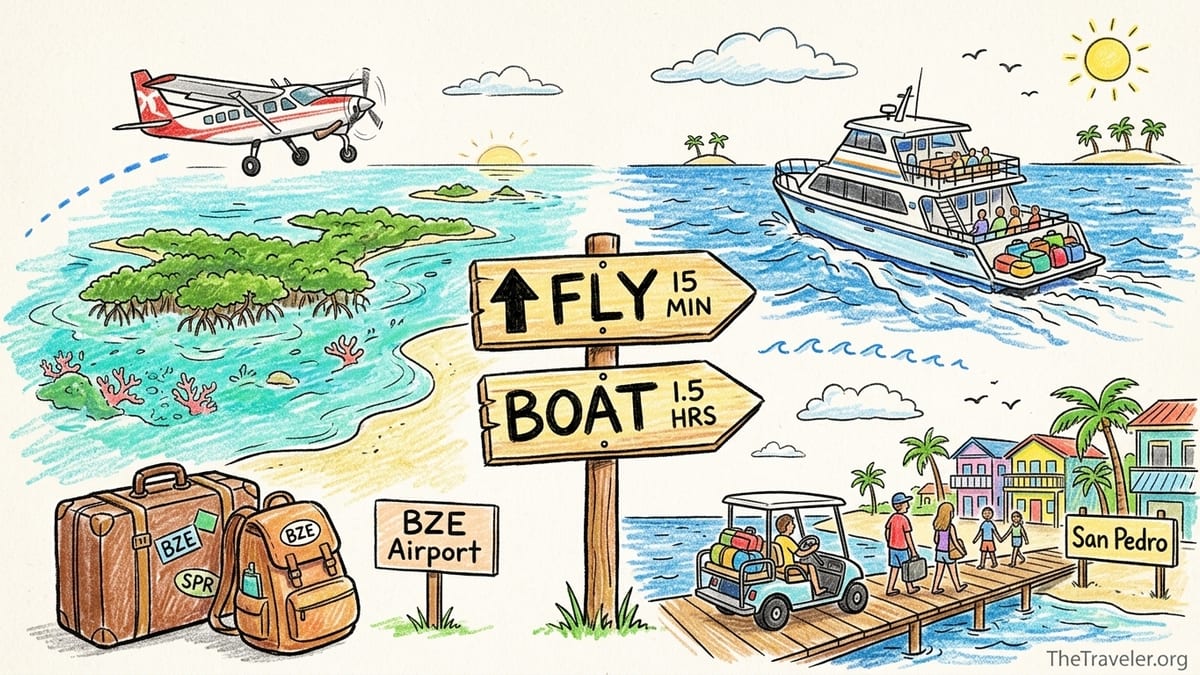
Understanding Your Two Main Routes to Ambergris Caye
Almost every international visitor to Ambergris Caye starts at Philip S. W. Goldson International Airport outside Belize City. From there, you either fly directly to San Pedro on a 12 to 14 minute domestic hop with Tropic Air or Maya Island Air, or you travel into Belize City and continue by water taxi with San Pedro Belize Express or Caribbean Sprinter. Both options run several times daily and both reliably get you to the island; the experience along the way is what sets them apart.
On the flight side, Tropic Air and Maya Island Air publish dense shuttle-style schedules between Belize City and San Pedro. Recent timetables show multiple departures each hour during the daytime from either the international airport or the closer municipal airstrip, with typical flight times in the 13 to 15 minute range. This frequency gives you flexibility if your international flight is a little late or if immigration takes longer than expected.
On the water, two operators dominate the Belize City to San Pedro run. San Pedro Belize Express and Caribbean Sprinter both sail from the Marine Terminal in downtown Belize City, calling at Caye Caulker and then continuing to San Pedro. Caribbean Sprinter’s current schedule lists six daily departures from Belize City and advertises a sailing time of about 1 hour 15 minutes, plus or minus 10 minutes, to San Pedro. San Pedro Belize Express typically runs more departures, with eight or so Belize City to San Pedro boats on a full schedule day via Caye Caulker, usually taking around 1.5 hours in open water.
In other words, the “distance” is the same, but your day looks very different depending on whether you stay in airport mode and fly, or head into the city and join the locals on the water taxis. To choose well, you need to think in terms of door-to-hotel time, not just the segment between Belize City and San Pedro.
Step-by-Step: Door-to-Hotel Timing by Plane
Start with the flight route: International arrival at Philip S. W. Goldson International Airport, connection to a domestic flight, and landing at San Pedro’s small airstrip a short taxi ride from most hotels. The key variables are how many international flights land at once and how comfortable you are cutting transfers close. Recent traveler reports suggest that on a busy mid-day bank of arrivals, it can take 60 to 90 minutes to clear immigration and customs; on quieter mornings, some passengers have walked through in 30 to 45 minutes.
Once you exit customs at BZE, the domestic counters for Tropic Air and Maya Island Air are right in the same terminal. If you have prebooked, you check in with your passport and are normally assigned to the next suitable San Pedro departure. Flights run shuttle-style, and if your original departure time has just gone, the staff typically move you to the next available seat. In my experience and from recent accounts, you should allow about 30 to 45 minutes from check-in to boarding to cover security screening and any short wait in the small departure lounge.
The flight itself is quick. Most timetables list about 13 to 15 minutes in the air between Belize City and San Pedro. The planes are small single-engine Cessna Caravans with big windows; luggage is weighed, and large checked bags are loaded a few steps from where you board. On clear days you get sweeping views of the mangroves and coral shallows. From touchdown in San Pedro to rolling your bag into a taxi is usually five minutes or less, since the airstrip sits essentially in town and baggage is handed off right beside the plane.
From the San Pedro airstrip to a central hotel on or near Front Street, a taxi or golf cart transfer generally takes 5 to 10 minutes. Resorts further north or south of town take longer, but many arrange their own pickups. When you tally the full journey on a typical day, a realistic door-to-hotel window from BZE arrival to your check-in desk in central San Pedro is roughly 2.5 to 3 hours: around 60 to 90 minutes for immigration and customs, 30 to 45 minutes for the domestic check-in and boarding process, 15 minutes in the air, then 10 to 20 minutes on the ground to reach your lodging.
Step-by-Step: Door-to-Hotel Timing by Water Taxi
Reaching Ambergris Caye by boat adds steps on land but can make sense if you value cost savings and do not mind a longer travel day. The first phase is identical: you land at Belize’s international airport and pass through immigration and customs. Timing here is the same as for flyers, often 45 to 90 minutes depending on arrivals. The difference begins when you exit the airport and head for Belize City instead of the domestic terminal.
From Philip S. W. Goldson International to the Marine Terminal in downtown Belize City, you can travel by licensed taxi or prebooked shuttle. The airport is about 10 miles from the city, and current taxi advice from local tourism information suggests a transit time of roughly 20 to 30 minutes in light to moderate traffic. You pay on arrival at the dock, then walk through the terminal building to the ticket counters for San Pedro Belize Express or Caribbean Sprinter.
Recent sailing schedules show Caribbean Sprinter running six Belize City departures daily to San Pedro, usually at set times from early morning into late afternoon, with an advertised crossing time of around 1 hour 15 minutes. San Pedro Belize Express typically runs more frequently, commonly eight departures spread through the day, with a route that stops in Caye Caulker and reaches San Pedro in about 1.5 hours under normal sea conditions. You check in with your passport details, tag your checked bags, and place carry-ons in the line with you.
Boarding flows in waves. Checked bags are stacked at the stern by staff and transferred for you at the other end. You choose a seat inside or on the open back deck, and the boat gets up to speed quickly after clearing the harbor. In calm seas the ride can be smooth, but in brisk winds the bow can slap against the chop and spray may reach the sides and rear; timing can stretch slightly beyond the posted durations. Once you dock in San Pedro, luggage comes off in a controlled pile on the pier, and passengers step ashore directly into town. From the water taxi pier to a central hotel, the walk can be as short as a few minutes, though many people opt for a brief taxi or golf cart ride, especially with luggage and mid-day heat.
Costs, Fares and What You Actually Spend
Fares change with fuel prices and season, but current information gives useful ballpark comparisons. Recent government and tourism fare tables show that a one-way adult water taxi ticket from Belize City to San Pedro sits around 55 to 65 US dollars return, depending on operator and whether you buy a one-way or round trip ahead of time. Third-party booking platforms list Belize City to San Pedro water taxi tickets in the range of about 30 to 35 US dollars one way on San Pedro Belize Express or Caribbean Sprinter in late 2026, with modest discounts for round trips or off-peak times.
By contrast, domestic flights between Belize City and San Pedro generally price higher. Example searches on major flight aggregators and airline tools in October 2026 show one-way fares on Tropic Air or Maya Island Air clustering around 100 to 130 US dollars per person from the international airport to San Pedro, with slightly lower promotional fares sometimes available from the municipal airstrip. Packages and tour operators occasionally fold these flights into overall itineraries, which can obscure the exact per-leg cost but keep the convenience.
Transfers to connect the legs add another line item. A taxi from the international airport to the Belize City Marine Terminal is commonly quoted in the 25 to 35 US dollar range for the vehicle, not per person. Some travel agencies and shuttle companies sell combined transfers that pick you up at the airport and drop you at the water taxi dock, sometimes bundled with your boat ticket, for a similar per-vehicle price. If you fly, you typically avoid this cost, since you are just walking from international arrivals to the domestic counters in the same building.
Putting these pieces together, many couples and families discover that for two travelers, the water taxi plus taxi transfer often comes out somewhat cheaper than two domestic flight tickets, although the margin is not as large as you might expect for a journey of only 15 minutes in the air. For three or more people, savings can add up significantly if you are willing to trade extra time on the road and water for money you can instead spend on tours or dinners once you reach the island.
Comfort, Seasickness and What the Journey Feels Like
Numbers aside, how you get to Ambergris Caye feels very different depending on the mode. Domestic flights put you in a small plane with about a dozen fellow passengers, one pilot and big cockpit windows. Seats are narrow but the flight is very short; many travelers describe it more like a scenic ride than a standard plane trip. On clear days you see patchwork reefs and sandbars, and even on slightly bumpy ones the short duration limits discomfort. However, if you have a severe fear of small planes, the experience can be anxiety provoking regardless of the time savings.
The water taxi route is social and a bit more rugged. Boats on both San Pedro Belize Express and Caribbean Sprinter are large multi-row vessels with a covered interior cabin and, often, limited open-air seating at the rear. The sound of the engines can be loud, and the ride varies dramatically with sea state. When winds are light, you may chat with locals, watch Caye Caulker appear on the horizon and enjoy a breezy hour and a quarter. On windy days, the combination of engine vibration, chop and enclosed seating can challenge anyone prone to motion sickness; a 75 to 90 minute ride is long enough for symptoms to build if you are unprepared.
For those sensitive to seasickness, the domestic flight is usually the safer bet. If you choose the boat anyway, sitting near the middle of the vessel, facing forward, and keeping your eyes on the horizon can help. Many repeat travelers take over-the-counter motion sickness medication about 30 to 60 minutes before boarding, bring a light snack, and keep water handy. In heavy weather, operators may slow the crossing slightly to manage conditions, which can add a bit of time but often improves comfort.
From a luggage perspective, both options are straightforward. On the plane, bags are weighed and may be subject to strict limits; occasionally bulky or heavy items ride on a slightly later flight if the small aircraft is full, though staff in San Pedro are used to matching bags to owners quickly. On the boats, weight limits are more forgiving, but there is more manual handling as bags are stacked and unstacked at each terminal. It pays to pack important items, electronics and medications in a daypack you keep with you in the cabin rather than in the main luggage pile.
Realistic Itineraries: When Each Option Works Best
Consider a typical North American arrival that lands at Belize’s international airport at 11:30 a.m. On a reasonably busy travel day, you might be out of immigration and customs by around 12:45 p.m. If you are flying on to San Pedro, that gives you a comfortable buffer to check in for an early afternoon domestic flight. After a short wait and a 15 minute hop, you could realistically be stepping into a taxi in San Pedro around 2:00 p.m., and at a central hotel by about 2:15 to 2:30 p.m. You would have time to drop your bags, change clothes and still make a late afternoon snorkel briefing or sunset cocktail on the beach.
Now run the same arrival through the water taxi route. You exit customs at about 12:45 p.m., find a taxi by 1:00 p.m., and reach the Marine Terminal around 1:30 p.m. If you are targeting Caribbean Sprinter’s 1:30 p.m. departure and the taxi has moved quickly, you might still board that sailing after a rapid ticket purchase and bag drop, especially if staff know you are en route. If you are a few minutes late, you would roll automatically to the next sailing, such as a 3:00 p.m. boat, giving time to buy tickets, grab a snack and settle in. With a 75 to 90 minute crossing and a short walk or taxi at the other end, you are more realistically checking into a central San Pedro hotel around 4:30 to 5:00 p.m.
Late arrivals highlight the differences even more. If your international flight lands after 4:00 p.m., your chances of comfortably catching the last water taxi of the day shrink quickly, especially if immigration lines are long. With boats usually stopping departures from Belize City in the late afternoon, one delay can strand you on the mainland for the night. Domestic flights, by contrast, run later into the day and treat schedules more flexibly; if you miss a specific departure, airlines often move you to the next available hop as long as weather and daylight cooperate. For anyone landing mid to late afternoon who wants to sleep on Ambergris Caye the same night, flying becomes the more robust choice.
Budget, group size and travel style round out the decision. Solo travelers and couples arriving early in the day with light luggage and time to spare often enjoy starting their Belize adventure with the boat, watching the city fade and the cayes appear one by one. Families with tired children after long-haul flights, or divers keen to make next-morning boat departures, frequently prioritize the predictability and speed of the flight, accepting the higher cost for the smoother start.
How to Book Smart: Schedules, Buffers and Practical Tips
Whichever route you pick, booking with realistic buffers makes the difference between a relaxed arrival and a stressful dash. Domestic airlines often recommend allowing up to three hours between scheduled international arrival and domestic departure to San Pedro. This is conservative and designed to absorb worst-case immigration lines and baggage delays, but recent traveler experiences suggest that a two to two and a half hour window usually works for most daytime arrivals. The key is to avoid locking yourself to the very last possible domestic departure unless you are comfortable with the small risk of a forced overnight in Belize City.
For water taxis, step one is always to confirm same-season schedules close to your travel date. Operators occasionally adjust departure times, add extra sailings during peak weeks or shift first and last boats according to demand and maintenance. Look at the latest published timetables and then mentally treat the Belize City to San Pedro leg as a 75 to 90 minute commitment, not a precise science. Build at least an hour of margin between your earliest realistic arrival at the Marine Terminal and the boat you aim to catch, particularly if you prefer the more popular mid-morning and early afternoon sailings that can fill up.
Transfers are another place where planning helps. From the airport to the pier, you can simply take the next licensed taxi in line, but many travelers appreciate prearranged shuttles that know your flight details and can coordinate with boat staff if your plane is late. On the island side, let your hotel know in advance whether you are arriving by plane or boat. Some properties near town send golf carts to collect guests, while resorts further up the north and south coasts might arrange additional boat or road segments after you reach San Pedro.
Finally, travel light where possible. For both flying and water taxis, moving through Belize is easier if you can comfortably manage your own bags up short flights of stairs, across piers and into small vehicles. Keeping important items in a compact carry-on, having some local currency or small US bills handy for taxis, and carrying printed details of your hotel and domestic bookings on paper or a screenshot all smooth out the inevitable small frictions of island travel.
The Takeaway
Choosing between a flight and a water taxi from Belize City to Ambergris Caye is ultimately a choice between speed and simplicity on one hand, and cost savings plus a more local-feeling journey on the other. The plane is almost always faster door to hotel, especially for mid-day and late arrivals, and it sidesteps seasickness for anyone sensitive to rough water. The water taxi costs less per person, particularly for groups, and adds a sense of arrival as San Pedro’s colorful waterfront slowly comes into view.
From a purely practical perspective, if your international flight is scheduled to land before early afternoon, you are comfortable with a longer travel day and you do not suffer badly from motion sickness, the water taxi is a solid, budget-friendly way to start your stay. If you are arriving later, have tight onward plans, or simply want to get your feet in the sand as quickly as possible, booking a domestic flight from the international airport to San Pedro is usually the wiser investment.
Whichever route you choose, build in generous buffer time around immigration, treat schedules as guides rather than promises, and arrange your airport and island transfers in advance where you can. That way, your journey to Ambergris Caye becomes part of the adventure rather than an obstacle between you and the reef.
FAQ
Q1. How long does it really take from Belize International Airport to my hotel in San Pedro by plane?
Most travelers should expect about 2.5 to 3 hours door to hotel, including 45 to 90 minutes for immigration and customs, 30 to 45 minutes for domestic check-in and boarding, a roughly 15 minute flight, and 10 to 20 minutes for a short taxi or golf cart ride to central hotels.
Q2. How long does it really take from Belize International Airport to my hotel in San Pedro by water taxi?
A realistic estimate is about 3.5 to 4.5 hours. That includes 45 to 90 minutes for immigration and customs, 20 to 30 minutes by taxi from the airport to the Marine Terminal, 30 to 60 minutes of buffer before your chosen departure, 75 to 90 minutes on the boat, and a short walk or taxi to your hotel from the San Pedro pier.
Q3. Which is cheaper, flying or taking the water taxi from Belize City to San Pedro?
Water taxis are generally cheaper per person. Recent examples show one-way water taxi tickets around 30 to 35 US dollars, while domestic flights often cost roughly 100 to 130 US dollars one way. You should also factor in a 25 to 35 US dollar taxi from the airport to the Marine Terminal if you choose the boat.
Q4. How many daily departures are there for water taxis from Belize City to San Pedro?
Current information shows Caribbean Sprinter operating six daily departures from Belize City to San Pedro, and San Pedro Belize Express commonly running about eight daily departures on a full schedule day. Exact times can vary by season, so always check the latest schedules close to your travel date.
Q5. How rough is the water taxi ride and what if I get seasick?
In calm weather the crossing can feel smooth and breezy, but in windy conditions the boat may pound over short chop and produce spray, especially on the bow and sides. The ride lasts 75 to 90 minutes, which can be challenging for anyone prone to motion sickness. Sitting near the middle, facing forward, focusing on the horizon and using motion sickness medication when needed all help. If seasickness is a serious concern, flying is usually a better choice.
Q6. Can I miss my domestic flight to San Pedro if immigration lines are long?
It does happen when several large international flights arrive close together, but domestic airlines treat their schedules more like shuttles than fixed one-off departures. If you miss your specific booking, staff usually move you to the next available San Pedro flight, subject to seat availability and remaining daylight. Booking with a generous connection window reduces the risk and stress.
Q7. Is it necessary to book the water taxi in advance?
Advance booking is not strictly required for every sailing, but it is a good idea for popular mid-morning and early afternoon boats, as well as for peak season or holiday travel. Buying tickets ahead guarantees your seat and can speed check-in at the terminal. If you choose to purchase on arrival, aim to reach the ticket counters at least 30 to 45 minutes before your target departure.
Q8. Which arrival option is better if my international flight lands late in the afternoon?
If your international flight is scheduled to arrive after about 3:00 or 4:00 p.m., the domestic flight is usually safer. Water taxis generally stop running in the late afternoon, so any immigration delay can push you past the last boat. Domestic flights typically operate later and give more flexibility to move to the next departure if your incoming flight is late.
Q9. How close are the airport and water taxi terminals to my hotel in San Pedro?
The San Pedro airstrip sits on the edge of town, and many central hotels are only a 5 to 10 minute taxi or golf cart ride away. The water taxi pier is directly in town as well, so guests at central properties can often walk from the dock in a few minutes. Resorts further north or south generally arrange transfers from either arrival point.
Q10. If I am traveling with a family or group, which option makes more sense?
For families or groups of three or more, the water taxi often provides meaningful savings compared with buying several domestic flight tickets, especially when you share the cost of the taxi between the airport and the Marine Terminal. If young children are exhausted from long flights or someone in the group is highly prone to seasickness, the added expense of flying may still be worthwhile for the shorter, more predictable journey.