


I used to tell friends that you could visit Ambergris Caye “anytime.” After several trips in very different months, that advice feels lazy. The island’s combination of trade winds, sargassum on its east-facing shore, calmer water on the west side around Secret Beach, and now Belize’s 2026 Green Season discounts means your experience can swing from glassy snorkel days to storm-cancelled boat trips and seaweed-choked beaches. Getting the timing right matters, not just for weather but for crowds and cost.
Get the latest updates straight to your inbox!
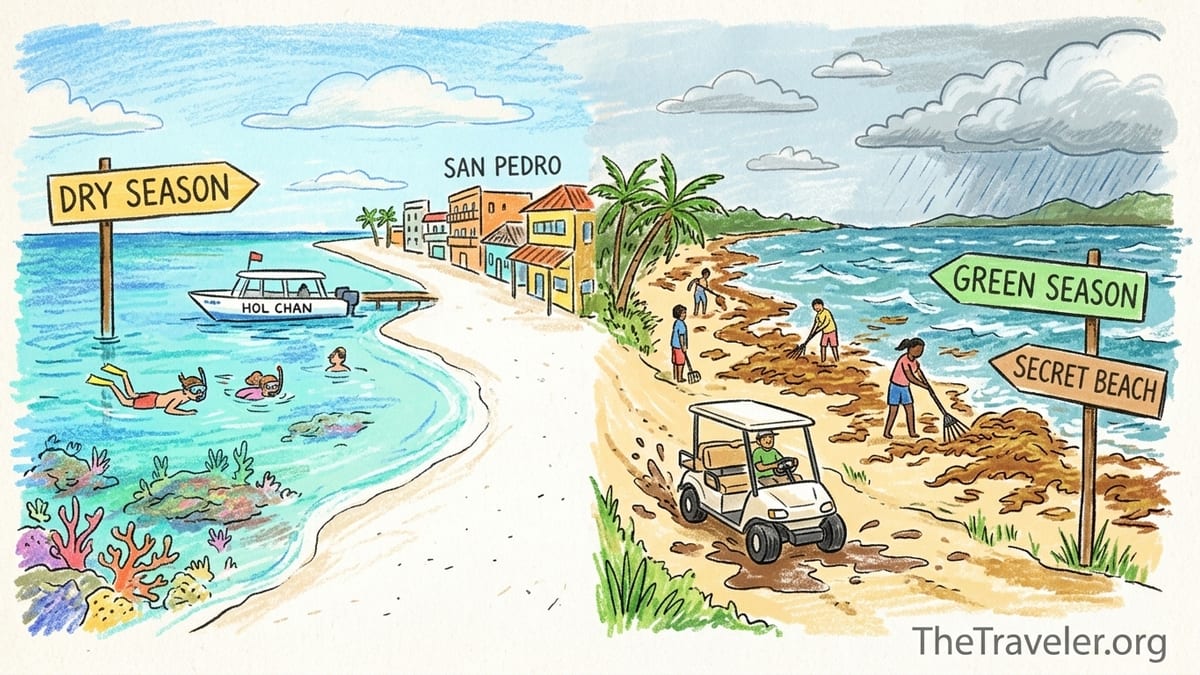
How Ambergris Caye’s Seasons Really Feel On The Ground
Ambergris Caye lives in that tropical band where temperatures hover around the high 70s to mid‑80s Fahrenheit all year, so on paper there is no bad month. In practice, what changes is rainfall, humidity, wind, and the Atlantic’s sargassum cycles. Long‑term climate data for the island shows a drier period from roughly late December through May, then a wetter “green” period from June into November, with a noticeable spike in rain in September and October. Air temperatures barely move, but the way the island feels under your feet absolutely does.
Walking along the seafront in San Pedro in February, I usually get crisp blue mornings, a steady breeze that keeps the heat honest, and only quick showers that blow through in minutes. Return in late September, and the same stretch of beach can be wrapped in heavy, still air, with clouds stacking up over the mainland and afternoon downpours that flood low‑lying streets. Humidity in mid‑summer and early fall routinely sits well above 80 percent, so even low 80s temperatures can feel like a warm, damp blanket.
Those seasonal swings matter for more than comfort. They ripple into dive visibility, whether your Hol Chan snorkel trip runs on schedule, and how many people you are sharing Secret Beach with. Pair that with Belize’s official 2026 Green Season campaign, which offers savings of up to about 30 percent at selected properties between early June and late September, and timing your trip becomes a real trade‑off between risk and reward rather than a simple “dry versus wet season” choice.
Conditions can also shift year to year. A September that is mostly blue sky one year can deliver almost daily squalls the next. That is why I have stopped promising friends “perfect” months. Instead, I match what they care about most – calm snorkeling, nightlife, budget, or avoiding sargassum – to the season that usually gives them the best odds, then insist they recheck conditions right before they fly.
Dry Season: The Classic “Best” Time For Weather And Visibility
From roughly late December through May, Ambergris Caye settles into its most reliable rhythm. Climate records for the island show this window as the driest, with relatively few heavy rain days compared to late summer and fall. On my own February and March trips, sunrise over the reef has almost always meant clear skies, moderate trade winds, and seas calm enough that even nervous snorkelers felt comfortable on a small boat heading to Hol Chan Marine Reserve.
This is when underwater visibility usually shines. Local snorkel and dive operators frequently describe March and April as their clearest months, with visibility at popular sites like Hol Chan and Shark Ray Alley often in the 80 to 100 foot range on calm days. Water temperatures sit comfortably in the low 80s Fahrenheit, warm enough to skip a wetsuit but cool enough that long snorkel sessions still feel refreshing. I have had some of my best reef days in late April, drifting over bright coral fingers with almost no sediment in the water and eagle rays visible from the surface.
Dry season does not mean wind‑free. Cold fronts from the north can push down between about November and January, bringing a day or two of stronger winds and chop. I have lost at least one Blue Hole trip in January to a front that kicked up the open water crossing beyond what the operator was willing to risk. Those fronts tend to be short‑lived, but if your heart is set on an outer reef or atoll trip, building in an extra buffer day or two is wise.
The trade‑off is cost and crowds. Late December through Easter is peak season. When I priced a mid‑March 2026 stay, mid‑range seafront hotels in San Pedro were regularly quoting rates around 250 to 350 US dollars per night for a standard room, with boutique options and dive resorts climbing higher. Golf cart rentals push toward the upper end of their normal range, and you will want dinner reservations at well‑known spots in town during weekends. For a traveler whose priority is the calmest seas and clearest visibility, those costs can be worth it, but it is not the season for spontaneous bargains.
Green Season: Cheaper Rates, Bigger Weather Dice Roll
Belize’s “green season” is not a marketing invention. From June into November, rainfall climbs, especially in September and October, and the humidity steps up noticeably. On Ambergris Caye I feel that shift most clearly in late afternoon. A June morning can still dawn cloudless and bright, but by mid‑day you often see build‑ups over the mainland that can sweep across the island, bringing a sudden, heavy shower and short‑term chop on the water.
In 2026, the Belize Tourism Board leaned into those months with an official Green Season campaign, promoting reduced crowds and accommodation discounts of up to around 30 percent at participating properties, with sample offers running from early June through late September. When I compared June 2026 rates with February 2026 at the same mid‑range San Pedro hotel, the June price was roughly one third lower for identical room categories. Inland, places like San Ignacio Resort Hotel have even advertised autumn reductions of 30 to 45 percent off suites and rooms, a signal of how much softer demand can be once the summer showers and sargassum headlines start.
On the island this shift is obvious in the feel of town. I have walked down Barrier Reef Drive in August and found tables easily at restaurants that were packed solid in March. Boats to Hol Chan still run daily when seas allow, but departure boards show more last‑minute openings. Even Secret Beach, which is never exactly empty, takes on a slower, more local vibe, with day‑tripping Belizeans mixing with a smaller pool of international visitors.
The flip side is that weather is simply less predictable. I have had a brilliant, mostly sunny first week of August with only one short storm rolling through at night. I have also watched a September visit get chopped up by several days of grey skies and sloppy seas that forced operators to cancel or shorten full‑day trips to the outer reef. The core question is how you personally feel about risk. If you are flexible and willing to swap a reef day for a long lunch or a mainland excursion when the forecast sours, the green season’s combination of lower prices and thinner crowds can be superb value. If your dream is a once‑in‑a‑lifetime Blue Hole dive on a fixed date, you may want the drier months’ better odds.
Understanding Sargassum: East Versus West
The biggest surprise for many first‑time visitors is not rain, but sargassum. This floating brown seaweed gathers in the Atlantic and Caribbean, riding currents until it washes ashore along exposed coasts from Brazil to Florida. On Ambergris Caye, that typically means the east‑facing shoreline, including much of San Pedro town and the strips of sand you see in front of many seafront hotels. The west side of the island, especially around Secret Beach on the leeward shore, often stays far clearer even on days when the town beaches are carpeted.
I have walked the beachfront near San Pedro in April and seen crews out with rakes and front‑loaders piling sargassum into heaps by mid‑morning. The water at the edge was a murky brown tangle, with the usual shallow swim area effectively closed. That same afternoon, a 25‑minute golf cart ride to Secret Beach delivered knee‑ to waist‑deep clear water, a sandy bottom, and almost no seaweed at my feet. Bars around Secret Beach had their usual line of loungers and floating platforms, and kids were swimming without a second thought.
This contrast is backed up by local observation rather than strict monthly rules. Residents and repeat visitors repeatedly report that when the east side of Ambergris Caye is struggling with sargassum, the west side often remains swimmable. The reason is simple geography and wind: the barrier reef sits close to the east shore, with open water beyond, so floating mats of seaweed hit that coast first. The west side sits behind the island, with far less direct exposure to the incoming sargassum belt.
One critical point: sargassum does not obey tourist seasons or fixed calendars. Some years bring heavy arrivals as early as March that last deep into summer; other years see noticeable relief in late fall and winter. There is a rough pattern where warmer summer waters and stronger trade winds from the east can push more seaweed in, but real‑time satellite monitoring and local reports matter far more than any month‑by‑month promise. I never tell anyone that any date will be “sargassum‑free.” Instead, I suggest they assume the east shore might see some level of seaweed and plan at least a couple of Secret Beach or lagoon‑side days as a backup.
How Rain, Wind, And Visibility Change Your Time On The Water
For many visitors, the whole point of Ambergris Caye is the water: snorkeling Hol Chan, diving the reef, or just floating off a dock with a Belikin in hand. The interplay between rain, wind, and water clarity is what makes timing so important. Heavy rain by itself is less of a problem offshore than you might expect. I have snorkeled Hol Chan under low cloud with rain falling and still had solid visibility, because the reef lies in clear water that is not fed by major rivers. What really eats visibility and comfort is wind.
During the heart of the dry season, steady but moderate trade winds often mean small chop on the surface but excellent horizontal visibility once you are under the water. In March, I have ridden out to the reef in a 25‑foot open boat with nothing more than a light spray and then dropped into water where I could see my guide from thirty or forty feet away. By late summer, however, the combination of localized squalls and stronger gusts can roughen up crossings enough that operators cancel or confine trips to more sheltered sites.
Most snorkel tours to Hol Chan and Shark Ray Alley are relatively short runs and can operate safely in a range of conditions, but longer open‑water trips to Turneffe Atoll or the Blue Hole are far more sensitive to wind forecasts. On a blustery September morning in San Pedro, I watched a dive shop call off a Blue Hole departure at 6 a.m., explaining that seas outside the reef were already too lumpy and the forecast showed things building through the day. Everyone got a refund or rebooking, but for travelers on tight itineraries the lost day stung.
Underwater visibility itself follows a gentle pattern. Dry spring months, especially March and April, tend to deliver the clearest water, with visibility at popular sites often reaching tens of meters. As summer progresses and more storms roll through, visibility can drop somewhat, especially after a blow that stirs up sand and seagrass. Even so, Belize’s reef rarely becomes genuinely “bad” for snorkeling. The bigger question is whether you feel comfortable on the boat ride out and how likely your particular excursion is to run.
Crowds, Pricing, And The Real Cost Of Flexibility
Seasonal changes around Ambergris Caye show up just as starkly in room rates and restaurant bookings as in the sky. In late January, San Pedro feels like a small city: golf carts nose‑to‑tail on Front Street after sunset, beach bars humming with music, dive shops posting full boats for the next day. That energy is part of the appeal, but it also means higher prices across the board. Standard rooms at branded beach resorts can spike above 400 US dollars per night around Christmas and New Year, and even simple guesthouses raise rates for that period.
Slide your trip to mid‑June or August and the picture changes. With the Green Season promotions in 2026, official tourism campaigns highlighted limited‑time discounts of up to 30 percent at selected hotels across Belize, some of which include properties on Ambergris Caye. In practice, that can mean a seafront hotel that was 300 US dollars per night in March dropping closer to 200 dollars in late summer, or an inland add‑on in Cayo offering 30 to 45 percent off suites for October stays. Airfares from major US hubs to Belize City sometimes soften slightly outside school holiday spikes as well, though that varies by route.
Crowd levels fall in step with those prices. When I visited in an August shoulder week, I could walk into popular San Pedro restaurants like Elvi’s Kitchen earlier in the evening without a reservation, and day trips booked the night before still had room. Secret Beach remained busy on weekends but far less congested on weekdays, with more open loungers and quicker service at beach clubs. For independent travelers who like to keep plans loose, that flexibility is worth almost as much as the cash savings.
The hidden cost is that flexibility has to run both ways. In green season you may have to shuffle your own plans when a storm front cancels a full‑day sailing or bumps your snorkeling to a calmer morning. I now build at least one “spare” day into any summer or early fall trip, so that a postponed reef tour has somewhere to land without cutting into departure day. I also mentally treat those months as partly a Belize City plus inland combination trip: if the coast takes a hit from weather or sargassum, Cayo’s caves and ruins are usually running happily under their own afternoon showers.
Planning Around Secret Beach And The Island’s Two Coasts
Because Ambergris Caye’s east and west shores behave so differently, thinking in terms of “two coasts” helps. Most hotels, restaurants, and docks that serve Hol Chan and reef excursions line the east side along and north and south of San Pedro town. This is where you wake to sunrise over the reef, hop directly onto snorkel boats from your pier, and stroll the beach between beach bars. It is also the side that is most exposed to incoming sargassum and to wind from the prevailing easterlies.
The west side, accessed most famously at Secret Beach, offers a different personality. Here you get shallow, usually calm water with sandy and seagrass bottoms, a sunset view, and a lineup of beach clubs that, for better or worse, control much of the comfortable shoreline access. On days when the town beaches are choked with sargassum, I have seen whole families migrate by golf cart to Secret Beach, paying for drinks and lunch at one of the waterfront bars in exchange for loungers, floating mats, and easy entry into clearer water.
This does mean that swimming on the west side can feel more commercialized. Many of the nicest spots to enter the water sit directly in front of a bar or restaurant, and staff will reasonably expect you to order something if you plan to camp out in their chairs. For some travelers, that is part of the fun: a bucket of beers, a ceviche platter, and hours of easy swimming. For others, it can feel less like an untouched Caribbean cove and more like a social beach club. Setting expectations ahead of time avoids disappointment.
Logistically, reaching Secret Beach from San Pedro town takes around 25 to 35 minutes by golf cart, depending on road conditions. After heavy rain the unpaved stretches can turn muddy and slow. On my last September drive out, several large puddles forced carts to weave and crawl, adding ten minutes to the journey. It is another reminder that in wetter months you will want both flexible timing and footwear you do not mind getting splashed.
The Takeaway
After experiencing Ambergris Caye in crisp February trade winds, warm April clarity, and sticky September stillness, I no longer believe there is a single “best” time to visit. There are better months for certain priorities. If clear water and the highest odds that your reef and atoll trips will run are non‑negotiable, late January through April gives you the strongest hand. If you care as much about value and elbow room as about weather, June through August under Belize’s 2026 Green Season deals can offer serious savings and a more relaxed pace, as long as you are ready to dance around passing squalls and possible sargassum.
Sargassum itself is the wild card no calendar can fully tame. Ambergris Caye’s east‑facing coast will likely see some seaweed many months of the year, while the west‑facing Secret Beach area often stays swimmable when town beaches look rough. Instead of chasing a mythical “sargassum‑free month,” plan for both coasts: stay where it makes sense for boats and restaurants, and earmark a couple of Secret Beach days in case the wind and current turn.
Most importantly, treat any advice you read, including this article, as a starting point. Before you lock in 2026 dates, check current forecasts for Belize’s Caribbean coast, look at recent photos or live updates from San Pedro and Secret Beach, and ask your chosen hotel or dive shop how conditions have been in the last few weeks. Ambergris Caye rewards travelers who pay attention not just to what the climate usually does, but to what the sea and sky are doing right now.
FAQ
Q1. What is the single best month to visit Ambergris Caye?
There is no perfect month, but late February through April usually balances dry weather, good visibility, manageable wind, and slightly fewer peak‑holiday crowds.
Q2. When are sargassum levels usually lowest on Ambergris Caye?
Local experience suggests late fall and winter, roughly November through early spring, often see fewer heavy arrivals, but sargassum varies widely by year.
Q3. Is Secret Beach always free of sargassum?
No, but it is often much clearer than east‑facing town beaches because it sits on the west side of the island, sheltered from the incoming sargassum belt.
Q4. How likely are boat tours to be cancelled in green season?
Short reef trips usually run, but longer atoll and Blue Hole trips are more vulnerable to wind and swell, especially in late summer and early fall.
Q5. How much can I really save by visiting during Belize’s 2026 Green Season?
Official campaigns highlight discounts of up to about 30 percent at participating properties, and some hotels advertise even deeper shoulder‑season deals.
Q6. Is August too hot and humid to enjoy Ambergris Caye?
August is warm and humid, but steady breezes and time in the water make it bearable for most visitors who are comfortable in tropical conditions.
Q7. What months offer the clearest water for snorkeling and diving?
Dry spring months, especially March and April, generally bring the best combination of calm seas and clear water around Hol Chan and the barrier reef.
Q8. Will I need to book restaurants and tours in advance in low season?
You will usually find more walk‑in availability in green season, though it is still wise to reserve popular tours and a few dinners during weekends.
Q9. Should I stay on the east side or near Secret Beach?
Most visitors stay on the east side for docks and dining, then visit Secret Beach by golf cart for clearer swimming when sargassum affects town beaches.
Q10. How close to my trip should I check current sargassum and weather conditions?
Check in the two weeks before travel and again a few days before arrival, using recent photos, local reports, and direct messages to your hotel or tour operator.