


Helsinki Airport has built its reputation on being compact, calm and efficient, which makes it one of the easier hubs in Europe for transfers and tight connections. Recent expansions have unified the facilities into a single, walkable terminal, but the layout can still feel confusing if it is your first time or you are dealing with a short layover. This guide walks you step by step through check in, transfers and connections at Helsinki Airport, using real timings and examples so you can plan with confidence.
Get the latest updates straight to your inbox!
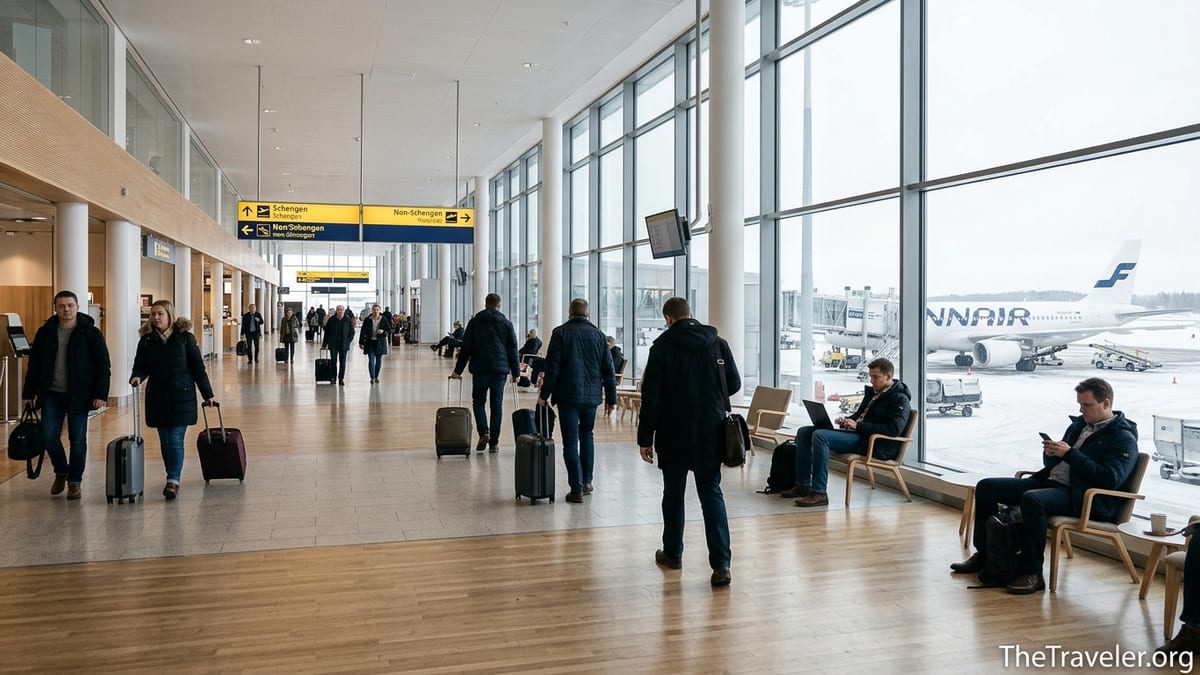
Understanding Helsinki Airport’s Layout and Zones
Helsinki Airport operates as a single integrated terminal, even though older maps and some booking systems still refer to “Terminal 1” and “Terminal 2.” Today these areas are joined airside and landside, so you will not need to change buildings during a normal connection. Instead, you move between different gate areas within one continuous terminal. Schengen flights mostly use gates in the lower numbers, while non Schengen long haul services, such as Finnair departures to Tokyo or Dallas, typically use higher numbered gates in the 40s and 50s. This means most connections are simply a matter of walking along the concourse and following signs for your next gate.
The key concept to understand is the division between Schengen and non Schengen areas, not between former terminals. If you are arriving on a Finnair flight from Paris and connecting to Kuopio, your entire journey stays within the Schengen zone and you will not see border control, just the transfer corridor and departure gates. If you arrive from Singapore and connect to Berlin, you will land into the non Schengen area, then follow signs to Schengen transfers and pass through passport control before reaching your European departure gate. Knowing whether your next flight is Schengen or non Schengen tells you if you should expect a border check during your connection.
The terminal has been designed to keep walking distances relatively short compared with large hubs like Frankfurt or Amsterdam. Typical walks from one end of the Schengen pier to the non Schengen gates take around 10 to 15 minutes at an average pace, and there are moving walkways in the longer corridors. Even if you arrive at a bus gate, as can happen on regional flights during peak times, the bus drop off points are close to the main concourse so you are not losing much time getting into the terminal.
Signage at Helsinki Airport is clear and consistent, with yellow gate numbers and large pictograms. All key wayfinding information is in Finnish, Swedish and English. If you step off a flight from London and are not sure where to go, look for the blue “Flight connections” signs first, then check the information screens for your next gate. Staff in Finnair uniforms and airport customer service jackets circulate in busy transfer areas, particularly when waves of long haul flights arrive, and are used to helping passengers who are worried about making their connection.
Minimum Connection Times and What They Mean in Practice
Helsinki’s official minimum connection times are among the shortest in Europe, reflecting the compact terminal and efficient border control setup. For many airline combinations, Schengen to Schengen connections are sold with as little as about 35 minutes between flights, and Schengen to non Schengen or non Schengen to Schengen connections can be sold from about 40 to 45 minutes. In practice, these short connections work surprisingly often, especially for Finnair to Finnair transfers where schedules are timed to feed specific long haul departures.
For example, it is not uncommon to find an itinerary from Copenhagen to Rovaniemi via Helsinki with just a 40 minute layover. If both legs are on a single Finnair ticket, your baggage is checked through and your boarding pass shows both flights, the airline has already verified that the connection meets its minimum standard. If your inbound flight is a few minutes late, ground staff and gate agents monitor connecting passengers and can hold the onward flight for a short period, especially when many passengers are affected. When delays are more serious and you miss the connection, the airline will usually rebook you on the next available flight to your destination.
That said, treating these tight connections as comfortable buffers is risky if you are a nervous traveler or are accompanying young children. If you prefer time for a restroom stop, coffee and a quick browse of duty free, aim to build in at least 60 to 90 minutes between flights where you have control over the booking. For complex itineraries, such as arriving from New York in the early morning and continuing to a smaller Finnish airport, a layover of one and a half to two hours can feel much more relaxed, especially in winter when deicing can add time to ground operations.
Travelers on separate tickets should be particularly cautious. If you buy a low cost ticket from Riga to Helsinki and a completely separate long haul ticket from Helsinki to Bangkok, no airline will take responsibility for protecting your connection. In this situation, you must collect your luggage in Helsinki, clear customs, check in again at departures and pass through security from scratch. This can easily take an hour or more, even on a good day. Allow at least three hours between arrival and your next departure if you are self connecting, and longer if you are traveling in peak holiday periods or with bags to recheck.
Check In and Bag Drop: From City to Gate
For most passengers, check in at Helsinki Airport begins online or in the airline’s mobile app. Carriers such as Finnair, Norwegian and SAS all allow online check in, often opening 24 hours before departure. Completing check in in advance means you can usually skip the full service desk and head straight to a self service kiosk or bag drop when you arrive at the airport. This is particularly valuable for early morning departures, when queues at traditional counters can form quickly as multiple flights leave around the same time.
Self service kiosks are located in the main departures hall, which you enter after coming up from the train station or through the main doors from the taxi and bus area. Here you can print your boarding pass and bag tags in a couple of minutes by scanning your passport or typing in your booking reference. Once your tag is attached, you move to the row of self service bag drop machines, which weigh and accept your luggage automatically. These are typically available around the clock for major airlines, meaning you can often check your bag several hours ahead of departure, then spend time relaxing airside.
If you prefer traditional check in or have special luggage such as skis, musical instruments or pets, head to your airline’s manned counters. For instance, Finnair maintains staffed desks that open a few hours before each departure, and other carriers such as Lufthansa and Turkish Airlines do the same according to their flight schedule. Passengers with business class tickets or elite frequent flyer status usually have access to priority check in lanes, which can significantly reduce waiting times at busy periods.
Arriving from the city, it is realistic to step off a commuter train at the airport station with a checked bag and be airside within 25 to 40 minutes on a normal weekday morning, assuming you already checked in online and only need to use bag drop and security. On a Saturday in February, when many Finns fly to Lapland ski resorts, those same formalities may take longer. As a rule of thumb, arrive at the airport around two hours before a European departure and at least three hours before a long haul flight, allowing extra time if you need to return a rental car or are unfamiliar with the airport.
Security, Passport Control and Moving Between Schengen and Non Schengen
Once your boarding pass is in hand and any checked bags are dropped, your next step is security control. Helsinki Airport provides several security checkpoints, and digital displays in the departures hall show estimated waiting times for each. Many local travelers quickly scan these screens and walk to the checkpoint with the shortest queue, which might be slightly farther away but saves several minutes. On days with heavy traffic, additional lanes are opened to keep lines moving, and staff direct passengers with imminent departures toward dedicated “priority” or “tight connection” lines when possible.
For transfer passengers already airside, security may or may not be part of your connection. If you arrive from another Schengen airport on a standard commercial flight, you normally disembark into the Schengen arrivals corridor and walk directly to your connecting gate without passing through security again. If you arrive from a non Schengen country, such as the United States or the United Kingdom, and connect to a Schengen flight, you will go through passport control and then often through a transfer security checkpoint before reaching the Schengen concourse. The process is streamlined, but during peak banks of arrivals you should allow extra time for these formalities.
Moving from Schengen to non Schengen is similarly straightforward. Imagine you land from Munich at a Schengen gate and are connecting to a Finnair flight to Tokyo. Information screens will indicate that your outbound flight departs from a non Schengen gate in the 40s or 50s. You follow signs for “Gates 40–55” and “non Schengen,” pass through border control where your passport is checked and then emerge into the non Schengen departures lounge. Duty free and food options are available on both sides of the border, so you do not need to worry about losing access to basic services when you cross between areas.
Queues at passport control are generally shorter in Helsinki than at many larger hubs, but they can still build up when multiple long haul flights arrive within minutes of each other, especially for non EU passengers. Automated eGates for eligible passports help keep lines moving, while manual booths handle other travelers and families with children. If you see that your boarding time is approaching and the queue is long, it is worth politely approaching an officer or airport staff member and explaining that you have a short connection. They cannot always move you to the front, but in many cases they do their best to help passengers with genuine time pressure.
Making the Most of Short or Overnight Connections
Helsinki’s compact size makes tight same day connections realistic, but it also means the airport can feel quiet at night. If you are arriving late and departing early the next morning, consider booking a hotel within walking distance rather than trying to sleep in the terminal. Several international chain hotels are located a short walk or shuttle ride from the main doors, and many travelers find the extra rest well worth the cost compared with an uncomfortable night on a bench.
During daytime layovers of two to four hours, you can comfortably clear formalities and still have time to enjoy the airport’s amenities. After arriving from a regional flight from Tallinn, for instance, you might have two hours before your long haul departure to Chicago. In that time you can walk to the non Schengen area, browse Nordic design shops, grab a salmon soup or a cinnamon bun from a café, and perhaps visit one of the airline or pay in lounges if you have access. The airport offers free Wi Fi throughout, so it is also easy to catch up on work or stream a series while you wait.
For very long daytime layovers of six hours or more, especially on a single ticket where your baggage is checked through, it might be tempting to pop into the city. The airport train connects directly to Helsinki Central Station in roughly 30 minutes, with regular departures throughout the day. A traveler landing from London at 09:00 and departing to Rovaniemi at 17:00 could realistically clear Schengen entry, take the train into the city, enjoy a few hours around the central Esplanadi area, then return to the airport by mid afternoon. The key is to factor in at least two hours back at the airport before your next departure to re clear security and walk to your gate without rushing.
If you are connecting on separate tickets and need to recheck bags, or you prefer not to carry heavy hand luggage during a city visit, the airport provides luggage lockers and storage facilities in landside areas. This allows you to leave a suitcase or backpack at the airport while you explore, returning with only a small day bag. Opening hours for staffed storage may be limited on public holidays, so check in advance if your layover falls on a major Finnish holiday such as Christmas Eve or Midsummer.
Ground Transport Connections: Trains, Buses and Taxis
Helsinki Airport’s rail link is one of its greatest strengths for both departures and arrivals. The train station is located directly beneath the terminal, accessible by escalators and lifts from the arrivals and departures levels. Two commuter train lines, often labeled with letters, operate in a loop between the airport and Helsinki Central Station, stopping at several suburban stations along the way. Travel time to the city center is around half an hour in normal conditions, and trains run frequently throughout most of the day.
If you are arriving on an early morning flight, such as a 06:00 arrival from Oslo, you can often be on a train toward the city by around 07:00 after collecting checked luggage. Tickets can be purchased from vending machines in the arrivals hall or via regional transport apps before you board. For travelers continuing onward by long distance train to other Finnish cities such as Tampere or Turku, Helsinki Central Station is the main interchange. Many itineraries are sold as combined air and rail journeys, but even if you buy tickets separately it is straightforward to connect between the airport and mainline services.
Long distance buses and regional coaches also serve Helsinki Airport, stopping outside the terminal. These can be convenient if you are heading directly to cities like Lahti or Porvoo, or to some of the larger suburbs that are not on the rail loop. Schedules are typically coordinated with major flight arrival times, especially in the early morning and late evening. If you have a checked bag and are worried about lifting it onto a train, a coach transfer can be a less stressful option, though it is more susceptible to traffic delays in bad weather.
Taxis line up outside the arrivals level, and licensed vehicles display fixed price lists for typical city destinations. While a taxi is significantly more expensive than the train, it can be worthwhile if you are traveling as a group with large suitcases, or if you arrive very late at night when public transport frequencies are reduced. For instance, a family of four arriving from Dubai close to midnight with multiple ski bags may prefer a taxi directly to a hotel in the city center, avoiding extra lifting and transfers. Ride hailing services also operate, and pick up points are clearly signposted, reducing confusion during late night arrivals.
The Takeaway
Helsinki Airport’s single terminal layout, efficient processes and clear signage make it one of Europe’s more forgiving hubs for transfers, tight check in windows and onward connections. Understanding the Schengen versus non Schengen split, the role of passport control in your journey and the typical walking times between gate areas allows you to judge whether a proposed itinerary is comfortable or merely feasible. When flights are booked on a single ticket and baggage is checked through, even 35 to 45 minute layovers often work, especially on Finnair’s coordinated network.
At the same time, giving yourself a buffer pays off. Arriving two hours ahead for European departures and three hours for long haul flights leaves room for seasonal surges, security queues and the occasional rail or bus delay. If you are self connecting on separate tickets, building in at least three hours protects you from most routine disruptions. With realistic expectations and a clear sense of how to move through the terminal, you can keep Helsinki Airport as it is designed to feel: calm, compact and surprisingly stress free, even on a busy travel day.
FAQ
Q1. Is a 40 minute layover at Helsinki Airport enough for a connection?
It can be enough if both flights are on a single ticket, your bags are checked through and you are comfortable walking briskly between gates. However, if you prefer a relaxed pace or are traveling with young children, aim for at least 60 to 90 minutes.
Q2. Do I need to go through security again when transferring at Helsinki?
If you arrive from a Schengen country and connect to another Schengen flight, you usually do not pass security again. If you are arriving from or connecting to a non Schengen flight, you may go through passport control and a transfer security checkpoint.
Q3. How early should I arrive for check in at Helsinki Airport?
Plan to be at the airport about two hours before a European flight and at least three hours before a long haul departure. During peak holiday periods or if you need special services, add extra time.
Q4. Can I check in my bags the evening before an early morning flight?
Several airlines operating at Helsinki allow evening bag drop for early morning departures on specific routes. This lets you arrive closer to departure time with only hand luggage, but availability depends on your airline and flight.
Q5. How long does it take to get from Helsinki city center to the airport?
The commuter train between Helsinki Central Station and the airport takes around 30 minutes in normal conditions. Allow additional time to buy a ticket, walk to the platform and move from the station up into the terminal.
Q6. What happens if my first flight is delayed and I miss my connection at Helsinki?
If both flights are on a single ticket, the operating airline will usually rebook you on the next available service at no extra cost. If you booked separate tickets, you are responsible for buying a new onward ticket if you miss the connection.
Q7. How do I know if my next flight from Helsinki is Schengen or non Schengen?
Check your boarding pass and departure screens. Flights within most of Europe, including Finland, Sweden, Germany and Spain, are typically Schengen. Flights to destinations such as the United Kingdom, United States or Japan are non Schengen and depart from dedicated gate areas.
Q8. Are there good places to rest during a longer layover?
Yes. Helsinki Airport has quiet seating areas, cafés and lounges where you can rest between flights. For overnight layovers, many travelers find it more comfortable to book a nearby airport hotel rather than staying in the terminal.
Q9. Is baggage storage available if I want to visit the city during a layover?
Landside luggage lockers and storage services allow you to leave larger bags at the airport while you take the train or bus into Helsinki. This is useful if you have several hours between flights and prefer to explore with only a small day bag.
Q10. How accessible is Helsinki Airport for passengers with reduced mobility?
Helsinki Airport provides assistance services that can be booked through your airline in advance. Staff can help with wheelchairs, escorting you through security and passport control and ensuring you reach your gate in time for boarding.