


More news on this day
MSC Cruises’ newest mega ship, the 6,700-passenger MSC World America, has successfully completed sea trials in the Atlantic, clearing a key technical milestone ahead of its North American debut.
Get the latest news straight to your inbox!
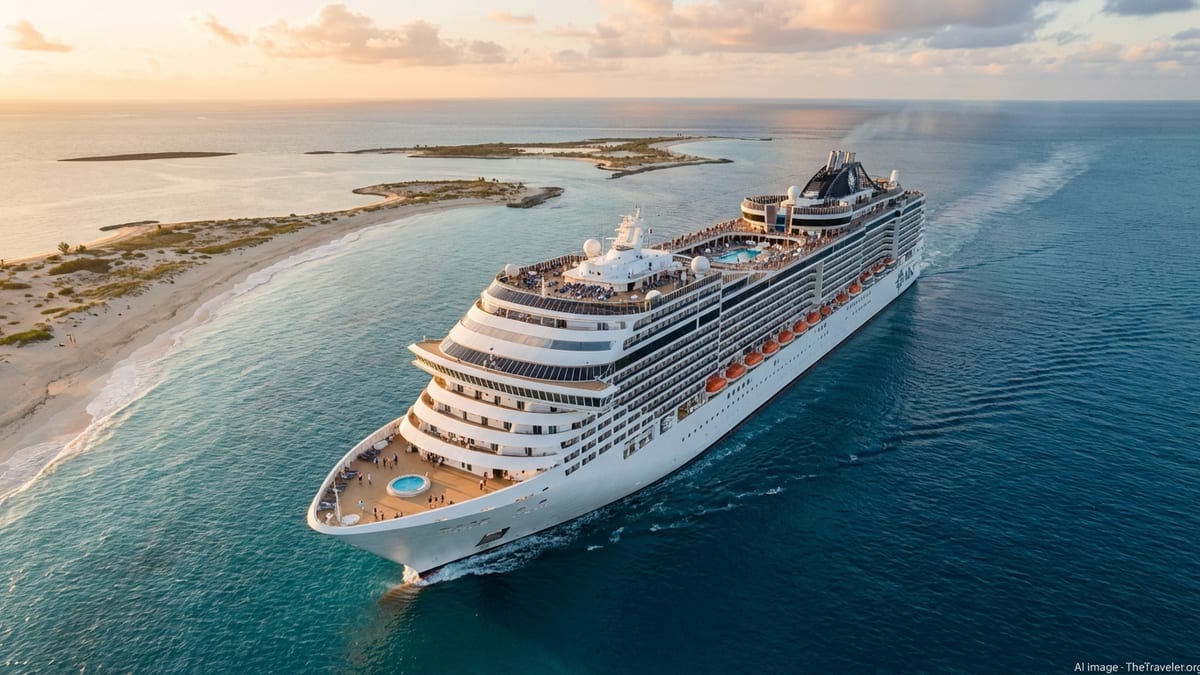
Final Sea Trials Mark Major Milestone
According to publicly available information from MSC Cruises and industry coverage, MSC World America carried out intensive deep-water testing off the French Atlantic coast, focusing on propulsion, maneuverability and safety systems. The trials are described as the last major technical step before the vessel’s handover from the Chantiers de l’Atlantique shipyard.
Reports indicate that engineers evaluated the ship’s main engines, steering, emergency backup systems and fuel performance under a range of speeds and conditions that cannot be replicated dockside. These exercises are standard practice for new ocean-going vessels and are designed to verify that all critical systems meet international regulatory and classification requirements.
Industry outlets note that the sea trials were completed without major incident, enabling the 6,700-guest ship to return to the yard for final interior outfitting and finishing work. Delivery to MSC Cruises is scheduled ahead of the ship’s first season sailing from Miami, which will make MSC World America the line’s newest flagship for the U.S. market.
LNG-Powered Design Targets Lower Emissions
MSC World America is part of the company’s World Class series and is powered by liquefied natural gas, reflecting the wider cruise sector’s shift toward lower-emission fuels. Publicly available technical details show that the ship is equipped with dual-fuel engines capable of running on LNG, which can significantly reduce sulfur oxide and particulate emissions compared with conventional marine fuel.
The vessel also features advanced waste heat recovery, shore power connectivity and energy-efficient systems intended to cut overall fuel consumption. Cruise industry analyses describe the class as among the largest LNG-powered passenger ships in service, positioning MSC Cruises within a competitive field of operators investing heavily in greener propulsion technologies.
Environmental groups and industry observers have noted that LNG is viewed as a transitional fuel rather than a long-term solution, but the adoption of this technology is still considered an important near-term step for large-capacity ships. With sea trials now completed, attention is turning to how the new mega ship will perform in regular commercial service on busy North American routes.
Onboard Features Aimed at the U.S. Market
Published descriptions of MSC World America highlight a ship tailored specifically to North American preferences, with family-focused amenities, high-capacity entertainment venues and a broad range of dining concepts. The vessel is reported to span more than 20 decks and accommodate passengers across a mix of standard cabins, suites and MSC Yacht Club ship-within-a-ship accommodations.
Industry coverage points to extensive outdoor spaces, multiple pool areas and a large water park designed to appeal to families and multigenerational groups. The ship also incorporates the World Class signature open aft promenade and central outdoor space, elements that have been cited as key design features on its sister ship, MSC World Europa.
The entertainment line-up is expected to include large-scale theater productions, immersive digital venues and a substantial dedicated area for children and teenagers. Analysts note that these offerings are part of MSC Cruises’ strategy to grow its presence in the North American market by competing more directly with established U.S.-based mega-ship operators on hardware and onboard experience.
Strengthening MSC Cruises’ North American Expansion
MSC World America’s progression through sea trials also underscores MSC Cruises’ ongoing expansion in North America, where the company has been increasing both capacity and visibility. Publicly available data shows that the line has invested in new terminals and additional ships homeported in Miami and other U.S. ports in recent years.
By introducing one of its largest ships specifically configured for the region, the company is aiming to capture a larger share of the fast-growing North American cruise market. Industry reports suggest that the deployment of MSC World America will add thousands of lower berths to the company’s annual capacity from U.S. ports, particularly on Caribbean and private-island itineraries.
Analysts observe that this expansion comes at a time of strong demand for large-ship cruising, with the wider sector reporting record bookings and higher occupancy. The completion of sea trials for MSC World America is therefore being viewed as a timely development that positions MSC Cruises to benefit from sustained interest in mega-ship vacations among U.S.-based travelers.
Part of a Broader Newbuild Pipeline
MSC World America’s successful testing forms part of a larger multi-ship newbuild program at MSC Cruises, which includes additional World Class vessels and luxury ships for its Explora Journeys brand. Orderbook data compiled by cruise industry publications lists several more deliveries for the group through the late 2020s, reflecting a long-term growth strategy across different market segments.
Chantiers de l’Atlantique, the French yard responsible for building MSC World America, is also engaged in subsequent World Class projects, while Italian shipbuilder Fincantieri is constructing the Explora Journeys series. These concurrent construction programs highlight the scale of investment by MSC Group in both contemporary and luxury ocean products.
With sea trials for MSC World America now complete, attention within the cruise industry is turning to the ship’s forthcoming debut season and its impact on competitive dynamics in the North American mega-ship market. Observers will be watching closely how the new vessel’s scale, LNG propulsion and U.S-focused design resonate with passengers once it begins regular sailings.