


Vintgar Gorge near Lake Bled has quietly become one of Slovenia’s most tightly managed natural attractions. With one-way walkways, off-site parking, mandatory helmets and time-slot tickets, it can feel surprisingly complex to plan a simple gorge walk. This guide breaks down, in plain language, how to navigate the entrances, trails, shuttles and rules so you spend more time watching turquoise water and less time worrying about logistics.
Get the latest updates straight to your inbox!
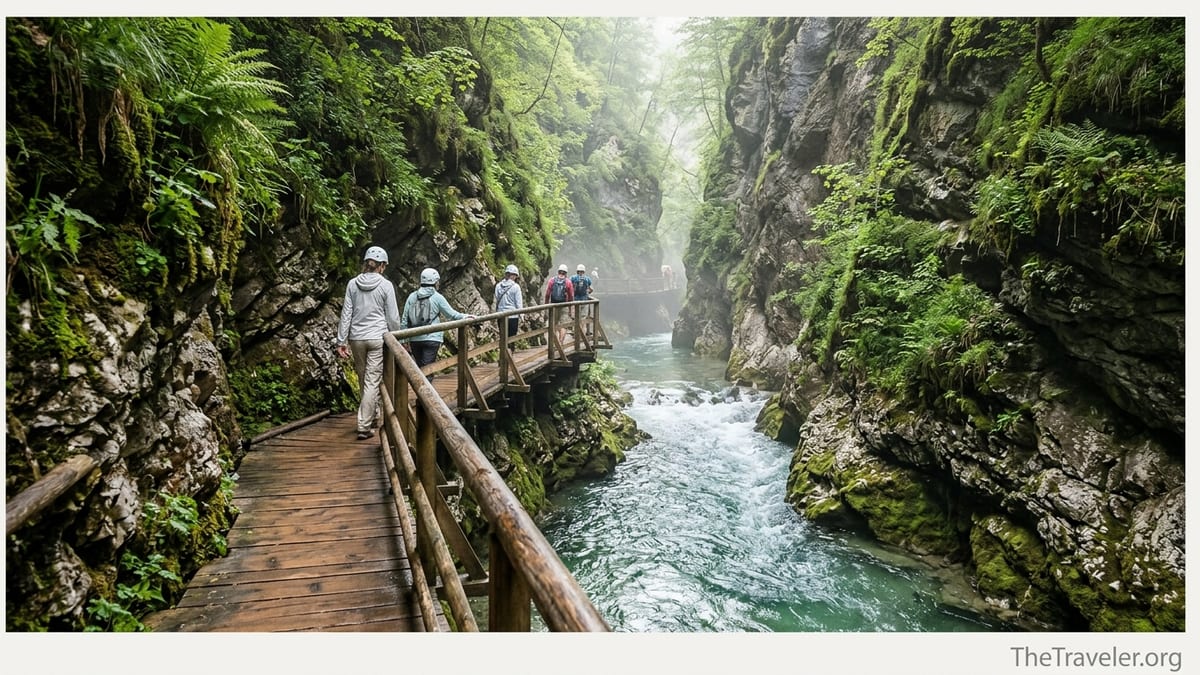
Understanding the New Access System at Vintgar Gorge
Vintgar Gorge lies about 4 kilometers northwest of Lake Bled on the edge of Triglav National Park. For years, visitors simply drove to Podhom, bought a ticket at the gate and walked in. As visitor numbers climbed into the hundreds of thousands per year, that model became unsustainable. Since 2025, local authorities have introduced a managed access system that concentrates parking off-site, controls entry through time slots and routes visitors in a single direction through the gorge.
The key change for travelers is that you no longer treat the gorge as a casual walk-up attraction. You plan your visit almost like a timed museum entry. Most visitors now start at the main entrance near the village of Podhom, walk the 1.6 kilometer boardwalk along the Radovna River to the Šum Waterfall exit, then return to the starting area via one of several marked forest trails rather than backtracking inside the gorge.
To make this work smoothly, the gorge operators and the Municipality of Bled created a “Vintgar Gorge All-in-One Pass.” This is a single ticket that, for adults, currently costs around 15 euros. It bundles the gorge entry, a small conservation and safety fee, access to an audio guide and what they call “Green Access,” which covers official parking and the shuttle bus that links the parking and Bled with the visitor center.
The overall result is that the gorge feels less crowded on the walkways, but you must think ahead. Many summer visitors now book a 10:00 or 12:00 slot weeks in advance and plan their day in Bled around it. If you arrive at peak time without a reservation, you risk waiting for the next free slot or being turned away if caps have been reached for the day.
Entrances, Exits and Where You Actually Start Walking
For practical purposes, Vintgar Gorge now has one main public entrance and one main exit for ordinary visitors. You enter the gorge at the Vintgar Visitor Centre above the village of Podhom and you exit near the Šum Waterfall at the lower end of the gorge. A secondary access point that once allowed entry closer to Blejska Dobrava has been restricted following local funding disputes, so travelers should not plan to start there.
Almost everyone begins at the Podhom side. This is where the Vintgar Visitor Centre issues helmets, distributes audio guides and checks your timed entry tickets. If you arrive on the Vintgar shuttle from the Central Parking Vintgar LIP lot or from Bled’s central bus station, it will drop you a short walk from this entrance. Cyclists can still ride right up and lock bikes near the visitor center, and motorcycles are allowed to park there directly, but private cars are no longer permitted to drive to the gateway itself.
Once you pass the ticket control, you step onto wooden walkways and gravel paths that cling to the gorge walls above the Radovna River. The walkway leads you gradually downstream, crossing the river several times, until you reach the dam and then the Šum Waterfall area at the far end. This lower area functions as the effective exit: staff and signs will remind you that it is not permitted to re-enter or walk back through the gorge from there.
Your physical “exit” from the gorge is therefore not a turnstile but more of a transition point. There is usually a refreshment kiosk near Šum, a drinking water spout and clear direction boards. From here you follow marked forest trails and rural lanes that loop around the ridge and bring you back to either the Podhom visitor center, the Vintgar parking area or, if you choose a longer option, viewpoints like St Catherine’s Church above the valley.
Tickets, Time Slots and Where to Buy Them
The most common mistake first-time visitors make is assuming they can buy tickets at the gorge gate. Since the 2025 season, tickets are not sold at the physical entrance. Instead, you purchase them online or at designated VINTGAR Hubs before boarding the shuttle. These hubs include the Central Parking Vintgar LIP facility and the main bus station in Bled, where staff and self-service terminals handle sales for same-day and future time slots.
The standard product is the Vintgar Gorge All-in-One Pass. As of the most recent season, adult passes are priced around 15 euros, with children from roughly 3 to 15 years paying about 5 euros, and dogs around 3 euros. Children younger than 3 enter free, but the management explicitly advises against bringing toddlers due to the narrow walkways, drop-offs and the requirement to wear a helmet. Prices may change slightly season by season, particularly as conservation fees are adjusted, but this gives a realistic sense of cost for planning.
Time-slot booking is mandatory in busy periods. A typical summer visitor staying in Bled might reserve a 9:40 entry slot for a Tuesday in July. The ticket confirms that you must be at the Vintgar Visitor Centre ready to enter at that time. Because the shuttle from the Central Parking LIP lot runs roughly every 20 minutes and because queues can form at ticket machines and toilets, the official guidance is to arrive at the parking lot at least 45 minutes before your chosen gorge entry time.
In practice, this means if your accommodation is in central Bled, you might leave your hotel around 8:30, drive or walk to the LIP car park, buy or collect your ticket if you have not done so online, then catch a 9:00 or 9:20 shuttle up to Podhom. Travelers arriving by train can get off at Podhom Station and walk up to the visitor center, but even in that case you must sort tickets in advance or at a designated hub. Turning up at 9:35 without a ticket and expecting to join your friends in the 9:40 slot will likely cause delays and frustration.
Parking, Shuttles and Getting to the Trailhead
For anyone arriving by car, the Central Parking Vintgar LIP lot has become the main gateway. It is located outside the gorge and is signposted from the Bled ring road. The parking itself is currently free for ticket holders but is linked to your All-in-One Pass through the “Green Access” component, which is why parking outside official lots and trying to walk or hitch directly to the entrance is discouraged and, in some cases, policed.
From the LIP lot, the official Vintgar Shuttle runs at roughly 20 minute intervals. Services start about 20 minutes before the gorge opens for the day and continue until roughly two hours after closing to allow visitors to return. The shuttle is a small electric or low-emission bus that typically takes around 10 to 15 minutes to reach the Podhom visitor center. On peak August mornings it can be busy, so leaving at least one or two shuttle cycles between you and your time slot is wise.
If you are staying in Bled without a car, you have two main options. First, you can walk or cycle to Vintgar. From the lakeside near Bled Rose Hotel, it is roughly 2 kilometers and about 30 minutes on foot to reach the Podhom area, though you still need to hold a valid timed ticket before you arrive. Second, you can use public buses that stop at the Central Bled bus station and connect to the Vintgar Shuttle, which runs from there as well during the main season. This is particularly convenient for travelers based in Ljubljana doing a day trip by bus or train to Bled.
Cyclists have a small advantage. While cars must stay at the LIP lot or in Bled, bicycles are allowed to continue to the visitor center, where small bike racks and posts are available. This makes a combined lake circuit and gorge visit feasible: you can rent a bike from a Bled shop, pedal to the visitor center in 20 to 30 minutes, lock up, walk the gorge, then ride back via country lanes in the afternoon.
Trail Layout, One Way System and Choosing a Return Route
Inside the gorge itself, the path is simple. The managed section is about 1.6 kilometers long and strictly one way, always from Podhom toward Šum Waterfall. Wooden galleries bolted into the rock face and compacted gravel paths lead you gradually downstream. The typical walking time through the gorge is 45 minutes to one hour, depending on how often you stop for photos and how crowded it is. Signage makes it very clear that walking in the opposite direction is not allowed, and fines are published for those who ignore the rule.
Where you have real choice is on the return. Once you pass the waterfall and leave the official gorge walkway, you can follow a network of marked forest and village trails that loop around the ridge. The simplest option is the classic circular route that climbs through the woods back to the Podhom area. Another popular variant angles up toward the Church of St Catherine, a hilltop chapel with sweeping views over Lake Bled and the Karavanke range, before descending back toward the visitor center and parking.
Since 2024 the gorge operator has also promoted named return routes such as the “River of Trees” trail. One example is a loop that leaves the Šum area on a right-hand path signed toward Blejska Dobrava car park, then curves across meadows and low forest before joining a track that returns you to the visitor center. Distances vary from about 4.3 kilometers to around 5.7 kilometers for the entire circuit, including the gorge section, and involve roughly 80 meters of ascent on the way back.
In practical terms, most reasonably fit visitors will spend between 1.5 and 3 hours on the total experience. That includes a slow walk through the gorge, a short break near the waterfall and an unhurried hike back along one of the circular trails with time for views and photos. If you want a longer outing, you can link the gorge with local village paths signed from Zasip or Podhom, but you must always respect the one-way rule within the gorge itself and exit at Šum before connecting to other hiking routes.
Visitor Rules: Helmets, Dogs, Drones and What Not to Do
Because Vintgar Gorge is part of the Triglav National Park landscape and because the walkways run directly above a fast-moving river, visitor rules are stricter than in many lowland parks. The most visible requirement is the helmet rule. Helmets are mandatory for all visitors inside the gorge, and you collect them at the Vintgar Visitor Centre before entering. Staff are increasingly firm about compliance, particularly during rainy periods when rockfall risk is marginally higher and when branches and debris can be dislodged from the cliffs above.
Dogs are allowed but under conditions. They must be kept on a leash at all times, and if you use the shuttle bus, a muzzle is typically required because of Slovenian public transport regulations and to prevent conflicts in the small enclosed space. Some visitors carry a lightweight fabric muzzle specifically for this purpose. There is also a separate pet ticket charge, currently a few euros. The narrow walkways, gaps in railings and other people’s fear of dogs mean that only well-behaved, crowd-tolerant animals should be brought along.
Several activities are explicitly banned. Swimming in the Radovna River or wading in pools is forbidden, both for safety and environmental reasons. Drones are not allowed within the gorge, in line with Triglav National Park’s wider ban on recreational drones in sensitive areas. Open fires, camping and bivouacking are prohibited anywhere along the gorge or near the trailheads. Litter bins have deliberately been removed from the interior of the gorge to discourage wildlife habituation, so visitors are expected to carry out all trash and dispose of it at the visitor center or parking areas.
There are also behavioral expectations. The pathways can be only 1 to 1.5 meters wide in places, so stopping for long photo sessions can quickly create bottlenecks. Guides and staff encourage people to step aside at slightly wider sections and keep moving steadily otherwise. Running, trail running and using the walkways as a fitness course are discouraged. Local mountain rescue organizations have repeatedly pointed out that even a minor slip on wet boards can have serious consequences above the river, which is one reason helmets and non-slip footwear are emphasized in all official materials.
Seasonality, Weather and Safety Considerations
Vintgar Gorge is usually open from roughly late April to late October, though exact opening and closing dates vary year by year depending on snow melt, rainfall and maintenance works. In winter, heavy ice, fallen trees and rockfall risk make the wooden galleries unsafe. Travelers visiting in late autumn, winter or very early spring should not expect the gorge to be accessible, even if Lake Bled itself appears quiet and ice-free.
Seasonality also affects crowding and the feel of the walk. In July and August, the busiest period, midday slots between about 10:00 and 14:00 can feel busy despite capped visitor numbers. Timed entries even out the load, but you will still likely share the boardwalks with a steady stream of other hikers and families. In May, June, September and early October, mornings and late afternoons are calmer, and photography conditions are often better due to softer light and less glare off the water.
Weather matters in two distinct ways. First, heavy rain can raise the river and splash the walkways, making boards slick and increasing spray in narrow sections. On such days, staff may advise caution, temporarily delay entries or, in rare cases, close the gorge for part of the day. Second, hot summer days often lure visitors into wearing sandals or smooth-soled fashion trainers, which perform poorly on damp wood. A practical, real-world choice is a pair of light hiking shoes or trail runners with good grip, plus a light shell jacket you can pull on if temperatures drop in the narrow canyon where direct sun is limited.
Families should take the published “not recommended for children under 3” warning seriously. The combination of steps, railings with gaps large enough for small children to slip through and the one-way flow make the gorge unsuitable for strollers and challenging for toddlers who cannot reliably walk on their own. Many visiting parents choose to use a structured child carrier backpack and keep children clipped in during the gorge section, letting them walk only later on the wider forest trails on the way back.
The Takeaway
Vintgar Gorge today is a far more structured experience than it was a decade ago, but that structure exists to protect both visitors and a fragile canyon that is visited by hundreds of thousands of people each season. Understanding where you can park, how the time-slot ticket works, which entrance you use and how the one-way trail is organized turns what could be a confusing day into a smooth, memorable walk alongside some of the clearest river water in the Julian Alps.
If you remember a few key points, you will be fine: buy your ticket in advance and never at the gate, arrive at the official parking or bus hub at least 45 minutes before your slot, wear the helmet you are given, and respect the one-way system and bans on swimming, drones and littering. Combine that with decent footwear and realistic expectations about crowds in high season, and Vintgar Gorge can be a highlight of any trip to Bled and Triglav National Park.
FAQ
Q1. Can I buy tickets at the entrance to Vintgar Gorge?
Tickets are no longer sold at the physical gorge entrance. You must buy them online in advance or at official VINTGAR Hubs such as the Central Parking Vintgar LIP lot or Bled bus station before boarding the shuttle or walking up.
Q2. Is it possible to walk both ways through the gorge?
No, the gorge operates on a strict one-way system from the Podhom entrance toward the Šum Waterfall exit. Walking back through the gorge in the opposite direction is prohibited and can result in fines, so you must return via marked forest and village trails.
Q3. How long does the Vintgar Gorge hike take in total?
The gorge section itself is about 1.6 kilometers and usually takes 45 minutes to an hour. Including time for photos, a short break near Šum Waterfall and the forest walk back to the starting area or parking, most visitors spend between 1.5 and 3 hours.
Q4. Where should I park if I am driving to Vintgar Gorge?
Private cars should park at the Central Parking Vintgar LIP lot, which is signposted from Bled. Parking here is included as part of the All-in-One Pass, and an official shuttle bus connects the lot with the Vintgar Visitor Centre near Podhom.
Q5. Are helmets really mandatory inside the gorge?
Yes, helmets are mandatory for all visitors walking through the gorge. They are provided at the Vintgar Visitor Centre and must be worn on the walkways for safety, especially in areas with potential rockfall.
Q6. Can I bring my dog to Vintgar Gorge?
Dogs are allowed but must be kept on a leash at all times. If you use the shuttle bus, a muzzle is usually required. There is also a small pet ticket fee, and only well-behaved dogs comfortable with crowds and narrow walkways are recommended.
Q7. Is Vintgar Gorge suitable for strollers or wheelchairs?
No, the boardwalks have steps, narrow sections and uneven surfaces that make them unsuitable for strollers and wheelchairs. Families with small children generally use child carrier backpacks instead of buggies.
Q8. When is the best time of year and day to visit?
The gorge typically opens from late spring to late autumn, with July and August the busiest months. For fewer crowds and softer light, aim for morning or late afternoon visits in May, June, September or early October.
Q9. Are there toilets and food available along the trail?
There are toilets and a café at the Vintgar Visitor Centre near the entrance and usually a small refreshment kiosk and water fountain near the Šum Waterfall exit. There are no toilets, shops or bins inside the gorge itself, so plan accordingly and carry out all waste.
Q10. Can I swim or fly a drone in Vintgar Gorge?
No, swimming or entering the Radovna River is prohibited for safety and environmental reasons, and recreational drones are not allowed because the gorge lies within the wider Triglav National Park protected area.