


Slovenia’s gorges are some of the country’s most photogenic landscapes, and they are not all the same. Vintgar Gorge near Bled is the big name, but Tolmin Gorge in the Soča Valley, Mostnica Gorge above Lake Bohinj and the smaller stretches of the Soča Gorge itself each offer very different moods, logistics and crowds. Choosing the right one can shape everything from your accommodation base to how rushed your itinerary feels. Here is how these gorges compare in 2025 and 2026, and how to decide which experience fits your trip best.
Get the latest updates straight to your inbox!
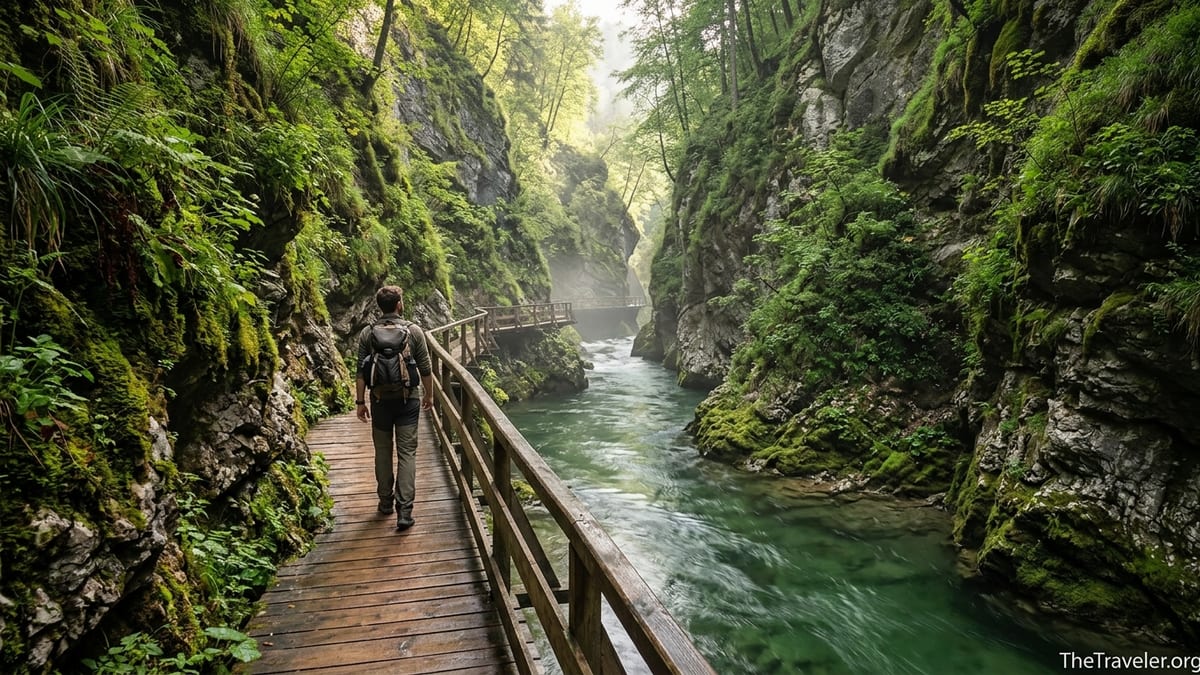
Vintgar Gorge: Slovenia’s Classic Boardwalk Experience
Vintgar Gorge is the most famous of Slovenia’s gorges, and for many visitors it is their first taste of the country’s turquoise rivers. Just 4–5 kilometres from Lake Bled, it slices between vertical walls up to about 100 metres high, with wooden boardwalks hugging the rock above jade-green pools and rapids. The standard walk is around 1.6 kilometres one way, taking most people 1.5 to 2 hours including photo stops, and it ends at the small Šum waterfall and a café where many people pause for coffee or a simple snack before looping back on side trails or a shuttle.
In recent years, management of Vintgar has been tightened to cope with its popularity. Since 2025 you buy timed tickets at dedicated Vintgar hubs in Bled or at central parking, not at the gorge entrance, and most visitors arrive using a free electric shuttle that leaves from Bled’s main bus station and other marked stops. This system cuts private car traffic up the narrow access road and makes it easier to pair Vintgar with a morning at Lake Bled without worrying about parking. The downside is that you must commit to a specific entry window, which can feel rigid if you like spontaneous travel.
Vintgar’s strengths are accessibility and drama. The boardwalks require very little hiking experience, which makes the gorge suitable for families with children and older travellers who are comfortable with some steps and railings. Parents with toddlers often carry them in a sling or child carrier, since standard strollers are awkward on the narrow boards and there are pinch points where people need to pass. The views are instant and continuous, so even visitors with limited time in Slovenia can get a “wow” experience in a compact half-day.
Vintgar’s weaknesses are crowds and atmosphere. In high season, especially between late June and early September, the gorge can feel like a moving queue of people stopping for selfies. If you are sensitive to crowds or hoping for a quiet nature experience, even an early-morning slot might still feel busy. The boardwalks also mean you are very much on rails: you cannot scramble down to the water, linger on riverbanks or extend the walk into wilder terrain. Vintgar works best if you want a straightforward, photogenic stop close to Bled and you accept that you will share it with many others.
Tolmin Gorge: Compact Drama in the Soča Valley
Tolmin Gorge sits at the southern edge of Triglav National Park, where the Tolminka and Zadlaščica rivers carve a narrow canyon through limestone. Most people base themselves in Tolmin, Kobarid or Bovec in the Soča Valley and visit as a half-day outing. The circular walking route is short, typically 1.5 to 2 hours at a relaxed pace, but it packs in hanging bridges, steep staircases, viewpoints high above the river and signature features like a wedge-shaped rock called Bear’s Head balanced between the gorge walls and a tiny thermal spring where warm water seeps into the cold river.
Compared with Vintgar, Tolmin Gorge feels more rugged. The paths are well maintained, but there are steeper sections and more stairs, so you need decent footwear and at least moderate fitness. This makes Tolmin less ideal for those with mobility issues or families with very young children in strollers, yet very appealing for travellers who want something that feels closer to hiking than to a promenade. Water temperatures here are low, around 5 to 9 degrees Celsius, so people tend to limit themselves to quick paddles or sitting on rocks near the water rather than full swimming sessions.
On the practical side, Tolmin Gorge has seasonal opening hours that shift through spring and autumn, and entry prices for adults usually vary between roughly the low and mid teens in euros depending on month. Parking is concentrated at the main entrance, and in peak dates there can be a short shuttle from larger car parks in Tolmin. Travel bloggers and recent guides note that the gorge typically takes 1.5 to 2 hours to visit including photo stops, so it is easy to combine with other Soča Valley highlights like the Napoleon Bridge at Kobarid, the Kozjak waterfall or a late-afternoon soak by the wider Soča River near Most na Soči.
For many travellers doing a loop through western Slovenia, the choice is not Vintgar or Tolmin but whether to include the Soča Valley at all. If your route already includes driving the scenic Vršič Pass or basing in Bovec for rafting and canyoning, Tolmin Gorge is a natural fit. It adds a compact, atmospheric walk that complements the valley’s open river scenery. If, however, you are staying only around Ljubljana and Bled and you will not travel as far west as the Soča Valley, then Tolmin becomes more of a deliberate detour that you must weigh against limited days.
Mostnica Gorge: Quiet Trails Above Lake Bohinj
Mostnica Gorge, just above Lake Bohinj, appeals to travellers who like to walk rather than shuffle along a boardwalk. The Mostnica River has carved a series of narrow slots and deep pools into the rock, and a footpath follows the gorge for around 2 kilometres before continuing into the broad, pastoral Voje Valley. Many visitors simply walk along one side of the gorge and return along the other, while keen hikers extend the outing to reach the Voje waterfall and back, which can turn the day into a 3.5 to 4-hour hike.
Practically, Mostnica is reached from the village of Stara Fužina, about a ten to fifteen minute drive or bus ride from the eastern shore of Lake Bohinj. You walk up through the village, cross the arched Devil’s Bridge and reach a ticket point where local rangers sell day passes for the protected area. In recent seasons, prices have tended to fall below the better-known gorges, making it a comparatively budget-friendly option, though there may be additional parking or toll charges if you drive further up the valley to shorten the walk. Information boards suggest good hiking or mountain shoes, as some sections can be muddy or slippery after rain.
The atmosphere here is very different from Vintgar. Instead of a single, continuous canyon, Mostnica offers a mix of intimate gorge sections, forest paths and meadow views. The trail is narrow in places, but much less crowded than Bled’s boardwalks, especially outside peak summer weekends. This makes it a favourite for travellers staying several nights at Lake Bohinj who want to spend a full day exploring on foot rather than ticking off a list of sights. The route is well signed, but you feel more like you are on a proper hike than on a tourist attraction.
Mostnica is a strong choice if you enjoy combining water scenery with longer walks, and if you are happy to organise yourself rather than rely on shuttles and fixed time slots. It is better suited to travellers with some walking fitness, families with school-age children who like hiking and independent visitors who plan to stay in Bohinj for at least a couple of nights. If your priority is quick access from a rental car and dramatic boardwalk views in under an hour, Mostnica may feel too slow-burning for a tight itinerary.
Soča Gorge and River Spots: For Swimmers and Road-Trippers
The Soča River itself is a long, sinuous gorge in places, with sections known as the Great Soča Gorge near the village of Soča and other narrow passages scattered along the valley between Bovec and Kobarid. These are not curated boardwalk attractions like Vintgar; they are stretches of wild river flanked by short trails, pebbly beaches and occasional roadside viewpoints. The water is strikingly emerald or turquoise, and on hot days in July and August you will see people sunbathing on the rocks, wading into quiet eddies and watching kayakers run the rapids.
Unlike the ticketed gorges, access to the Soča River is generally free, though some popular swimming spots near villages and campsites may charge for parking. The Great Soča Gorge, for instance, is often reached via small pullouts along the road where visitors walk down to the water on narrow, sometimes steep paths. Local tourism boards highlight a handful of safer swimming areas, such as around Most na Soči or certain gravel bars where the current slows, which are better for families or less confident swimmers than the deeper, fast-flowing chutes.
Logistically, the Soča Gorge areas work best for travellers with a car. Buses in the valley do operate, particularly in summer, but services are limited and may leave you with long walks along the road to reach river access points. Many people fold these stops into a road trip that also includes the Vršič Pass, Kobarid’s First World War museum and short hikes to waterfalls like Virje or Boka. The gorge sections rarely take more than an hour or two to explore, so you can treat them as scenic pauses rather than destination hikes in their own right.
If you are comparing the Soča Gorge to Vintgar, Tolmin or Mostnica, the main question is what kind of experience you want. The Soča River offers freedom: you can choose your own rock to perch on, your own angle for photos and how long you stay. It is less about a structured attraction and more about lingering in a landscape. For travellers who like spontaneous stops and do not mind reading local safety signs, this can be the most rewarding choice. For those who prefer clear paths, obvious entrances and toilets and cafés at the start and end, one of the more developed gorges will feel more comfortable.
Which Gorge Fits Your Route and Travel Style?
When deciding between Vintgar, Tolmin, Mostnica and the Soča Gorge, start with your route. If you are basing in Bled for only one or two nights and do not plan to drive far, Vintgar is the logical option: you can reach it in about ten minutes via the free shuttle from Bled’s bus station, walk the gorge and be back at the lake for lunch or an afternoon swim. Many visitors pair Vintgar with the classic Bled viewpoints like Ojstrica and Mala Osojnica, turning the day into a mix of easy walking and lake time.
If your base is Lake Bohinj rather than Bled, Mostnica Gorge is the more natural choice. You can walk there directly from villages like Stara Fužina, spend several hours exploring the gorge and Voje Valley, and still enjoy a quiet evening by the lake. This option particularly suits travellers who favour slower stays in one region instead of packing multiple regions into a single week. You can still day trip to Bled by bus if you wish, but you do not need to fight for a Vintgar time slot to feel you have “done” a Slovenian gorge.
Travellers who have committed to the Soča Valley, perhaps for rafting, kayaking or cycling, should look at Tolmin Gorge and the various Soča River spots as complementary rather than competing. In this context, skipping Vintgar entirely can make sense, especially if it would require an extra driving day or backtracking. Your gorge experiences will come from Tolmin’s ladders and bridges and from wandering along the turquoise Soča itself, and you can round out your days with other valley highlights.
Beyond route, think about your tolerance for crowds and level of fitness. If you want minimal effort and you are comfortable sharing the path with many others, Vintgar delivers the goods with very little planning. If you crave quieter trails and do not mind a bit more uphill, Mostnica and parts of the Soča Gorge offer more solitude. Tolmin sits in the middle: a ticketed attraction that can get busy in high summer, but still feels wilder and more three-dimensional than a pure boardwalk walk.
Costs, Crowds and Timing: Realistic Expectations
Entrance fees and related costs are another way to differentiate the gorges. Vintgar’s adult tickets have risen over the years to reflect its popularity and the infrastructure required to manage visitors, and parking near the gorge is now heavily regulated or limited in favour of the free shuttle. By the time you add perhaps a coffee or snack at the far end and a paid parking space in Bled if you have a rental car, the outing can feel relatively expensive compared to a free forest hike. For many, the easy logistics and iconic photos justify the price, but budget travellers may prefer alternatives.
Tolmin Gorge also charges seasonal entrance fees, generally in a similar band to Vintgar in peak season, although specific prices can vary by month. There may also be a modest parking fee at the main car park. Mostnica Gorge, by contrast, tends to sit in a slightly lower price bracket for adult tickets and feels more like paying a conservation fee for trails and maintenance around Bohinj than for a built-up attraction. Access to stretches of the Soča River is often free aside from optional parking charges, which can be appealing for longer stays in the valley where you visit the water repeatedly.
Crowd patterns follow familiar curves. Vintgar is busiest from late morning to mid-afternoon in July and August, as day tours from Ljubljana and cruise-ship excursions from the Adriatic feed into Bled. Securing an early morning or late afternoon slot can help, but you are seldom alone. Tolmin and Mostnica can also be busy on sunny summer days, but because they are a bit further from the main capital-to-Bled axis, they often feel more relaxed. Shoulder seasons in May, June and September are generally more pleasant in all locations, with cooler temperatures and fewer people, though you should always check opening dates because gorges can close or shorten hours outside the main season.
Time of day matters too. If you are staying in Bohinj, walking into Mostnica early in the morning before buses arrive can give you several quiet hours, whereas Vintgar’s ticketing system semi-evens out arrivals through the day. In the Soča Valley, many travellers stop at riverside spots in the late afternoon after hiking or driving the Vršič Pass, so planning a morning swim or riverside walk can be a way to enjoy the gorge sections with fewer people around.
Safety, Difficulty and Who Each Gorge Suits
All of Slovenia’s popular gorges have safety signage and basic infrastructure, but they differ in difficulty. Vintgar Gorge is by far the easiest, with wide wooden boardwalks, railings and only modest climbs. It is suitable for most reasonably mobile visitors, though those with severe vertigo might find narrow sections challenging. Children must be supervised, as there are drops into the water beside the boardwalk, but the route does not require special equipment beyond sturdy shoes. In wet weather the boards can be slick, so it is wise to walk slowly and avoid fashion sandals.
Tolmin Gorge includes more stairs and steeper slopes, and you spend time both on river-level paths and on higher viewpoints. Travellers should be comfortable with uneven ground and moderate climbs. For families, older children who enjoy adventure often love Tolmin’s ladders and bridges, while parents with smaller children may opt for a carrier or limit their route to the easier sections. Water here is cold and fast, so paddling is best done with caution and never in deeper or turbulent stretches.
Mostnica Gorge and the Voje Valley are more like a traditional hiking trail than a built attraction. The path is generally good, but there are roots, rocks, occasional muddy patches and some exposed drops beside the river. Sturdy footwear and a modest level of fitness are essential, and the longer extension to the waterfall is a proper half-day hike. Travellers who are new to mountain walking may want to keep to the shorter loop along the gorge and avoid venturing too far if the weather turns, while experienced hikers may treat Mostnica as a warm-up for longer routes into the Julian Alps.
Along the Soča Gorge, safety depends heavily on your choices. There are no entry gates controlling how and where you access the water, and strong currents and cold temperatures can surprise even confident swimmers. Local advice emphasises using designated swimming areas, respecting warning signs and never jumping from rocks or bridges into unknown depths. For many visitors, simply sitting by the river, dangling feet in the shallows and watching the play of light on the water is more enjoyable than braving a full plunge.
The Takeaway
If your Slovenia itinerary revolves around Lake Bled and you have one gorge to pick, Vintgar Gorge remains the most logical choice. It is close, easy, photogenic and well organised, which matters on a short trip. Accept the crowds as part of the experience, book a timed slot that suits your day, ride the shuttle from Bled and enjoy the boardwalk views.
Travellers with more time, or those who prefer quieter paths, should look beyond Vintgar. Base yourself at Lake Bohinj and wander up Mostnica Gorge into the Voje Valley for a full day of riverside hiking. Build a Soča Valley loop and fold Tolmin Gorge into days that also include rafting, historic sites and riverside swims. Use the free and semi-wild Soča Gorge areas as flexible stops on a road trip rather than fixed attractions.
There is no single “best” gorge in Slovenia, only the one that best suits your route, your fitness and how you like to experience landscapes. With a bit of planning and realistic expectations about crowds, costs and transport, you can pick the gorge that feels less like a box to tick and more like a highlight stitched naturally into the rhythm of your trip.
FAQ
Q1. Is Vintgar Gorge worth visiting if I am already going to the Soča Valley?
If you will spend several days in the Soča Valley, visiting Tolmin Gorge and riverside sections of the Soča will already give you dramatic canyon scenery. In that case, Vintgar is most worth the extra effort only if you are passing close to Bled or you especially want the iconic boardwalk experience.
Q2. Which gorge is best for families with small children?
Vintgar Gorge is generally the most family friendly because of its boardwalks, clear route and shuttle access from Bled. Parents with toddlers usually use carriers rather than strollers. For older children who enjoy hiking, Mostnica and Tolmin can also be excellent, provided you are comfortable with steeper paths and keep a close eye near drops.
Q3. Can I swim in any of these gorges?
Swimming inside Vintgar, Tolmin and Mostnica gorges is either prohibited or strongly discouraged for safety reasons, though you can sometimes paddle in shallow spots near the entrances. For proper swimming, look to designated areas along the Soča River or to lakes like Bled and Bohinj, always checking local signs and conditions first.
Q4. Do I need to book tickets for Vintgar Gorge in advance?
Yes, in the main season you should plan on securing a timed ticket in advance through official Vintgar hubs in Bled or at central parking facilities, as tickets are no longer sold at the gorge entrance. This helps manage crowding and ensures you will be admitted during your preferred time window.
Q5. How much time should I plan for each gorge?
For most visitors, Vintgar and Tolmin gorges each take around 1.5 to 2 hours to walk, not counting travel time. A shorter loop through Mostnica can also fit into that window, but extending to the Voje Valley and waterfall can turn it into a 3 to 4-hour hike. Soča Gorge viewpoints and river stops are flexible and can be anything from a 30-minute pause to a lazy half-day by the water.
Q6. Which gorge is least crowded in peak summer?
No gorge is truly empty in July and August, but Mostnica Gorge and some stretches of the Soča River usually feel calmer than Vintgar, especially early in the morning or later in the afternoon. Tolmin can also be quieter than Vintgar, though it still attracts many visitors on sunny days.
Q7. Do I need a car to visit these gorges?
You can reach Vintgar via the free shuttle from Bled and Mostnica from Lake Bohinj by local bus and a short walk. Tolmin Gorge and the dispersed Soča Gorge river spots are easier with a car, as public transport in the valley is limited outside peak periods and may not align well with your hiking plans.
Q8. Are the gorges open all year round?
No, most gorges operate seasonally, typically opening in spring and closing in late autumn, with exact dates and hours depending on weather and maintenance. Conditions like heavy rain, snowmelt or rockfall can also trigger temporary closures, so always check current information shortly before your visit.
Q9. What should I wear and bring when visiting a gorge?
Wear sturdy, closed-toe shoes with good grip, even on boardwalk routes, and bring a light jacket or extra layer because gorge interiors can be noticeably cooler than nearby towns. A small daypack with water, snacks, sun protection and a waterproof layer is sensible, and trekking poles can be useful for steeper paths in Tolmin or Mostnica.
Q10. If I only have time for one gorge, which should I choose?
Let your base decide: pick Vintgar if you are staying in Bled, Mostnica if you are at Lake Bohinj, and Tolmin if you are focused on the Soča Valley. If you are simply driving through western Slovenia and want a flexible, low-cost stop, a scenic pause along the Soča River may offer the most freedom with the least planning.