


Oslo’s Flytoget Airport Express Train has a reputation for being one of Europe’s slickest airport links: fast, frequent and famously punctual. It is also, by Norwegian standards, not cheap. If you are planning a trip that runs through Oslo Airport Gardermoen, you will almost certainly face the question many travelers now ask: is Flytoget actually worth the premium, or are you better off on the regular Vy trains, airport buses or a taxi? Here is how the numbers and real-world traveler experiences stack up in 2026.
Get the latest updates straight to your inbox!
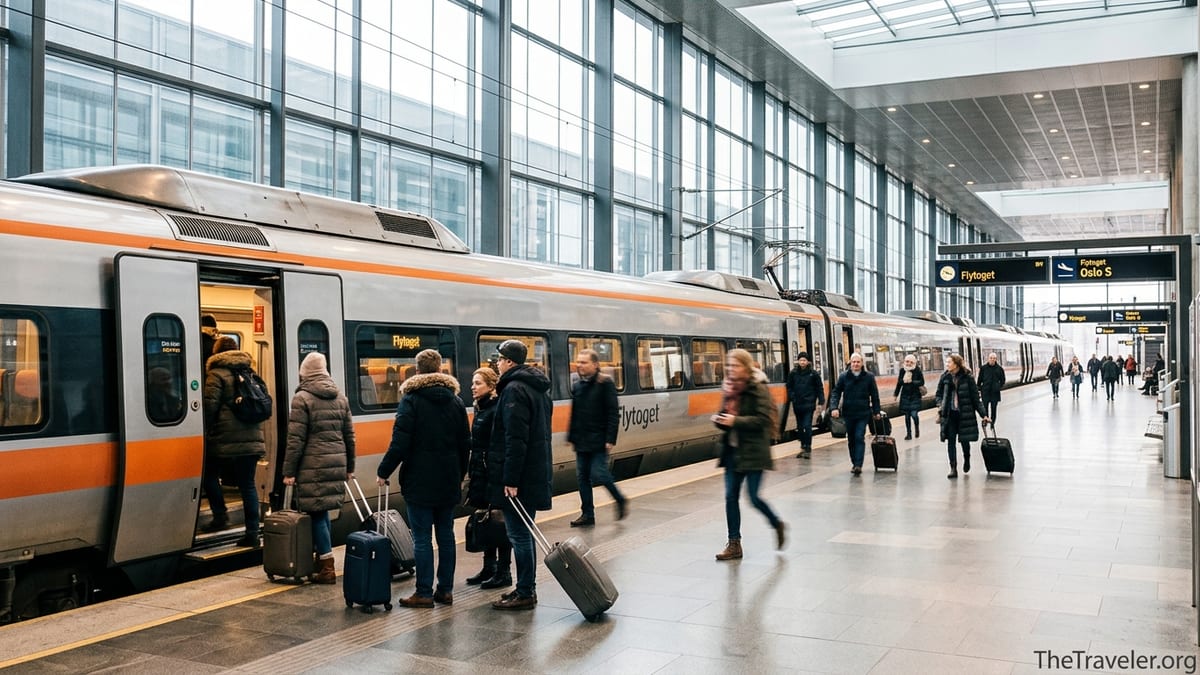
What Flytoget Actually Is – And How It Works
Flytoget is a dedicated high-speed airport train that runs on the Gardermoen Line between Oslo Airport and Oslo Central Station, with some departures continuing through the city toward areas like Lysaker and occasionally Drammen. The trip from the airport to Oslo S typically takes about 19 minutes, and trains are scheduled roughly every 10 minutes during the day. For many visitors, this is the first impression of Norwegian public transport: clean, quiet carriages with wide doors, luggage racks and power outlets at many seats.
The station is directly under the arrivals hall at Oslo Airport. After customs, you simply follow the train symbols, ride the short escalator down and step onto the platform. There are no ticket barriers in the traditional sense. Instead, many travelers simply tap a contactless bank card at the Flytoget readers by the escalators before walking onto the train, or buy a QR ticket from the Flytoget machines or app. The experience is designed to be as frictionless as possible for tired long-haul arrivals who do not want to decode a new ticketing system.
Flytoget is separate from Norway’s national rail company Vy, which also runs trains from the same platforms into Oslo. That means it has its own pricing, its own branding and a service concept built entirely around airport passengers. Carriages have generous luggage areas near the doors, clear screens in English and Norwegian showing time to each stop and live updates if there are minor delays. For business travelers and short-stay tourists, this purpose-built feel is a major part of the appeal.
Historically, Flytoget has focused heavily on punctuality and customer satisfaction. Even in earlier annual reports, the company highlighted satisfaction figures in the mid-90s percentile range and placed on-time performance at the core of its brand. Over time this has given Flytoget an almost default status among Norwegians who fly often. When a local tells you, “Just take the airport train,” they usually mean Flytoget, not the cheaper Vy alternative.
Prices, Frequency and How It Compares to Vy Trains
The biggest question for many visitors is price. As of 2026, a standard one-way adult ticket on Flytoget from Oslo Airport to Oslo Central Station costs in the region of 230 to 245 Norwegian kroner, depending on minor seasonal or tariff adjustments reported by various travel guides. Travel sites that track costs to the city center typically quote figures around 243 kroner for a 19-minute ride, which translates to roughly the mid-20s in US dollars for a single adult.
Vy, by contrast, runs regular regional and commuter trains from the same airport station into Oslo. These trains usually take about 23 to 25 minutes to reach Oslo S, so only 4 to 6 minutes slower in practice. Ticket prices, however, are markedly lower. Current guides aimed at budget travelers often quote Vy fares in the ballpark of 120 to 140 kroner one way from the airport to the city center for adults, roughly half or a little more than half the Flytoget price, depending on the exact ticket type.
The difference becomes very noticeable for groups or families. A family of two adults and two children might pay well over 500 kroner in total on Flytoget, once child discounts are applied, whereas a similar journey on Vy’s regular train can come out a hundred kroner or more cheaper. Some travel bloggers describe scenarios where groups of four save enough on the Vy train to cover a round of coffees and pastries in central Oslo shortly after arriving.
Where Flytoget clearly wins is frequency and perceived reliability. During peak hours, Flytoget departures can be as frequent as six trains per hour, while Vy trains are less frequent and can feel more “commuter-style,” meaning more crowded at rush hour. Travelers on discussion forums sometimes note that while the Vy train is almost as fast and much cheaper, they have occasionally experienced packed carriages with many people standing, especially at busy times. In contrast, frequent Flytoget services, together with the dedicated airport layout, make it more likely you will find space for both yourself and your suitcase.
Comfort, Reliability and What Travelers Notice Onboard
Comfort is one of Flytoget’s strongest selling points. Carriages are modern and bright, with comfortable seating, tables at some bays, and generous legroom. The train is built for passengers with baggage: large suitcases slide easily into spacious racks near the doors, and overhead shelves hold smaller bags. Free Wi‑Fi is available, and the ride is generally very quiet, which frequent fliers appreciate when they have just stepped off a long-haul flight from North America or Asia.
Punctuality has traditionally been excellent. Even older performance data on Flytoget shows on-time figures well above what many travelers are used to in other countries, and that reputation has persisted in user comments and recent transport reports. Business travelers who commute weekly between Oslo and European hubs regularly mention booking tight onward connections in Oslo, such as a 25-minute change from plane to intercity rail, because they trust Flytoget to run on time from the airport to central Oslo.
Real-world accounts highlight several details that make an impression. Many passengers appreciate the clear in-train information screens that show the exact time remaining to Oslo S and connect that with departures on other lines. Others mention that the quiet, predictable environment feels safer and more relaxing late in the evening than some bus or taxi options. Young solo travelers and parents with children often comment that the intuitive layout makes it hard to get lost: once you are on the platform, there is little chance of boarding the wrong train if you follow the Flytoget signs.
That said, not every traveler feels the difference justifies the extra cost. Some visitors note that the Vy regional trains, while slightly older in carriage design, offer perfectly adequate comfort and similar journey times once you are seated. They point out that Vy trains also have luggage racks and Wi‑Fi, and that the main difference is not so much the seat itself as the entire service concept and the crowd levels. For a backpacker or budget-conscious family, a somewhat busier commuter-style train can be an acceptable trade-off for saving the equivalent of several museum tickets.
When Flytoget Is Worth Paying For
There are several scenarios where Flytoget’s higher fare often makes sense. The most obvious is when time is genuinely critical. Imagine landing at Oslo in the late afternoon with a tight window to catch a northbound long-distance train to Trondheim. A Flytoget departure every 10 minutes and a 19-minute journey with high reliability gives you the best chance of making that connection without the added stress of longer waits or potential crowding on the cheaper train.
Another common case is the jet-lagged arrival. Travelers arriving from North America report valuing the “plug and play” experience after an overnight flight. You step off the plane, follow the Flytoget signs, tap your card and sink into a quiet seat, without having to work out zone boundaries, local transport apps or whether your ticket will also be valid on the metro. For many, the first hour sets the tone of the whole trip, and starting with a seamless rail link can feel like money well spent.
Flytoget is also popular with business travelers whose companies cover the fare. Corporate visitors to Oslo, especially for conferences or government meetings, often receive instructions to “take the Airport Express Train to Oslo Central” in official travel documents. In these contexts, the difference between 130 and 240 kroner is negligible compared with hotel and flight costs, while a missed meeting due to a slower or less frequent connection would be much more expensive.
Finally, there are situations where Flytoget is simply the more predictable choice at odd hours. Early-morning departures from Oslo Airport, such as flights leaving around 7:00, often require passengers to arrive at the terminal before 5:30. Travelers on local forums note that Flytoget operates very early services from Oslo S, such as trains around 04:40, that allow even suburban passengers to make early flights by connecting through central Oslo. For these dawn journeys, where taxis can be inconsistent and buses infrequent, many locals consider Flytoget the least stressful option.
When Vy, Buses or Taxis Make More Sense
Despite Flytoget’s strengths, many seasoned travelers argue that it is not the best value for everyone. The Vy train is the standout alternative for most visitors. If your accommodation is near Oslo Central Station, and you are not on a tight schedule, Vy offers a very similar experience at a much lower price. Buying a Vy ticket through the Ruter or Entur app is straightforward, and some locals combine a multi-day public transport pass that covers the fare from the airport with their city travel, effectively reducing the airport journey to just another zone-based ride.
For example, a traveler staying a week in Oslo might buy a 7-day pass covering the necessary zones including the airport area, then simply board the regular Vy train at Gardermoen without paying anything extra. Another traveler might land in the afternoon with no checked luggage and walk directly to the platform to catch the next Vy train, accepting that it may take a few minutes longer and may be busier than Flytoget. For them, the 100-plus kroner saved each way can be redirected toward a fjord cruise or dinner in the city.
Buses can be a good compromise in particular situations. Dedicated airport buses, operated by various companies under names like Flybussen on some routes, connect the airport not only to the city center but also to districts and hotels where direct rail connections are less convenient. The journey can take 40 to 70 minutes depending on traffic and route, but for travelers whose hotel lies along a bus corridor, this can avoid a taxi or an extra tram ride from Oslo S. Bus tickets often cost less than Flytoget, falling closer to Vy train prices.
Taxis are the least economical choice in most cases, especially since Norwegian media has reported very high prices for late-night rides from Gardermoen when trains have stopped running. A short hotel transfer of only a few kilometers from the airport has in some cases cost several thousand kroner. For travelers arriving well after 01:20, when both trains and most airport buses have finished for the night, a taxi may be the only option, but during normal hours the combination of Flytoget or Vy plus local public transport almost always works out far cheaper and often faster.
Real Traveler Experiences: Why Opinions Differ
If you browse recent discussions among Oslo locals and frequent visitors, you will find a clear split of opinion about Flytoget. Those who love it describe it as “the only sane way” to travel between the airport and the city, praising its reliability and the feeling that their trip is in safe hands. One frequent flyer described Flytoget as “50 times more reliable than any ride-share,” explaining that in winter, trusting a scheduled, well-maintained train beats hoping an app-based driver will show up in heavy snow.
On the other side, cost-conscious travelers sometimes joke that Flytoget is a “tourist tax” for people who do not know about Vy. Posts on travel forums frequently mention that locals often advise visitors to take “any train from the airport platform that is not marked Flytoget” if they want to save money. Passengers report that in practice, the Vy train feels almost the same, especially outside rush hour, and that the extra 5 minutes on board are hardly noticeable when your day’s schedule is flexible.
Crowding also shapes opinions. Some people who have used Vy at busy times describe standing in the aisle with luggage for part of the ride into Oslo because seats were taken, which can be uncomfortable after a long flight. Those same travelers tend to switch to Flytoget on future trips, citing more available seating and a calmer atmosphere. Meanwhile, others report that with a bit of timing, such as avoiding the 08:00 or 16:00 peaks on weekdays, Vy trains are comfortably quiet and the savings are substantial.
Travel expectations matter as well. Visitors used to very expensive taxis from airports in other countries may view Flytoget as a bargain, while backpackers comparing the cost with long-distance coaches in Eastern Europe may find it expensive. For someone flying business class and staying in a central boutique hotel, an extra 100 kroner feels insignificant relative to the overall budget, whereas for a family of five traveling in Norway for two weeks, every saved kroner can go toward once-in-a-lifetime activities like glacier hiking or a fjord cruise.
How to Decide: A Simple Framework for Your Trip
To decide whether Flytoget is worth it for you, start with three questions: what is your budget, how much time do you really need to save, and how complex is your overall journey. If your budget is tight and saving the equivalent of 20 to 30 US dollars per round trip makes a real difference, then Vy is likely the better choice. The extra few minutes of travel and the higher chance of a busy carriage may be a small price to pay for a much lower fare.
If time is your priority, consider your connections. For example, if you are landing at 15:30 and need to catch a 17:02 intercity train from Oslo S to Bergen, Flytoget’s higher frequency and slightly faster journey can shave important minutes off your margin and reduce the anxiety of waiting for a less frequent train. In such cases, many travelers are willing to pay more to avoid the risk of missing a once-daily onward train or an evening meeting.
The complexity of your journey also matters. If you must navigate from the airport to a suburban neighborhood via multiple transfers, Flytoget’s clarity can simplify the first leg. You know that any train with the Flytoget branding will take you quickly to central Oslo, where you can then switch to metro, tram or local train. On the other hand, if you already need to download the local transport app to use the metro or trams during your stay, learning how to buy a Vy ticket in the same app is a small extra step that can save money from the very start.
Finally, think about your arrival and departure times. During the core daytime and evening hours, both Flytoget and Vy offer solid connections. In the very early morning, Flytoget may have an edge with earlier departures. Late at night, when trains and most buses stop running, the choice may come down to a hotel at or near the airport or a taxi. Planning your flight times to match the robust daytime rail schedule between Oslo and Gardermoen can improve both cost and comfort, regardless of which train you choose.
The Takeaway
So, is Flytoget worth it. For many travelers, the answer is yes, but not for everyone and not in every situation. Flytoget delivers exactly what it promises: a fast, frequent, comfortable airport train that removes almost all friction from the trip between Oslo Airport and the city center. Its track record for punctuality, the convenience of contactless tap-in payments and the calm, luggage-friendly carriages justify the premium for business travelers, tight schedules and anyone who values a stress-free arrival over shaving costs.
At the same time, Norway’s regular Vy trains from the airport offer nearly the same journey in terms of time and distance for a significantly lower price. For budget-minded visitors, longer stays, families and backpackers, using Vy and integrating the airport trip into a wider public transport pass can free up cash for more memorable experiences in Norway itself. Airport buses and, in specific cases, taxis round out the options, but for most visitors the core decision is simply between Flytoget and Vy.
If you land in Oslo exhausted from a long flight, facing a tight connection or a day of meetings, Flytoget’s premium is usually money well spent. If you arrive with time to spare and a close eye on your budget, the Vy train will likely serve you just as well. Either way, the good news is that Oslo offers one of Europe’s most efficient airport-to-city rail links, and the real choice is not between good and bad, but between two levels of good that suit different kinds of traveler.
FAQ
Q1. How long does Flytoget take from Oslo Airport to the city center.
The journey from Oslo Airport Gardermoen to Oslo Central Station on Flytoget usually takes about 19 minutes under normal conditions.
Q2. How much more expensive is Flytoget compared with the Vy train.
Flytoget typically costs roughly twice the price of a standard Vy ticket on the same route, though exact fares vary slightly with time and ticket type.
Q3. Is Flytoget more reliable than the regular Vy trains.
Both services are generally reliable, but Flytoget has built its brand around high punctuality and frequent departures, which many travelers perceive as more dependable.
Q4. Do I need to buy a Flytoget ticket in advance.
No. Most travelers simply tap a contactless bank card at the Flytoget gates or buy a digital ticket on arrival. Advance purchase is optional and mainly a matter of preference.
Q5. Can I use an Oslo public transport pass on Flytoget.
Ordinary Ruter public transport passes and zone tickets do not cover Flytoget, which has its own pricing. They can, however, be used on Vy trains between the airport and the city when correctly zoned.
Q6. Is there a big difference in comfort between Flytoget and Vy.
Flytoget offers a more purpose-built airport experience with very spacious luggage areas and a quieter feel. Vy trains are slightly more commuter-style but still comfortable for most travelers.
Q7. What is the best option for families with children.
For families watching their budget, Vy often makes more sense because the total saving can be significant. For families prioritizing an easy, low-stress first hour, Flytoget can still be worth the extra cost.
Q8. Which option is better if my flight arrives very late at night.
If you land after trains and most airport buses have stopped running, you may need to stay at an airport hotel or use a taxi. When trains are operating, both Flytoget and Vy are solid choices.
Q9. Can Flytoget take me beyond Oslo Central Station.
Some Flytoget departures continue past Oslo S toward stops like Nationaltheatret and Lysaker, but others terminate at Oslo S, so checking the destination boards before boarding is important.
Q10. Should first-time visitors to Oslo choose Flytoget or Vy.
First-time visitors who value simplicity and a smooth arrival often choose Flytoget, while those who are price-sensitive and willing to handle a slightly more local-style experience often prefer Vy.