


Access to a functioning bank account is a critical operational requirement for anyone planning to live, work, or study in Germany. Foreign nationals encounter a structured but sometimes fragmented landscape of account types, regulatory rules, and bank-specific practices. Understanding how German banks assess residency, identity, and risk is essential for planning a smooth financial onboarding when relocating.
Overview of the German Banking Framework for Foreigners
Germany operates a dense banking network that includes large commercial banks, regional savings banks, cooperative banks, and fully digital direct banks. For foreigners, the practical choice is usually between a standard current account used for everyday payments and a legally mandated “basic payment account” designed to ensure access to essential banking services. While the legal framework gives broad rights to consumers, implementation still varies significantly by institution.
Most day-to-day transactions in Germany rely on a current account with an International Bank Account Number (IBAN) denominated in euros. Employers, landlords, utilities, and public authorities generally expect a German or at least a euro-area IBAN for recurring payments and direct debits. Although other European IBANs can technically be used for many payments, foreigners who intend to stay medium to long term typically require a German account to avoid practical frictions.
Foreigners should distinguish between being physically present in Germany, being legally resident in the European Union, and being a true non-resident opening an account from abroad. Each status affects which banks are willing to open an account, which identification methods are accepted, and whether a right to a basic payment account applies. Planning should start by clarifying the expected move date, address situation, and legal residence status in the EU.
The regulatory backbone is the Payment Accounts Act, anti-money-laundering rules, and customer due diligence requirements. These set minimum identity standards and give consumers certain rights, including to a basic payment account with core features. However, banks remain free to choose which customer segments and nationalities they serve within this framework.
Account Types Available to Foreign Nationals
For relocation planning, it is useful to differentiate between several main account categories: standard current accounts, basic payment accounts, online-only accounts, and special-purpose products such as blocked accounts for students. Each serves different needs and has different entry thresholds for foreigners.
A standard current account (Girokonto) is the main workhorse for residents in Germany. It usually includes an IBAN, debit card, domestic and SEPA transfers, standing orders, and direct debits. Many banks now charge a monthly fee, which may be waived with minimum income inflows. Overdraft facilities, credit cards, and premium packages often require established credit history and residence, which new arrivals may initially lack.
The basic payment account (Basiskonto) is a legally mandated account with essential functions such as cash deposits and withdrawals, payment card, transfers, and direct debits. All consumers legally resident in the European Union, including many third-country nationals and persons with tolerated or asylum status, have a right to such an account provided identity can be verified and no narrow legal grounds for refusal apply. This option is particularly relevant for individuals who encounter repeated rejections from commercial banks despite lawful residence.
Digital or “direct” banks operating in Germany often target mobile-first users and may welcome foreign passport holders, but they typically impose stricter geographic and residency filters. Many require legal residence in the European Economic Area and a compatible ID document for video identification. In parallel, a small number of providers offer blocked accounts for international students, where funds are locked to meet proof-of-finance requirements but are not suitable as a main transactional account for everyday payments.
Eligibility, Residency, and Legal Right to a Basic Account
Eligibility to open a bank account in Germany depends on a mix of legal rights and bank-specific policy. Legally, consumers who are lawfully resident in Germany or elsewhere in the European Union have a right to a basic payment account with core features if they do not already hold a comparable account in Germany that they can actually use. This right extends in principle to EU citizens, most third-country nationals with lawful stay, and many categories of refugees and tolerated persons, subject to identity verification requirements.
In practical terms, many banks still design their standard current account products around customers with a registered address in Germany. Newly arrived foreigners are often asked to present a registration certificate from the local municipality together with identification documents. However, some banks and fintech providers operate at EU level and accept residencies in multiple European countries, as long as the applicant is legally resident in the European Union and meets their risk criteria.
Non-residents who are not yet living in Germany and have no EU residence often face tighter restrictions. While there is no general legal prohibition on non-resident accounts, customer due diligence and tax reporting obligations make many banks reluctant to open standard accounts for individuals based outside the EU. Some direct banks periodically accept applications from selected non-resident segments, but policy changes are frequent and should be checked shortly before application.
Certain nationalities or tax profiles, such as citizens of countries subject to far-reaching extraterritorial tax reporting rules, may experience additional scrutiny or outright rejection by some German institutions. These decisions are driven by compliance and risk management rather than formal legal bans. Foreigners with complex tax situations should anticipate additional documentation and longer processing times.
Identity, Documentation, and Address Requirements
German banks are legally required to verify the identity of each customer under anti-money-laundering law. Valid official photo identification that meets passport and identity standards is the core requirement. For foreigners, this usually means a national passport or recognized identity card. In specific cases, substitute documents issued under asylum or migration law can also be accepted as equivalent identity documents.
In addition to identity, banks usually require proof of address. For residents in Germany this is often the registration confirmation from the local authorities, supplemented where necessary by a rental contract or utility bill. Some banks accept foreign addresses for customers legally resident elsewhere in the European Union, particularly for basic payment accounts or digital offerings. Where an address outside the EU is provided, the number of institutions willing to proceed declines sharply.
Tax identification details are increasingly requested at account opening, especially if the customer is tax resident in another country. Applicants may be asked to declare all countries of tax residence and provide corresponding tax identification numbers. This allows banks to comply with international reporting obligations and domestic anti tax-avoidance rules. Missing or inconsistent tax information can delay or block account opening.
For specific customer groups such as university students, minors, or persons opening blocked accounts, banks may require additional documents such as enrollment confirmations, parental authorizations, or scholarship letters. These requirements differ by institution and often reflect internal risk and operational policies rather than uniform national rules.
Verification Methods: In-Branch, PostIdent, and VideoIdent
Foreigners can expect identity verification to follow one of three main methods: in-branch verification, postal identification, or online video identification. The method offered depends on the bank’s operating model and the applicant’s location and documentation.
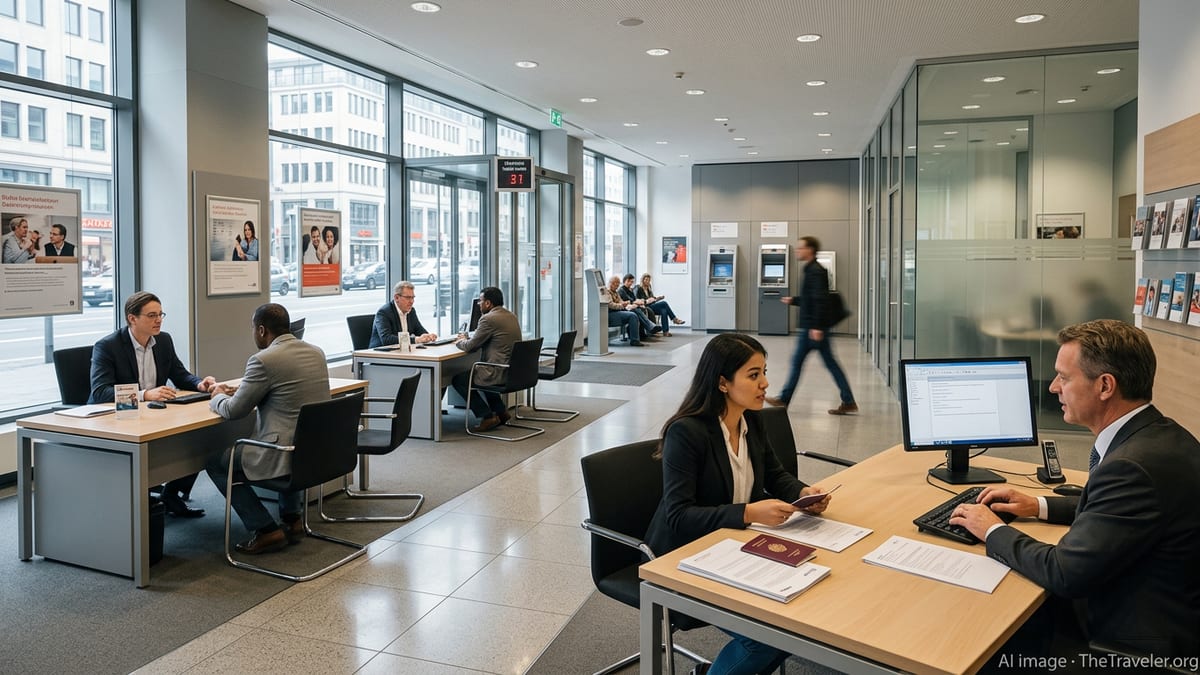
Traditional banks with physical branches often verify identity onsite. The applicant presents original identification documents at a branch office, where staff capture personal data, scan documents, and initiate account opening. This method is straightforward but requires presence in Germany and sometimes prior registration at a local address.
Postal identification services such as PostIdent allow banks to outsource identity verification to the national postal operator. The customer receives a case identifier from the bank and presents it with their identification document at a post office or via designated online channels. Staff or online agents then perform the legally required checks and transmit confirmation to the bank. Multiple variants exist, including in-person at a branch and remote video chat based on the same legal framework.
VideoIdent solutions enable fully remote verification using a smartphone or computer camera. The applicant connects to an authorized agent who inspects the ID document, compares facial features, and may trigger a security code by text message. This method is used widely by digital banks and by some traditional institutions for online account opening. Not all passports are supported for automated or semi-automated video verification, and applicants with unsupported documents may be redirected to postal or in-branch methods.
Key Steps to Open a Bank Account as a Foreigner
Opening a bank account in Germany typically follows a predictable sequence. The first step is to determine the primary purpose: receiving salary, paying rent, managing benefits, studying, or holding savings. This defines whether a standard current account, a basic payment account, or a specialized product such as a blocked account is most suitable. Relocating workers and long-term residents usually prioritize a standard current account that supports salary payments and recurring domestic debits.
The next step is selecting a provider category: a nationwide commercial bank, a local savings or cooperative bank, or a digital provider. Foreigners who plan to rely on in-person assistance may favor institutions with branches close to their residence or workplace, while frequent travelers and digitally oriented workers may prefer mobile banks. It is important to review whether the bank explicitly accepts foreign passports, whether a German address is required at application, and whether non-EU residence is supported if relevant.
After choosing a provider, applicants complete an online or paper application, providing personal details, address information, tax residence declarations, and where required, data on employment or study status. Identity verification then takes place using one of the recognized methods. Processing times can range from same-day activation at a branch to several working days for online applications that rely on postal delivery of debit cards and security credentials.
Once opened, the account typically becomes fully operational only after the customer receives and activates the debit card, sets up online banking credentials, and in some cases confirms receipt of certain disclosures. Foreigners should factor these timelines into relocation planning, especially if an employer or landlord expects a German account within a narrow time window after arrival.
Costs, Service Features, and Risk Considerations
Account fees and service structures in Germany vary widely. Many banks charge a fixed monthly fee for a standard current account, often between low single-digit and moderate double-digit euro amounts, with potential waivers if a minimum monthly inflow from salary or pension is met. Basic payment accounts are legally capped at reasonable charges for core services, but they may still be more expensive than standard promotional accounts targeted at salaried residents.
Foreigners should examine whether incoming international transfers, debit card withdrawals outside the euro area, or cash services at branches incur surcharges. Some digital banks focus on low costs for European card payments but offer limited access to physical branches or cash deposits. Conversely, savings banks and cooperative banks may provide extensive local branch networks but charge for many individual services.
Risk management policies influence both eligibility and ongoing account operation. Banks monitor accounts for unusual activity and may request additional documentation if patterns deviate from the expected customer profile. Foreign remote workers, cross-border commuters, and individuals with income from multiple countries should anticipate periodic questions and be prepared to provide contracts or payment evidence to avoid restrictions.
Foreign customers should also be aware that most German bank deposits are covered by statutory deposit protection up to a defined euro threshold per customer and bank. Additional voluntary schemes may provide further coverage for certain institutions. While these protections apply irrespective of nationality, customers holding very large balances might consider diversifying across banks or banking groups.
The Takeaway
Opening a bank account in Germany as a foreigner is feasible but requires alignment between legal rights, bank-level risk policies, and the applicant’s residency and documentation profile. Legislation provides a safety net in the form of a basic payment account for consumers legally resident in the European Union, including many non-EU nationals and refugees, provided identity can be verified and no specific grounds for refusal exist.
For most relocating professionals and students, a standard current account at a commercial, savings, cooperative, or digital bank will be the operational cornerstone of daily financial life. The most common friction points are proof of address, compatibility of identity documents with electronic verification systems, and additional tax documentation for customers with complex cross-border profiles. Addressing these areas in advance often prevents delays.
Decision-grade preparation involves mapping out when a German address certificate will be available, which identification method is realistic, how long different banks typically take to activate accounts, and what fee and service structures align with expected payment patterns. Foreigners who face multiple rejections from standard products should evaluate the legal right to a basic payment account and, where necessary, seek advisory support to enforce this right.
In relocation planning, the bank account should be treated not as an administrative afterthought but as a core infrastructure element. A realistic understanding of eligibility rules, documentation requirements, and available account types enables foreign nationals to integrate into the German financial system with fewer surprises and more predictable timelines.
FAQ
Q1. Can a non-EU citizen open a bank account in Germany?
Yes, many non-EU citizens can open a bank account in Germany if they can prove identity and lawful stay. Banks may require a local registration certificate, valid passport, and in some cases a residence document, but legal residence in the European Union is the key factor for a right to a basic payment account.
Q2. Do I need a German address to open an account?
Most traditional banks expect a German residential address, particularly for standard current accounts. Some digital providers accept other EU addresses and a few may support non-resident arrangements, but offerings change frequently and should be checked close to the planned application date.
Q3. What is a basic payment account (Basiskonto)?
A basic payment account is a legally mandated account that provides essential functions such as deposits, withdrawals, card payments, and transfers. Consumers legally resident in the European Union who do not already have a usable payment account in Germany can generally demand such an account from banks that offer payment accounts to the public.
Q4. How long does it take to open a bank account in Germany?
Processing times vary. In-branch openings can result in an active account the same day, though physical cards and security devices often arrive by mail within several days. Online applications using postal or video identification may take from a couple of days to about a week before the account is fully usable.
Q5. Can I open a German bank account before moving to Germany?
Some institutions periodically allow account opening for future residents or EU-based non-residents, often via online verification. However, many banks restrict new accounts to people already registered at a German address or resident within the European Union, so options should be verified shortly before initiating the process.
Q6. What documents are typically required for foreigners?
Foreigners are usually asked to provide a valid passport or national ID card, proof of address such as a registration certificate or rental contract, and tax identification numbers for any countries of tax residence. Depending on status, banks may also request residence permits, enrollment confirmations, or employment contracts.
Q7. What if a bank refuses to open an account for me?
If multiple banks decline an application for a standard current account, foreigners who are legally resident in Germany or elsewhere in the European Union should consider applying specifically for a basic payment account. In that case, banks must provide a written explanation for refusal, and there are complaint and review mechanisms if the applicant believes the refusal is not justified.
Q8. Are there special accounts for international students?
Yes, several banks and specialized providers offer accounts tailored to international students, including blocked accounts used to demonstrate sufficient funds. Students still typically require a separate transactional current account in Germany to manage rent, utilities, and everyday expenses once they arrive.
Q9. Will my deposits be protected as a foreigner?
Deposits in German banks are usually covered by statutory deposit protection up to a defined limit per customer and bank, regardless of nationality. Some institutions participate in additional voluntary schemes that extend this protection, but very large balances may warrant diversification across banking groups.
Q10. Can refugees or asylum seekers open a bank account?
Many refugees and asylum seekers can open a basic payment account if they hold recognized identification or substitute documents issued under German law. Where practical difficulties arise, such as rejected identification procedures, specialized advisory organizations often assist in asserting the right to an account with basic features.