


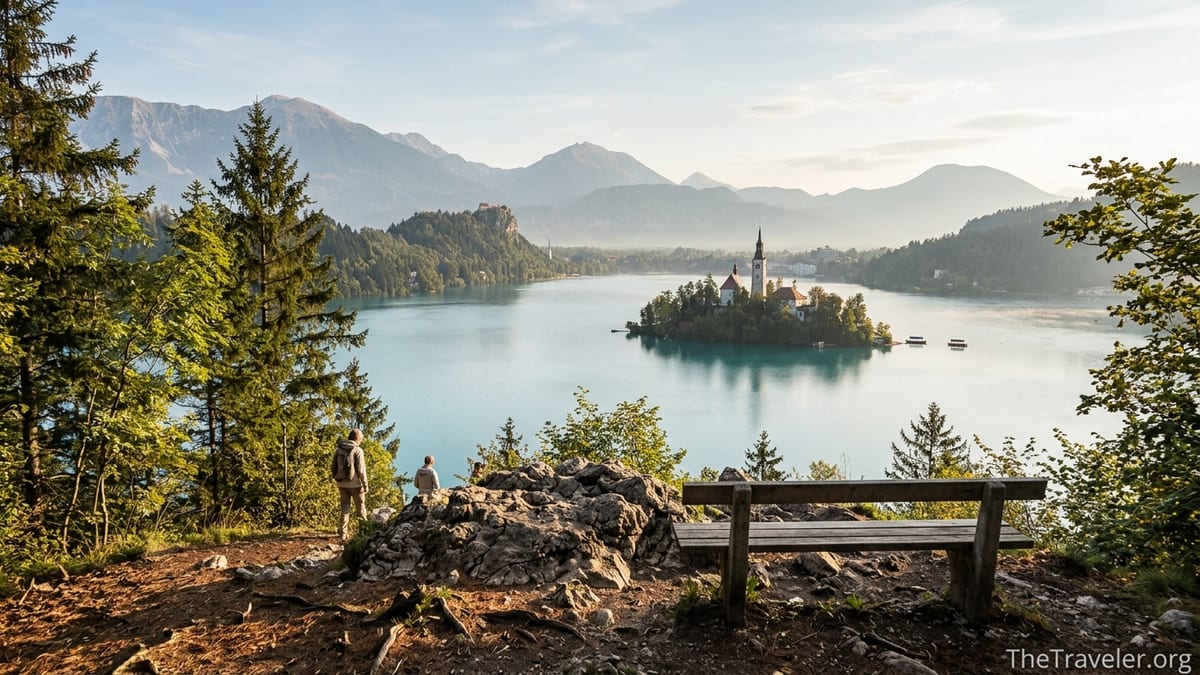
Mala Osojnica is one of Slovenia’s most photographed viewpoints, perched in the forested hills above Lake Bled. The short but steep hike rewards you with a classic panorama of the island church, Bled Castle and the Julian Alps. Because the trail is so popular and Bled is tightening traffic and parking rules, good planning will save you time, money and stress. This guide focuses on real-world logistics: where to park, when to start, which trail to choose, and how to avoid common mistakes on this compact but demanding hike.
Get the latest updates straight to your inbox!
Understanding the Mala Osojnica Hike
Mala Osojnica sits on the south-western side of Lake Bled, above the Velika Zaka and Mala Zaka bays. The viewpoint is often confused with nearby Ojstrica and Velika Osojnica, but Mala Osojnica is slightly lower than Velika Osojnica and offers a wider, more open panorama of the lake. For most visitors it is the single most rewarding short hike in the Bled area, combining a forest climb with classic postcard views of the island and surrounding mountains.
The most common route for visitors starts at the lakeshore near the Velika Zaka area and climbs through mixed forest. Typical descriptions put the walking time at about 45 to 60 minutes uphill, depending on fitness and how often you stop. Several trail descriptions group Mala Osojnica together with Ojstrica and Velika Osojnica as a loop of roughly 2.5 to 3.5 kilometres with 200 to 300 metres of elevation gain, which feels short on paper but can be surprisingly tough for anyone not used to hiking steep, uneven paths.
The path is signposted as part of the local Bled hiking network and is considered a “short mountain hike” rather than a simple stroll. Expect dirt paths with roots, some rocky sections and a series of wooden or metal steps on the steeper parts. In wet weather these can be slippery. In normal summer conditions, reasonably fit hikers will manage the viewpoint in sports shoes, but proper trail shoes are strongly recommended, especially if you are combining Mala Osojnica with Ojstrica.
Because the hike is relatively short and close to town, it attracts a very wide range of visitors: experienced hikers heading out before sunrise, day-trippers in casual trainers starting mid-morning, and wedding photographers arriving around golden hour with camera gear. This mix contributes to crowding on narrow sections of trail and around the viewpoint bench, which is one of the reasons your choice of timing and route matters.
Where to Park for Mala Osojnica
Parking rules around Lake Bled have tightened in recent years, with the municipality pushing visitors toward official lots and encouraging use of a seasonal shuttle bus. Most parking near the lakeshore is paid during the day, often from about 8:00 to 20:00, and hourly rates around the lake are typically several euros per hour. Travellers regularly comment that Bled is one of the more expensive places to park in Slovenia, so factor parking costs into your budget when planning the hike.
For the classic Mala Osojnica route, the most convenient options are the official lots at Velika Zaka and Mala Zaka, on the western shore of the lake. These are close to the camping area and rowing centre, a short walk from the trailhead signs for Ojstrica and Osojnica. At Velika Zaka, visitors report paying an hourly rate in the low single digits in recent seasons, with prices varying slightly by year and season. It is realistic to plan for around three hours of parking if you want to hike up, enjoy the viewpoint, take photos and perhaps swim or have a drink at the lakeshore afterwards.
A second practical option, especially in peak season, is to leave your car at one of the larger car parks closer to Bled town or below Bled Castle and take the local Bled shuttle bus toward Velika Zaka. Recent municipal documents highlight a “Bled Bus” service in summer, linking central parking areas with lakeside stops including Velika Zaka and Bled Jezero train station. This can be useful if lakeside lots are full, or if you want to avoid driving the narrow lakeshore road at busy times.
Some hikers choose to park at or near the small Bled Jezero railway station above the lake and start the hike from there. Travel blogs mention a flat parking fee there for several hours in the past, while reporting that Velika Zaka charged by the hour and was slightly more expensive per hour but closer to the trailhead. Exact tariffs change from year to year, so it is wise to check signs on arrival and carry a bank card or coins. Informal parking at supermarket lots on the edge of town is sometimes discussed by locals, but it is not officially encouraged and may be monitored, so visitors should rely on signed, legal parking to avoid fines or towing.
Best Time of Day and Season to Hike
Timing your hike to Mala Osojnica is as important as choosing where to park. The two most popular time windows are early morning shortly after sunrise and late afternoon leading into sunset. At sunrise, you are more likely to share the trail mainly with photographers and serious hikers. The air is cooler, parking spots at Velika Zaka and Mala Zaka are easier to find, and light often falls gently across the island and Bled Castle. In high summer, starting between 6:00 and 7:00 can mean walking in the shade of the forest and reaching the viewpoint before tour buses and day-trippers arrive.
Late afternoon and early evening are also beautiful. In clear weather, the sun moves behind the mountains to the west, casting warm light over the lake and turning the island church into a glowing focal point. Many visitors aim to start the climb about 90 minutes before sunset, leaving enough time to reach the viewpoint, take photos and descend before it becomes fully dark. If you plan to stay until the sky turns deep blue and town lights come on, carry a headlamp for the descent and remember that some parking zones and shuttle services have time limits or stop operating late in the evening.
Seasonally, the main hiking period runs from about May to October. In late spring the forest is lush, the lake is quieter than in July and August, and temperatures are often ideal for hiking. Summer brings the biggest crowds and hottest temperatures; in July and August it is often worth treating Mala Osojnica as a dawn or dusk outing rather than a midday hike. Early autumn can be spectacular, with colourful foliage reflected in the lake and generally more stable weather than spring, though days are shorter.
In winter and during shoulder-season cold spells, the trail can become icy, especially on shaded steps and north-facing slopes. Official trail descriptions caution against attempting the hike in icy conditions unless you have proper equipment, such as microspikes, and mountain experience. Even when the lake area is snow-free, a freeze overnight can leave compacted ice on the steps, making falls more likely. If you visit between November and March, check local conditions, avoid late-start descents in the dark, and consider alternative low-level walks if surfaces look treacherous.
Choosing the Right Route: Direct, Loop and Combinations
For most visitors, the simplest choice is the direct route from the Velika Zaka area up to Mala Osojnica. From the lakeshore, you follow signposts toward Ojstrica and Osojnica, cross a meadow and enter the forest where the path quickly becomes steeper. After a junction where a trail climbs more sharply toward Ojstrica, routes toward Osojnica continue up via a combination of dirt switchbacks, roots and wooden steps. The final approach to the Mala Osojnica viewpoint includes a set of steep steps and a short path to a small, open area with a bench and several natural rock platforms.
If you have a little more time and are comfortable with steeper terrain, a popular variant links Ojstrica, Velika Osojnica and Mala Osojnica in a single loop. Trail descriptions suggest that this “three viewpoints” route works well clockwise from Velika Zaka: first up to Ojstrica for its dramatic, slightly higher-angle view; then across to Velika Osojnica on a forest path; and finally down past Mala Osojnica before returning to the lake. For reasonably fit hikers this loop can take about two to three hours of walking time, longer if you pause at each viewpoint for photos.
A third approach combines Mala Osojnica with other local trails, such as routes starting near Straža hill or from hotels on the south side of the lake. Regional walking maps show a network of marked paths connecting Straža, Mlino, Mala Osojnica and Ojstrica, allowing you to start the hike directly from your accommodation if you are staying nearby. Outdoor guides published for Bled and surrounding areas describe such routes as moderate, with steep but short climbs and rewarding ridge views, making them good training walks for bigger mountain days elsewhere in Slovenia.
Whichever route you choose, remember that distances in kilometres can be misleading. Steep, rooty trails slow many people down, especially if you are not used to hiking or are carrying heavy camera equipment. An American couple on a recent trip, for example, planned to “squeeze in” Mala Osojnica between a late breakfast and a boat trip, budgeting 45 minutes round trip based on online distance alone. In the end they needed nearly two hours by the time they found parking, climbed at a moderate pace, queued briefly for the classic bench photo and returned to the lake. Build generous margins into your schedule to keep the day relaxed.
Trail Conditions, Safety and What to Bring
The Mala Osojnica trail is short but should not be underestimated. From Velika Zaka, you gain roughly 200 metres of elevation over a compact distance. The steepest sections have steps, but there are still tree roots, loose stones and uneven surfaces. In dry summer conditions, families with active children generally manage well, but parents should be ready to supervise closely near the viewpoint edges, where there are steep drop-offs without fences. Pets are commonly seen on the trail, but dogs that pull strongly can create balance issues on narrow, stepped sections, so a good harness and leash are important.
Weather changes quickly in the alpine foothills around Bled. A clear morning can turn into a stormy afternoon, especially in late summer. Thunderstorms can bring heavy rain and slippery conditions to the wooden and metal steps. Always check the forecast in the morning and be prepared to turn back if dark clouds build up. The forested nature of the trail means you will be in the trees for much of the climb, which offers some protection from sun and wind but can hide incoming weather until it is close.
Footwear is a frequent point of debate. While you will see visitors hiking in casual sneakers or even sandals, the safest choice is closed shoes with a grippy sole, such as trail-running shoes or light hiking boots. The combination of steep steps and loose dirt makes flat-soled fashion trainers or flip-flops a bad idea, particularly on the descent. A small daypack with water, a light jacket, basic snacks and a headlamp is a sensible minimum. Trekking poles are optional but can be very helpful, especially for those with sensitive knees.
In terms of navigation, the main paths to Mala Osojnica are clearly worn, and junctions are marked with red-and-white hiking signs typical for Slovenia. Offline maps on your phone can still be useful if you accidentally miss a turn, but you are never far from the lake. Mobile coverage around Bled is generally good, though it can weaken in ravines and dense forest. As with any popular viewpoint, keep a close eye on your belongings at the top, especially cameras placed on rocks or mini-tripods near the edge.
Dealing With Crowds, Photography and Realistic Timings
Because the Mala Osojnica viewpoint has become a social media staple, crowd management is now part of planning the hike. On sunny days in July and August, and on many weekends from late spring to early autumn, there may be a line for the classic bench photo. Groups often rotate quickly, but a patient photographer setting up a tripod can slow the flow. To keep the mood friendly, arrive with the expectation that you will share the space, step aside between shots and allow others their turn.
If your schedule forces you into a midday hike, when tour groups are active and the light can be harsh, think about shooting wider environmental scenes rather than only the classic postcard frame. Cloudy conditions around midday can actually be excellent for balanced exposures, while crowds on the bench can be cropped out by moving slightly higher onto the rocks to the side. Photographers aiming for more original compositions sometimes bring a longer lens to compress the island against the mountain backdrop or focus on details like pletna boats crossing the lake.
In terms of overall time budgeting, a realistic plan for an average visitor driving from central Bled might look like this: 15 to 30 minutes to navigate one-way traffic around the lake and find parking at Velika Zaka or nearby; 45 to 60 minutes to climb to the viewpoint at a comfortable pace; 20 to 40 minutes at the top for photos and rest; and 30 to 45 minutes to descend and return to the car. That total of roughly 2.5 to 3 hours can stretch further if parking is busy or if you include Ojstrica and Velika Osojnica.
One practical example: a family of four staying in Ljubljana drove to Bled on a Saturday in August, arriving around 9:30. It took them nearly 25 minutes to reach the Velika Zaka parking lot through traffic and another 10 minutes circling for a space. By the time they started hiking it was already warm and the trail was busy. Two days later they returned for a second attempt, this time setting out from Ljubljana before 6:00 and parking easily just after 7:00. They were at the viewpoint with only a couple of other hikers and back at the lakeshore for coffee by 9:00, well before the main crowds arrived.
The Takeaway
Mala Osojnica is a compact hike with outsized rewards, providing one of Europe’s most celebrated lake views for the price of a short but steep forest climb. Successful planning revolves around three main decisions: where to park, when to start and which route to take. Favour official car parks at Velika Zaka, Mala Zaka or central Bled, arrive early or late in the day to avoid traffic and heat, and consider whether you want the straightforward out-and-back climb or the fuller loop that includes Ojstrica and Velika Osojnica.
With realistic timing, sturdy footwear and a little patience at the viewpoint, even first-time visitors can enjoy a smooth experience that feels far from the stress of parking meters and tour buses. Whether you are an avid hiker, a photographer chasing sunrise light, or a family on a summer holiday, a well-planned Mala Osojnica hike will likely be one of the enduring memories of your time at Lake Bled.
FAQ
Q1: How long does it take to hike to Mala Osojnica from Lake Bled?
Most visitors take about 45 to 60 minutes to hike uphill from the Velika Zaka area to the Mala Osojnica viewpoint, then 30 to 45 minutes to return, not counting time spent at the top.
Q2: Where is the best place to park for the Mala Osojnica hike?
The most convenient parking is usually at the official lots near Velika Zaka and Mala Zaka on the western shore of Lake Bled, which are closest to the main trailhead, though central Bled car parks plus the seasonal shuttle bus are a good backup in busy periods.
Q3: Do I need hiking boots for Mala Osojnica or are sneakers enough?
In dry summer conditions many people manage in sturdy sneakers, but light hiking or trail-running shoes with good grip are strongly recommended because of steep, uneven sections and wooden steps that can be slippery.
Q4: Is the trail to Mala Osojnica suitable for children?
Active children who are used to walking generally manage the trail, but parents should be prepared for a fairly steep climb, supervise closely on the steps and keep children well back from the unfenced edges at the viewpoint.
Q5: Can I hike Mala Osojnica in winter?
You can sometimes hike it in winter, but the trail can be icy and official descriptions advise against it in such conditions unless you have proper equipment like microspikes and experience on slippery, steep paths.
Q6: What is the difference between Mala Osojnica, Velika Osojnica and Ojstrica?
Ojstrica is a slightly lower but very dramatic rocky viewpoint, Velika Osojnica is higher and often reached on a loop, and Mala Osojnica offers a wider, more open classic panorama; many hikers combine all three in a single circuit.
Q7: When is the best time of day to hike for photography?
Early morning shortly after sunrise and late afternoon before sunset offer the most flattering light, fewer crowds and cooler temperatures, making them ideal for both casual photos and more serious photography.
Q8: Are there toilets or food near the trailhead?
There are no facilities on the trail itself, but near the Velika Zaka and Mala Zaka parking areas you will usually find lakeside cafés, camp facilities and public toilets, so it is wise to use them before you start hiking.
Q9: Do I need to pay an entrance fee for the Mala Osojnica hike?
There is no separate entrance fee for hiking to Mala Osojnica; however, you should expect to pay for parking in most official lots around Lake Bled during the day.
Q10: Is it possible to reach Mala Osojnica without a car?
Yes, you can walk from Bled town along the lakeshore to the Velika Zaka trailhead in roughly 30 to 45 minutes, or in peak season use the local Bled shuttle bus that stops near Velika Zaka and the Bled Jezero train station.