


At first glance, Oslo Cathedral can look like just another steeple in Norway’s capital, framed by tram lines and busy shoppers at Stortorvet square. Step inside or linger around its arcades for more than a few minutes, though, and a different picture appears. This is not simply the city’s main Lutheran church. It is a royal stage, an artistic landmark, a quiet refuge and a surprisingly down-to-earth meeting place where modern Oslo brushes up against more than 300 years of history, day after day.
Get the latest updates straight to your inbox!
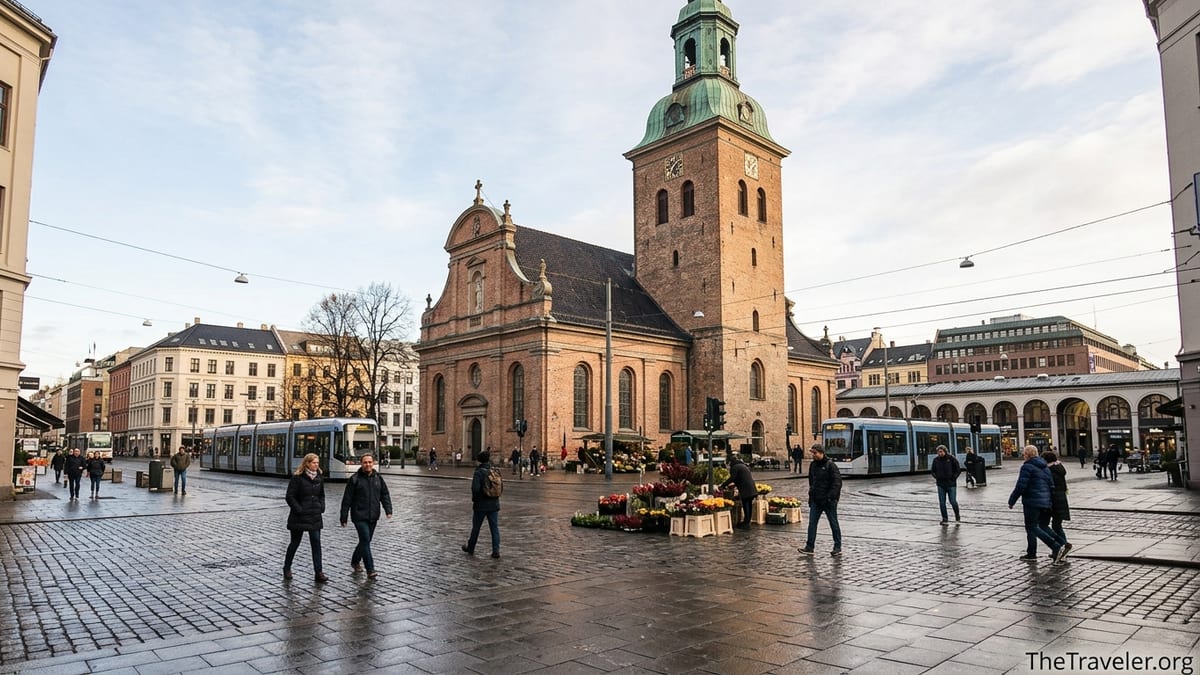
The Beating Heart of a Royal and Civic Capital
Oslo Cathedral, or Oslo Domkirke, is officially the main church of the Church of Norway’s Diocese of Oslo and the parish church for the downtown area. In practice it serves as the spiritual front room of the Norwegian state. The current building was consecrated in 1697, and since then it has hosted many of the country’s most symbolic public moments, from royal weddings to national services of remembrance. When Crown Prince Haakon married Mette Marit in August 2001, the entire square outside became a sea of flags and television cameras, turning the cathedral into the focal point of the nation’s attention for a day.
The Norwegian royal family and government still use the cathedral for official occasions, which means travelers often stumble upon rehearsals for state ceremonies or see barriers and TV vans being set up on Stortorvet. On days of national mourning or thanksgiving, such as after tragedies or major anniversaries, it is here that Oslo residents line up to light candles and sign condolence books. For visitors, this gives the building a role that goes far beyond regular worship. It is a place where Norway collectively marks what matters, whether you personally attend services or are just passing through the square on your way to the tram.
Even on ordinary weekdays, you can sense that dual identity. Office workers from Karl Johans gate slip inside for a few quiet minutes between meetings, while tourists study the painted ceiling. Outside, the bronze statue of King Christian IV points across Stortorvet with the words “here the city shall lie,” a reminder that this church has stood at the heart of Oslo’s story since the early days of the modern capital.
A Living Piece of Baroque Oslo, Not a Frozen Museum
Architecturally, Oslo Cathedral is a relatively modest baroque church, built in brick on a rocky outcrop at the edge of what would become Stortorvet square. It lacks the towering spires of Nidaros Cathedral in Trondheim or the dramatic setting of Arctic churches further north, but for Oslo that understatement is part of its charm. The squat tower and copper roof blend into the low-rise city center, meaning that your first sight of the cathedral is often from a tram window as you roll into Stortorvet stop or from the outdoor tables of nearby cafés.
The interior, however, quickly corrects any impression of simplicity. Look up and you find a sweeping painted ceiling, the work of Norwegian artist Hugo Lous Mohr, who began decorating the 1,500 square meter vault in the late 1930s. The restoration of these ceiling paintings, completed in the 2010s, has brought back their rich, slightly muted colors. During daylight the effect is especially striking when shafts of sun fall through the south windows and pick out small details of angels and biblical scenes, a reminder that this is also a serious piece of 20th century church art layered onto a 17th century shell.
Unlike a museum, though, you will rarely find the cathedral empty. On a typical weekday in summer, groups with local guides pause near the altar to talk about the baroque pulpit and baptismal font, while a solo traveler might sit in a side pew to listen to the organist rehearsing. Children pass through with school assignments. Maintenance staff quietly move chairs for upcoming concerts. The building is historic, protected and carefully maintained, but it is also in constant use, and that lived-in feel is part of what sets it apart from purely touristic landmarks.
Where Organ Music and Choirs Bring Stone and Paint to Life
Music is one of the most immediate ways Oslo Cathedral becomes more than a religious building for visitors. The cathedral has a long tradition of church music, supported by a significant main organ and several smaller instruments. Regular services feature organ preludes and postludes that echo under the painted ceiling, and on many weekdays there are short recitals around midday. A typical traveler might wander in from the square just as an organist launches into a piece by Bach or a contemporary Norwegian composer, transforming a quick look-around into an impromptu concert.
Choirs are equally important to the cathedral’s identity. Oslo Cathedral Choir, along with children’s and youth choirs, rehearse and perform here throughout the year, and their calendar stretches from Advent concerts to special Passion music before Easter. For a visitor in December, that can mean catching a late afternoon rehearsal of carols while snow falls outside, or buying a reasonably priced ticket for an evening concert that draws both locals and tourists. The quality is generally high, with many singers and organists trained at the Norwegian Academy of Music or active in professional ensembles elsewhere in the city.
During church festivals and in the Norwegian Church Music scene more broadly, the cathedral often acts as a flagship venue. In recent years it has hosted performances linked to the Oslo Church Music Festival and other cultural programs, where contemporary works are performed alongside traditional repertoire. For travelers who love music, it is worth checking local listings or posters by the entrance; some concerts are free or donation-based, while others have modest ticket prices compared to standalone concert halls. Even if you do not plan ahead, simply timing your visit around a midday mass can reward you with several pieces for organ and choir at no extra cost.
A Daily Refuge in the Middle of Stortorvet
Location is another reason Oslo Cathedral feels like much more than a church. It stands right on Stortorvet, a historic market square that has been a trading place since the 1600s and was formally established as the city’s main square in the 1730s. Today, flower stalls still cluster outside, especially in the warmer months, and the soundscape mixes street musicians, tram bells from the Stortorvet stop and the low murmur of people moving between nearby department stores and office buildings.
In this environment the cathedral functions as a daily refuge. The doors are usually open from morning until late afternoon or early evening, and entry to the main space is free when no special event is taking place. Travelers walking up Karl Johans gate from Oslo Central Station often duck in for a few minutes of quiet before continuing towards the Royal Palace or the harbor. You can sit on a wooden pew, watch candlelight flicker in side chapels and let the city noise fall away. For many locals, visiting the cathedral is less about formal religion and more about having a place where you can pause, light a candle for someone, or simply sit without needing to buy a coffee.
The atmosphere shifts with the time of day. At midday a mix of tourists, office workers and elderly Oslo residents politely share the space. In the late afternoon, you might find small groups of friends meeting before heading out to nearby bars and restaurants, using the cathedral steps as a rendezvous point. In winter, when darkness falls early, the warm interior lighting and candles offer a particularly inviting contrast to the cold air just outside the heavy wooden doors. Whatever the season, the cathedral quietly anchors the square, giving a sense of continuity that many travelers pick up on even if they only visit once.
A Gateway to Markets, Bazaars and Everyday Oslo Life
Step out of Oslo Cathedral and within a few meters you are in one of the city center’s most textured corners. To one side lies Stortorvet with its flower stalls and tram stop. To another stretch the brick arcades of the Oslo Bazaars, originally built in the 19th century for butchers selling meat to the market. Today, these vaulted passageways host small shops, cafés and craft-oriented businesses. For visitors, browsing here offers an easy way to pair a cultural stop in the cathedral with a taste of everyday local commerce, far from the polished feel of indoor malls.
Prices in the immediate area reflect its central location but are not out of reach. A takeaway coffee from a small café under the arcade or across the square typically costs the equivalent of a few euros or dollars, while a light lunch at a nearby brasserie or bakery will be more. Because the area is dense with offices, most places offer weekday lunch deals, which can be more affordable than evening menus. This makes the cathedral and its surroundings a convenient midday stop in a sightseeing day, allowing you to combine art, architecture and a simple meal without long detours.
Public transport ties in closely with the cathedral’s role as a gateway. The Stortorvet tram stop is on multiple lines that crisscross central Oslo, and buses also serve the square. Many visitors first glimpse the church from the tram as they travel between neighborhoods like Grünerløkka, Majorstuen and the central station. As a result, it naturally becomes a landmark to orient yourself: “get off at Stortorvet, right by the cathedral” is a phrase you will hear from locals giving directions to shops, restaurants or events in the city center.
From Free Entry to Paid Tours: Practical Visitor Experience
From a traveler’s perspective, Oslo Cathedral strikes a careful balance between openness and organization. Entry to the main nave is typically free during daytime opening hours, and you can wander around, sit quietly or look at architectural details without needing a ticket. This is particularly valuable in a city where many attractions and activities can feel pricey by international standards. Families, backpackers and cruise passengers alike often appreciate having a central, cost-free place to visit between other paid sights.
At the same time certain parts of the cathedral complex or specific events may require a ticket. Guided tours, special exhibitions or evening concerts often carry a fee, helping support the church’s music program and ongoing maintenance. Tickets are commonly sold through local platforms or at the door, with prices that are generally moderate compared with large concert venues. For example, a ticketed choral concert might cost less than a similar-length performance at a major theater, while still featuring professional-level musicianship and a memorable setting beneath the painted ceiling.
Opening hours can vary slightly by season and by day of the week, and the cathedral occasionally closes for private ceremonies, weddings or official events. On such days you might find signs at the entrance indicating when general visitors can enter. It is wise to build some flexibility into your itinerary: if you arrive to find the church closed for a ceremony, you can explore the markets, arcades and side streets around Stortorvet, then return later in the day when it reopens. Because the building is visible from much of the surrounding area, you will always have an easy visual cue for when the doors have opened again and people begin flowing in and out.
History You Can Feel, Not Just Read About
Oslo has had earlier cathedrals, including the medieval St. Hallvard’s Cathedral whose ruins lie east of the modern center, but the current Oslo Cathedral is where the city’s more recent layers of history converge. Inside you can see traces of different eras: a baroque altar and pulpit, 19th century stained glass, 20th century ceiling paintings, and restorative work from the 21st century. Rather than being preserved in a single time period, the building shows how generations have adapted and reinterpreted it according to their needs and aesthetics.
For visitors, this layered history becomes tangible in small details. A plaque might mention royal weddings from the 1960s and early 2000s, while another notes ongoing restoration funded by local foundations. You may notice how some pews bear signs of wear from centuries of use, while newer elements like modern lighting and discreet audio equipment make the space workable for contemporary events. The result is an atmosphere that feels neither purely old-fashioned nor aggressively modern, but genuinely lived in.
Because the cathedral continues to host everyday services alongside large civic events, it also offers a window into Norwegian religious life today. While regular church attendance is relatively modest in Norway by global standards, major festivals like Christmas and Easter still fill the building, and milestone moments such as confirmations draw extended families dressed in traditional bunads. Even if you only attend a short weekday mass, noticing how quietly people move, the modest but heartfelt way hymns are sung, and the gentle formality of the liturgy can tell you something about the understated character of public life in Norway’s capital.
The Takeaway
Oslo Cathedral is easy to visit but surprisingly hard to reduce to a single label. It is a working parish church, a royal ceremonial venue, a concert hall, an art gallery and a neighborhood refuge all in one. Its location at Stortorvet means it is woven into the daily routines of commuters, market vendors and students, rather than standing apart as a distant monument. The scent of candle wax and old wood, the sound of trams and organ music mingling, and the play of light on Hugo Lous Mohr’s ceiling paintings all hint at a place where history is still unfolding.
For travelers, that mix is what makes Oslo Cathedral more than just another church on a European itinerary. You can step in for a free moment of quiet, stay for a lunchtime recital, or return in the evening for a ticketed choral concert. You might find the square outside full of flower stalls, TV cameras for a royal event, or simply locals meeting under the tower before heading out into the city night. Whatever your plans in Norway’s capital, allowing a little unhurried time here will give you a deeper sense of how Oslo holds its past and present together under one modest but remarkably resonant roof.
FAQ
Q1. Is there an admission fee to visit Oslo Cathedral?
Most of the time entry to the main nave of Oslo Cathedral is free during regular opening hours. Special events, guided tours or evening concerts may require a paid ticket, which helps support the music program and building maintenance.
Q2. Do I need to book in advance to attend a service or mass?
For ordinary services such as weekday masses or Sunday worship you usually do not need to book in advance, and visitors are welcome to attend respectfully. For major holidays like Christmas or Easter, and for some high-profile concerts, seats can fill quickly and advance tickets or early arrival may be advisable.
Q3. What are typical opening hours for Oslo Cathedral?
Opening hours vary slightly by season, but the cathedral is generally open daily from morning until late afternoon or early evening. It can occasionally close for private ceremonies, royal events or maintenance, so it is wise to allow flexibility in your plans and check posted notices at the entrance.
Q4. How do I get to Oslo Cathedral using public transport?
Oslo Cathedral stands on Stortorvet square in the city center, right beside the Stortorvet tram stop served by several tram lines. It is also a short walk from Oslo Central Station and from bus stops along nearby streets such as Karl Johans gate and Grensen, making it easy to include in any central Oslo itinerary.
Q5. Can I take photos inside the cathedral?
Non-flash photography for personal use is generally allowed in Oslo Cathedral when no service is in progress, but visitors are expected to be discreet and respectful. During services, concerts or private ceremonies, photography may be restricted or discouraged to preserve the atmosphere and privacy of participants.
Q6. Are there regular organ concerts or choir performances?
Yes, organ and choral music are central to life at Oslo Cathedral. There are often short organ recitals linked to weekday services, and the cathedral hosts a range of concerts throughout the year, especially around major church festivals. Some events are free or donation-based, while others require reasonably priced tickets.
Q7. Is the cathedral accessible for visitors with limited mobility?
Oslo Cathedral has level access at main entrances and generally flat floors inside, making it relatively accessible for visitors using wheelchairs or with limited mobility. However, access to certain smaller areas, such as galleries or choir lofts, may be restricted due to stairs and the historic layout of the building.
Q8. What should I wear when visiting Oslo Cathedral?
There is no strict dress code, but modest, respectful clothing is recommended, especially if you plan to attend a service. Comfortable attire suitable for other city sightseeing is generally fine, as long as shoulders and knees are reasonably covered and hats are removed inside.
Q9. Are there places to eat or shop near the cathedral?
Yes, the cathedral is surrounded by the Oslo Bazaars and the shops and cafés of Stortorvet and nearby streets. Within a few minutes’ walk you will find bakeries, coffee bars, casual eateries and more formal restaurants, allowing you to combine your visit with a meal or some shopping.
Q10. How much time should I plan for a visit?
A quick look around the interior can take 20 to 30 minutes, but many visitors choose to spend an hour or more, especially if they sit for a short service, listen to music or explore the surrounding markets and arcades. Allow extra time if you plan to attend a concert or guided tour.