


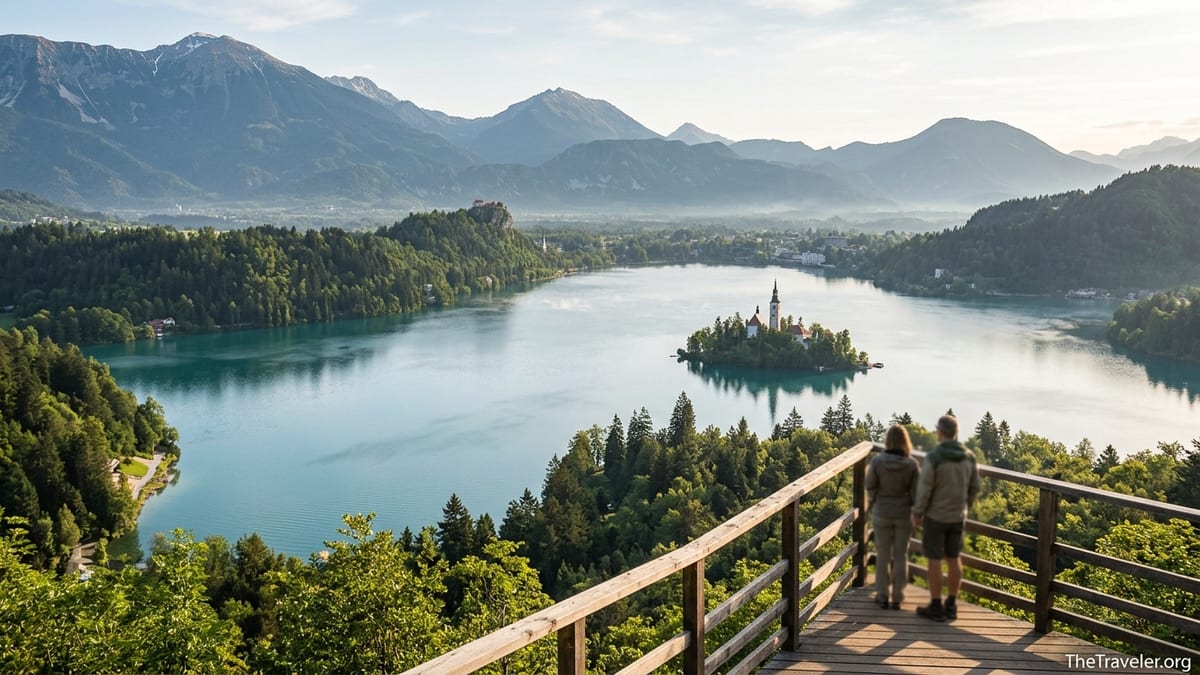
Every destination has that one photograph that seems to define it. For Slovenia’s Lake Bled, it is the elevated view where the turquoise water, tiny wooded island, clifftop castle and distant mountains line up in a single perfect frame. That viewpoint has a name: Mala Osojnica. This small hill on the western shore has become a rite of passage for photographers and casual travelers alike, offering what many consider the most famous and rewarding view over Lake Bled.
Get the latest updates straight to your inbox!
A Natural Balcony Above Slovenia’s Most Famous Lake
Mala Osojnica is a forested hill that rises to roughly 685 meters above sea level on the southwest corner of Lake Bled. From the lakeshore at Velika Zaka, the summit is only about 200 vertical meters above you, but that modest elevation gain is enough to transform the way the landscape unfolds. At the top, a small wooden viewing platform juts out over the trees, creating a natural balcony with a sweeping panorama of the entire lake basin.
From this vantage point, you see almost every element that has made Lake Bled famous. Directly in front of you lies Bled Island with its Baroque church and bell tower, surrounded by the lake’s distinctive blue-green water. To the right, Bled Castle perches dramatically on a rocky cliff, while behind everything rise the Karawanks and Kamnik-Savinja Alps, their ridges often dusted with snow well into spring. It is an arrangement that seems almost too perfect to be accidental, which is why it appears on postcards, tourism posters and guidebook covers around the world.
What sets Mala Osojnica apart from viewpoints closer to the water, such as lakeside promenades or hotel terraces, is this sense of depth and layering. The height allows the island and castle to sit within a wider mountain backdrop, while the curve of the shoreline leads your eye around the scene. For travelers who have already walked around the lake or visited the island by traditional pletna boat, the view from Mala Osojnica feels like finally seeing the full picture.
The setting itself is surprisingly modest. There is no café, no ticket booth and no cable car, just a bench, a simple railing and an information board. You may share the summit with a handful of other hikers arranging their tripods at sunrise, but the infrastructure here is minimal, which helps the viewpoint feel more like a discovery than an attraction.
A Short, Steep Hike With Big Rewards
One of the reasons Mala Osojnica’s view is so well known is that it is relatively easy to reach. From the lakeshore near Camping Bled and the Velika Zaka car park, most hikers reach the viewpoint in about 30 to 45 minutes. The distance is short, typically around 1 kilometer from the trailhead, but the path is steep almost from the first steps, climbing through mixed beech and spruce forest on a series of switchbacks.
The elevation gain is roughly 150 to 200 meters, depending on your exact route. That makes the ascent manageable for reasonably fit travelers, including older children, but it does surprise some visitors who expect a gentle stroll. Reviewers on hiking platforms often describe arriving at the top “sweaty but happy,” which is a fair summary. The trail can be muddy after rain, and there are sections where you step over slick roots or rocks, so sturdy footwear is more practical than city sneakers.
Near the top, a sloping metal staircase and handrails help you tackle the final, steepest pitch. This short ladder section can feel exposed if you dislike heights, but it is solid and allows people of varied abilities to reach the platform safely. Many hikers choose to ascend using the steeper eastern path first, then descend via a gentler loop that passes nearby viewpoints such as Velika Osojnica or Ojstrica. Local guides and hiking blogs commonly recommend this clockwise direction to avoid down-climbing the metal stairs.
Because the hike is short and starts close to popular accommodation areas, Mala Osojnica fits easily into even a tight Lake Bled itinerary. For example, travelers staying in central Bled can catch an early local bus or walk about 30 minutes around the lakeshore to Velika Zaka, hike up for sunrise, and still be back at their hotel in time for breakfast. Others tack the viewpoint onto a larger day that includes rowing to the island, visiting Bled Castle, or continuing on to nearby Lake Bohinj.
Why This View Became the Postcard Image of Lake Bled
Many viewpoints around Lake Bled are beautiful, but the composition from Mala Osojnica has a few visual advantages that make it especially photogenic. First, the angle of elevation is high enough that the island and church are fully separated from the far shore, so they appear to float in open water rather than blend into the background. Photographers often talk about “separation” in an image, and this small detail is a big part of why photos from Mala Osojnica feel so clean and striking.
Second, the hill’s position on the southwest side of the lake means the sun rises roughly behind you for most of the year. In practice, that gives soft front or side lighting on the island and castle at sunrise, reducing harsh shadows and creating gentle reflections on the water. Travelers who hike up in July or August often describe watching the fog lift off the lake as warm light hits the church tower, while the mountains behind remain a cool blue. It is the kind of natural lighting that landscape photographers usually have to work hard to find.
Third, Mala Osojnica is just far enough from the town and major hotels that the built environment feels secondary. You can still spot lakeside villas and café terraces if you look closely, but your eye is drawn first to natural elements: the forested shoreline, the shape of the island, distant peaks like Stol and Begunjščica in the Karawanks. This balance of developed and wild scenery fits the romantic image of Lake Bled that tourism campaigns have promoted for decades.
Finally, the viewpoint’s fame feeds on itself. When travel magazines like National Geographic Traveler or photography websites run features on Slovenia, they often choose an image shot from Mala Osojnica. Social media has amplified that trend. On a typical summer morning, you might see photographers with lightweight mirrorless cameras, couples sharing a smartphone tripod, and even drone pilots who hiked up just to get an elevated starting point before takeoff. For many visitors, recreating “that exact shot” is part of the appeal of coming to Lake Bled at all.
Practical Tips for Timing Your Visit
Because Mala Osojnica is relatively easy to reach and widely publicized, timing your hike can significantly affect the experience. Sunrise is generally considered the best and calmest time to be at the viewpoint. In high summer, that may mean starting up the trail around 4:30 or 5:00 in the morning, before public buses begin running. Travelers staying at Camping Bled or in guesthouses along the western shore are at an advantage because they can walk from their door to the trailhead in about 10 minutes.
At sunrise, the lake is often glassy, with just a few early rowers heading for the island. In September or October, cool nights can produce a low mist that hangs over the water and then slowly reveals the church spire and castle as it lifts. Air temperatures on the summit can be several degrees cooler than in town at dawn, so packing a light jacket or fleece is a good idea, even in midsummer.
Late afternoon and golden hour before sunset are the second most popular times to visit. The sun shifts around to the west, casting warm light on the castle and the eastern slopes above Bled. In summer, this is when you will find more small tour groups and casual hikers, many of whom have spent the rest of the day swimming or paddleboarding at Velika Zaka beach below. If you prefer quieter conditions and are visiting in July or August, consider a shoulder season month like May or late September, when daytime temperatures still allow for lake activities but the crowds are smaller.
The viewpoint is accessible year-round, but conditions vary. In winter, snow and ice can make the trail slippery, particularly on the metal stairs, and daylight hours are short. Local hiking guides often recommend microspikes or trekking poles if you plan a winter ascent. Spring can be muddy, though the trade-off is lush green foliage and fewer visitors. Whenever you go, checking the weather forecast and recent trail reports in Bled’s tourist office or through your accommodation is a simple way to avoid surprises.
How Mala Osojnica Compares to Other Lake Bled Viewpoints
Part of understanding Mala Osojnica’s fame is comparing it with other popular viewpoints around Lake Bled. The closest rival is Ojstrica, a slightly lower hill on the same side of the lake. Ojstrica’s summit is a rocky outcrop with just enough space for a bench and a handful of people. The view from there is a bit more intimate, with tree branches partially framing the lake and island. Some photographers love Ojstrica for its moody, close-up feel, but many agree that Mala Osojnica offers a broader, more balanced panorama.
Velika Osojnica, a higher point on the same ridge, is another option. Reaching it requires an additional 20 to 30 minutes of hiking beyond Mala Osojnica and a steeper ascent, but the reward is a slightly different angle that reveals more of the surrounding valley and distant peaks. Travelers following the full Ojstrica–Velika Osojnica–Mala Osojnica circuit often describe doing it as a half-day outing, combining three distinct viewpoints into a single loop before returning lakeside for lunch.
Then there is Bled Castle itself. The castle terrace offers a commanding, almost vertical view straight down onto the lake and island, and it is easily accessible by car, taxi or a short, steep walk from town. However, the castle lies close to the lake’s eastern shore, so the background is dominated by forested slopes rather than the snowy Karawanks. There is also an admission fee to enter the castle complex, whereas access to Mala Osojnica is currently free, aside from any parking charges at Velika Zaka.
Other viewpoints, such as Straža hill with its summer toboggan run, or lakeside hotels with rooftop terraces, each give their own perspective. Yet for most travelers who have seen multiple angles, Mala Osojnica stands out as the spot where everything aligns just right. It is the view that captures not only the lake and island, but also their larger alpine setting and the quiet forests that still surround much of Bled.
Making a Day of It: Combining the Hike With Local Experiences
Most people spend less than two hours hiking to Mala Osojnica and back, which leaves plenty of time in the day to enjoy Lake Bled and the surrounding region. A popular option is to pair an early morning hike with a relaxed lakeside brunch. Cafés in central Bled and near Velika Zaka typically open by mid-morning, serving strong coffee, fresh pastries and, of course, slices of the local specialty, kremna rezina, or Bled cream cake. Many travelers reward themselves with a slice after their hike, often joking that the calorie balance just about evens out.
From the viewpoint, you will likely spot traditional wooden pletna boats gliding back and forth to Bled Island. Later in the day, you can join them by hiring a pletna ride from one of the landing stages or renting a rowboat to paddle yourself. The climb to Mala Osojnica provides a bird’s-eye preview of these activities, which can help you decide whether you want a quieter, self-rowed experience or the social atmosphere of a shared boat.
Active travelers might continue from Mala Osojnica into a longer circuit that includes Ojstrica, Velika Osojnica or even Straža hill, before dropping back to the lake to swim. In summer, Velika Zaka has a designated swimming area where locals and visitors lay out towels on the grass and rent paddleboards or kayaks. Looking down from the viewpoint in July or August, the lake often sparkles with colorful boards and inflatables, a reminder that Bled is as much a place of everyday recreation as it is of iconic landscapes.
If you have several days in the area, Mala Osojnica can also be a warm-up for more ambitious hikes in the Julian Alps. Many visitors use Bled as a base for day trips to places like the Vintgar Gorge, Pokljuka plateau or Lake Bohinj. Having already experienced the “classic” view from Mala Osojnica, you will recognize familiar peaks from new angles as you explore deeper into the region.
Responsible Visiting and Preserving the View
With rising popularity comes increased pressure on trails and natural viewpoints. Mala Osojnica is no exception. On busy summer weekends, the small wooden platform can feel crowded at prime times, and erosion on the steepest sections of the path is an ongoing concern for local authorities and land managers. As a visitor, a few simple choices can help keep the experience pleasant and the environment healthy.
First, staying on marked trails protects both vegetation and your own safety. Shortcuts between switchbacks may seem tempting when you are tired, but they quickly widen into eroded channels that wash out in heavy rain. The official path is clearly marked with wayfinding signs and, in some sections, metal railings. Following it also reduces your chances of wandering onto informal paths that end at steep drops or slippery slopes.
Second, timing your visit can reduce crowding. If you are not set on shooting sunrise, consider visiting in the late morning on a weekday outside of peak school holiday periods. The viewpoint will still be beautiful, and you are more likely to find space on the bench or along the railing without jostling for tripod positions. Tour operators often schedule their group hikes for early evening, so shifting your plans slightly can make a real difference.
Finally, carrying out everything you bring in is an essential courtesy. There are no bins at the summit, and even small items such as bottle caps or snack wrappers accumulate quickly in such a confined space. A compact reusable bag for your own trash is easy to tuck into a daypack. Some travelers even make a habit of picking up a few stray items on their way down, treating it as a small thank-you to a place that provided them with such memorable views.
The Takeaway
Mala Osojnica’s popularity is not a matter of chance. The hill’s position, height and orientation combine to deliver a view that feels almost tailor-made for the way we like to see landscapes framed. From its simple wooden platform, Lake Bled reveals itself in full: the island, the castle, the mountains, the curve of the water and even the daily life unfolding along the shore.
At the same time, reaching this famous viewpoint still requires a bit of effort. The short, steep hike filters out those unwilling to leave the lakeside promenade, and the forested trail preserves an atmosphere that is more mountain path than urban lookout. For many travelers, standing at the railing and watching morning light spill over the lake is the moment when Lake Bled shifts from a pretty destination on a brochure to a real, lived experience.
Whether you are a photographer chasing the perfect composition, a couple looking for a memorable sunrise, or a family wanting to add a small adventure to your holiday, Mala Osojnica delivers far more than its modest height might suggest. It is the kind of place that lingers in memory long after your trip ends, a balcony in the hills where Slovenia’s most famous lake shows you its very best side.
FAQ
Q1. How long does it take to hike to Mala Osojnica?
The hike from the lakeshore near Velika Zaka or Camping Bled typically takes 30 to 45 minutes each way for most reasonably fit adults.
Q2. Is the trail to Mala Osojnica suitable for beginners?
The trail is short but quite steep, with some roots, rocks and a metal staircase near the top, so it is manageable for beginners who are comfortable with a sustained uphill walk.
Q3. Do I need special equipment to hike Mala Osojnica?
No technical gear is needed in normal conditions, but sturdy shoes with good grip are strongly recommended, and in winter simple traction devices can be helpful.
Q4. What is the best time of day to visit Mala Osojnica for photos?
Sunrise is widely considered best for calm water, soft light and fewer people, while late afternoon and golden hour also offer beautiful conditions with warmer tones.
Q5. Is there an entrance fee for Mala Osojnica?
Access to the trail and viewpoint itself is currently free, though you may need to pay for parking at Velika Zaka or nearby lots if you arrive by car.
Q6. Can children hike to Mala Osojnica?
Many families do the hike with school-age children who are used to walking; younger kids may need frequent breaks and close supervision on the steeper and stair sections.
Q7. How does Mala Osojnica compare to Ojstrica for views?
Ojstrica offers a slightly lower, more intimate viewpoint, while Mala Osojnica provides a wider, more classic panorama that includes more of the lake and mountain backdrop.
Q8. Is the trail to Mala Osojnica open year-round?
The path is generally accessible in all seasons, but snow, ice or heavy rain can make it slippery, so winter hikers should check conditions and take extra care.
Q9. Are there facilities at the top of Mala Osojnica?
There are no toilets, cafés or shelters at the summit, only a small viewing platform, bench and information board, so bring water and any snacks you might need.
Q10. Can I visit Mala Osojnica without a car?
Yes, you can reach the trailhead on foot from central Bled in about 30 to 40 minutes, or by local bus to stops near Velika Zaka and then walking a short distance along the lake.