


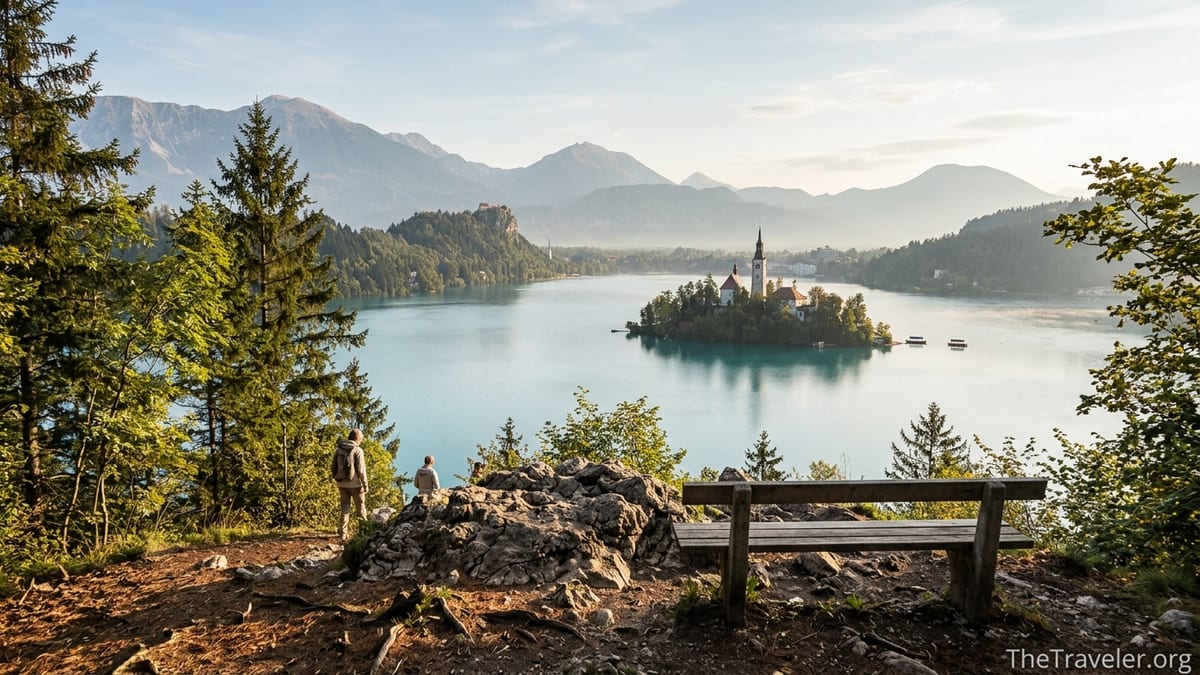
Mala Osojnica is one of Slovenia’s classic postcard viewpoints, a compact forest hike that rewards you with a sweeping panorama over Lake Bled, its tiny island church and clifftop castle backed by the Karawanks and Julian Alps. Although it is a short outing, poor planning can mean parking headaches, slippery trails or arriving in the wrong light for photos. This guide walks you through everything you need to know before you go, using real on-the-ground details so you can treat Mala Osojnica as a highlight of your time at Lake Bled rather than an afterthought.
Get the latest updates straight to your inbox!
Understanding the Mala Osojnica Hike
Mala Osojnica is a forested hill on the western shore of Lake Bled, rising to about 685 meters above sea level. The summit area is modest, but just below it a wooden viewing platform and benches open onto one of the most photographed vistas in Slovenia: the entire lake, Bled Island with its Church of the Mother of God on the Lake, Bled Castle on its rock, and the line of the Karawanks and Kamnik Alps behind. It feels surprisingly wild for something so close to a major resort town.
The hike itself is short but steep. Most visitors follow a route of roughly 2 to 3 kilometers round trip, with an elevation gain of around 150 to 250 meters depending on the exact path you choose. Walkers in average shape usually reach the main viewpoint in about 30 to 45 minutes from the lakeside, which makes this an excellent add-on to a day spent around Lake Bled rather than a full-day alpine excursion.
Despite its modest statistics, trail conditions deserve respect. Sections climb directly up through mixed beech and spruce forest on dirt and roots, and in some places on steep wooden or metal steps. After rain, clay-rich soil can stay muddy and slick for days. Local hiking descriptions and recent trip reports describe the route as easy to moderate for regular walkers, but closer to challenging for anyone with poor footwear, limited mobility or a fear of steep steps.
The hill sits just outside the boundary of Triglav National Park but is part of a wider network of walking routes promoted by the Bled tourist board. In practice that means clear signposts at key junctions, but also a steady flow of people in high season. Understanding how the route fits into the wider Lake Bled landscape helps you decide when to go, how much time to budget and whether to combine it with neighboring viewpoints such as Ojstrica or Velika Osojnica.
Choosing Your Route and Starting Point
Most visitors approach Mala Osojnica from the western side of Lake Bled, between the Camping Bled area and the Velika Zaka lakeside bay. The simplest version begins almost directly across from the Bled Jezero railway station and climbs up through forest on a signed path. Another popular access is from the Velika Zaka paid car park, where brown hiking signs point toward Ojstrica and Osojnica from the lakeside road.
A typical loop for first-time visitors is to start at Velika Zaka, climb first to the lower Ojstrica viewpoint, continue up to Mala Osojnica, then descend on a different branch of trail that returns to the lakeside. This creates a compact circuit of about 2.5 kilometers with roughly 150 meters of total ascent. Many recent hikers report completing this in one to two hours including photo stops, which makes it suitable as a half-morning walk after breakfast in Bled or as a late-afternoon outing before dinner.
If you prefer to minimize crowding and elevation, you can skip Ojstrica and head directly to Mala Osojnica from near Camping Bled or from the Bled Jezero station side. This direct version is steeper but shorter. Families with young children often choose this approach, trading a more sustained climb for less total time on the trail. On the other hand, strong walkers sometimes extend the hike into a longer loop that combines all three viewpoints, the full 6 kilometer circuit around Lake Bled, or even nearby hills like Straža on the opposite shore.
Whichever start point you choose, pay close attention to signage at the lakeside. Trailheads are not elaborate visitor centers but simply small wooden or metal signs mounted near breaks in the roadside barrier, with arrows marked “Ojstrica,” “Mala Osojnica” or “Osojnica.” Because there are desire paths and unofficial shortcuts in the area, it is worth taking a moment to confirm that your initial path matches the arrow rather than simply following the first dirt track heading uphill.
Getting There, Parking and Public Transport
Reaching Mala Osojnica from Bled town is straightforward on foot or by public transport. The western shore of the lake, where the trailheads begin, lies about 3 kilometers from the main town center. Many travelers simply walk the lakeside promenade from hotels on the eastern shore, which takes 30 to 40 minutes at a relaxed pace, passing boat rental spots and viewpoints along the way.
If you are driving, the two most practical parking options are Velika Zaka and the Bled Jezero railway station. At Velika Zaka, recent travelers have reported parking fees in the region of 3 euros per hour, with a ticket machine in the lot and strict enforcement in high season. At the Bled Jezero station lot, some hiking guides mention a flat fee of around 6 euros for up to four hours. Prices can change seasonally, so check the latest rates posted at the machines when you arrive and carry coins or a bank card that works with Slovenian meters.
Public transport is a good option in summer, particularly if you are staying elsewhere in the region. Regional trains connect Bled Jezero station to Jesenice and Bohinjska Bistrica, and buses from Ljubljana or Radovljica typically stop at Bled town, from which you can walk the lake circuit to the western shore. Many visitors staying in central Bled simply skip driving altogether, using hotel bikes, rental bikes from lakeside kiosks, or walking to the trailhead as part of a full day without a car.
Parking rules and access can change from year to year, especially as Bled authorities try to manage congestion and protect lakeside nature. It is wise to avoid relying on informal roadside parking near Camping Bled or along the narrow western road. Instead, plan on using an official lot even if it adds a ten minute walk. On busy summer Saturdays in July and August, spaces at Velika Zaka can fill before 10 a.m., so consider an early start or aim for late afternoon if you are attached to driving.
Trail Conditions, Difficulty and Safety
The Mala Osojnica hike may be short, but it is not a paved lookout stroll. The lower half of the path typically follows a wide dirt track with tree roots, stones and occasional switchbacks. Higher up, you encounter steeper gradients where the trail builders have installed ladders of wooden or metal steps fixed into the slope. Some of these steps feel almost like a staircase in the forest, others are uneven with varying riser heights.
In spring and autumn, when rain is frequent, the clay soil holds water and can turn sections of the trail into slippery mud. Recent trip reports from late May describe shoes caked in mud and recommend extra care on the descents, especially on wooden steps that can become slick. In winter and early spring, snow or ice can persist in the shade even when the lakeside is mostly thawed. In those shoulder seasons, lightweight hiking crampons or microspikes can make a noticeable difference in comfort and safety.
For most reasonably active visitors, the difficulty is primarily about short bursts of exertion rather than technical obstacles. People in their 60s and 70s regularly complete the route, as do families with children who are used to hiking. However, the combination of steep sections and slippery surfaces means the route is not ideal for strollers, very young toddlers on foot, or anyone with significant knee problems. If you have vertigo, you may find some of the steeper stair segments uncomfortable, though the viewpoint itself is on a broad platform without exposure.
Standard European mountain safety advice applies even here close to town. Check the weather forecast from a reliable local source before you go, avoid thunderstorms, and carry a light jacket as mountain weather can change quickly. In summer, afternoon thunderstorms sometimes build over the Julian Alps and roll toward Bled. If the sky is already darkening or thunder is audible, postpone your hike. In autumn and winter, daylight hours shorten rapidly, so bring a small headlamp if there is any chance you will be returning after sunset.
What to Wear and Pack for Mala Osojnica
Because Mala Osojnica lies only a few hundred meters above the lake, many visitors underestimate how much gear they need. You do not need full alpine equipment, but you should treat it as a proper forest hike rather than a city park stroll. The key piece is footwear. Closed shoes with a decent tread, such as trail runners or lightweight hiking boots, are highly recommended. Traveling in sneakers with flat, worn soles significantly increases your chance of slipping on mud, roots or damp leaves.
Clothing should be layered. Even in July, early-morning temperatures above Lake Bled can feel cool in the shade, while the climb itself quickly warms you up. A breathable T-shirt or light hiking shirt under a thin fleece or windproof jacket works well. In spring and autumn, add a beanie and light gloves for dawn or dusk starts. In winter, expect temperatures near or below freezing and dress accordingly, paying special attention to warm socks and a waterproof outer layer if snow is melting.
For such a short hike, your packing list can be minimal but thoughtful. At a minimum, bring a small bottle of water, especially on hot days when the forest can feel surprisingly humid. There are no taps or cafes on the hill itself. Many photographers carry a compact backpack with a camera body, a wide-angle lens in the 16 to 24 millimeter range, and possibly a lightweight tripod for sunrise or blue hour shots. A microfiber cloth for lens cleaning is useful in misty or drizzly conditions.
Sun protection matters more than many expect. The hike is mostly shaded, but the viewpoint platform is exposed, and the sunlight reflecting off the lake can be intense around midday. A hat, sunglasses and sunscreen can make lingering at the top more pleasant. If you are hiking in the shoulder seasons, consider adding a small sit pad for the benches, which can stay damp from overnight condensation.
Best Time of Day and Season to Go
The timing of your Mala Osojnica hike has a big influence on both your experience and your photos. Many photographers aim for sunrise, when the lake is often calm and the island church glows in early light. In summer, that can mean starting your climb as early as 4.30 to 5.00 a.m. from the Camping Bled side, using a headlamp in the forest. Hikers who have done this in July describe sharing the viewpoint with only a handful of people and watching the sky turn from pale blue to pink above the mountains.
If sunrise feels too early, consider a mid-morning or late afternoon visit. By mid-morning, the sun is generally high enough that the castle and island are well lit, and tour boats begin to appear on the lake. This can add scale and life to your photos but also means more people at the viewpoint. Late afternoon and early evening often bring warmer light and long shadows across the water. On clear days in September and October, this can be one of the most atmospheric times to visit, with autumn colors in the surrounding forests.
Seasonally, Mala Osojnica is hikeable most of the year. In high summer from late June to August, expect warm temperatures, lush green foliage and the highest visitor numbers. Weekends and national holidays are especially busy, and you may need to wait your turn to stand at the most popular photo spots on the platform. Spring brings wildflowers and snow still visible on the highest peaks, but trails can be very muddy from snowmelt. Autumn offers rich colors and often clearer air, with slightly fewer crowds outside peak weekends.
Winter visits require more preparation. Snow and ice can make the path significantly more difficult, turning steep steps into slippery ramps. However, on cold clear days the reward is a quiet forest and a view of Lake Bled ringed by snow, with the Julian Alps and Karawanks white in the distance. If you plan a winter hike, check with your accommodation or the Bled tourist information office about current trail conditions, and consider using microspikes and trekking poles.
Photography and Viewpoint Etiquette
The wooden platform at Mala Osojnica is small compared with the number of people who want that signature Lake Bled shot. At busy times you might find a semi-circle of photographers with tripods set up along the front edge. It is worth approaching with a bit of patience and a cooperative attitude to keep the atmosphere friendly.
For photography, wide lenses work best. A focal length between 16 and 24 millimeters on a full-frame camera captures the entire lake, including Bled Island offset slightly right of center and Bled Castle perched on the left-hand cliff. On a phone, use the standard lens rather than ultra-wide if you want to avoid exaggerated distortion at the edges. Many visitors like to include the wooden railing or some foreground foliage for depth, rather than cropping a pure lake-and-sky image.
If you arrive and the platform is crowded, take a moment to scout alternative angles rather than jostling for space. Just a few meters to the side or slightly above on the slope, you can often frame a similar view through trees. When your turn comes to stand at the prime spot, be mindful of others waiting. Take your shots, enjoy the view, then step back to make space. If you are using a tripod at sunrise or sunset, try to position it to one side and remember that this is a shared public viewpoint, not a private photo session.
Drone use around Lake Bled is restricted, and flying from the viewpoint itself is typically not recommended due to safety and disturbance concerns. Even if you see drone footage of Mala Osojnica online, assume that regulations or permit requirements apply and focus instead on making the most of the natural vantage point with your handheld camera or phone.
Combining Mala Osojnica with Other Lake Bled Experiences
Because the Mala Osojnica hike is relatively short, it fits easily into a broader Lake Bled itinerary. One popular pattern is to start the hike early, be back at lake level by mid-morning, then rent a traditional wooden pletna boat or a small rowboat to visit Bled Island. Boat rentals from the western side of the lake are typically priced by the hour, and combining them with the hike gives you both the classic aerial and on-the-water perspectives in a single day.
Another option is to pair Mala Osojnica with a walk or run on the 6 kilometer path that circles the lake. For example, you might leave your car at a central parking area in Bled town, jog or stroll the lakeside promenade past the castle view, climb to the viewpoint, then continue the circuit back to town. This effectively turns a short viewpoint hike into a moderately long but varied outing with changing scenery the entire way.
Food and drink options cluster along the lake and in Bled town rather than at the trailhead. After your descent, you might stop at a lakeside café near Velika Zaka for coffee, a cold drink or a slice of Bled cream cake, the local pastry specialty with puff pastry and vanilla custard. In summer, simple snack kiosks near the camping area often sell ice cream, grilled dishes and drinks, which can be welcome if the day has turned hot.
If you have more time in the area, consider integrating Mala Osojnica into a multi-day hiking-focused stay. Nearby highlights include the Vintgar Gorge boardwalk near Podhom, the easier Straža hill walk with a summer toboggan run, and day trips to the larger Lake Bohinj, where trails lead to Savica Waterfall and higher alpine valleys. Compared with those outings, Mala Osojnica remains the most accessible way to see Lake Bled from above without committing to a full mountain day.
The Takeaway
Mala Osojnica is a compact hike with an outsized payoff, giving you that classic Lake Bled panorama for the price of a 30 to 45 minute climb. Planning ahead on practical details makes the difference between a rushed, slippery scramble and a memorably calm moment above the lake. Think through your start point, parking choice or public transport plan, the timing of your visit, and the footwear and layers you will need for current conditions.
If you approach it as a real hike rather than a casual stroll, even while traveling with limited time, Mala Osojnica can slot neatly into a half day at Bled. Combine the viewpoint with a lap around the lake, a boat out to the island, or a leisurely café stop and you will have experienced several of the valley’s classic perspectives in one coordinated plan. That preparation, more than any particular camera or lens, is what turns a popular viewpoint into a personal highlight of your trip.
FAQ
Q1. How long does it take to hike to Mala Osojnica?
The climb from the lakeside to the main viewpoint usually takes about 30 to 45 minutes one way for an average walker, not counting extended photo stops.
Q2. Is the Mala Osojnica trail suitable for beginners?
Yes, many beginners complete the hike, but it is steep with roots and steps, so comfortable closed shoes, a normal level of fitness and a cautious pace are important.
Q3. Can I hike Mala Osojnica with young children?
Families with school-age children often manage well, but the route is not suitable for strollers, and very young children may struggle on the steeper, muddier sections and steps.
Q4. Do I need hiking boots or are sneakers enough?
Sturdy sneakers with good grip can work in dry summer conditions, but lightweight hiking shoes or boots are strongly recommended when the trail is wet, muddy or icy.
Q5. Is there an entrance fee for the Mala Osojnica hike?
No, the trail itself is free to access. Your main costs are likely parking at Velika Zaka or Bled Jezero station and transport to Lake Bled if you are not staying nearby.
Q6. What is the best time of day for photos from Mala Osojnica?
Sunrise and late afternoon tend to offer the most flattering light, calmer water and fewer crowds, while midday brings stronger sun and more haze but can still be scenic.
Q7. Can I combine Mala Osojnica with Ojstrica in one hike?
Yes, many visitors follow a short loop that climbs to Ojstrica first, then continues to Mala Osojnica and returns to the lake, typically taking one to two hours in total.
Q8. Is the trail open year-round?
The path is generally accessible throughout the year, but snow, ice or heavy rain can make conditions challenging, so winter and shoulder-season hikers should check conditions locally.
Q9. Are there toilets or shops on the trail?
No, there are no facilities on the hill itself. Toilets, cafés and kiosks are available around the lake near Velika Zaka, Camping Bled and in Bled town.
Q10. Do I need a guide to hike Mala Osojnica?
Most travelers hike independently using trail signs and offline maps, but guided walks are available through local outdoor operators if you prefer structured support or a group.