


Most visitors glimpse Michelangelo’s David through a forest of raised phones, spend two rushed minutes in front of it, then spill back into Florence wondering what the fuss was about. Yet for travelers who slow down, plan ahead, and know where to look, this single block of marble in the Galleria dell’Accademia can become one of the most vivid memories of Italy. Here is how to experience David without missing its most remarkable details.
Get the latest updates straight to your inbox!
Plan Your Visit So David Is Not Just A Box To Tick
David lives in the compact Galleria dell’Accademia in Florence, a former art school that now receives close to two million visitors a year. The building was not designed for crowds, so timing matters. As of 2026, standard adult tickets are around 20 euros, with dynamic pricing and combined passes available that also cover the Bargello Museum from mid‑March onward. Booking a timed ticket through the official system several weeks ahead in high season is increasingly essential, especially for June to September and holiday periods when peak hours often sell out days in advance.
Opening hours typically run from 8:15 a.m. to around 6:50 p.m. Tuesday through Sunday, with Monday closures and a handful of evening openings in summer. For a calmer experience, aim for the first slot at 8:15 a.m. or a late afternoon entry after 5 p.m., when many group tours have departed. Travelers posting recent trip reports consistently describe walking into a relatively empty Tribune at opening time, sometimes sharing the space with only a dozen other people for the first 10 to 15 minutes, compared with the shoulder‑to‑shoulder crowds that can pack the room from late morning.
Build the Accademia into your day so you are not sprinting through. Many visitors pair it with the nearby Duomo area in the morning, then cross the river to the Oltrarno for lunch and an afternoon in the Boboli Gardens. Others book an early Uffizi ticket, take a long break, then reserve Accademia for the late afternoon. What matters less is the exact order, and more that you give yourself at least an hour inside the Accademia, with 20 to 30 unrushed minutes reserved just for David.
If official tickets are sold out, consider reputable same‑day guided tours that still have blocks of group tickets, or accept that you may need to line up for a limited number of same‑day walk‑up spots. Queues for these can reach an hour or more in peak season, which will eat into time and energy you could otherwise spend quietly studying the statue’s surface.
Enter With Context: What You Are Really Looking At
David is more than a pretty statue of a biblical hero. When Michelangelo began carving it in 1501, he inherited a massive, flawed block of Carrara marble that earlier sculptors considered unusable. Over roughly three years he carved a 5.17‑meter figure that contemporaries immediately recognized as a statement about Florence itself: youthful, tense, defiant in the face of larger powers. When the work was unveiled in 1504, it was placed outside the Palazzo della Signoria, effectively as a symbol of the Florentine Republic.
Knowing this changes how you read the statue’s pose. Michelangelo shows David before the battle, not after. There is no severed head, only a young man weighing a decision. Look at the knitted brow, the slightly parted lips, the veins raised along the right hand that clutches the sling. Instead of generic heroism, you see concentration and unease, the moment that precedes action. Guided visits that focus on this political and psychological layer can be worth the extra 15 to 25 euros on top of admission, especially if your time in Florence is short.
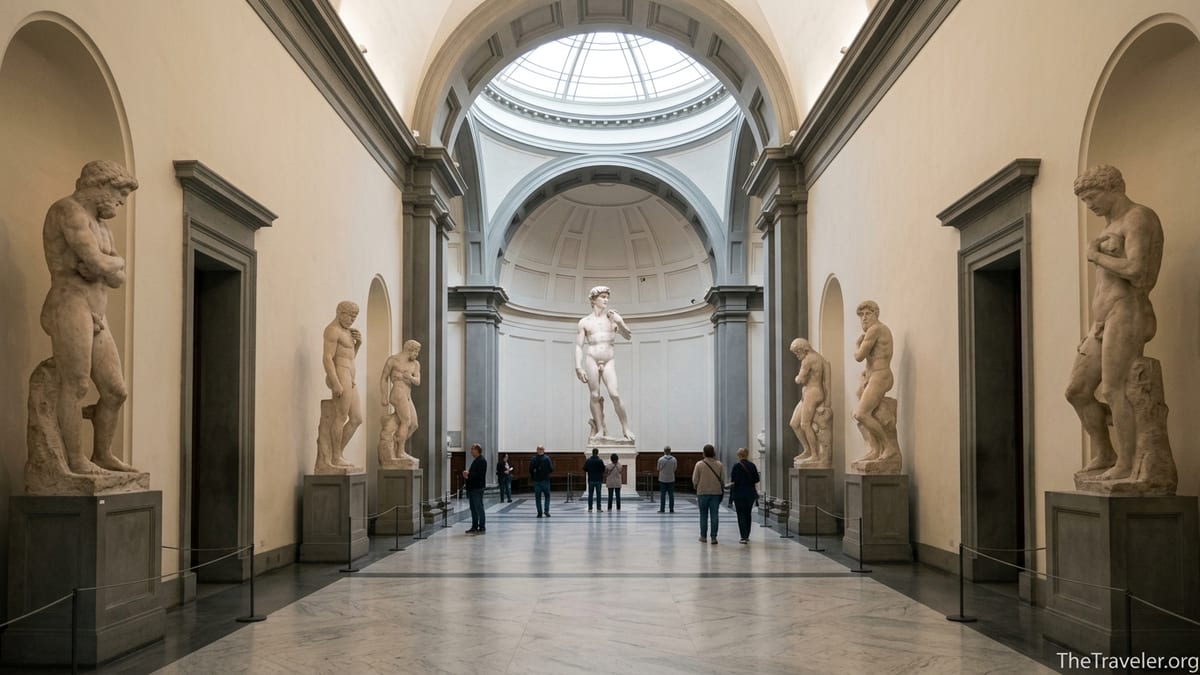
The setting you see today is not original. In the 19th century, after centuries of weathering and occasional damage, David was moved indoors to protect it. The long corridor of the Galleria, lined with Michelangelo’s unfinished “Prisoners,” culminates in the domed Tribune where David stands under a skylight. This axial approach is part of the experience: your first glimpse at the far end of the hall, then the gradual sharpening of details as you walk forward. Resist the urge to stop halfway and immediately start taking photos. Keep walking until you are near the base, then circle slowly.
Arriving with this historical and spatial context means that when you finally stand in front of the marble, you are not simply reacting to its fame but to the story of how a flawed stone became a city’s emblem.
Use The Room: Where To Stand And How Long To Stay
The Tribune can feel chaotic at first: guides talking loudly, people walking backward for selfies, others craning from the entrance. To reclaim the space, think like a photographer. Your goal is not a perfect picture but a sequence of viewpoints that reveal specific details. Many experienced travelers find it helpful to mentally divide their time into three passes: a distant overall view, a front and side study, and a close‑up circuit around the base.
Start directly in front, at a distance of about five to seven meters. From here the statue’s contrapposto becomes clear, with the weight on the right leg and the subtle S‑curve of the spine. This is where the oversized hands and head balance the composition, something harder to see close up. Spend a few minutes simply looking without zooming your camera. If you must photograph, take one or two wide shots and put the phone away.
Next, move deliberately to the right side, almost in line with David’s right shoulder. Here you see a strong diagonal that runs from the left foot, up through the hips, to the head turned toward the left. The connection between the right hand and the sling over the shoulder becomes obvious at this angle. Then cross to the left side, where the twist of the torso and the subtle curvature of the back are more pronounced. Many visitors skip this side entirely, yet it is where the tension in the neck, jaw, and shoulders reads most clearly.
Finally, walk all the way around the base. This is where crowds thin out; most people cluster along the front half. Use the quieter back half to lean on the balustrade and study the carved tree stump supporting the right leg, the chisel marks along the hair, and the slight flattening on the back of the torso where Michelangelo had to negotiate the limits of the marble block. If you can, give yourself at least 20 continuous minutes in the room. Setting a simple intention like “I will walk around twice, slowly, without taking pictures on the second circuit” can dramatically deepen what you notice.
Do Not Miss These Subtle Physical Details
Many of David’s most remarkable features sit in plain sight yet go unseen because they are not what people expect to look for. One of the most discussed quirks is his scale. The head and hands are slightly larger in proportion to the body. Rather than an error, this is likely a combination of practical and expressive choices: Michelangelo compensating for the original high outdoor placement, and emphasizing the instruments of thought and action. When you stand below and slightly to the right, imagine viewing the figure from several meters lower again, as 16th‑century Florentines did in the piazza.
Look carefully at the right hand. You can see the tendons on the back rise as if just tensing, with individual veins running toward the knuckles. The thumbnail is carved with a precise edge. This kind of almost anatomical portraiture continues up the arm into the deltoid muscle and clavicle. These are the places where a simple phone snapshot flattens the experience. Lean in, let your eyes trace from the wrist to the shoulder, and remember that Michelangelo carved this without live models in front of him, relying on an internalized knowledge of the body.
Now examine the face. From the front, David can look oddly calm. Shift to the left side and raise your gaze slightly so you view him almost at eye level. Here the furrow in the brow deepens, the nostrils flare a touch, and the upper lip seems to press against the teeth. There is a tiny vein carved on the right side of the forehead that many guides like to point out as evidence of Michelangelo’s obsession with lifelike detail. Once you see it, David’s expression is no longer generalized heroism but focused apprehension.
Finally, pay attention to the surface itself. In some areas, such as the torso and thighs, the marble is polished to a near‑skinlike softness. Other sections, especially around the hair and the tree stump, retain more visible tool marks. Many specialists believe Michelangelo deliberately varied the finish to create a play of light and shadow. Watch how the natural light from the dome drifts across the body over several minutes, picking out the ribs, the abdomen, and the subtle hollow above the collarbone.
Light, Material, And Distance: Seeing Beyond The Selfie
David is carved from a single piece of Carrara marble, a stone whose faint translucence contributes to the “living” quality many visitors describe. Under the Tribune’s skylight, light penetrates a few millimeters beneath the surface before scattering back, softening edges and creating an almost waxy glow on the flesh. If you are accustomed to seeing reproductions photographed under studio lighting, the real statue’s changing luminance can be surprising.
To appreciate this, step back to the middle of the hall and watch how light pools on different areas: sometimes the chest catches brightness, sometimes the left thigh or the twisting neck. On a bright morning, the side facing the entrance often appears more luminous, while cloudy afternoons flatten the contrasts. A long, quiet look from this distance helps you understand why so many 19th‑century writers described the figure as if it were about to move. The tiny shadow under the left heel, where the foot just lifts from the support, is a perfect example of how a few millimeters of marble can convey a sense of poised motion.
Light also reveals surface vulnerabilities. Over centuries outdoors, and even indoors, the marble has developed small hairline fractures and inclusions. They are part of the work’s history, not flaws to be airbrushed away. Restorers and curators constantly monitor these, and you may see discrete sensors near the base. Knowing that preservation is an ongoing effort can encourage more respectful behavior: keeping a safe distance, not touching the balustrade unnecessarily, and avoiding using flash even if your camera permits it.
If you are a photographer, prioritize one or two carefully composed shots over dozens of similar images. A classic approach is to frame David from the side using one of the Prisoners in the foreground, creating a depth effect and visually linking the unfinished slaves with the finished hero. Another option is to step back to the hall entrance, wait for a brief lull, and capture the full corridor with David illuminated at the far end. Both strategies respect other visitors and keep you focused on seeing rather than collecting digital trophies.
Connect David To Michelangelo’s Other Works In Florence
Seeing David in isolation can distort your sense of Michelangelo’s range. Florence offers several opportunities to place this figure within a wider body of work. A natural pairing is the Bargello Museum, now linked through combined ticketing with the Accademia. At the Bargello you can study Donatello’s earlier Davids and other Renaissance sculptures, then compare how Michelangelo’s monumental marble diverges from or echoes those precedents. Even a brief hour there helps you understand that Michelangelo was responding to a lively sculptural tradition, not inventing heroism from scratch.
Within the Accademia itself, the unfinished Prisoners that line the approach to David may be the single best introduction to Michelangelo’s working method. These figures, emerging half‑formed from rough stone, appear as if they are struggling to free themselves from the marble. Art historians have long debated whether they were abandoned commissions or deliberate demonstrations of the idea that statues “already exist” within the block and the sculptor simply reveals them. Walking past these rough, chisel‑raked surfaces into the smooth perfection of David gives you a before‑and‑after glimpse of that process.
Elsewhere in Florence, look for Michelangelo’s Medici Chapel in San Lorenzo, where the reclining figures of Night and Day, Dawn and Dusk show how he sculpted complex, intertwined bodies for a very different architectural setting. Though executed in different phases of his career, they echo some of David’s muscular language. If time allows, step into Santa Croce to see the artist’s tomb, designed by his contemporaries. These additional stops do not require specialist knowledge, only the habit of comparing: How does this muscle, this turn of the head, this emotional register relate back to the young giant in the Accademia.
Even copies of David around the city can serve as useful lenses. The marble replica in Piazza della Signoria stands roughly where the original once did, giving you a sense of how foreshortening and weather would have altered the impact. The bronze cast at Piazzale Michelangelo, high above the Arno, offers a very different context and patina. Use them to reflect on how material, scale, and setting shape your response to the same basic form.
Practical Tips To Protect Your Time And Attention
An extraordinary encounter with David depends as much on logistics as on art history. Arrive at the Accademia entrance on Via Ricasoli around 15 minutes before your timed slot; lines for security and check‑in can form even for advance ticket holders. Travel light, as larger backpacks must be checked in a cloakroom. Photography is typically allowed without flash, but rules on tripods and selfie sticks are strict, so leave bulky gear at your hotel or apartment.
If you are prone to museum fatigue, consider limiting your visit to the Accademia and one other major site that day. The compact size of the gallery encourages a “we can just squeeze it in” mentality, but pushing through while tired makes it harder to slow down in front of David. Families with children may find it helpful to agree ahead of time on a simple game: count how many unfinished figures you see before reaching David, or ask older kids to sketch one detail, like the hand or the face, in a small notebook. This not only keeps younger travelers engaged but also directs their attention away from screens.
Guided tours that focus on David and the Accademia’s sculpture rooms generally last 60 to 90 minutes and cost in the region of 35 to 60 euros per adult, including priority entry. These can be a very good value if you appreciate structured explanations, but they are not mandatory. An alternative is to download or print the free English‑language visitor material shared by the museum and read a concise overview before entering, so you do not have to parse long labels in a crowded room.
After your visit, resist the urge to immediately plunge into another major attraction. Walk a few minutes to a nearby cafe or gelateria, jot down what you remember most vividly about David’s expression or pose, and compare impressions if you are traveling with companions. This simple decompression ritual often fixes the experience more firmly in memory than another dozen hurried photos ever could.
The Takeaway
Michelangelo’s David is one of those world‑famous works of art that risks feeling overexposed before you ever see it. Yet on the ground in Florence, with a bit of planning and a willingness to slow your pace, it can become deeply personal. Choose a calm time of day, protect at least twenty uninterrupted minutes in the Tribune, and approach the statue methodically: from afar, from the sides, and finally in quiet detail around the base.
Notice the slightly oversized hands and head, the tensed veins, the shifting light on the marble, and the subtle unease in David’s face. Connect what you see to Michelangelo’s other sculptures in the Accademia and across the city, and you will leave not just with proof that you were there, but with a felt understanding of why this particular block of stone has captivated viewers for over five hundred years.
FAQ
Q1. How much time should I plan for seeing Michelangelo’s David at the Accademia?
Most travelers should plan about one to one and a half hours for the entire Accademia visit, with at least twenty to thirty minutes devoted just to David so you can circle the statue slowly and study different angles.
Q2. What is the best time of day to visit the Accademia to avoid crowds around David?
The quietest times are usually the 8:15 a.m. opening slot and late afternoon after 5 p.m., especially on weekdays outside major holidays; mid‑morning to early afternoon, particularly on Saturdays and free‑entry Sundays, is typically the most crowded.
Q3. Do I need to buy tickets in advance to see David?
Advance timed tickets are strongly recommended, particularly from spring through early autumn, because same‑day slots often sell out and walk‑up lines can exceed an hour, cutting into the time and energy you have for actually looking at the statue.
Q4. Is a guided tour necessary to appreciate Michelangelo’s David?
A guided tour is not strictly necessary but can be very helpful if you want historical and artistic context delivered in a structured way; otherwise, a brief self‑study of David’s history and a good printed or digital guide can give you enough background to notice key details on your own.
Q5. Can I take photos of David inside the Accademia Gallery?
Photography of David is generally allowed for personal use without flash, but selfie sticks, tripods, and large professional setups are restricted, so it is wise to travel light and focus on a few thoughtful shots instead of constant shooting.
Q6. How does the original David differ from the copies in Florence?
The original marble David in the Accademia has a warmer, subtly translucent surface and far finer detail than the outdoor copies in Piazza della Signoria and Piazzale Michelangelo, which are exposed to weathering and are better for understanding scale and original placement than for close study of carving.
Q7. What should I look for to really appreciate David’s craftsmanship?
Pay close attention to the oversized hands and head, the veins and tendons in the right hand, the furrowed brow and tense jaw seen best from the left side, the varying polish of the marble surface, and the way light from the skylight plays across muscles and features as you move around the statue.
Q8. Is the Accademia Gallery suitable for children and teens?
Yes, the Accademia is compact and manageable for families, and many children respond strongly to the scale of David; engaging them with simple tasks like counting the unfinished statues in the hall or sketching one detail can make the visit more memorable and less overwhelming.
Q9. Can I see other works by Michelangelo in the Accademia besides David?
Yes, the gallery houses several unfinished statues known as the Prisoners or Slaves, as well as other sculptures and works that illustrate Michelangelo’s evolving approach, and these pieces provide valuable context for understanding how David emerged from raw marble.
Q10. How should I fit the Accademia into a short stay in Florence?
For a one‑ or two‑day stay, many visitors book an early morning Accademia slot paired with the Duomo area, or a late afternoon visit after the Uffizi or city walking, making sure not to schedule too many other major sights immediately around it so they can arrive rested and ready to focus on David.