


Most travelers step into Florence’s Accademia Gallery, turn a corner, see Michelangelo’s David, whisper “wow, it’s huge,” take a few photos and move on. Yet the very things that make this sculpture unforgettable are not its size or fame, but subtler details: a scarred block of marble, enlarged hands and head, tiny veins, unfinished figures nearby, and the way light, space, and crowds shape your experience. Slow down, and an over-photographed icon becomes a surprisingly intimate encounter with a 26-year-old sculptor and the city that commissioned him.
Get the latest updates straight to your inbox!
The Story Inside a “Ruined” Block of Marble
Most visitors know David as a symbol of Renaissance perfection, but few realize he began as a problem: an awkward, weather‑worn block of Carrara marble abandoned for decades in a yard behind Florence’s cathedral. In the early 16th century, the Opera del Duomo, which oversaw work on the cathedral, had already paid other sculptors to work the stone and given up on it as too tall, too narrow, and badly damaged. Michelangelo accepted the challenge in 1501, when he was just 26, and spent more than two years coaxing a figure out of what locals called the “giant.”
Knowing this backstory changes what you see when you walk down the long corridor of the Accademia toward David. Instead of a flawless god-like hero, you are looking at a rescue. The statue’s slightly shallow depth front to back, especially visible in side views, reflects the limitations of that block. The proportions were dictated not by an ideal cube of stone, but by the scars and hollows other hands had already cut. When guides mention the “torso is surprisingly slim if you view him from the side,” they are pointing to that compromise. It is not immediately obvious from the front, and most people never circle far enough around to notice.
Next time you visit, walk all the way around to the back left side, near the museum attendants’ post. From there, the figure’s flatness is clearer, and the connection to the damaged block suddenly feels real. You are seeing what Michelangelo saw: limited material, high expectations, and a need to turn constraints into drama.
This context also helps you understand why Florence is so protective of the original. Today David stands under a domed skylight in the Tribuna of the Accademia, but until 1873 he weathered rain, soot, and political unrest on Piazza della Signoria. The version you glimpse outside Palazzo Vecchio now is a 20th‑century copy, and a bronze David surveys the city from Piazzale Michelangelo. They echo the pose, but only the original carries the full biography of that battered stone.
Why the Head and Hands Look “Wrong” Up Close
First‑time visitors who get close enough to David often feel a quiet jolt of surprise: the head and hands are too big. Seen from the floor of the Tribuna, his right hand looks massive, out of proportion with the arm and torso, and the head seems almost heavy on the neck. Many simply assume Michelangelo misjudged his anatomy. The real explanation is more compelling, and most people never hear it.
David was originally meant to stand high above street level, on an exterior buttress of Florence’s cathedral or another elevated public position. From that intended vantage point, viewers would have looked sharply upward, seeing mostly the head, shoulders, and upper chest foreshortened against the sky. To correct for the distortion, Michelangelo deliberately enlarged the head and hands and slightly lengthened the torso. In other words, what looks “wrong” in a small museum room would have felt right when the statue was viewed from forty meters below on a piazza or façade.
The right hand in particular carries extra meaning. Look closely at the tendons and veins, especially in morning light when shadows are sharp. The fingers are relaxed but full of potential energy, veins swollen as if blood has rushed into the hand before action. Some scholars read the oversized hand as a visual metaphor for David’s “mano di Dio,” the hand guided by God, or as an emphasis on human will: Florence’s small republic daring to stand against larger powers. You do not have to accept any single interpretation to feel how focused that hand is, especially if you compare it to the calmer left hand holding the sling over his shoulder.
To see these details properly, step in closer than the typical ring of selfie‑takers, ideally after a cluster of tour groups passes. Stand slightly to David’s right, level with the wrist, and then shift toward the rear to catch the hand in profile. The marble’s surface reveals tiny tool marks and soft transitions in the skin that are nearly invisible from across the room. What most visitors call “disproportion” becomes a precise response to both viewpoint and story.
The Moment Before the Battle, Not After
Visitors who know the biblical story of David and Goliath often arrive expecting gore: a severed head at the hero’s feet, a bloody sword raised in triumph. That is how Donatello and many earlier Florentine artists imagined David. Michelangelo chose the only quiet moment in the narrative, and that choice is easy to miss in the chaos of a crowded gallery.
Look at David’s face from the front left. The jaw is tight, lips slightly parted as if he is controlling his breath. His brow is furrowed into a tense V, and the neck muscles stand out strongly. This is not a victorious grin; it is concentrated calculation. The sling is slung casually over his left shoulder, almost disappearing against his back, and the stone is barely visible in his right hand. Without a guide pointing them out, many people simply do not register these elements. They only see a beautiful nude.
Florentines of the early 1500s would have read the scene instantly. This is David just before he commits, sizing up the giant, trusting intellect and skill over brute force. In a city that thought of itself as a small but cunning republic surrounded by larger monarchies, that psychological pause mattered. When you visit today, you can simulate the original street‑level experience by studying the marble copy on Piazza della Signoria from the far side of the square. At that distance, with people and palace windows in the background, the tension in the face is clearer than when you are nose‑to‑ankle indoors.
Inside the Accademia, the timing of your visit also affects how much of this you actually perceive. In high season, late‑morning and midday slots fill the Tribuna with dense crowds and raised tour‑guide flags. It is hard to concentrate on the sculpture’s mental drama when someone’s phone is blocking your view. Booking the first entry slot of the day, usually at 8:15 or 8:30 am depending on the season, or an evening slot after 5 pm, dramatically changes your ability to stand still and read the expression without constant jostling.
The Prisoners: A Key Most Visitors Walk Straight Past
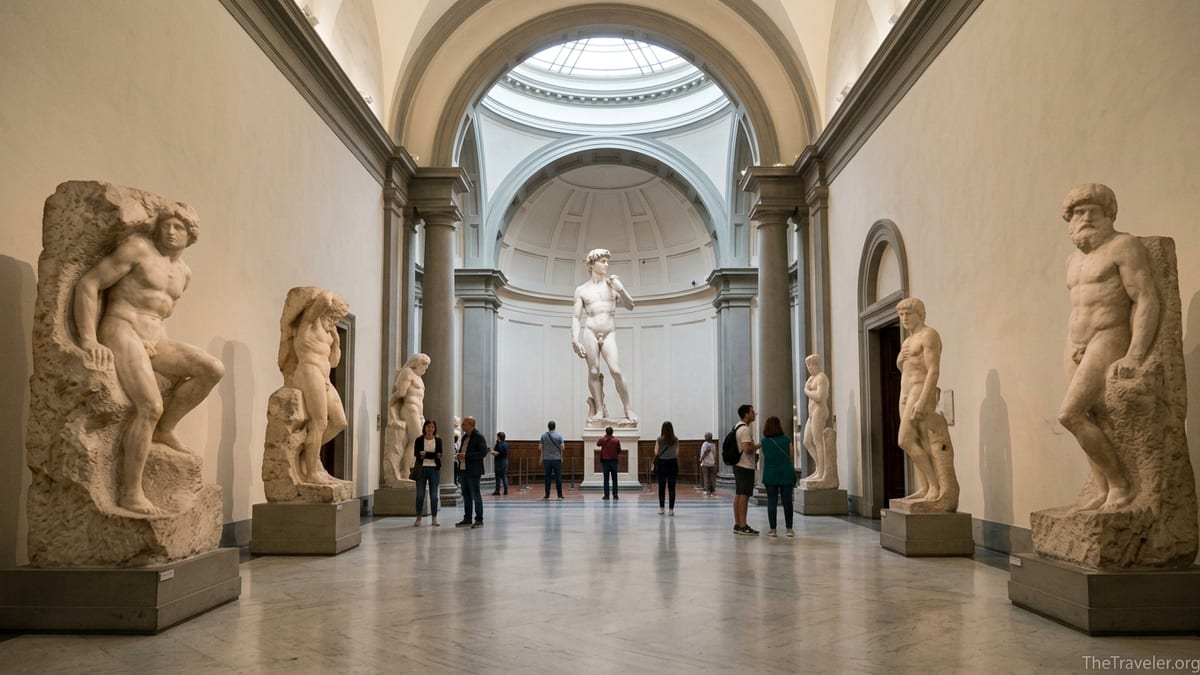
The most revealing works in the Accademia are not David or the famous musical instruments, but the four unfinished statues lining the corridor that leads to the Tribuna. These “Prisoners” or “Slaves” were carved by Michelangelo for a never‑completed project for Pope Julius II and show human figures half‑emerging from rough marble. Many visitors, lured by the light around David at the far end, hurry straight past them.
Stop halfway down the hall and look back. You will see torsos twisted against stone, a leg pushing out while the rest of the body remains trapped. Chisel marks gouge deep channels in the untouched areas; surfaces shift abruptly from rough quarry texture to smooth skin. Art historians often describe these figures as metaphors for the soul struggling to free itself from the body, but they are also practical evidence of Michelangelo’s carving method: he visualized the form as already present and “freed” it by subtracting everything that did not belong.
In practical terms, the Prisoners are your best guide to understanding what David once looked like. Imagine the giant figure halfway done, head emerging while the legs remain locked in a pillar of stone. The Accademia’s own labels explain that these works reveal his preference for carving directly into marble rather than relying heavily on clay models. For a traveler, the key is to give these works their own ten or fifteen minutes before you turn fully toward David. If you arrive early in the morning or during a quieter late‑afternoon window, you may find yourself almost alone in this corridor, with sunlight slanting in from high windows and emphasizing the contrast between raw rock and polished anatomy.
A useful strategy is to walk up the right side of the hall, pausing at each Prisoner, then circle around David and return along the left side. You will notice different details with the change in direction and distance: drill holes near a trapped shoulder, or the way the muscles of a struggling thigh anticipate the tension in David’s standing leg. Most visitors only walk this corridor once, and only in one direction.
Light, Space, and Where You Stand Matter
Online photos flatten David into a neutral white shape. Inside the Accademia, the experience depends heavily on light and where you choose to stand. The Tribuna was redesigned in the 19th century with a high circular skylight, angled to bathe the statue in natural light. On clear mornings, especially in spring and autumn, sunlight pours in at just the right angle to pick out the veins on the hands, the texture of the hair, and the subtle modeling around the eyes. On overcast winter afternoons, the marble looks cooler and more introspective.
Most tour groups congregate in the center of the room, directly in front of the statue, held there by guides who need to be heard. For a richer view, try three specific positions. First, stand near the entrance of the Tribuna and look along the axis of the hall: the diminishing row of unfinished Prisoners frames David as an endpoint, linking his polished grandeur to their rough struggle. Second, move to his left side, near the ropes, and look up past the curve of the back and shoulder; from here, the contrapposto pose and the twist of the torso reveal themselves much more clearly than from the front. Third, if the room is not too crowded, step back toward the opposite wall directly under the skylight and observe how the shadow of the nose and chin change as clouds pass overhead.
Practical planning makes these subtleties easier to catch. As of 2026, timed tickets for the Accademia typically cost only a few euros more than standard entry but save you from long exterior lines that can stretch to an hour or more in summer. Aim for the first or last slots of the day on a weekday; Saturdays between 10 am and 2 pm are reliably the most crowded. Travelers who visit Florence in October or early November often report that a late‑afternoon visit gives them enough space to see the statue from multiple angles without constant shuffling.
Flaws, Cracks, and Controversies in the Marble
From across the room, David looks perfectly preserved. Up close, the marble tells a more complicated story. The stone itself contains natural veins, small lines of slightly different color or texture running through the torso and legs. In some places they are almost invisible; in others, such as the left leg, careful observers can trace faint fractures and repairs made over the centuries.
Weathering during the statue’s years in Piazza della Signoria left small pockmarks and surface losses, especially on the back and lower legs. When David was moved indoors in the 19th century, restorers cleaned and patched these areas, but traces remain if you know where to look. More recently, debates over how aggressively to clean the surface have made headlines in Italy. In the 1990s and early 2000s, tests and conservation campaigns sparked public arguments over whether water‑based or dry methods were safer, and how much patina should be removed. The result is a surface that looks pristine in photos but, in person, reveals subtle differences in texture and color between original marble and later interventions.
For travelers, noticing these flaws adds a layer of realism. Stand near the base and scan upward along the left calf and knee. You may see faint hairline cracks and small support pins, a reminder that this is a five‑hundred‑year‑old object that has survived lightning strikes, a broken arm from a thrown bench during a 16th‑century riot, and centuries of urban pollution. Knowing that the statue is vulnerable helps explain why tripods, flash photography, and touching the base are prohibited, and why climate control and vibration monitoring in the Tribuna are taken so seriously.
If your schedule allows, pair your Accademia visit with a stop at the Opera del Duomo Museum, a ten‑minute walk away. There you can see other large marble sculptures that once stood on the cathedral façade. Their weathered surfaces and missing details offer a useful visual comparison: you understand instantly why Florence decided to protect David indoors and display copies in the open air instead.
Seeing David in the Context of the Whole Museum
One of the most common mistakes visitors make is treating the Accademia as a single‑object stop: rush in, photograph David, rush out. That habit means many travelers miss the chance to understand what made this sculpture different in its own time. The museum holds earlier and later works that show how radical Michelangelo’s choices were.
In nearby rooms you will find altarpieces and panel paintings by artists such as Botticelli and Filippino Lippi, where David often appears clothed, crowned, or surrounded by narrative details. Comparing these images to Michelangelo’s bare, self‑contained nude shows just how far he stripped the story down. The gallery of plaster casts, the Gipsoteca, offers another useful contrast: rows of 19th‑century academic sculptures, carefully modeled and idealized, surround you. After walking through that room, returning mentally to David’s coiled tension and imperfect marble feels like leaving a textbook diagram and meeting a real person.
The Accademia is compact; most visitors spend less than ninety minutes inside. To see beyond David, plan an extra half hour and make small, deliberate choices. For example, after your time in the Tribuna, head to the Museum of Musical Instruments housed in the same complex, where you can see early string instruments and one of the oldest surviving pianos associated with Bartolomeo Cristofori. The craftsmanship and tactile detail echo what you have just observed in marble, and the instruments’ polished wood in low light forms a quiet visual counterpoint to the bright white statue.
By widening your focus to the whole museum, you also avoid the dense bottleneck that forms around the entrance and exit of the Tribuna. Many travelers report that when they consciously slow down in the lesser‑known rooms, the memory of David lingers more strongly, framed by the art and craft that surrounded him across centuries.
The Takeaway
Michelangelo’s David is not just a big statue in a famous museum. It is the story of a flawed block of marble turned into a civic symbol, of carefully distorted proportions designed for a lost viewpoint, of a psychological pause before violence, and of a sculptor’s hand revealed in unfinished works nearby. Most visitors leave with a memory of size. With a bit of context and a slower pace, you can leave with a memory of decisions: where Michelangelo chose to exaggerate, where he accepted the stone’s limits, where centuries of weather and restoration left their marks.
On a practical level, that means booking a timed ticket, aiming for early morning or late afternoon, and reserving at least an hour not only for the Tribuna but also for the Prisoners, the painting galleries, and the instruments. On an emotional level, it means standing close enough to see the veins in the right hand, walking far enough around to notice the statue’s surprising flatness in profile, and pausing long enough in front of those half‑emerged Prisoners to feel how raw marble becomes living form. In doing so, you will join the smaller group of travelers who leave Florence having truly seen David, not just his silhouette.
FAQ
Q1. Is Michelangelo’s David really worth visiting if I have limited time in Florence?
Yes. Even with only one full day in Florence, many travelers rank David among their most powerful experiences. With a pre‑booked timed ticket, you can see the statue and the surrounding highlights in about 60 to 90 minutes. If your schedule is very tight, aim for an early morning or late‑afternoon slot so you spend more time with the sculpture and less time in line.
Q2. What is the best time of day to see David with fewer crowds?
The quietest times are usually the first entry of the day and the last hour before closing on weekdays. In high season, mid‑morning to early afternoon sees the densest tour‑group traffic. If you can choose, book an 8:15 or 8:30 am slot or an evening visit after 5 pm. In shoulder seasons like October, a late‑afternoon visit often offers calmer rooms and more space to move around the statue.
Q3. Do I need to book Accademia tickets in advance?
Advance booking is strongly recommended, especially from spring through early autumn. Same‑day tickets are sometimes available, but queues can stretch to an hour or more and walk‑up capacity is limited. Official timed tickets cost only slightly more than standard entry and let you bypass the exterior ticket line, going straight to security at your chosen time.
Q4. How much time should I plan inside the Accademia Gallery?
Most visitors spend 60 to 90 minutes in the museum. If you only want to see David and the Prisoners, an hour is enough at a relaxed pace. To also explore the painting galleries, the Gipsoteca with its plaster casts, and the Museum of Musical Instruments, plan for about two hours. Booking a time earlier or later in the day helps you use that time more calmly.
Q5. Can I see a version of David without entering the Accademia?
Yes. A full‑size marble copy stands outside Palazzo Vecchio on Piazza della Signoria, in David’s original public location, and a bronze David overlooks the city from Piazzale Michelangelo. These copies let you experience the statue in an outdoor urban setting, but they lack the fine surface detail, subtle veins, and historical scars of the original marble in the Accademia.
Q6. Why do David’s head and hands look too big in person?
The head and hands are intentionally enlarged because the statue was designed to be viewed from far below, possibly on a high cathedral buttress or an elevated outdoor position. From that vantage point, the distortions would compensate for extreme foreshortening and make the key features more legible. Seen at today’s closer indoor distance, those adjustments are more noticeable, especially in the right hand.
Q7. What are the unfinished “Prisoners” and why are they important?
The Prisoners, or Slaves, are four unfinished marble figures lining the corridor leading to David. They show human bodies struggling to emerge from rough stone and reveal Michelangelo’s working process better than any polished statue can. Spending time with them before or after viewing David helps you understand how he carved and how radically he transformed a damaged block into a finished masterpiece.
Q8. Are photos allowed inside the Accademia Gallery?
As of recent visitor regulations, non‑flash photography for personal use is generally permitted, but tripods, selfie sticks, and flash are not. Rules can change, so check posted signs at the entrance and follow staff instructions. Even when photography is allowed, taking a few thoughtful photos and then putting your phone away will help you notice more of the sculpture’s subtleties.
Q9. What should I look for if I want to see the statue’s flaws and restorations?
Stand close to the base and scan upward along the legs, especially the left one, to spot faint veins and hairline cracks in the marble. Look for tiny differences in color and surface texture around older repairs and on areas that faced the weather when the statue stood outdoors. These details, along with small pockmarks and tool traces, remind you that David is a centuries‑old object that has survived damage, conservation, and changing attitudes toward restoration.
Q10. How can I combine a visit to David with other art sites in Florence?
The Accademia is within walking distance of the Florence Cathedral complex and the Opera del Duomo Museum, where you can see other large façade sculptures that contextualize David. Many travelers pair a morning at the Accademia with an afternoon at the Uffizi Gallery or a stroll through Piazza della Signoria to see the outdoor copy of David. Building your day around these connected sites helps you understand how the statue fit into Florence’s broader artistic and civic life.