


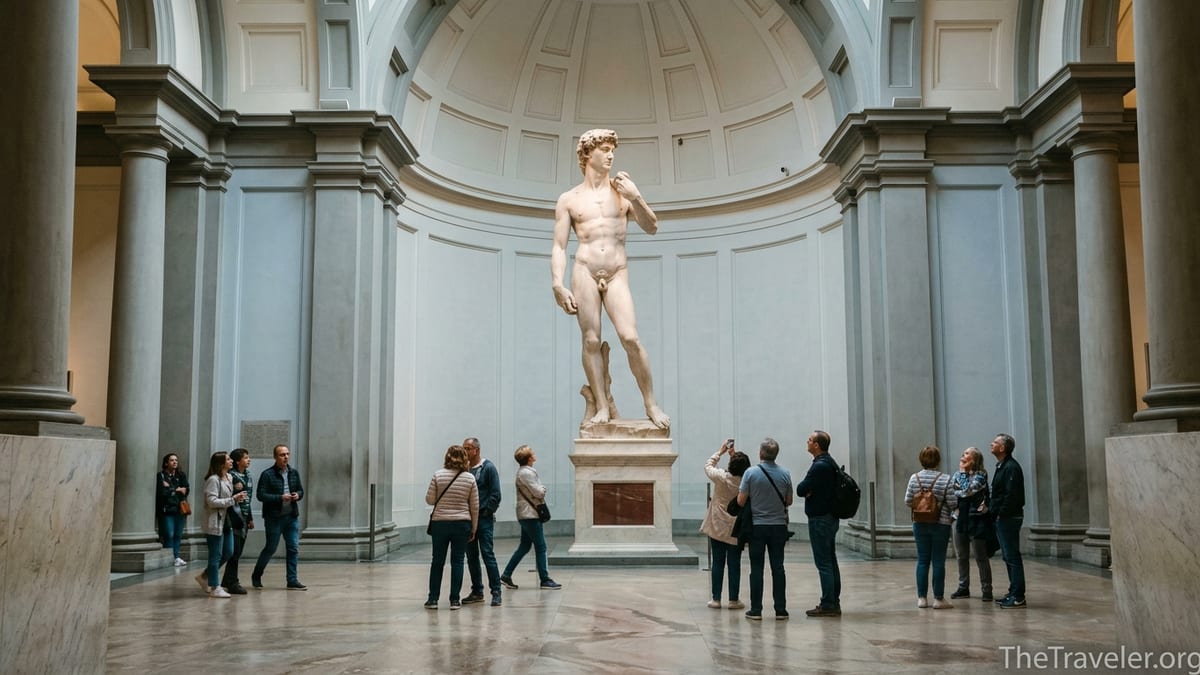
Seeing Michelangelo’s David in person is one of Europe’s great travel moments. It is also one of Florence’s most crowded experiences, with thousands of visitors funneling each day into the relatively compact Galleria dell’Accademia to stand beneath the 5.17‑meter marble giant. With a bit of timing strategy though, you can dramatically reduce the crush around you, enjoy better light on the statue, and linger long enough to appreciate the details that most rushed tour groups miss.
Get the latest updates straight to your inbox!
Why Timing Matters So Much at the Accademia
The Galleria dell’Accademia is not a vast museum like the Louvre. Its main draw is Michelangelo’s David, and most visitors cluster in the central Tribuna where the statue stands under a skylight. On busy days, visitor numbers can reach several thousand, and even with timed tickets you may find several layers of people around the pedestal at peak hours. Because the space is compact, a difference of just a few dozen people feels significant.
Officially, the Accademia is open from Tuesday to Sunday, 8:15 to 18:50, with last admission around 18:20 according to current Florence tourism and museum schedules. Special evening openings are sometimes added on select dates, such as Tuesday late openings in summer or one-off cultural nights, but these are exceptions, not the rule. Planning around the regular daytime schedule will already put you ahead of most visitors who only look at the date, not the hour.
Daily crowd patterns are predictable. Lines are relatively short at opening, then surge from about 9:30 into the late morning as tour buses and group visits arrive. Numbers stay high through the early afternoon and begin to ease from mid to late afternoon, especially outside peak summer months. On popular online ticket platforms, the earliest and latest time slots are typically the first to sell out for this reason.
Since nearly 2 million people now visit the Accademia each year, the difference between a peak August midday slot and a January weekday morning can feel like two different museums. The good news is that with timed entry, careful slot selection, and a few on-the-ground tactics, you can tilt the odds strongly in favor of a calmer, more contemplative encounter with David.
Best Times of Day for Smaller Crowds and Better Viewing
If your priority is space around the statue, two windows consistently offer the best balance: the first 60–90 minutes after opening, and the final 60–90 minutes before closing. On a normal Tuesday, for example, a ticket for 8:15 or 8:30 often means you are among the day’s first visitors. Many organized tours do not start until 9:00 or 9:30, and late-rising tourists tend to arrive even later, so the gallery fills gradually behind you.
At the other end of the day, entering around 17:00 to 17:30 can also be excellent. Some visitors report waits of just 10–15 minutes for security around 17:00, even in late spring, compared with 60 minutes or more for walk-up lines in the late morning. Many tour groups have finished by then, and day-trippers with evening trains are already heading out of Florence. Inside, you will still encounter people, but the press around David is noticeably thinner and more fluid.
From a viewing perspective, these times also offer nicer light. The Tribuna’s overhead skylight brings in bright, somewhat harsh midday light in summer, which can flatten details and raise the ambient temperature. In the softer morning and late-afternoon light, the modeling on David’s torso, the veins in his hands, and the subtle chisel marks on his legs are easier to read and photograph without aggressive glare. Photographers often favor the early slot in spring and autumn for this reason.
One practical example: a traveler visiting on a Saturday in May booked a 9:45 ticket after reading that mornings are less busy. On arrival they still found thick crowds. By contrast, another visitor on the same weekend with a 13:30 slot reported a relatively quick entry because so many people were at lunch. The lesson is that within broad patterns, micro-timing matters. Aim decisively for the first slot of the day or the late afternoon period, and if you cannot, consider a slightly off-peak time like 13:15–14:15 when some people are eating rather than lining up.
Choosing the Right Season and Day of the Week
Season is the second major factor in your experience. High season in Florence traditionally runs from roughly April through October, with a sharp peak from June to early September. During these months, both the Accademia and Uffizi sit at or near capacity most days, and timed entries for popular morning slots can sell out several weeks in advance. A 10:30 ticket on a Saturday in July is almost guaranteed to come with dense crowds around David, regardless of your finesse.
Shoulder seasons, particularly November, early December, late January, February, and early March, deliver a very different feel. The weather can be cool and damp, but the museum is far less saturated. Anecdotal reports from visitors in February and early March describe walking straight in near opening time with a pre-booked ticket, and at times having enough space around the statue to make a full slow circuit without bumping shoulders. Prices for accommodation in Florence also tend to be lower, which can free up budget for timed tickets or a guided tour.
Within any season, weekdays are noticeably calmer than weekends. Tuesday and Wednesday mornings are often among the quietest, especially outside summer. Local tourism offices and tour operators commonly recommend avoiding Saturday mornings when regional day-trippers and weekend city-break visitors all converge. If your schedule has flexibility, pairing a midweek visit to the Accademia with weekend time in less pressured attractions like the Oltrarno neighborhoods can smooth out your overall Florence experience.
Public holidays add a final variable. On Italian holidays such as April 25 or May 1, government museums, including the Accademia, sometimes offer free entry special days. Those events attract heavy local turnout and lines can snake far down Via Ricasoli. On such dates, early morning remains your best chance at relative calm, but you should expect far more company than on a normal paid weekday, and book any mandatory timed slot as soon as bookings open.
Tickets, Timed Entry and How to Use the Lines to Your Advantage
The Accademia relies on timed-entry tickets to control flow. You choose a 15- or 30-minute entry window, arrive a little before your time, pass security, and then explore at your own pace. Same-day walk-up tickets are possible at quieter times of year, but in high season the walk-up line can stretch to 60–120 minutes while timed-ticket holders pass through a separate, much faster line. Several Florence tourism guides and booking platforms note that, for most visitors, a standard timed ticket is enough to avoid the worst queues.
Outside the entrance you will see separate access points usually marked by colors or categories: a lane for timed-entry / skip-the-line tickets, another for groups and guided tours, and a general line for on-the-spot purchases. To minimize waiting, buy an official timed-entry ticket in advance, print it or keep the QR code ready on your phone, and follow the signage for reserved entry. In practice, people with pre-booked tickets often clear the entrance within 15–20 minutes, even when the general ticket line stretches down the block.
Third-party vendors such as global ticket platforms and local tour agencies also sell entry and tours to the Accademia. These can be convenient when the official website shows limited availability, but they often add service fees of 20–30 percent or bundle the ticket with guiding. It is worth comparing prices. For example, a basic timed ticket from an official channel might cost roughly the standard museum price plus a small booking fee, while a “skip-the-line tour” on a private platform might be double that because it includes a 60–90 minute guided visit. For many travelers focused on David, the extra guiding is worthwhile, but for budget-conscious visitors, an official timed-entry ticket alone is usually sufficient.
Whichever ticket source you choose, always read the fine print. Some third-party products require you to meet a representative near the museum 15–20 minutes before your slot to exchange a voucher for a physical ticket. That adds extra waiting and can be frustrating in high heat. If your aim is smaller crowds and a smooth entry, prioritize products that send you the actual timed-entry ticket in advance and allow you to go directly to the reserved entrance line.
On-the-Ground Strategies for a Calmer David Experience
Timing and tickets get you through the door, but what you do once inside also shapes your experience. Most visitors head straight down the central corridor toward David, stopping briefly at the unfinished “Prisoners” sculptures and then clustering at the front of the statue. To avoid joining the tightest circle immediately, take five minutes for a first slow pass around the hall. This gives you an overview of the space and lets tour groups shift. Then, when a gap opens up near one side of the pedestal, step in for close-up viewing.
One effective tactic is to let your visit breathe. Even in a busy time slot, crowd density in front of David ebbs and flows in 5–10 minute waves as groups arrive and depart. Spend your first 20–30 minutes exploring nearby rooms: the Hall of the Colossus with its plaster models, or the musical instruments collection. Then return to David toward the latter part of your visit. Several travelers report that their calmest moments with the statue came not at the start, but during a second viewing when many tour groups had already left the room.
Consider your physical comfort too. In summer, Florence frequently climbs above 30 degrees Celsius in the afternoon, and even an air-conditioned gallery can feel stuffy when full. An 8:15 or 17:15 visit lets you dodge the worst heat outside and reduces fatigue that makes crowds feel more oppressive. Dress lightly, carry a small bottle of water for before or after your visit, and factor in a quiet coffee or gelato stop nearby once you leave rather than rushing to another crowded sight immediately.
If photography is important to you, accept that there will almost always be some people in your shots. Instead of waiting for an empty frame, focus on close details and angles that naturally exclude the crowd. For example, step closer to frame David’s hands and torso against the dome of the Tribuna, use a moderate focal length (around 50 mm equivalent) to compress the background a bit, and wait for a moment when faces are turned away. The aim is not isolation but a sense of calm focus amid a living museum environment.
Pairing David With the Rest of Your Florence Day
For many travelers, seeing David is part of a packed Florence itinerary that may also include the Uffizi, the Duomo complex, and Ponte Vecchio all in one day. How you position your Accademia visit within this schedule affects crowd levels. One common and effective pattern is to book the Accademia for an early morning slot, say 8:15 or 8:30, spend about 60–90 minutes inside, then walk 15–20 minutes through the historic center to the Duomo or Uffizi by late morning.
Another workable strategy is the opposite: dedicate the cooler early morning to the Uffizi, where crowds grow very thick by late morning, then place the Accademia at 17:00 or 17:30. For example, you might enter the Uffizi at 8:15 for a focused three-hour highlights visit, have a leisurely lunch and rest in mid-afternoon, and then approach the Accademia when the main heat and queuing intensity of the day has passed. This structure divides your heavy museum time into two manageable blocks rather than one exhausting stretch.
If you are in Florence for several days, you can go further and design a low-crowd museum day around midweek slots. Book David at 8:15 on a Wednesday in March, for instance, and leave the rest of that day for wandering quieter Oltrarno streets, artisan workshops around Via Santo Spirito, or the Boboli Gardens. By contrast, save your Saturday for outdoor sights and neighborhoods where crowds are dispersed rather than concentrated in a single gallery.
Families with children or travelers sensitive to noise often find that combining a calm David visit with a relaxed, low-agenda day works best. Instead of stacking three major indoor sights, pair the Accademia with a picnic in the Cascine Park or a late morning exploring Mercato Centrale’s food stalls. The goal is to let the memory of David stand out, not blur together with a day of standing in lines.
Practical Booking Tips: How Far Ahead and What to Watch For
Booking windows and availability fluctuate, but a few general rules hold. For peak months like June, July, and September, plan to buy your Accademia timed-entry ticket at least two to four weeks before your visit if you want prime early morning or late afternoon slots, especially on Fridays and Saturdays. In shoulder season, a week or even a few days ahead may be enough, while in January or February you might find same-week availability for most time slots except perhaps the very first of the day.
Prices also vary slightly by season and vendor. Official tickets tend to be the most economical, with a base museum price plus a modest reservation fee. Third-party resellers sometimes wrap this into a higher but simpler “skip-the-line” product that may cost the equivalent of an extra cafe lunch or more per person. Before committing to a more expensive option, check whether the official channels still offer slots at your preferred time. For a couple or a family of four, the savings can cover an entire evening’s aperitivo in a neighborhood bar.
When aligning bookings for multiple Florence sights, leave generous buffers. If you plan to see the Uffizi and Accademia on the same day, do not book back-to-back entry times such as 8:15 at the Uffizi and 8:15 at the Accademia, as some travelers have mistakenly done. Instead, aim for spacing that accounts for security checks, walking time, and breaks: for example, an 8:15 Uffizi entry followed by a 14:00 Accademia slot, or an 8:15 Accademia followed by an 11:30 Duomo museum visit.
Finally, keep an eye out for special evening openings announced by the Italian Ministry of Culture or local tourism offices. In recent years, the Accademia has occasionally opened on Monday holidays or extended some Tuesday evenings in summer to 22:00. These events are popular but can still feel calmer than a standard August midday session, and the atmosphere of seeing David under evening light is distinctive. If your travel dates overlap one of these rare openings, consider adjusting your itinerary to take advantage.
The Takeaway
Seeing Michelangelo’s David will never be a private experience, but it does not have to be a stressful one. The same statue, viewed at 10:30 on an August Saturday in a solid ring of smartphones, feels very different at 8:20 on a Wednesday in March with just a modest crowd around you. By paying attention to three variables – season, day of the week, and, above all, time of day – you can stack the odds strongly in your favor.
In practice, the sweet spots are clear. Aim for early morning or late afternoon entry, favor midweek over weekends wherever possible, and, if you have the flexibility, consider shoulder or off-season travel to Florence. Secure an official timed-entry ticket, use the reserved line correctly, and give yourself enough time inside to step away from the initial crush and then return to David for a quieter second look.
Rather than treating David as just another checkbox on a fast-paced Florence checklist, build your day around giving the statue space. The reward is not only better photographs but a deeper appreciation of Michelangelo’s craft: the tension in the twisted torso, the concentration in the furrowed brow, the astonishing sense of living flesh carved from a single flawed block of marble five centuries ago. With thoughtful timing, you will remember not the crowd, but the sculpture.
FAQ
Q1. What is the single best time of day to see Michelangelo’s David with fewer crowds?
The most consistently quiet time is usually the first entry slot of the day, around 8:15 to 8:30, especially on a weekday outside peak summer.
Q2. How far in advance should I book Accademia tickets in high season?
For June through early September, aim to book two to four weeks ahead if you want prime morning or late afternoon slots, and at least one week ahead for any time on weekends.
Q3. Are late afternoon visits really less crowded than midday?
Yes, in most seasons crowd levels ease after about 17:00, when many tour groups have finished and day-trippers are leaving, making the final 60–90 minutes calmer than late morning.
Q4. Which days of the week are best for a quieter visit?
Tuesday, Wednesday, and sometimes Thursday tend to be the calmest, while Fridays and Saturdays are busier. Mondays are usually closed except for rare special openings.
Q5. Is it worth paying extra for a skip-the-line or guided tour ticket?
A standard timed-entry ticket already skips the main purchase line. Paying extra is mainly worthwhile if you value the commentary of a guide or if your preferred time is sold out on official channels.
Q6. Can I see David without booking in advance?
In low season you may sometimes buy same-day tickets at the museum, but expect possible waits. In spring and summer, advance timed booking is strongly recommended to avoid long walk-up lines or sold-out days.
Q7. How long should I plan to spend inside the Accademia?
Most visitors spend 60 to 90 minutes, enough for David, the Prisoners, and a walk through the galleries. Serious art enthusiasts may want two hours to move slowly and revisit the statue.
Q8. What if my timed-entry ticket is for a very busy hour?
Use on-the-ground tactics: enter promptly, visit nearby rooms first, then return to David after 20–30 minutes when tour groups thin, and look for openings along the sides rather than the front only.
Q9. Are special evening openings a good way to avoid crowds?
Occasional evening or holiday openings can feel slightly calmer than peak midday, and the atmosphere is memorable, but they still draw interest. If available, they are a good option, just not guaranteed to be empty.
Q10. Can I combine the Accademia and Uffizi on the same day without feeling rushed?
Yes, if you space your entries. For example, book one museum at 8:15 and the other around mid-afternoon or 17:00, with a long lunch and rest in between to avoid museum fatigue and crowd overload.