


On a coast lined with starry names like Nice, Cannes and Saint‑Tropez, Cap d’Antibes can seem almost shy. The pine‑covered peninsula between Antibes and Juan‑les‑Pins has no neon marina, no mega‑promenade, and only one true trophy hotel. Yet this small headland has quietly shaped the mythology of the French Riviera for more than a century, and still offers a very different experience from the busy seaside resorts around it.
Get the latest updates straight to your inbox!
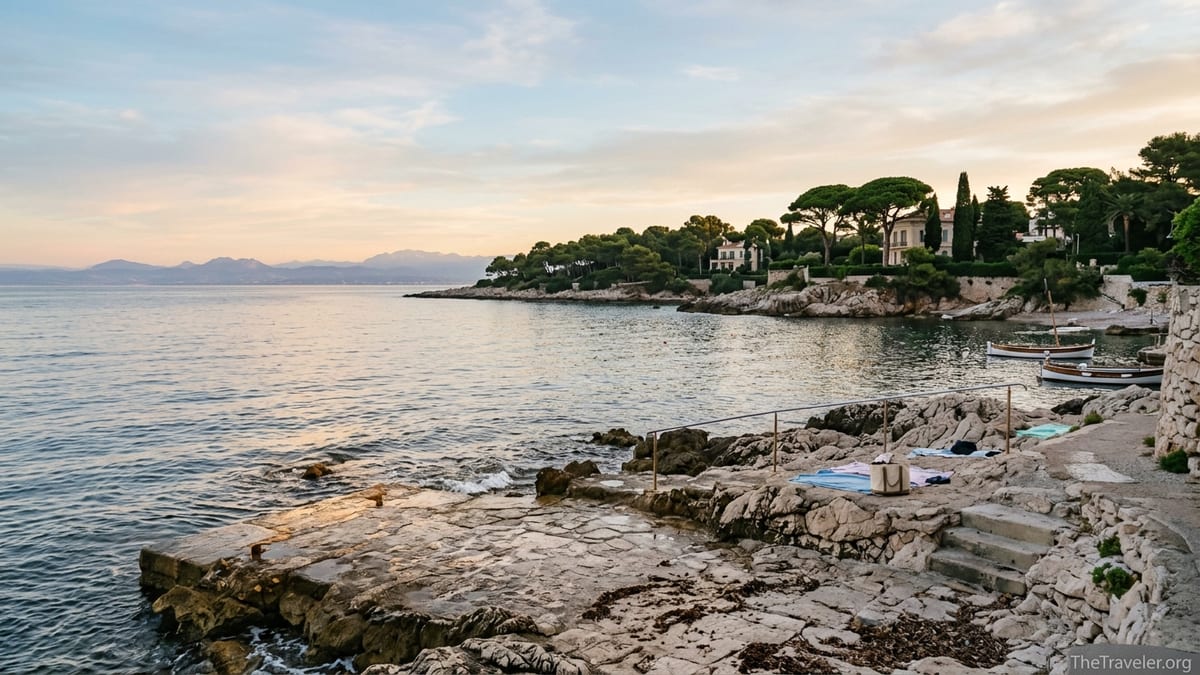
A Peninsula, Not a Resort Town
Most French Riviera escapes are compact resort towns, built around a waterfront promenade, casino or yacht marina. Cap d’Antibes is a peninsula, a rocky finger of land that juts into the Mediterranean between the old port of Antibes and the beaches of Juan‑les‑Pins. There is no single “center” here. Instead, a ring road and a lattice of narrow lanes loop past walled gardens, pine groves and secluded coves. You are never far from the sea, but you are rarely right on top of the crowds.
This geography shapes your stay in a practical way. In Nice, you might spend most of your time on the Promenade des Anglais; in Cannes, the Croisette naturally pulls you back to its boutiques and beach clubs. On Cap d’Antibes you build your days around little pockets: breakfast in Antibes’ old town market, a late‑morning swim at Plage de la Garoupe, an afternoon walk on the Sentier du Littoral coastal path, sunset aperitif in Juan‑les‑Pins. Each is a short drive, bus ride or taxi away, but when you return to the peninsula it feels like slipping back into a quieter world.
Because there is no dense hotel strip, night‑time on the cap is notably calmer than in the big resorts. Aside from a cluster of restaurants near La Garoupe and a few hotel bars, the peninsula is mostly residential after dark. Travelers who like to sleep with balcony doors open or stroll under pine trees instead of nightclub neon often find Cap d’Antibes a relief after a day trip to busier neighbors.
At the same time, the peninsula is not remote. From the main road that crosses its base, local buses shuttle to Antibes and Juan‑les‑Pins, and in summer ferries link the nearby harbors with Cannes and the Lérins Islands. That mix of seclusion and easy access is one of the first things that sets Cap d’Antibes apart.
Wild Coastline and the Sentier du Littoral
Visitors are often surprised by how wild parts of Cap d’Antibes still feel. While Nice and Cannes front mostly on broad, managed beaches, much of this peninsula is ringed by low cliffs and rocky inlets. The best way to experience it is on the Sentier du Littoral, also known locally as the Tire‑Poil coastal path, a stone footpath that wraps around the southern tip of the cap between Plage de la Garoupe and the gardens of Villa Eilenroc.
The trail, roughly 2.5 to 3 kilometers in its most popular section, was established under France’s coastal access law to guarantee public passage along the shore, even below the gardens of grand villas. In practical terms, this means you walk within meters of the sea, with waves sometimes sending spray over the path in windy weather. Steps and handrails hug the rocks, and occasional narrow sections require decent footwear, but in dry conditions the walk is straightforward for most reasonably fit travelers.
Along the way, you find tiny concrete ladders set into the rocks for swimmers, clear pools where locals snorkel over posidonia seagrass, and viewpoints back toward the snow‑tipped Alps on crisp spring days. There are no snack kiosks or loungers here; you carry your own water, maybe a sandwich from a bakery in Antibes, and choose a flat rock for a picnic. That absence of infrastructure is deliberate and is part of what makes the path feel almost secret compared with heavily serviced promenades in other coastal towns.
Because sections of the trail can be closed in stormy weather, it is worth checking conditions locally before setting out, especially in autumn and winter. In summer, starting early gives you shade from the cliffs and a better chance of having certain coves to yourself. Unlike many Riviera walks, you will often share the path less with tour groups and more with local joggers or families who have been using it for decades.
Beaches: From Discreet Luxury to Simple Towel‑on‑Sand
Cap d’Antibes has fewer beaches than neighboring resorts, but the ones it does have show the peninsula’s character in miniature. Plage de la Garoupe, on the east side, is the best known. In high season much of its soft sand is occupied by private beach clubs such as Plage Keller and its restaurant Le César, where a front‑row sun lounger with mattress and parasol can cost the price of a good bistro lunch in Antibes. Service runs to chilled rosé delivered to your chair and grilled fish at white‑clothed tables overlooking the bay.
Yet at the northern end of the same cove, a public strip of sand offers access to the exact same turquoise water for the cost of a beach towel. Facilities are basic, usually limited to seasonal lifeguards, showers and toilets, and you bring your own parasol. This side fills quickly in July and August, so locals arrive before 9 in the morning to claim a spot, then cool off every half hour with slow swims around the buoys. This contrast of high‑touch beach club and simple public patch just a few meters apart is typical of Cap d’Antibes: exclusivity sits alongside everyday Riviera life rather than being completely sealed off.
Elsewhere on the peninsula, smaller beaches are tucked among villas. Plage des Ondes, a west‑facing crescent below a small stone tower, is popular with families from Antibes for its gentle slope and views across to the Esterel hills. The tiny Port de l’Olivette, just around the coast, is a picturesque harbor of traditional wooden pointu fishing boats. There is no formal beach club here, just local kids jumping from the sea wall and paddleboarders gliding out at sunset. Travelers used to long, continuous strands of sand like those in Cannes may find these coves small, but their intimacy and lack of large developments are part of the peninsula’s charm.
Because the shoreline is so indented, water quality can be excellent on calm days, and snorkelers often report seeing bream, wrasse and sea urchins just a few strokes from shore. Sturdy water shoes make it easier to get in and out on rockier sections, especially on the coastal path where concrete ladders lead straight into deep water. For visitors who like to split time between classic sandy beaches and more natural rocky swimming spots, Cap d’Antibes offers both without long transfers.
Hotel du Cap‑Eden‑Roc and the Legacy of Riviera Glamour
No place defines the aura of Cap d’Antibes quite like Hôtel du Cap‑Eden‑Roc, the legendary seaside hotel at the peninsula’s tip. Originally opened in 1870 as Villa Soleil, a writers’ retreat created by the founder of the newspaper Le Figaro, it evolved in the early 20th century into a seasonal hotel with its own seawater pool carved into the rocks and a pavilion perched above the sea. Over the decades it became a discreet playground for film stars, artists and politicians, especially during the Cannes Film Festival each May.
Part of its allure is that, unlike many famous Riviera addresses, Eden‑Roc has remained seasonal and relatively small in capacity. Set within roughly 20 acres of pine gardens, with a single gated drive leading to a pale Napoleon III villa, it feels more like a vast private estate than a standard luxury resort. Guests still arrive to a long, tree‑lined allée, and most public areas look out to open sea rather than to a town or marina. The hotel’s iconic saltwater pool and diving boards, captured in mid‑century photographs, are still in use today, with synchronized swimmers occasionally performing during private events.
For non‑guests, access is intentionally limited. In high season, lunch on the terrace or a drink at the Eden‑Roc bar often requires advance reservations and comes with prices that reflect the hotel’s status. A poolside club sandwich can cost several times more than in central Antibes, and simple cocktails are firmly in special‑occasion territory. Many travelers will never stay here, but the hotel’s existence shapes how the whole peninsula is perceived: as a place of understated, long‑established wealth rather than showy nightlife.
Compared with other Riviera icons, such as the large palace hotels strung along the Croisette in Cannes or the Four Seasons on Cap‑Ferrat, Eden‑Roc’s setting feels more secluded. There are no busy roads in front, only rocks, pine trees and the sea. This physical separation reinforces a culture of privacy. Dress codes remain relatively strict in the main dining room, and regular guests often return at the same time each year, giving the hotel a club‑like atmosphere that is rare in more transient resort towns.
Everyday Life Behind the Villa Walls
From the outside, Cap d’Antibes can appear to be nothing but villas and high walls. Many of the peninsula’s plots were carved up in the late 19th and early 20th century for aristocratic and industrialist families who built grand properties in lush gardens. Some are still private, others have become event venues or luxury rentals. However, behind this impression of exclusivity there is a quieter, more ordinary rhythm that differentiates the cap from purely touristic enclaves.
Grocery vans make their rounds on weekday mornings, ringing bells outside side streets where residents emerge with straw market baskets. Gardeners’ trucks line the lanes, and local children walk to school buses on the roads that link the peninsula with Antibes and Juan‑les‑Pins. There are year‑round residents here, not just seasonal visitors, and that gives the place a different feel in the shoulder seasons. Visit in late September and you may find yourself sharing a café terrace with retirees discussing local roadworks, rather than with short‑stay city‑breakers planning a bar crawl.
This local presence also influences services. Instead of designer boutiques and big‑name chains, you find small bakeries and neighborhood restaurants catering to people who know each other. A simple lunch of salade niçoise and grilled sardines at a modest bistro near La Garoupe might cost only slightly more than in Antibes proper, even though the address is technically one of the most prestigious on the coast. For travelers, this means you can dip into serious luxury when you choose, but it is not forced upon you at every turn.
Property prices and summer rentals are high, and the peninsula undeniably skews affluent. Yet because zoning has kept buildings relatively low and limited large apartment complexes, the sense is less of a resort district and more of a leafy suburb stretched along the sea. Compared with the dense beachfront skylines of some Riviera towns, this feels gentler and more human in scale.
Access, Movement and a Different Sense of Pace
One of the subtle differences between Cap d’Antibes and destination towns like Saint‑Tropez or Monaco is how you move through your stay. There is very little reason to drive end‑to‑end on the peninsula multiple times a day. Most visitors choose a base and then adopt a walking or short‑hop rhythm. A couple staying in a small guesthouse near La Garoupe, for instance, might spend a full day without touching the car: morning swim, leisurely coastal walk, long lunch, afternoon reading under parasols, then a sunset stroll along Chemin de la Garoupe.
Traffic still exists, especially on sunny weekends when day‑trippers arrive from Antibes or Nice, but the absence of through‑traffic makes the roads feel calmer than the corniche highways elsewhere along the Côte d’Azur. Parking can be tight near popular beaches in high season, so many regulars time swims early or late to avoid peak hours. Buses onto the peninsula run less frequently than along the main coastal axis, which nudges visitors toward planning rather than spontaneous bar‑hopping.
This slower pace can be a revelation if you are coming from a multi‑stop Riviera itinerary heavy on checklists. Instead of racing from one notable sight to the next, days on Cap d’Antibes revolve around simple pleasures repeated often: a particular rock you like to swim from, the same shaded bench above Plage des Ondes where you watch the light change, the bakery that becomes “yours” for morning croissants. That sense of routine and familiarity is closer to how locals use the coast than to how many visitors move through it.
At the same time, the cap works well as a base for exploring the region. Antibes’ old town, with its Provençal market and Picasso Museum, lies just over the hill. Fast trains from Antibes station connect to Nice, Cannes and even inland to Grasse. For travelers who like quiet nights but easy access to day‑trip options, this balance is an important part of the peninsula’s appeal.
The Takeaway
Cap d’Antibes is not the place for those who want non‑stop nightlife, high‑rise hotels and a parade of luxury boutiques along a single, showpiece promenade. Other Riviera names serve that version of the Mediterranean better. What this peninsula offers instead is a blend that has become rare on such a famous coast: wild stretches of accessible shoreline, a single grande‑dame hotel that still shapes the region’s mythology, and pockets of real everyday life behind the walls of luxurious properties.
From the spray of the Sentier du Littoral to the clink of cutlery on the terrace at Hôtel du Cap‑Eden‑Roc, from the early‑morning quiet on the public section of Plage de la Garoupe to the sight of children fishing from Port de l’Olivette, the experiences here tend to be intimate rather than spectacular. That intimacy, combined with easy access to livelier neighbors when you want them, is what makes Cap d’Antibes feel so different from other Riviera coastal escapes and keeps devoted travelers returning year after year.
FAQ
Q1. Is Cap d’Antibes worth visiting if I am already staying in Nice or Cannes?
Yes. Cap d’Antibes makes an excellent day trip or half‑day escape from larger resorts, especially if you want a coastal walk, quieter swimming spots and a change of pace from busy promenades.
Q2. How do I get to Cap d’Antibes without a car?
The most common approach is to take a regional train to Antibes, then use local buses or taxis to reach the peninsula. In summer, many visitors also walk or cycle from Antibes or Juan‑les‑Pins, since distances are short if you are reasonably fit.
Q3. Can non‑guests visit Hôtel du Cap‑Eden‑Roc?
Access is limited, but non‑residents can sometimes book lunch, dinner or a drink at the bar, especially outside peak dates. Advance reservations are essential in high season, and there is usually a smart‑casual dress code in the main restaurant and bar areas.
Q4. Are there still public beaches on Cap d’Antibes?
Yes. While some of the most famous coves include private beach clubs, there are public sections at Plage de la Garoupe and small public beaches such as Plage des Ondes. Services are simpler than at private clubs, so bring towels, water and sun protection.
Q5. How difficult is the Sentier du Littoral coastal path?
The main section around the tip of the peninsula is short but can be uneven, with steps, rocks and occasional spray from waves. It is manageable for most active adults in good weather, but not ideal for strollers or those with reduced mobility. Sturdy shoes and a bottle of water are recommended.
Q6. When is the best time of year to visit Cap d’Antibes?
Late spring and early autumn often offer the best balance of pleasant temperatures, open services and fewer crowds. July and August are lively and hot, with busier beaches and higher prices. In winter, the peninsula is much quieter, with cooler water but beautiful clear light and fewer visitors.
Q7. Is Cap d’Antibes suitable for families with children?
Yes, particularly for families who enjoy swimming, seaside walks and quieter evenings. Sandy beaches like Plage de la Garoupe and Plage des Ondes have gently sloping shallows, but rocky areas and ladders along the coastal path require supervision and care with younger children.
Q8. How does Cap d’Antibes compare to Cap‑Ferrat or Saint‑Tropez?
Cap d’Antibes feels more low‑key than Saint‑Tropez and somewhat less manicured than Cap‑Ferrat. It combines very high‑end properties with more modest local life and is closer to a real town, thanks to its link with Antibes, which gives it a different, more lived‑in character.
Q9. Are there budget‑friendly options on Cap d’Antibes?
Accommodation on the peninsula itself tends to skew mid‑range to upscale, but staying in Antibes or Juan‑les‑Pins and visiting the cap by bus, taxi or on foot can keep costs down. Using public beaches and picnicking rather than relying on beach clubs also helps manage expenses.
Q10. Do I need a car to explore the whole peninsula?
No. While a car can be convenient for carrying beach gear or visiting multiple coves in one day, the peninsula is compact. Many visitors happily rely on walking, cycling, occasional taxis and buses, combining Cap d’Antibes time with the train connections found in nearby Antibes.