


Few museums in Barcelona feel as personal as the Picasso Museum. Spread across five medieval palaces in the Gothic Quarter, its low ceilings, stone staircases, and dense crowds can easily make a visit feel cramped and hurried. With timed tickets, free-entry windows, and more than 4,000 works connected to Picasso’s Barcelona years, it is also a place where poor planning almost guarantees a rushed experience. The good news: with a bit of strategy, you can slow everything down and turn your visit into one of the most rewarding art stops in the city.
Get the latest updates straight to your inbox!
Understand the Layout and How Much Time You Really Need
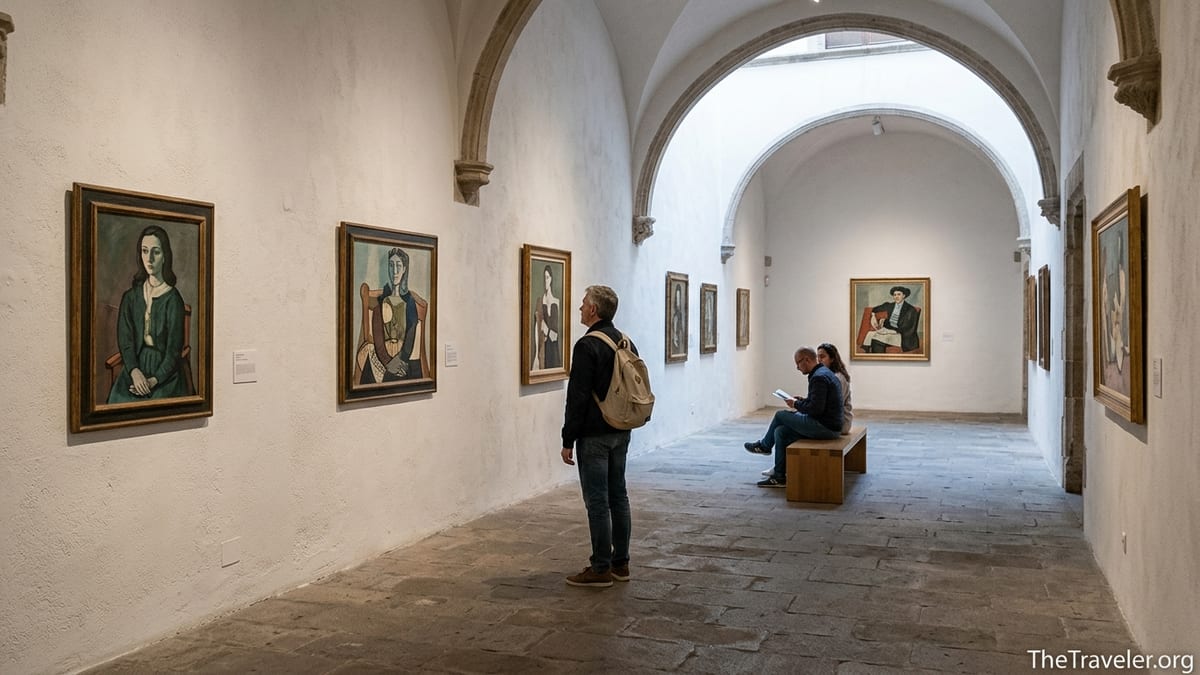
The Picasso Museum is not a single grand hall but a warren of interconnected palaces on Carrer de Montcada, each with its own staircases and small rooms. The permanent collection traces Picasso’s evolution from child prodigy to the creator of “Las Meninas” variations, alongside ceramics and temporary exhibitions on the upper levels. Moving through these spaces naturally takes longer than a single-floor gallery, and bottlenecks can form at narrow doorways and key works.
Most visitors who feel rushed underestimate how long the museum actually takes. If you are skimming, you can pass through in about 60 to 75 minutes, but you will likely leave frustrated. To feel unhurried, plan on 2 to 2.5 hours inside. That gives you time to pause with early academic paintings, compare the “Las Meninas” series, and still circle back to a favorite room without watching the clock. Add another 30 minutes for the security check, wardrobe adjustments, and a quick stop in the bookshop or inner courtyards.
Think of your visit in thirds. Aim to spend the first third slowly in the early years and Blue Period works, the middle third at the “Las Meninas” rooms and ceramics, and the final third revisiting what moved you most. This simple mental structure helps you stay present instead of anxiously wondering if you are “behind schedule” as you weave between palaces.
Before you go, look at a recent floor plan or collection overview and choose one or two themes that interest you most, such as Picasso’s relationship with Barcelona or his experiments in printmaking. Walking in with a loose focus makes it easier to ignore the urge to see everything and instead go deeper on what genuinely interests you.
Book Smart: Tickets, Time Slots, and Free Entry Windows
The single biggest factor in avoiding a rushed Picasso Museum visit is securing your time slot in advance. In 2026, standard timed tickets are generally around the mid-teens in euros for adults, with concessions for young people and seniors and free entry for small children. Online tickets function as skip-the-ticket-line passes: you still go through security, but you bypass the slower on-site purchase queue that can add 20 to 40 minutes on a busy morning.
Timed entries are usually offered from opening until early evening, with the last entry roughly 45 to 60 minutes before closing. Spring through autumn, particularly April to September and weekend days, often sell out the popular late-morning and mid-afternoon slots. If you know you prefer a slow pace, choose one of the earliest or latest entries. For example, on a Wednesday, reserving the 10:00 a.m. or final 5:00 to 6:00 p.m. slot can mean thinner crowds and more time to linger in front of key works without someone hovering behind you.
The museum also offers free entry windows, typically on Thursday afternoons and on the first Sunday of each month. These are attractive for budget travelers but come with a trade-off: demand is high, and tickets are limited, so the galleries are busier and lines form outside before the doors open for that free period. If you do choose a free slot, treat it as a shorter, targeted visit. For instance, a traveler with a 5:00 p.m. free Thursday entry might decide to focus only on the early works and the “Las Meninas” rooms, accepting that they will not see every display.
If you are planning to visit multiple museums, consider passes like the Articket BCN, which costs in the high thirties in euros and bundles Picasso with major institutions such as the Fundació Joan Miró and the Museu Nacional d’Art de Catalunya. Passholders still book a time at Picasso, but because your ticket is prearranged and already paid for, you are less tempted to squeeze too many sights into a single day and can dedicate a relaxed morning or afternoon to this one collection.
Choose the Right Time of Day to Slow Everything Down
Even with the right ticket, the time of day can make or break your experience. Visitor patterns at the Picasso Museum are fairly consistent. Late morning, from around 11:00 a.m. to 1:00 p.m., and mid-afternoon, from about 3:00 to 5:00 p.m., are the most popular times, especially in summer when cruise ship groups and city tours arrive. If you book into these windows, expect fuller rooms, more noise, and a slightly faster natural flow that can push you along before you are ready.
For a calmer visit, aim for the opening hour or the last official entry of the day. For example, arriving for a 10:00 a.m. slot on a Tuesday in January or March, you might find yourself almost alone in the first galleries, with only a handful of other visitors quietly moving between the early portraits. In contrast, a 4:00 p.m. slot on a Saturday in July can mean queuing outside on Carrer de Montcada and sharing the “Las Meninas” rooms with several small groups at once.
Early evening can be especially pleasant outside of peak season. In autumn, booking the final slot around 6:00 p.m., you might step out into a soft blue hour on Passeig del Born, having moved through the museum at a measured pace without watching your watch. Because the ticket office and entry close before the galleries, you still have enough time to see the highlights without being ushered out immediately.
When you pick your time, also think about your wider Barcelona itinerary. Pairing Picasso with other indoor attractions on the same day often leads to rushing between them. Instead, combine a morning at Picasso with an unstructured afternoon in the nearby El Born neighborhood, or visit late in the day after a slow lunch, so you are not cutting your museum time short to make another booking across town.
Guided Tours vs Self-Guided: Which Feels Less Rushed?
Several companies sell guided tours with timed, skip-the-ticket-line access to the Picasso Museum, typically priced from the low twenties in euros per person and lasting about 90 minutes inside the galleries. These can be a smart choice if you are short on context and want a clear path through the highlights. A small-group tour at 10:00 a.m., for instance, might start outside on Carrer de Montcada with an introduction to Picasso’s teenage years in Barcelona, then lead you through selected works in a logical order, ending in the “Las Meninas” rooms just as the museum begins to fill.
However, guided tours move at a set pace. If you know you like to double back or sit quietly in front of a single painting for ten minutes, you may feel hurried as the group flows on. One solution is to book a morning tour, then remain in the museum on your own afterwards if staffing allows, using the structure of the tour as your orientation and then revisiting specific rooms at your own speed. Always confirm on arrival whether you can stay post-tour; policies can vary by day and by provider.
Self-guided visits with the museum’s audio guide or a downloaded app feel more flexible. Audio guides cost a modest extra fee on top of your ticket and typically offer a core route of 45 to 60 minutes of commentary, plus optional deep dives. If you treat the guide as a menu rather than a script, you can slow down easily: listen to the tracks for the works that catch your eye and skip those that do not. For example, you might listen to the full commentary on “Science and Charity” and the early academic portraits, then turn off the device in the ceramics rooms and simply wander.
For many travelers, the least rushed experience is a hybrid: read a short article or watch a video about Picasso’s Barcelona years before your trip, arrive with a printed or digital floor plan, and then move through the museum at your own speed, pausing when a work speaks to you instead of feeling compelled to “cover” every label.
Slow Art in Practice: How to Experience the Collection
Once you are inside, resisting the impulse to hurry is largely about how you look. It is easy to snap a quick photo, glance at the wall text, and move on, especially when other visitors are doing the same. Instead, adopt a “slow art” approach and consciously decide to spend longer with fewer works. For example, in the early galleries, pick one childhood portrait and one Blue Period painting. Spend two or three minutes just looking at each: trace the brushstrokes with your eyes, notice how the light hits the subject’s face, and observe the mood in the color palette.
When you reach the “Las Meninas” rooms, where Picasso’s series reinterprets Velázquez, give yourself permission to sit or stand in one spot and compare three or four canvases in detail. Many visitors rush through this section because it is busy and they feel they are blocking the view. Step back to the far wall instead, where you can see several variations at once without standing in anyone’s way. You might notice, for example, how the placement of the dog shifts from painting to painting or how the background becomes more abstract as the series evolves.
It also helps to plan intentional pauses. Between palaces, when you step into a courtyard or along a stone staircase, take a moment to reset. Look up at the medieval arches, listen to the murmur of the crowd, and check how much time you actually have left. Often, you will find you are further ahead than you thought and can afford to slow down even more in the final rooms. If the ceramics or printmaking sections are not your main interest, allow yourself to skim them guilt-free so that you can return to a favorite period near the end.
If you are visiting with children or companions who tire quickly, agree in advance that it is acceptable to split up inside the museum. One person might want to linger in the early works while another prefers the later experiments. Setting a meeting point near the shop or main courtyard at a fixed time gives everyone space to move at their own rhythm without feeling they are dragging or being dragged.
Practical Logistics: Bags, Photos, and Energy Levels
Small practical decisions can subtly influence how rushed you feel. The museum is strict about certain items. Large backpacks, suitcases, and bulky umbrellas are generally not allowed in the galleries and must be checked, which can add several minutes if there is a line for the cloakroom. Arriving with only a small crossbody bag, phone, and wallet lets you bypass that step. If you are coming straight from the airport or train station with luggage, consider dropping bags at your accommodation or a luggage-storage service near Plaça de Catalunya before heading to the museum.
Photography rules can also shape the pace. The museum has varied its guidelines over time, but flash is typically prohibited and staff may limit photography around particularly sensitive works or temporary exhibitions. If you plan your visit around taking detailed photos, you may end up disappointed or hurried if restrictions are tighter that day. Instead, focus on absorbing the art in the moment and take a handful of wider, context shots in courtyards or corridors. A quick photo in the central courtyard, with its stone staircases and Gothic arches, captures the atmosphere without interrupting your flow in the galleries.
Energy management matters more than most travelers realize. The museum floors are stone, and lingering on them can be tiring. Wear soft-soled shoes and consider a light snack before your time slot so you are not rushing because of simple hunger or fatigue. A practical approach is to have a late breakfast or early lunch nearby on Passeig del Born, then walk the five minutes to the museum. Exiting afterwards, you can decompress with a coffee in one of the small squares rather than immediately diving back into a crowded itinerary.
Accessibility factors can also affect pacing. There are lifts and ramps, but moving between them sometimes means waiting briefly in narrower corridors. If you or a companion uses a mobility aid, factor in a bit of extra time so that these transitions do not create a sense of urgency. When you pick up or scan your ticket, you can ask staff which routes are easiest for those who prefer fewer stairs, which can make your path through the collection feel smoother and calmer.
Planning Your Day Around the Museum, Not the Other Way Around
One hidden cause of rushed museum visits in Barcelona is overambitious planning. Travelers often try to combine the Picasso Museum with Park Güell, the Sagrada Família, and a full tapas crawl all in one day. While it is technically possible, it almost guarantees that you will be checking your watch inside the galleries and leaving before you are ready. A better strategy is to treat Picasso as the anchor of a day spent mostly in the historic center and El Born.
For instance, if you book a 10:00 a.m. entry, you can arrive slightly early to clear security, then spend a relaxed two hours inside. Around noon, step out into Carrer de Montcada and wander towards Santa Maria del Mar church, stopping for a simple lunch at a neighborhood bar. In the afternoon, you might explore the narrow streets of El Born, browse small design shops, or sit in Parc de la Ciutadella. This kind of day keeps your schedule flexible and preserves the contemplative mood from the museum.
If your ticket is for late afternoon, use the morning for something low-pressure nearby, such as a stroll through the Gothic Quarter or a visit to the nearby chocolate museum, which tends to be shorter and less intense. By the time you enter Picasso in the late afternoon, you have already satisfied some of your curiosity about the old city and can give the art your full attention without worrying about another major booking afterwards.
When you map out your Barcelona stay, group indoor, timed attractions so that at least one major museum day is relatively light. This principle applies beyond Picasso: the same strategy helps at the Sagrada Família or the Miró Foundation. Designing at least one “slow culture” day ensures that you experience the city’s art not as a checklist but as a series of memories that have room to breathe.
The Takeaway
Getting the best experience at Barcelona’s Picasso Museum is less about insider secrets and more about respecting your own pace. Book a timed entry in advance, ideally at the day’s edges, and allow at least two hours to wander through the palaces. Decide ahead of time which parts of Picasso’s story interest you most, and then practice looking slowly rather than trying to see everything.
Build a gentle day around your visit instead of squeezing the museum between other tightly timed attractions, and arrive with only what you need so you are not delayed by cloakrooms or distracted by logistics. Whether you join a focused small-group tour or explore alone with an audio guide, the key is to protect patches of unhurried time in front of the works themselves.
Do that, and the Picasso Museum shifts from a crowded stop on a busy itinerary into what it was meant to be: an intimate, evolving portrait of an artist and his city, experienced at a human pace instead of a hurried one.
FAQ
Q1. How long does it really take to visit the Picasso Museum without feeling rushed?
Most visitors who want an unhurried experience should plan on about 2 to 2.5 hours inside the museum, plus extra time for entry and a brief stop in the shop or courtyard.
Q2. What is the best time of day to visit if I want fewer crowds?
The calmest experiences are usually during the first time slot after opening or the final entry of the day, especially on weekdays outside of peak summer months.
Q3. Do I really need to buy my ticket in advance?
Booking a timed ticket online in advance is strongly recommended. It lets you skip the slower on-site ticket line and reduces the risk of your preferred time slot selling out.
Q4. Are the free-entry times a good idea if I hate feeling rushed?
Free-entry windows are great for saving money but attract more visitors. If you dislike crowds, consider paying for a regular time slot where you can move more calmly.
Q5. Is a guided tour less rushed than visiting on my own?
A guided tour offers structure and context but follows a fixed pace. Independent visits allow more flexibility to linger, so the better option depends on your personal style.
Q6. How can I avoid feeling pushed through the galleries by other visitors?
Arriving at quieter times, stepping to the side of popular works, and focusing on fewer key pieces all help you resist the natural crowd flow and slow your pace.
Q7. What should I do if I only have one hour available?
If you have just an hour, concentrate on the early works and the “Las Meninas” series, and accept that this will be a highlights-only visit rather than a comprehensive one.
Q8. Are there facilities to store bags so I can move around more easily?
There is usually a cloakroom or storage area for larger bags and umbrellas, but arriving with only a small day bag is faster and makes it easier to navigate narrow rooms.
Q9. Can I take photos, or will that slow me down?
Photography is often allowed without flash in many areas but can vary by exhibition. Taking fewer, more intentional photos lets you stay present and keeps your visit flowing smoothly.
Q10. How should I organize the rest of my day around a visit to avoid rushing?
Plan a light schedule on your Picasso day, pairing the museum with relaxed nearby activities like wandering El Born or sitting in Parc de la Ciutadella, rather than stacking multiple major attractions.