


Few museums in Barcelona inspire the same mix of reverence and curiosity as the Picasso Museum. Tucked into a warren of medieval palaces in the Born district, it draws first-time tourists, art students and local residents alike. Far from being just another stop on the Gaudí trail, the Museu Picasso remains one of the city’s most important cultural attractions because it tells a story that is inseparable from Barcelona itself: how a teenage prodigy became Picasso, how his work mirrors the city’s own transformations, and why that dialogue still feels intensely relevant to travelers today.
Get the latest updates straight to your inbox!
Picasso’s Barcelona Roots Make This Museum Different
Unlike the grand Picasso museums in Paris or Málaga, Barcelona’s museum focuses on the years when the artist was still finding his voice. Here you follow a young Pablo Ruiz, as he signed his works at the time, through art school drawings, academic portraits and early experiments created between roughly 1890 and 1904. The result is a narrative that feels close to the streets outside. Many visitors step into the galleries after walking along the same Ciutat Vella alleyways where Picasso sketched, studied and debated late into the night with fellow artists.
For travelers, this local grounding changes the experience. Instead of being overwhelmed by a greatest-hits anthology, you see how a teenage student in Barcelona’s La Llotja art school slowly loosened his brushwork, darkened his palette and slid toward the melancholy blue tones of his Blue Period. A room with the painting “Science and Charity,” for example, shows a technically brilliant but conventionally academic composition Picasso completed as a teenager, while nearby works trace how he began to dismantle those same academic rules. You come away understanding not only the artist, but also the kind of cosmopolitan, restless Barcelona that shaped him.
The museum’s very existence is bound up with this relationship. It was founded in 1963 thanks largely to Picasso’s close friend and secretary, Jaume Sabartés, who donated his personal collection when Spain was still under dictatorship. Picasso himself insisted that the museum had to be in Barcelona, a quiet acknowledgement that this was where he first felt like part of a modern art scene. For today’s visitor, that backstory turns a ticket into more than admission; it becomes entry into a long, sometimes complicated friendship between an artist and a city.
A Collection That Reveals How a Genius Is Made
One of the main reasons the museum remains essential is the way it lets you watch Picasso learning, failing, and trying again. The permanent collection holds several thousand works, including paintings, drawings, prints and ceramics, but the emphasis is on the formative years rather than the blockbuster Cubist canvases you might expect. In practical terms, this means you spend more time in front of sketchbooks and small oils than monumental masterpieces, and that is precisely what makes the visit feel intimate.
In one gallery you might be surrounded by rapid charcoal studies of hands, legs and torsos, the kind of exercises many museums keep in storage. Here, they are displayed almost like a diary of his education. Nearby, portraits of friends and family from his Barcelona circle, such as the painter Carles Casagemas, show how tightly woven Picasso’s social and artistic lives were. Travelers who have visited other European art schools or academies often recognize the same mix of discipline and rebellion in these works, which makes the story unexpectedly universal: you are watching a student push against the boundaries of his teachers, as any student might.
The museum also gives space to lesser-known mediums that fascinated Picasso throughout his life. The print and engraving rooms showcase etchings and lithographs where he tests out compositions or revisits old themes with new techniques. Travelers who have only seen Picasso on posters and coffee mugs often find these small works more revealing than the famous paintings; they show a hand constantly in motion, correcting, inverting and distorting figures in ways that later explode into full-scale innovations.
This focus on process rather than finished myth explains why art students from local universities still crowd the galleries with sketchpads. For them and for curious visitors, the museum doubles as an open studio: you are not just admiring genius from a distance, you are standing inside the workshop as it develops.
The Las Meninas Series: A Once-in-a-Lifetime Room
The strongest single argument for the Picasso Museum’s importance is a room that almost every repeat visitor talks about: the gallery devoted to the complete Las Meninas series from 1957. Over several months that year, Picasso painted dozens of reinterpretations of Diego Velázquez’s 17th-century masterpiece, and he later donated the entire set to Barcelona. Today, seeing the full sequence together in one space is something you cannot experience in any other museum in the world.
Stepping into this gallery feels different from the rest of the museum. Instead of one or two key works, you are surrounded by variations on the same subject: the Infanta Margaret, the royal entourage, the dog at the bottom of the composition, all fractured, flattened, stretched and rebuilt in wildly different palettes. Some canvases are dense with detail, others almost schematic. Visitors who have seen the original Velázquez painting in Madrid often find themselves instinctively comparing poses, gazes and lines of perspective as they move along the walls.
For travelers, this concentrated encounter offers an accessible way into what can seem like a daunting modernist project. You see how Picasso breaks down a canonical image, not as an act of disrespect, but as a conversation across centuries. One painting might emphasize the glint of light on armor, another exaggerates the space of the room, a third reduces the figures to a handful of brushstrokes. Even if you are not deeply versed in art history, it quickly becomes a game of spotting what changes and what remains constant.
The series also encapsulates why Barcelona values this museum: it proves that the artist never completely left behind the academic training and Old Masters he studied as a teenager here. The Las Meninas room ties the museum’s early years focus to Picasso’s late, confident experimentation, underlining a thread that runs through his entire career. For many visitors, it is the point where the museum’s narrative clicks into place.
Five Medieval Palaces That Tell Barcelona’s Story
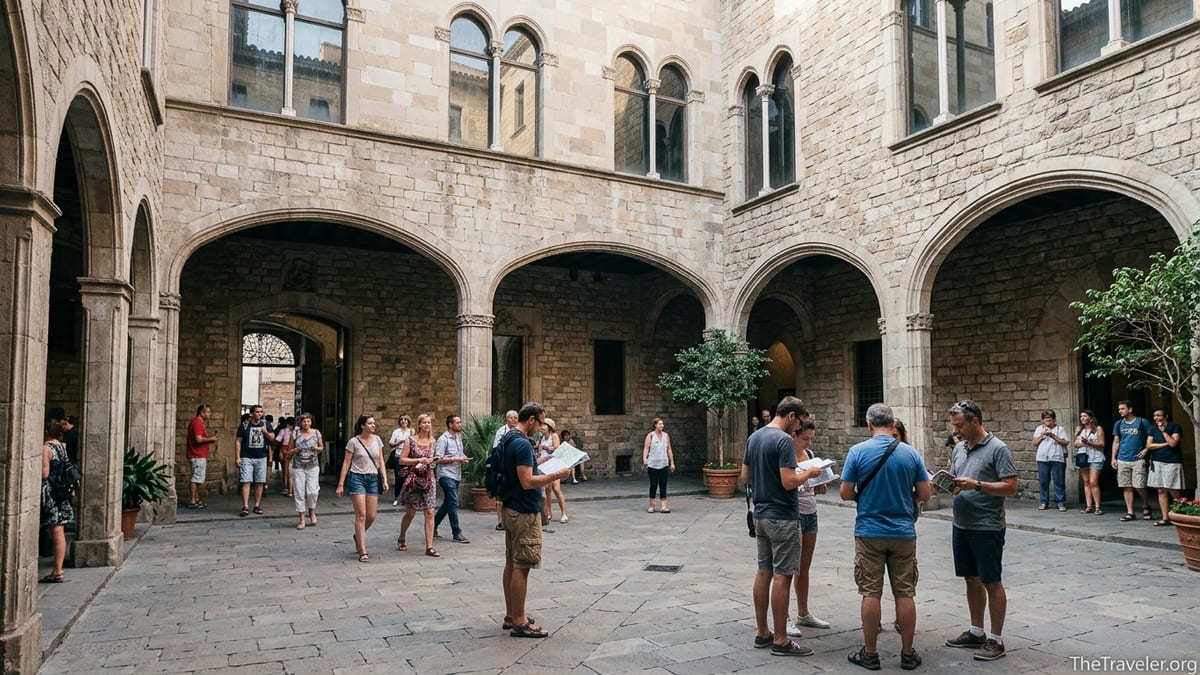
Even travelers who know little about Picasso often leave talking about the building itself. The museum occupies five interconnected medieval palaces along Carrer de Montcada, one of the most atmospheric streets in the old La Ribera neighborhood. Inside, stone staircases, arched galleries and quiet internal courtyards create a setting that feels both grand and human-sized. Moving from palace to palace, you cross open-air loggias where laundry once hung and merchants negotiated deals, now filled instead with students and visitors pausing between rooms.
This architectural setting does more than provide a pretty backdrop. It anchors the museum in the fabric of historic Barcelona. When you walk out of a gallery and look down into a Gothic courtyard, you are seeing the same kind of domestic space that would have surrounded the young Picasso when he arrived in the city in the 1890s. The contrast between the centuries-old stone and the restless experimentation on the walls draws a direct line between Barcelona’s medieval past and its modernist, avant-garde identity.
For many travelers, the palaces also offer a welcome change of rhythm from the crowded boulevards outside. Narrow staircases and vaulted halls break visitors into smaller streams, which can make even busy days feel more manageable than at some of the city’s other headline attractions. Summer visitors who step in from the heat of nearby Passeig del Born often remark on the cool, shaded courtyards, where you can sit for a few minutes before continuing your visit or heading to a nearby café.
Choosing to house a contemporary titan like Picasso in these old palaces rather than in a gleaming new building is a deliberate cultural statement by Barcelona. It shows a city that prefers to layer new stories onto old stones instead of replacing them. In that sense, the museum is not only about Picasso; it is about how Barcelona sees itself as a city that constantly reinvents while keeping its deep urban memory intact.
A Living Hub in the Born Neighborhood
The museum’s location in the Born district is another reason it remains central to Barcelona’s cultural life. Carrer de Montcada runs through a neighborhood where independent boutiques, tapas bars and small contemporary galleries share space with historic churches and civic buildings. For travelers, this means a visit to the museum naturally spills over into a full afternoon of wandering, eating and people-watching without ever needing to get on the metro.
Many visitors start their day at the museum, then walk a few minutes to Santa Maria del Mar, the great Gothic basilica that dominates the area, or continue on to Parc de la Ciutadella for a break among trees and fountains. Others pair their ticket with an evening concert at the nearby Palau de la Música Catalana, a modernist concert hall that showcases a different facet of Catalan creativity. The result is that the Picasso Museum is rarely an isolated stop; it sits at the center of a web of experiences that define how people remember Barcelona.
This integration into daily urban life is obvious if you pause outside the entrance in late afternoon. Alongside guided groups and tour buses, you will see parents with strollers, local couples on a weekday date and students dropping in with discounted passes. Cafés on the next streets serve workers from nearby offices as well as tourists comparing favorite paintings over shared plates of patatas bravas. The museum functions as both an international attraction and a neighborhood landmark.
Practical details reinforce this role. Timetables are designed to accommodate after-work visits, and on certain afternoons entrance is free for a limited number of visitors, encouraging residents who might not otherwise pay full price to step inside. For travelers, sharing the galleries with locals changes the mood: instead of feeling like a museum preserved only for tourists, it reads as part of Barcelona’s ongoing cultural conversation.
How the Museum Keeps Picasso Relevant for Today’s Travelers
One reason the Picasso Museum continues to matter is that it constantly reframes the artist for new generations. Temporary exhibitions place the permanent collection in dialogue with other artists, movements or social issues. A show might explore Picasso’s relationship with printmaking, pair his early Barcelona works with pieces from contemporary Catalan artists, or examine how later painters, photographers and filmmakers have responded to his legacy. These rotating displays ensure that returning visitors often see familiar works in a different light.
The museum also invests in interpretation that speaks to modern audiences. Audio guides, often available for a modest supplement on top of the base ticket, walk you through not just dates and titles but also the broader context: why certain streets mattered to the young Picasso, how political tensions in early 20th-century Spain seeped into his themes, or how his friendships shaped commissions. For many travelers, this narration turns what could have been a quick, box-ticking visit into a richer exploration of the city’s history and the artist’s personal struggles.
For families, the museum offers kid-friendly materials and occasional workshops that encourage younger visitors to experiment with collage, line drawing or color the way Picasso did. Parents often report that children respond more readily to the early works, where they can see that even a great artist once drew fairly realistic portraits and only gradually moved toward abstraction. This demystifies modern art and opens up conversations that can continue at other Barcelona attractions, such as the contemporary shows at the nearby Born cultural center or the waterfront arts spaces.
Because the museum is relatively compact compared with sprawling institutions, travelers can absorb a substantial amount in 90 minutes to two hours without feeling overwhelmed. That scale, combined with thoughtful curation, helps keep Picasso accessible and relevant even for visitors who might initially be more excited about the city’s food or architecture than about early 20th-century painting.
Planning Your Visit: What Travelers Actually Experience
On a practical level, the Picasso Museum remains a priority in many Barcelona itineraries because it offers a high cultural payoff for a relatively modest investment of time and money. Standard adult tickets are typically priced in the mid-teens in euros, with reduced rates for young adults, seniors and some student categories, while children under a certain age often enter free. Combination products such as city museum passes or multi-attraction cards sometimes include the museum, making it a smart choice for travelers hoping to see several cultural sites over a few days.
Because demand is consistently high, especially from spring through early autumn and on weekends, most visitors now reserve timed-entry tickets in advance through official channels. This practice usually saves you from the longest lines at the ticket counter and gives a clear window for planning the rest of your day in the Born district. Guided tours, offered by both the museum and reputable local companies, generally last around 1 to 1.5 hours and add an extra layer of commentary that many first-time visitors appreciate, particularly around the Las Meninas series and the evolution of Picasso’s style.
Inside the museum, routes are clearly signposted so that you can follow Picasso’s development chronologically. Many travelers choose to move fairly quickly through the earliest academic rooms, then slow down when they reach the Blue Period works and the Las Meninas gallery. Benches are placed strategically for those who want to sit and absorb several paintings at once, and staff are present in most rooms to answer basic questions about directions or facilities. A small bookshop near the exit sells catalogues, postcards and introductory texts that can be useful souvenirs for those who want to keep exploring the artist’s world after they leave.
For visitors with mobility or sensory concerns, it is worth checking the museum’s most recent accessibility information before arrival, as policies and facilities are updated over time. In general, however, the building incorporates lifts between floors and offers various forms of support, from tactile materials in some programs to seating throughout. Given the age of the medieval structures, some staircases and transitions remain narrow, but staff usually help direct visitors along the most accessible path. Planning an early time slot or a weekday visit can also reduce crowding and make the experience more comfortable.
The Takeaway
In a city overflowing with iconic architecture, lively beaches and creative cuisine, the Picasso Museum holds its place as a cornerstone attraction because it offers something the others cannot: an intimate look at how one of the 20th century’s defining artists grew up alongside Barcelona itself. Its focus on formative years, its unparalleled Las Meninas room, and its setting in five interlocking medieval palaces all root the experience deeply in local history.
For travelers, that combination translates into a visit that feels both globally significant and distinctly Barcelonian. You are not just ticking off a famous name; you are walking through the streets, rooms and ideas that shaped Picasso’s vision and, in turn, helped shape the city’s identity as a center of modern art. Whether you spend an hour with a guide, wander alone with a sketchbook, or pair your visit with an evening of tapas nearby, the Museu Picasso continues to be one of Barcelona’s most important cultural anchors, linking past and present in ways that stay with you long after you step back into the Born sunlight.
FAQ
Q1. Where is the Picasso Museum located in Barcelona?
The museum is on Carrer de Montcada in the Born district, a short walk from Santa Maria del Mar and Parc de la Ciutadella in the historic center.
Q2. How much time should I plan for a visit?
Most travelers spend between 90 minutes and two hours inside, which allows enough time to follow the main route and linger in the Las Meninas gallery.
Q3. Do I need to book tickets in advance?
Advance booking is strongly recommended, especially in high season and on weekends, to secure a timed entry and reduce waiting at the ticket counter.
Q4. Is the Picasso Museum suitable for children?
Yes. Many families find the early drawings and school works accessible for children, and the museum often offers kid-friendly materials or activities.
Q5. What is the best time of day to visit to avoid crowds?
Early morning slots and weekday late afternoons are generally less crowded than midday visits, when group tours and cruise passengers are most common.
Q6. Are there guided tours available in English?
Yes. The museum and local tour operators offer regular English-language tours that usually last around 1 to 1.5 hours and focus on collection highlights.
Q7. Is the museum accessible for visitors with reduced mobility?
The historic buildings include lifts and adapted routes, but some areas remain narrow. Checking the latest accessibility details in advance is advisable.
Q8. Can I take photos inside the museum?
Photography policies can change, but flash is typically not allowed and some rooms may restrict images. Look for posted signs or ask staff on arrival.
Q9. Is there a café or restaurant inside the museum?
The museum itself focuses on exhibition spaces, but it is surrounded by many cafés, tapas bars and restaurants in the Born neighborhood within a few minutes’ walk.
Q10. What makes this Picasso museum different from those in Paris or Málaga?
Barcelona’s museum concentrates on Picasso’s formative years and houses the complete Las Meninas series, set within five medieval palaces that root the visit in the city’s history.