


At first glance, visiting Barcelona’s Picasso Museum seems straightforward: buy a ticket, walk into a Gothic palace, and enjoy one of the world’s richest collections of the artist’s early work. Yet in practice, this compact museum in El Born is where many otherwise seasoned travelers lose precious hours in queues, arrive on the wrong day, or leave feeling they barely understood what they saw. With timed tickets, free entry windows, changing hours and strict access rules, small planning errors can translate into real frustration. Here are the biggest mistakes visitors make at the Museu Picasso Barcelona, and how to avoid them.
Get the latest updates straight to your inbox!
Ignoring Opening Hours, Free Slots and Closing Days
One of the most common mistakes is assuming the Picasso Museum keeps the same hours every day of the year. In reality, the schedule shifts seasonally and the museum is closed on Mondays. As of 2026, the core pattern is Tuesday to Sunday opening, with the museum generally operating from mid morning to early evening in winter and opening an hour earlier in the warmer months, with extended evening hours on some days. Many visitors only discover the Monday closure when they arrive at Carrer de Montcada to find the doors shut and a dense crowd in the surrounding streets headed instead to the nearby Basilica of Santa Maria del Mar.
Another frequent oversight involves the free entry windows. On the first Sunday of each month and some late afternoon slots on Thursdays, the museum offers free admission with advance booking. These periods are hugely popular and capacity is limited, which means that turning up without a prebooked free ticket almost always ends in disappointment. Travelers who read “free on Sundays” in an old guidebook and show up unreserved at 11:00 on the first Sunday often discover that the day’s allocation was snapped up online days earlier.
Closing time catches out many visitors as well. The museum stops selling tickets roughly 30 minutes before the posted closing hour, and staff may halt sales even earlier if the day’s capacity has been reached. It is not unusual for someone staying in Barceloneta or near Plaça de Catalunya to see that the museum closes at 19:00, stroll over at 18:30 thinking they have plenty of time, and find the ticket desk shuttered. If you are planning a same day visit, aim to enter at least 90 minutes before closing so you are not rushed through the collection.
The best way to avoid all of these pitfalls is to treat the Picasso Museum like a popular performance rather than a drop in attraction. Before setting out, check the current seasonal timetable on the official museum site, confirm whether your date coincides with a free entry period, and plan your slot early in the day or in the extended evening hours on Thursday to Saturday during high season. This small bit of planning prevents wasted walks and closed doors.
Not Booking Timed Tickets and Misunderstanding “Skip the Line”
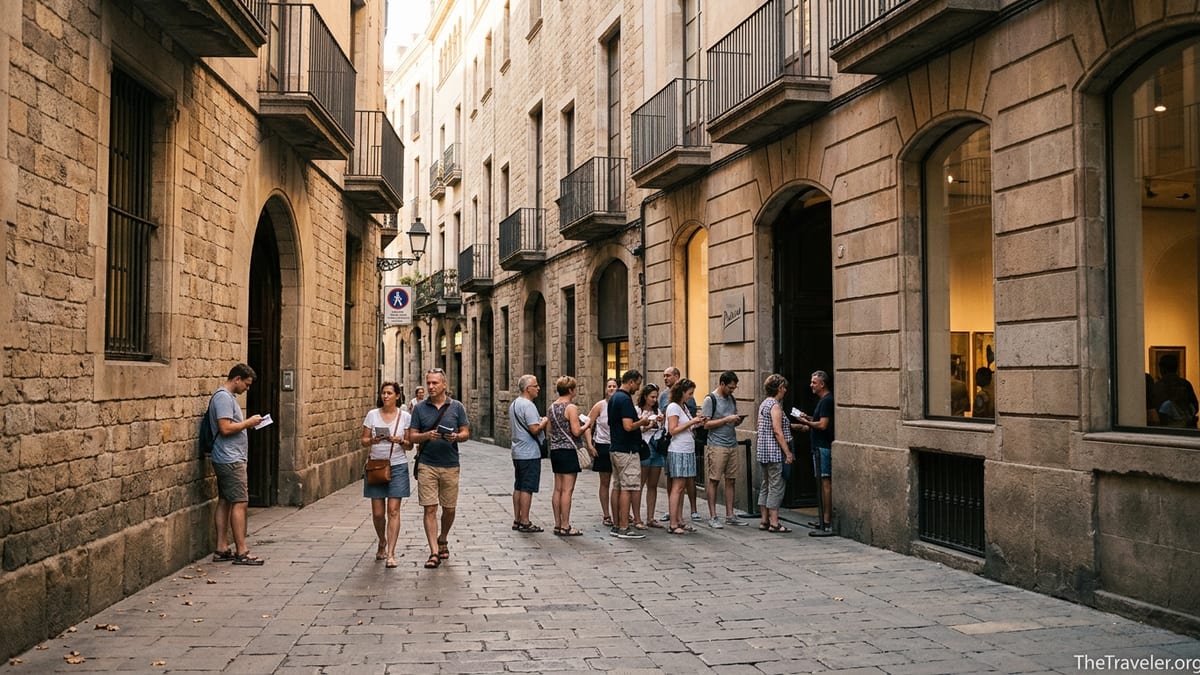
If there is a single error that spoils more visits than any other, it is arriving at the Picasso Museum without a timed ticket. The museum operates on timed entry, and on busy spring and summer days the on site ticket allocation can sell out by late morning. Lines for same day tickets frequently snake along Carrer de Montcada, especially between 11:00 and 14:00, when cruise ship excursions and day trippers from Costa Brava converge on El Born. In contrast, travelers who reserve official timed tickets for, say, 9:30 on a June Thursday generally walk straight into the shorter “already booked” queue.
Another confusion revolves around so called skip the line tickets sold by third party platforms. Many visitors pay a premium online assuming these passes will let them bypass all queues, only to discover that they are effectively the same as the standard timed ticket you can buy directly from the museum for about 14 euros online. In reality, what these platforms usually sell is either a bundled guided tour or a standard timed entry packaged with an audio guide. You still go through security and the same controlled entry system as everyone else. The only true time saver is choosing a quieter slot and securing it in advance.
There is also the risk of purchasing through unofficial channels. The museum’s own regulations explicitly recommend using only the official website, on site ticket offices or museum vending machines. Booking through secondary sites that are not transparent about inclusions can lead to mismatched dates, wrong time slots, or vouchers that must be exchanged at a travel agency office across town. More than one visitor has missed their slot while trying to resolve a booking issue at a phone support line that does not answer in English.
For a smooth experience, book directly and early. If you are visiting in peak months like May, June, September or during events such as La Mercè, secure your timed ticket several days ahead. Travelers with the Articket Barcelona museum pass or city passes that include Picasso should still log in and reserve a time using their pass, rather than turning up at random and expecting immediate entry. Treat your timeslot as you would a train departure and you will avoid the most frustrating bottlenecks.
Arriving at Peak Times and Not Accounting for Crowds
Even with the best ticket in hand, many people inadvertently choose the worst possible time of day to visit. The museum’s galleries are housed in five interconnected medieval palaces with relatively narrow staircases and corridors. When several large tour groups arrive at once or when midday crowds peak, rooms can feel cramped, with visitors funneling slowly past highlights such as the Las Meninas series. Travelers who start their visit at 11:30 on a Saturday in July often report needing to crane their necks from the second or third row just to glimpse key works.
The rhythm of the day is relatively predictable. Mornings between opening and roughly 10:30 are typically calmer, as are the last two hours before closing on regular weekdays, especially outside school holidays. In the extended summer schedule, Thursday and Friday evenings after 19:00 are often the most enjoyable, with a cooler temperature and a more contemplative atmosphere in the courtyards. An American couple staying in Eixample who shifted their planned midday visit to a Thursday evening slot in August described the difference as “night and day”: instead of shuffling shoulder to shoulder, they found pockets of space to linger, particularly in the early blue period rooms.
Another mistake relates to local events and cruise schedules. On days when several large cruise ships are docked in Barcelona, the early afternoon surge is particularly intense because many shore excursion buses drop passengers in the Gothic Quarter around lunchtime. Likewise, rainy spring days can transform the museum into a default bad weather activity, with visitors rebooking from the beach or Park Güell into indoor attractions. Checking the weather forecast and adjusting by even one or two hours can substantially reduce the crush.
Finally, visitors often underestimate how draining crowded galleries can be. If your only realistic window is a busy time, plan accordingly: eat beforehand in nearby cafés along Passeig del Born, carry a small water bottle to use in the courtyard areas, and be ready to take micro breaks on the benches by the cloister like courtyards between wings. Building those pauses into a 90 minute visit makes the crowds more bearable and helps you actually absorb what you are seeing.
Rushing the Collection or Seeing It Without Context
Because Picasso’s name is synonymous with cubism and late twentieth century art, many people arrive expecting a greatest hits tour of Guernica and the iconic weeping women. The Barcelona museum, however, is primarily devoted to his formative years, with a strong focus on early academic training, the Blue Period and his deep connection to the city. Travelers who walk in expecting the bombast of Guernica sometimes walk out saying, “But where were the famous paintings?” simply because they did not realize what this particular collection emphasizes.
A common mistake is trying to sprint through the entire collection in under 45 minutes. The museum’s layout winds chronologically, starting with remarkably accomplished childhood and student works, then leading through key Barcelona years, the Blue Period and ceramics. Visitors who treat the early rooms as a warm up and rush through them to look for the “big Picasso hits” in later galleries often miss one of the most powerful stories the museum tells: how a teenage painter trained in classical realism exploded into experimentation. Spending ten quiet minutes with works like Science and Charity can be more revealing than snapping quick photos of every canvas.
Skipping explanatory material is another misstep. While the wall texts are concise, they do include crucial context about Barcelona’s artistic circles, Picasso’s family life, and his friendships in El Born and the Gothic Quarter. Without these, it can be difficult to understand why a room of small portraits or sketches matters. Many visitors also overlook the temporary exhibitions and focused displays that explore a single work or theme; on a less crowded day, these can be some of the most memorable spaces in the building.
To avoid leaving underwhelmed, calibrate your expectations before arrival. Understand that you are visiting the story of Picasso’s youth and his relationship with Barcelona rather than a survey of his entire career. If you are short on time, prioritize the early academic rooms and the Las Meninas series near the end, which many guides highlight as essential. Allow at least 60 to 90 minutes for the visit, and consider downloading or renting an audio guide, especially if you are less familiar with his biography. A bit of narrative turns what could feel like a random progression of rooms into a coherent journey.
Underestimating Logistics: Getting There, Security and Museum Rules
Because the Picasso Museum sits in the pedestrian maze of the Born neighborhood, another frequent mistake is misjudging how long it takes to get there. The nearest metro stops, such as Jaume I on line 4 or Arc de Triomf on line 1, are a short walk away on paper, but those ten minutes can stretch if you get disoriented in the narrow streets of the old city. Travelers coming straight from Sagrada Família or Park Güell often leave themselves just enough time according to a mapping app, not accounting for navigating through the Gothic Quarter’s crowds. Arriving ten or fifteen minutes late to a timed slot may mean having to negotiate with staff to be allowed in or needing to wait for the next available wave.
Security procedures also catch people off guard. As with many major museums in Europe, you must pass through a controlled entry, and large backpacks, wheeled luggage and bulky items are not allowed in the galleries. While the museum offers cloakroom facilities, there are capacity limits, and queuing to check bags can eat into your visit. It is a common sight in peak season to see travelers with carry on suitcases turned away or asked to rearrange their plans, especially if they are on their way to or from Barcelona Sants or the cruise terminals.
Museum rules on photography, behavior and access are another area where small oversights can have big consequences. Personal photography without flash is generally permitted in the permanent collection, but staff may restrict it in crowded conditions or special exhibitions. Using flash, professional equipment or selfie sticks is not allowed and can lead to staff intervention. Eating and drinking are prohibited in the galleries, and talking loudly on the phone or playing audio without headphones is discouraged. The museum’s access regulations also emphasize that staff can temporarily suspend ticket sales or gallery access if rooms are at capacity, a measure many visitors interpret as arbitrary if they have not read the guidelines.
To keep logistics from undermining your visit, travel light, arrive early and read the basic regulations in advance. Do not bring large bags or tripods, and factor in extra walking time through El Born’s medieval streets. If you are pairing the museum with other sights in the old town, such as the Cathedral or Palau de la Música Catalana, cluster them geographically to reduce backtracking. Thinking about the museum as a destination within a dense, pedestrian neighborhood helps you schedule it realistically within your day.
Skipping the Neighborhood and Treating the Visit as a Quick Box to Tick
Another subtle mistake is treating the Picasso Museum as an isolated checklist item rather than the anchor of a wider exploration of El Born. The museum’s five medieval palaces open onto Carrer de Montcada, once a street of noble residences, and within a ten minute walk you can reach Santa Maria del Mar, the Mercat del Born cultural center and numerous small galleries and artisan shops. Visitors who rush in and out solely to “do Picasso” often miss the layered sense of place that gives the museum much of its resonance.
For instance, some of Picasso’s formative experiences took place in nearby cafés and studios in the early twentieth century, when El Born and the Gothic Quarter hosted a vibrant bohemian community. While many of those exact venues have changed, the urban fabric remains recognizable: narrow stone alleys, small balconies with laundry hanging overhead, and sudden openings onto sunlit plazas. Spending an extra hour drifting between the museum, Passeig del Born and the tiny squares branching from Carrer de la Princesa can make the artworks feel connected to the city rather than detached masterpieces.
Time pressure plays a role here. Travelers on tightly packed itineraries, especially those doing Barcelona in a single day from a cruise ship or Costa Brava resort, often slot the museum between Park Güell and a Sagrada Família visit. This leaves little space for the slow, observational walking that old Barcelona rewards. The result is a rushed museum visit followed by a sprint to the metro, and a vague memory of crowded galleries floating free of any neighborhood impressions.
To counter this, build El Born into your plan. Arrive early and have breakfast or a coffee near the Ribera market, visit the museum in the first time slot, then wander to Santa Maria del Mar and the waterfront. Alternatively, schedule a late afternoon visit and stay for tapas along Passeig del Born, watching locals and visitors mingle under plane trees. By pairing the museum with the surrounding streets, you transform a single cultural tick box into one of the most atmospheric half days in Barcelona.
Overlooking Budget Options, Passes and Free Entry Strategies
While the Picasso Museum is not the most expensive attraction in Barcelona, travelers frequently overspend or miss good value options because they have not researched prices or passes. In 2026, a standard adult ticket purchased online costs in the low to mid teens in euros, with a small surcharge at the physical ticket office. There are reductions for young adults, seniors and certain concession categories, as well as discounted combination tickets when a temporary exhibition is on. Yet many people end up paying significantly more through resellers that bundle the museum with generic walking tours or bus rides they do not really want.
One underused option for art focused visitors is the Articket Barcelona, a pass that covers six major museums including the Picasso Museum, the Joan Miró Foundation and the MNAC. Priced under 40 euros and valid for a full year, it can offer excellent value if you plan to visit at least three of the included institutions. However, some pass holders wrongly assume it grants instantaneous access at any time. In practice, you often still need to reserve a time slot for the Picasso Museum, especially in high season, even if the pass guarantees your ticket.
Free entry strategies can also backfire if not handled carefully. As mentioned earlier, the first Sunday of each month and certain late afternoon windows provide free access, but strictly with advance booking and capacity limits. Travelers who see “free Sundays” listed in a guide but neglect to reserve are left facing long standby lines with no guarantee of entry. Others save the museum for a free slot but end up experiencing it under the most crowded conditions, which can undermine the very appreciation they were hoping to gain.
The smartest approach is to decide what the museum is worth to you in terms of both time and money. If you have a flexible budget and value a relatively calm experience, paying the standard ticket price for a quieter time slot is often a better choice than battling the swell on a free day. If you are traveling with a family or planning a broader cultural itinerary, explore passes and concessions in advance, and factor in the need to book. That way, budget decisions enhance rather than compromise your visit.
The Takeaway
The Picasso Museum in Barcelona is one of the city’s most rewarding cultural experiences, but its popularity and setting in the dense streets of El Born mean that casual or last minute approaches often end badly. Typical missteps include ignoring the Monday closure and seasonal hours, failing to book timed tickets, arriving at peak midday times, rushing through the galleries without context, underestimating logistics, neglecting the surrounding neighborhood, and mishandling budget or free entry options.
With a bit of advance thought, each of these pitfalls is easy to avoid. Check current hours, reserve your slot directly with the museum, choose a calmer time of day, give yourself at least 60 to 90 unrushed minutes inside, and leave space to wander the streets around Carrer de Montcada. See the visit not as a checkbox but as a chapter in Barcelona’s larger story of art, architecture and urban life. Do that, and your time at the Museu Picasso will shift from a crowded obligation to a highlight that lingers long after you leave the palaces behind.
FAQ
Q1. How long should I plan for a visit to the Picasso Museum in Barcelona?
Most visitors are comfortable with 60 to 90 minutes inside the museum, not counting time for security, cloakroom use or browsing the bookshop. Art enthusiasts who like to read wall texts and explore temporary exhibitions in depth may want closer to two hours. It is better to schedule a realistic block of time than to rush through in under 45 minutes.
Q2. Do I really need to buy tickets in advance, or can I just walk in?
While it is sometimes possible to buy same day tickets at the museum, especially in low season or late in the day, relying on walk up availability is risky. On popular dates and during spring and summer, on site tickets often sell out by late morning, and queues for the ticket desk can be long. Buying timed tickets in advance directly from the museum greatly increases your chances of a smooth, predictable entry.
Q3. Are skip the line tickets for the Picasso Museum worth paying extra for?
Many skip the line offers sold by third party platforms are simply standard timed tickets bundled with a guided tour or audio guide. They do not bypass security checks, and you still enter in a controlled flow. If you are comfortable visiting independently, it is usually more economical to book directly with the museum. Paying extra only makes sense if you specifically want a guided experience in a small group at a particular time.
Q4. What is the best time of day to avoid crowds inside the museum?
The quietest periods are typically right after opening in the morning and the last two hours before closing on weekdays. During extended summer hours, Thursday and Friday evenings can be especially pleasant, with fewer large tour groups. Midday slots from late morning to mid afternoon, particularly on weekends and on days with heavy cruise ship traffic, tend to be the most crowded and are best avoided if you have flexibility.
Q5. Is the Picasso Museum suitable for children, or will they be bored?
Many families enjoy the museum, but children’s reactions depend on age and expectations. Older children and teenagers who already know a bit about Picasso or who are interested in drawing often respond well to seeing his early works and ceramics. Younger kids may find the chronological galleries less engaging if rushed through. Planning a shorter visit, focusing on a few rooms, and combining the museum with time in nearby plazas or at the waterfront can make the experience more balanced for families.
Q6. Can I take photos inside the Picasso Museum?
Personal photography without flash is generally allowed in the permanent collection, but not in all temporary exhibitions, and staff may restrict it if galleries are very crowded. Flash, tripods, large camera rigs and selfie sticks are not permitted. As a courtesy to other visitors, it is best to take quick, discreet photos and avoid blocking works for extended periods while composing shots.
Q7. What is the closest metro station, and how much time should I allow to walk from there?
The closest metro stops are usually Jaume I on line 4 and Arc de Triomf on line 1, each about a ten minute walk from the museum under normal conditions. However, the medieval street layout can be confusing, and crowds in the Gothic Quarter often slow progress. If you have a timed ticket, plan at least 20 to 25 minutes from the moment you exit the metro to account for navigation, short stops and security queues at the museum entrance.
Q8. Are there good places to eat or have coffee near the Picasso Museum?
Yes, the surrounding Born neighborhood is full of cafés, bakeries and tapas bars. You will find casual coffee spots on and around Passeig del Born, as well as small bakeries near the Ribera market and Carrer de la Princesa. Many travelers enjoy having breakfast before an early visit, then returning for tapas or a drink after the museum, using the visit as the centerpiece of a half day spent exploring El Born on foot.
Q9. Is the museum accessible for visitors with reduced mobility?
The Picasso Museum is housed in interconnected historic palaces, but it has been adapted with lifts and ramps to make the galleries accessible to visitors with reduced mobility. Some courtyards and passageways can still feel uneven underfoot, so comfortable, stable footwear is important. If you have specific accessibility needs, it is advisable to consult the museum’s current accessibility information in advance or contact them before your visit to confirm available services.
Q10. What should I not miss inside the Picasso Museum if I am short on time?
If your visit time is limited, focus on the early academic works that show Picasso’s technical skill as a teenager, the Blue Period rooms, and the Las Meninas series that reinterprets Velázquez’s famous painting. These areas provide a clear sense of his evolution and his relationship with Barcelona. Skipping some of the minor rooms while concentrating on these highlights will still give you a strong feeling for what makes this museum distinct.