


Few waterfronts in Europe pack in as much glamour per meter as Boulevard de la Croisette in Cannes. This palm-lined curve of promenade, framed by Belle Époque palace hotels on one side and the blue sweep of the Bay of Cannes on the other, is where the city’s festivals, fireworks, luxury shopping and beach life all collide. With so many famous spots lining just a couple of kilometers, it is easy to wander La Croisette and later realize you walked straight past some of its most iconic highlights. This guide shows you exactly how to visit Boulevard de la Croisette without missing the moments, addresses and views that make it legendary.
Get the latest updates straight to your inbox!
Getting Oriented: How La Croisette Fits Into Cannes
Boulevard de la Croisette, often just called La Croisette, runs for roughly two kilometers along the seafront from the Palais des Festivals et des Congrès near the old port to Port Canto and the more residential Pointe Croisette. On a map, it is the sweeping bayfront curve you see on the eastern side of Cannes. One side of the boulevard faces the sea and beaches, while the other is lined with luxury hotels, boutiques and outdoor café terraces.
Most visitors arrive at Cannes train station or park in one of the underground garages in the center, then join La Croisette near the Palais des Festivals, whose red-carpeted staircase is the visual anchor at the western end of the boulevard. From there, walking east keeps the sea to your right and makes it easy to tick off the big names in order: the Majestic, Gray d’Albion, 55 Croisette’s designer storefronts, the Carlton, the cluster of beach clubs and finally Port Canto. This simple west-to-east walk is the best way to be sure you do not miss a section.
La Croisette runs broadly parallel to Rue d’Antibes a couple of blocks inland, which is the city’s main midrange shopping street. Knowing this helps you plan short detours: you can window-shop haute couture on La Croisette, then cut back to Rue d’Antibes for more casual brands and a coffee, before returning to the seafront without losing your bearings. For a first visit, allow at least half a day to walk La Croisette at a relaxed pace with photo stops, a coffee or ice cream break, and time on the sand.
Walking the Classic Route: A Half-Day Itinerary
The most efficient way to see La Croisette’s biggest highlights is to start at the Palais des Festivals in the morning, when the light is soft and the promenade is quieter. From the steps of the Palais, you can photograph the red carpet and scan the handprints embedded into the pavement nearby, then immediately step onto La Croisette itself. This first stretch passes Plage du Casino, one of the main public beaches on the boulevard, where locals lay towels on the sand in front of the hotel district without paying for a sunbed.
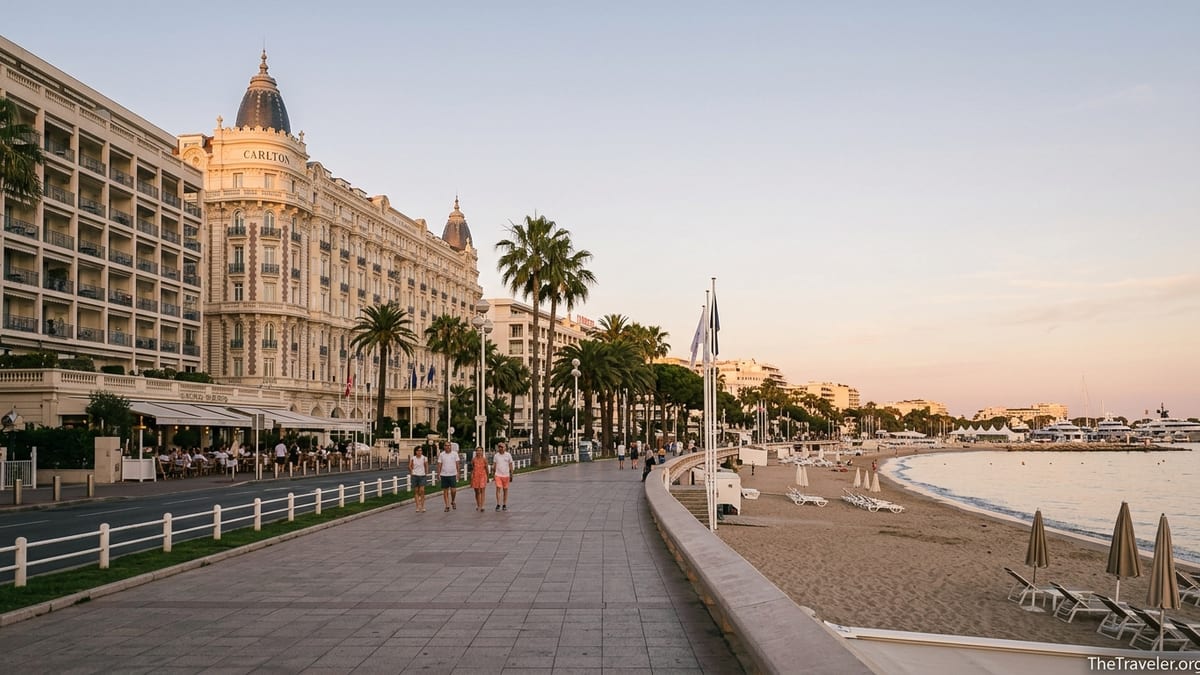
Continuing east, you will soon pass the façade of Hôtel Barrière Le Majestic and, just beyond, a run of designer storefronts. After 10 to 15 minutes of easy strolling, the boulevard opens up slightly and one of La Croisette’s crown jewels appears on your left: the Hôtel Carlton Cannes with its twin domes and ornate Belle Époque architecture. Even if you are not a hotel guest, it is worth stepping into the lobby for a quick look at the restored interiors or pausing on the sidewalk outside for a classic photo with the domes framed by palm trees.
From the Carlton to Port Canto is where La Croisette feels most like a leisurely seaside promenade. Benches face the sea, the walkway is wide, and you can cut down to the sand via stairways or slopes every couple of minutes. If you maintain a meandering pace and stop for photos, you can comfortably cover the full boulevard from the Palais to Port Canto in about 45 minutes to an hour. The key is to think of it not as a point-to-point march, but as a spine from which you slip occasionally onto the beaches, into shops or onto café terraces before rejoining the main promenade.
Palace Hotels and Legendary Lobbies
La Croisette is synonymous with its palace hotels, and walking past them without taking a moment inside is like walking by the Eiffel Tower without looking up. Starting near the Palais, Hôtel Barrière Le Majestic is one of the first grande dames you encounter. Step into the lobby for a quick look at its creamy marble floors, contemporary art pieces and glimpses of the sea through the bar windows. Even ordering a single espresso at the terrace bar gives you a taste of the festival atmosphere in May, when film professionals occupy most tables.
A little farther along, the Carlton dominates the midsection of La Croisette. Fresh from a major renovation completed in the mid-2020s, its façade looks crisp and immaculate, and its lobby has been refreshed while preserving the Belle Époque bones. If your budget allows, a late-morning coffee or early evening drink on the Carlton’s sea-facing terrace is one of the best ways to soak in the boulevard’s atmosphere without the cost of a room. Be prepared for premium pricing; a basic coffee can cost several euros more than in backstreet cafés, but you are paying as much for the view and the people-watching as for what is in the cup.
Near the eastern end of La Croisette, close to Port Canto, smaller luxury properties and serviced residences catch the overflow from the central palace cluster. Even if you are staying in a simpler hotel in Le Suquet or around Rue d’Antibes, La Croisette’s palace lobbies are usually open to non-guests during the day, provided you behave respectfully and are appropriately dressed. They can also be handy spots for clean restrooms, quick phone charging and a pause in air conditioning on hot summer afternoons.
Beaches and Beach Clubs: Public vs Private
One of the biggest decisions when visiting La Croisette is whether to enjoy the free public beaches or splash out on a private beach club. Along most of the boulevard, the sand is divided between sections run by the big hotels and restaurants, where sunbeds, parasols and waiter service are available for a fee, and stretches that are completely public, such as Plage du Casino. Public sections are genuinely free to access; you simply bring your towel, water and perhaps a foldable umbrella. In high season, they fill up quickly by late morning, especially on weekends, so an early start helps.
Private beach clubs attached to hotels like the Carlton, the Majestic or independent operators nearer Port Canto offer a different experience. Renting a sunbed in high season can easily cost several dozen euros per person for a full day, sometimes more on the front row by the water. In return you get a mattress with adjustable backrest, parasol, fresh towels, direct access to the sea, and the ability to order drinks and food to your lounger. For some travelers, booking a half-day session at a club is worth it for one “treat” day on La Croisette, while using public beaches the rest of the time keeps costs reasonable.
Toward the eastern end, near a spot like Bijou Plage and the shaded park just behind the sand, the vibe becomes more relaxed. Here you will find a mix of public areas and restaurant-run beach sections with slightly lower prices than the central palace clubs. Families appreciate this part of La Croisette because the bay remains shallow for some distance and snack kiosks on the promenade make it easy to keep children fed without committing to a sit-down restaurant. Whichever you choose, remember that dogs are generally not allowed on public beaches in summer and that topless sunbathing, while legal in France, is less common here than on some wilder Riviera beaches.
Shopping the Boulevard: From Haute Couture to Souvenirs
La Croisette is one of France’s densest concentrations of luxury boutiques, and even if you are only window-shopping, it is part of the experience. Between the Majestic and the Carlton, and again near mid-boulevard addresses like the cluster around 55 Boulevard de la Croisette, you will walk past flagship stores for brands such as Chanel, Dior, Gucci and Dolce & Gabbana, as well as high-end jewelers. Many travelers allocate a specific shopping window, for example one hour in the late afternoon, to avoid drifting in and out of boutiques all day and losing time for the beach and sights.
For those who want variety without the full designer price tags, it is easy to step inland to Rue d’Antibes, a parallel street packed with more attainable French and international brands as well as pharmacies, bakeries and department-store-style outlets. A typical pattern is to browse La Croisette’s haute couture houses, then cut up a side street to Rue d’Antibes to buy a linen shirt, sandals or a swimsuit at a midrange price. You can then return to La Croisette within a few minutes on foot, using the domes of the Carlton or the silhouette of the Palais as visual anchors.
If you are visiting in summer, watch for temporary pop-up spaces that appear along La Croisette, particularly between the Majestic and the Carlton. In recent seasons, luxury resale concepts and watch and jewelry specialists have opened small seasonal boutiques here, reinforcing the boulevard’s role as a showcase for rare pieces and limited editions. These pop-ups can be a good opportunity to see pre-owned luxury goods from major houses in person, sometimes at prices that are lower than the brand’s current collections, although still well above mainstream budgets.
Views, Photo Spots and Off-Boulevard Detours
While La Croisette itself is endlessly photogenic, some of the best views of it come from nearby vantage points. One classic detour is to climb up to Le Suquet, the old hilltop quarter rising behind the Vieux Port just west of the Palais des Festivals. From the terrace near the church, you get a sweeping view over the bay, with La Croisette curving away to the east, dotted with hotel façades and backed by the Esterel hills. Late afternoon is ideal, when the light is warm and the haze offshore softens the horizon.
Another rewarding viewpoint is along the breakwater near Port Canto at the eastern end of La Croisette. From here, you can look back toward the city and see the palace hotels lined up along the shore, their private jetties stretching into the water and the Croisette’s palm trees forming a green fringe between sand and stone façades. Walking to Port Canto also exposes you to a different side of Cannes: rows of moored yachts, a more residential feel, and fewer crowds than around the Palais.
If you have a full day, consider pairing your La Croisette walk with a boat trip to the nearby Lérins Islands. Departures leave from the old port just a short walk from the western end of the boulevard, and in about 15 to 20 minutes you can be walking through pine forests or visiting a centuries-old monastery. Returning to La Croisette in the late afternoon and watching the boulevard light up for the evening highlights creates a satisfying contrast between quiet island time and the city’s polished seafront.
Evenings on La Croisette: Fireworks, Aperitifs and Night Strolls
Evenings are when La Croisette shows off its most glamorous side. As the sun drops behind the Esterel hills, the façades of the palace hotels pick up a golden glow, and the promenade fills with people on their pre-dinner passeggiata. Many visitors choose this time for an aperitif at a terrace bar, whether at a palace hotel or at a smaller café directly across from the beach. Ordering a spritz, a glass of Provençal rosé or simply a sparkling water around sunset typically costs more than inland, but the payoff is front-row seats to watch the boulevard shift from day to night.
On selected summer nights, the bay explodes into color during the Festival d’Art Pyrotechnique, Cannes’ long-running international fireworks competition. The fireworks are launched from barges anchored offshore, and La Croisette becomes a linear viewing platform as tens of thousands of people line the seawall. If your visit coincides with one of these evenings, arrive early, ideally at least an hour before the scheduled start time, to claim a spot on the promenade or the sand. Local advice is to bring a light jacket, snacks and water; once the crowds settle in, it can be difficult to move around freely.
Even on non-fireworks nights, a post-dinner stroll along La Croisette is a highlight. Street musicians often set up near the central section, and the reflections of hotel lights shimmer on the water. Families walk with ice creams, and joggers take advantage of the relatively cool air. If you are staying elsewhere in Cannes, you can safely walk La Croisette until late in the evening, but it is wise to keep an eye on the time of your last train or bus if you are heading back to another town along the Riviera.
Practical Tips: Transport, Timing and Costs
Reaching La Croisette is straightforward whether you are staying in Cannes or visiting on a day trip. From Cannes train station, it is a roughly five- to ten-minute walk down to the Palais des Festivals and the western end of the boulevard. Several underground car parks serve the area, including facilities near the Palais and along the central section of La Croisette, although rates can feel high compared with smaller towns nearby, especially during major events. If you are coming by bus from other Riviera towns, many services stop close to the port and the casino, from where it is an easy stroll onto the promenade.
Timing your visit can make a big difference to comfort. In July and August, midday heat on the paved promenade can be intense, and beach clubs and public sands alike are busiest. For a more relaxed experience, consider late May or June, or September, when sea temperatures are still pleasant but crowds are thinner outside peak festival windows. If your dates are fixed in high season, plan your main La Croisette walk for early morning or late afternoon, then retreat inland or to shaded cafés for the middle of the day.
Prices on La Croisette reflect its status. A basic coffee or soft drink can cost significantly more on the seafront than two or three streets inland, and sit-down meals at beach clubs or palace hotel restaurants add up quickly once you include drinks and service. A common strategy is to enjoy one or two “splurge” experiences on the boulevard, such as a sunset drink at a palace terrace or a half-day sunbed rental, balanced by more everyday meals and coffees in Le Suquet, Rue Meynadier or Rue d’Antibes. Carry a reusable water bottle; there are public fountains in Cannes where you can top up at no cost.
The Takeaway
La Croisette is more than just a pretty promenade; it is the stage on which Cannes presents its most polished version of itself to the world. By approaching it with a simple plan, moving from the Palais des Festivals toward Port Canto, and deliberately pausing at the palace hotels, beaches, viewpoints and terraces along the way, you can experience its highlights without feeling rushed or overwhelmed. Whether you choose to spend on a private beach club, limit yourself to free sands and window-shopping, or mix both, the essential ingredients are the same: the curve of the bay, the silhouettes of the domes and palms, and the constant interplay between sea and city.
If you give La Croisette at least half a day and align your visit with sunrise calm or evening glow, it becomes more than a quick photo stop. Instead, it anchors your memory of Cannes, tying together festival glamour, Mediterranean light and the simple pleasure of walking beside the sea. Plan a little, leave time to linger, and you will leave the boulevard feeling that you have met it on its own terms rather than just rushing past its famous façades.
FAQ
Q1. How long does it take to walk the full length of Boulevard de la Croisette?
At a relaxed pace with photo stops, most visitors cover the main stretch from the Palais des Festivals to Port Canto in about 45 minutes to one hour.
Q2. What is the best time of day to visit La Croisette?
Early morning offers cooler temperatures and fewer crowds, while late afternoon and sunset provide the most flattering light and liveliest atmosphere on the terraces.
Q3. Are there free public beaches directly on La Croisette?
Yes. Sections such as Plage du Casino and parts of the eastern end of the bay are completely public, where you can lay a towel without paying for a sunbed.
Q4. Do I need to book private beach clubs in advance?
In high season and during major events, reserving sunbeds at popular clubs tied to hotels like the Carlton or Majestic is strongly recommended, especially for weekends.
Q5. Is La Croisette suitable for families with children?
Yes. The promenade is wide and stroller-friendly, the bay is generally shallow near the shore, and there are snack kiosks and shaded park areas near the eastern beaches.
Q6. What should I wear to visit the palace hotels on La Croisette?
Smart casual clothing is normally sufficient during the day. In the evening, some bars and restaurants may ask for closed shoes and discourage beachwear or athletic outfits.
Q7. How expensive is it to eat and drink on La Croisette?
Prices are higher than in backstreets. Simple drinks and snacks often cost significantly more on the seafront, so many visitors mix one or two splurge moments with inland meals.
Q8. Can I visit La Croisette easily from other Riviera towns?
Yes. Regular trains and buses connect Cannes with nearby towns like Nice and Antibes, and from Cannes station it is only a short walk down to the start of La Croisette.
Q9. Are there good views of La Croisette from elsewhere in Cannes?
Climbing to Le Suquet above the old port or walking to the breakwater at Port Canto both give wide views over the bay and the full curve of the boulevard.
Q10. Is La Croisette safe to walk at night?
The promenade is generally well lit and busy in the evening. Normal city precautions apply, but most visitors feel comfortable walking there until late in the night.