


On the French Riviera, two legendary seafronts compete quietly for your affection: Cannes’ Boulevard de la Croisette and Nice’s Promenade des Anglais. Both offer Mediterranean light, iconic views and glamorous history, yet they deliver very different moods once you are actually walking the pavement or stretching out on a lounger. If you are planning a Riviera trip and can only linger on one shoreline, understanding how each place feels in real life will help you choose where to spend your precious days in the sun.
Get the latest updates straight to your inbox!
First Impressions: Atmosphere at Street Level
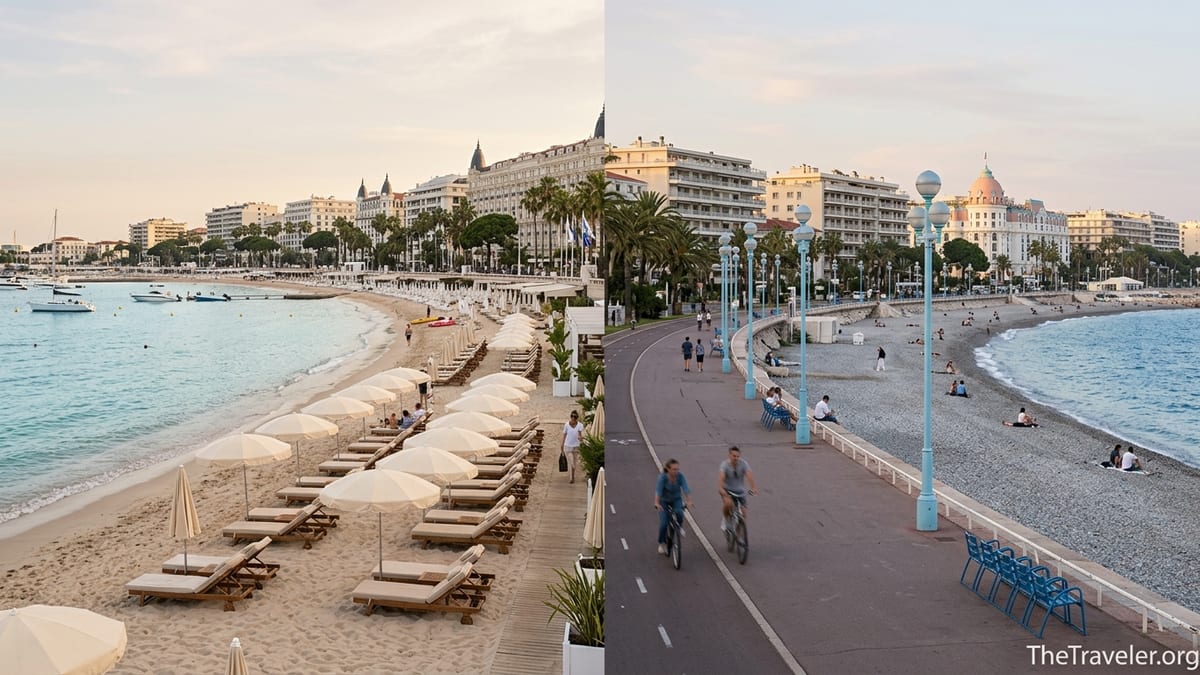
Arriving on Boulevard de la Croisette, the first impression is curated glamour. The boulevard runs along the bay of Cannes with a row of grand hotels on one side and a near-continuous line of private beach clubs on the other. Facades like the Carlton Cannes and the Martinez, high-end boutiques and neatly planted palms create a sense of contained luxury that feels almost like an open-air lobby. Traffic usually moves slowly, and outside peak events such as the Cannes Film Festival, the vibe is polished but relatively calm, especially in the morning.
The Promenade des Anglais in Nice feels broader, lived-in and more democratic. Stretching along the Baie des Anges from near the airport all the way to the eastern edge of the old town, it is a long ribbon of light-blue lampposts, bike lanes, joggers, dog walkers and beachgoers heading down to the pebbles. You are more likely to see locals in running gear or parents pushing strollers than couture gowns, especially outside the height of summer. It feels like a shared urban space rather than a resort façade.
In practice, this means Croisette often feels like a film set, with everything arranged toward the sea and the red-carpet myth. Promenade des Anglais feels like a daily ritual, especially at sunrise and sunset when locals claim the benches and famous blue chairs to watch the light change over the Bay of Angels.
If you want to step off the train and immediately feel as if you have walked onto a Riviera postcard, the Croisette delivers that intensity in a compact stretch. If you prefer to blend into an everyday Mediterranean city, the Promenade des Anglais feels more natural and varied.
Beach Experience: Sand vs Pebbles, Public vs Private
The most obvious physical difference is under your feet. Cannes’ Croisette fronts a sandy shoreline, with fine imported sand groomed by the private and municipal teams. Lying directly on the beach is comfortable, and children can build sandcastles near the waterline. Even the public stretches between beach clubs offer a soft surface for towels and beach games, which is why many families gravitate to Cannes for long days by the sea.
Nice’s Promenade des Anglais backs onto long pebble beaches. The stones are smooth and photogenic, but they are hard on bare feet and thin towels. Many visitors quickly buy inexpensive plastic sea shoes from kiosks along the promenade just to get in and out of the water more comfortably. Once you are in the sea, the water clarity can be outstanding, but the slope into deeper water is steeper than in Cannes, which some swimmers love and families with toddlers sometimes find tricky.
Access also feels different. Along the Croisette you get a patchwork of public beaches and tightly spaced private clubs such as Croisette Beach, Goeland or Bijou Plage. In high season, daily sun‑lounger rentals on the Croisette can range roughly from about 40 to well over 100 euros depending on the row and the prestige of the club, especially in July and August. You are buying both comfort and status: thick mattresses on wooden decks, table service for chilled rosé and grilled sea bass, and often a well-dressed crowd who booked weeks ahead.
On the Promenade des Anglais, the city maintains numerous public plage areas interspersed with around a dozen private concessions. At public sections, you can simply lay a towel on the pebbles for free, then climb back up to the promenade to buy a sandwich or ice cream from a simple snack bar. In private clubs like Cocoon Beach or Le Galet, recent posted rates often list standard sunbeds from about 20 to 30 euros per day in low or mid season, and more for prime first rows or double beds. Overall, it is usually easier on the budget to enjoy a private setup in Nice than in the heart of the Croisette.
Who Each Seafront Suits Best
Travelers who adore the Croisette tend to be those who enjoy a self-contained resort world. If you imagine spending a day where everything you need is within a few hundred meters of your lounger, Cannes works beautifully. At a place like La Plage du Festival or Croisette Beach, you might arrive late morning, pay for a front-row sunbed, order a cappuccino while someone lays out fresh towels, then stay put until sunset with lunch and cocktails delivered to your side table. For a couples’ escape or a short break where you want to feel pampered, this model is hard to beat.
Families also appreciate the soft sand and the manageable size of the Croisette. With children, it is easier to walk a short distance from a hotel such as the Marriott or Martinez to a familiar beach club where you can rent one or two loungers, let kids play on the sand in front, and have restrooms, shade and food only a few steps away. The atmosphere feels controlled, and there is less need to haul gear across town.
The Promenade des Anglais is a better fit for travelers who enjoy mixing city life with beach time. If you like to start the morning with a run or a bike ride, grab a takeaway espresso from a small café near Place Masséna, then drop to a public beach for a quick swim before exploring museums or the Cours Saleya market, the promenade layout makes this easy. You are never far from tram stops, grocery stores, simple bakeries and casual restaurants, and you can treat beach time as one activity among many rather than the focal point of the day.
Budget‑conscious travelers, solo visitors and groups of friends often feel more comfortable in Nice, where you can alternate between free pebbly public beaches and the occasional splurge at a private club without the social pressure to dress up. If you are the kind of person who is happy with a supermarket picnic on the shore and a reasonably priced lounger maybe once during your stay, the Promenade des Anglais feels more forgiving and flexible.
Scenery, Walkability and Photo Moments
Both shorelines are beautiful, but they frame their scenery differently. On the Croisette, the bay is relatively shallow and framed by the Lérins Islands in the distance. The water tends to shift through soft blues and turquoises, and the sandy curve of the beach creates classic Riviera views where parasols and boats share the horizon. Early in the morning, when delivery vans are still servicing the hotels and the beach clubs are just unlocking their doors, light reflects off the calm water and the terracotta roofs on the hills behind Cannes.
The Promenade des Anglais faces a broader, deeper bay. From the benches near the Jardin Albert Ier, you can watch planes glide over the sea as they approach the airport at the western end of the bay, and the hills of Nice tiered up behind the seafront hotels and apartments. At sunrise, the light comes obliquely across the water, catching the white façades of the Belle Époque buildings such as the famous pink-domed Negresco hotel. Even in cooler months, there is almost always someone strolling, which gives photos a sense of life rather than emptiness.
In terms of walkability, the Promenade des Anglais wins for sheer variety. You can walk, cycle, jog or rollerblade for several kilometers in one direction without interruption, with clear separation between the bike lane and pedestrian path. Locals use the promenade as a daily corridor: picking up bread, stopping at small kiosks for coffee, or sitting for ten minutes on the blue chairs before continuing into the old town. For a visitor, this means you are never stuck in one atmosphere; within 20 minutes on foot you can move from relatively quiet stretches near the airport to much livelier areas near the casino and public beaches close to the old town.
The Croisette is shorter, and its walk is about savoring details rather than covering distance. A stroll from the Palais des Festivals to the eastern Pointe Croisette takes you past luxury brands, hotel gardens and carefully maintained flowerbeds, with side streets leading inland to shopping avenues. Photographically, the Croisette provides tighter, more composed shots: a cocktail glass balanced on a beach-club table against the background of bobbing yachts, or the red carpet at festival time seen from the sea wall.
Food, Drinks and After‑Beach Life
On Boulevard de la Croisette, many of the beach clubs double as full‑service restaurants where lunch can easily become the centerpiece of your day. Menus often feature classic Mediterranean dishes at resort prices: think grilled sea bass, truffled pasta, burrata with heritage tomatoes and desserts like tarte tropézienne. It is common to spend 40 to 60 euros per person at lunch with wine in mid‑range establishments, and more in the most fashionable places. There are a few more casual snack options, but the boulevard overall targets visitors who are willing to spend for an elegant setting.
Evenings on the Croisette revolve around terrace bars, hotel lounges and a few high‑profile nightclubs, particularly in festival periods and August. Dress tends to be more polished; you might see jackets, summer dresses and high heels on the pavements after sunset. If your idea of the Riviera involves sipping a cocktail at a rooftop bar while watching superyachts in the bay, Cannes aligns with that picture.
Along the Promenade des Anglais, you still find chic restaurants within private beach clubs, but the surrounding city gives you far more choice at different price levels. From the promenade, you can walk a few blocks inland and quickly reach small bistros, pizzerias, gelato shops and inexpensive kebab or socca stands popular with locals. A sunset drink on the promenade might be a reasonably priced glass of rosé from a beachfront bar or a takeaway beer enjoyed on the pebbles instead of a crafted cocktail.
After‑beach life in Nice often shifts away from the promenade into the narrow streets of Old Nice, where bars and casual restaurants fill up later in the evening. The promenade itself becomes calmer, with joggers and late walkers sharing the path. This separation between beach and nightlife can feel more relaxed, especially if you like to change moods between day and evening.
Practicalities: Access, Costs and Seasonality
Access and accommodation strongly influence how each seafront feels. Cannes’ Croisette is lined with upscale hotels and serviced residences, plus a limited number of more modest options on side streets. Staying directly on the boulevard typically means paying for a four or five‑star property. Many visitors on tighter budgets therefore stay farther inland or in neighboring towns and visit the Croisette for day trips, which reinforces its image as a special-occasion destination.
Nice’s Promenade des Anglais is connected to a broader mix of accommodation. You will find historic grand hotels, mid‑range chains, small family‑run properties and apartment rentals along or near the seafront. At the same time, the city’s tram network makes it easy to stay in districts slightly back from the water and still reach the promenade in ten or fifteen minutes. This spreads the visitor base and makes the seafront feel less exclusive and more integrated into daily city life.
Costs differ most sharply when you are using services every day. A couple staying in Cannes for a week in July, renting two front‑row sunbeds on a private beach each day and having full lunches on site, can easily spend the price of a city‑center hotel room each day just on the beach experience. In Nice, you can alternate between public beaches and an occasional day at a private club at more modest daily rates, helping a week‑long stay feel less financially intense.
Seasonality adds another layer. In winter and early spring, the Promenade des Anglais still functions as a local artery: people exercise, walk their dogs and sit in coats on benches to enjoy the light, even if they do not swim. Cannes’ Croisette can feel quieter between major conferences and festivals, with some beach clubs reduced in size or closed outside peak months. If you are visiting in the shoulder seasons of April or October, you may find Nice’s promenade livelier overall, while Cannes feels more like a resort resting between events.
The Takeaway
Choosing between Boulevard de la Croisette and the Promenade des Anglais ultimately comes down to the kind of Riviera story you want to tell. The Croisette is the classic, carefully dressed stage: sandy beaches managed by polished beach clubs, a front row of grand hotels and boutiques, and a sense that you have stepped into the frame of a film premiere. It feels self‑contained and indulgent, particularly if you plan to spend on private beach services and terrace dining.
The Promenade des Anglais is broader in every sense: broader bay, broader demographic, broader range of budgets. Its pebble beaches and long waterfront path invite you to weave beach time into a city stay rather than structure your whole day around a single lounger. You can wake up, run along the sea, grab a coffee, work through museums and markets, take a quick swim in the late afternoon and end with an inexpensive picnic on the stones as the lights come on across the hills.
If you only have a day or two and want Riviera glamour concentrated in one curated strip, base yourself near the Croisette and lean fully into the experience. If you have several days and crave a mix of everyday city life, flexible beach time and reasonable prices, let the Promenade des Anglais be your anchor. Many travelers ultimately discover that the perfect Riviera trip is not choosing one seafront or the other, but pairing a day of polished Cannes indulgence with three or four days of relaxed Nice routine.
FAQ
Q1. Which seafront is better for families with small children?
For small children, the sandy beaches of Cannes along the Croisette are generally more comfortable for playing and easier on little feet, though Nice’s public beaches can work with water shoes, close supervision and shorter swim sessions.
Q2. Where is it cheaper to rent a sunbed?
Nice’s Promenade des Anglais typically offers lower‑priced sunbeds at its private beach clubs compared with many of the prime spots on the Croisette, where high‑season front‑row loungers can be significantly more expensive.
Q3. Can I enjoy the beach without paying for a private club?
Yes. Both Nice and Cannes have public beaches where you can lay a towel for free. Nice has long stretches of public pebbly shore, while Cannes offers smaller public sandy sections between private concessions.
Q4. Which promenade feels more local and less resort‑like?
The Promenade des Anglais feels more like a lived‑in city space, used daily by residents for commuting, exercise and socializing, whereas the Croisette feels more like a focused resort and event showcase.
Q5. Is the water quality different between Cannes and Nice?
Both seafronts usually offer clean, swimmable water in season, checked by local authorities, though exact conditions can vary after storms or heavy boat traffic, so it is wise to check local notices during your stay.
Q6. Which area has better nightlife close to the seafront?
Cannes concentrates chic bars, hotel lounges and clubs directly along or just behind the Croisette, while Nice’s liveliest evening scene is mostly a few streets inland in Old Nice rather than on the promenade itself.
Q7. How accessible are the beaches for travelers with limited mobility?
Both cities offer ramps and designated areas, and some private clubs provide lifts and adapted facilities, but Nice’s long, level promenade and multiple access points can make it slightly easier to find a suitable spot.
Q8. Do I need to book beach clubs in advance?
In peak summer and during major events, especially in Cannes, advance reservations for private beach clubs are strongly recommended, while in Nice same‑day availability is more common outside the busiest weekends.
Q9. Which seafront is better if I do not plan to rent a car?
Nice’s Promenade des Anglais is particularly convenient without a car thanks to its tram connections, frequent buses and proximity to the train station, while Cannes is smaller but slightly less connected by local public transport.
Q10. If I have only one day, which should I choose?
If you want a concentrated dose of Riviera glamour and sandy beach lounging, spend your day on the Croisette; if you prefer a long scenic walk, city atmosphere and flexible, lower‑key beach time, choose the Promenade des Anglais.