


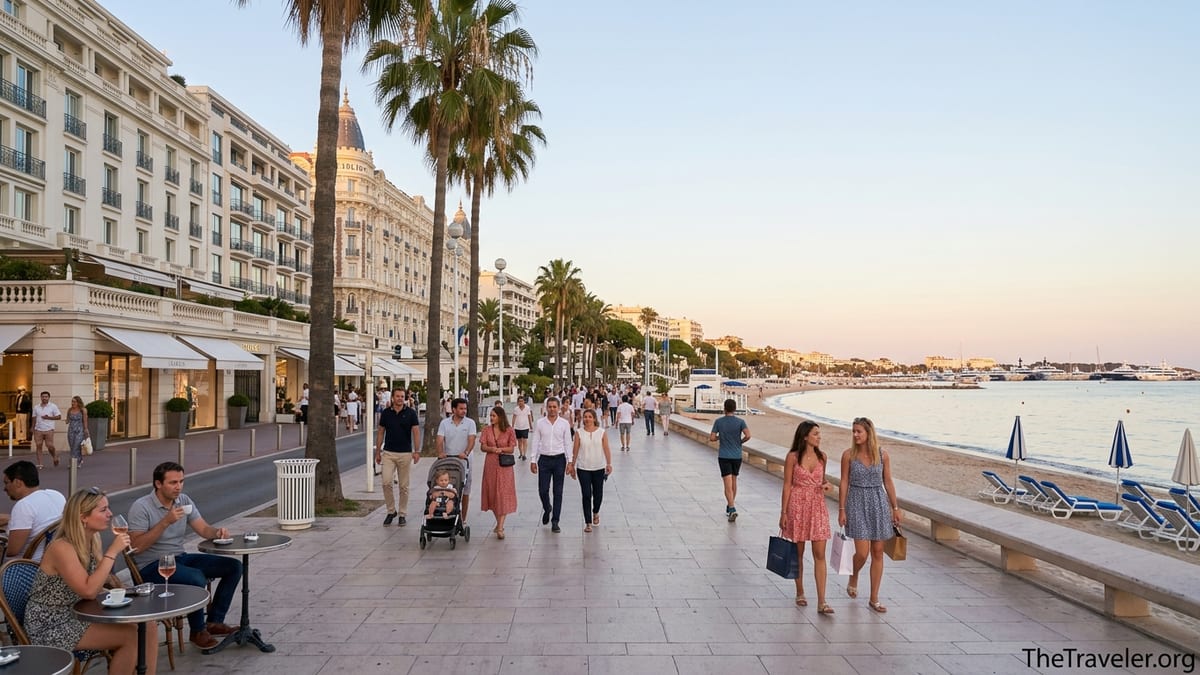
Boulevard de la Croisette is the glamorous three‑kilometre waterfront spine of Cannes, where palm trees frame the bay, designer boutiques rub shoulders with grand hotels, and locals and visitors promenade from sunrise to well past midnight. Walking, shopping, and people watching along this curve of the Côte d’Azur can be the highlight of a trip to the French Riviera, provided you time it right, know where to linger, and understand how the boulevard changes from one end to the other.
Get the latest updates straight to your inbox!
Getting Oriented: How La Croisette Really Works
La Croisette runs in a broad arc along the Bay of Cannes, from the Palais des Festivals et des Congrès at the western end, near the old port, to Palm Beach at the eastern tip. The bay side is lined with sandy beaches and beach clubs, while the land side is home to luxury hotels, flagship boutiques, and a wide sidewalk shaded by palms. Knowing this basic layout helps you decide how to structure your time: strolls and people watching on the seafront side, shopping and cafe stops on the inland side, and detours to the sand whenever you feel like a swim.
The most intense stretch is between the Palais des Festivals and roughly the Hotel Martinez, where you find some of the most famous hotels in France, including Hotel Barrière Le Majestic Cannes and the Carlton Cannes, as well as a dense cluster of luxury boutiques. Farther east toward Port Canto and Palm Beach, the boulevard becomes more residential and relaxed, with smaller beaches and fewer crowds, especially outside high season. This gradual shift in mood along the same boulevard is what makes La Croisette so appealing to explore on foot.
The promenade itself is pedestrian friendly, with wide pavements and benches facing the sea. Traffic on the roadway can be busy at times, especially during May’s Cannes Film Festival and major conventions, but for walkers the experience remains surprisingly calm as long as you stay on the seafront side. If you are coming from the Cannes train station or Rue d’Antibes shopping street, you can reach La Croisette on foot in around 5 to 10 minutes, making it easy to drop down to the water whenever you need a break from the city.
A practical detail worth knowing is that public toilets, drinking fountains, and beach showers are scattered along the promenade, usually signposted near beach entrances and small parks. These seem minor, but they are what make a long walking day along La Croisette actually comfortable, especially in the peak summer heat when temperatures along the paving stones can feel several degrees warmer than the forecast.
The Perfect Walking Routes: From Sunrise Calm to Evening Glow
If you enjoy a quiet, almost local atmosphere, set your alarm and be on La Croisette just after sunrise. Start near Palm Beach at the eastern end and walk west toward the Palais des Festivals with the early light behind you. At this hour, you are likely to see joggers, dog walkers, and hotel staff setting up sun loungers in neat rows on the sand. Cafes are just beginning to open, and the bay is often glassy, with small fishing or sailing boats heading out from Port Canto. This is the moment to appreciate the curve of the bay and the view across to the Esterel hills without the distraction of midday crowds.
By late morning, a classic route for first‑timers is to begin near the Palais des Festivals, where the red‑carpet steps and the handprints on the Chemin des Etoiles create a natural starting point, then wander east along the sea side of the promenade for about 1.5 to 2 kilometres. This section passes some of the most photogenic points of La Croisette, including the row of beach clubs in front of the Majestic and Carlton and the municipal Zamenhof beach near the Martinez. You can step off the main pavement onto the low seawall in places for uninterrupted views over the bay and the Lérins Islands.
In the late afternoon and early evening, the light over the bay turns soft and golden, and people watching reaches its peak. At this time, a good route is to walk a shorter loop between around the Carlton and the Palais des Festivals, zigzagging between the seafront and the terrace bars of the big hotels. This is when you will see families in beachwear blending with well‑dressed shoppers carrying boutique bags and, in festival season, guests in tuxedos and gowns walking toward the Palais. If you prefer a calmer scene, head instead toward the eastern stretch between Port Canto and Palm Beach, where the promenade is quieter but the sunset views back toward the old town are excellent.
For night owls, a final, slower stroll after dinner is worth the effort. La Croisette takes on a different personality with hotel facades and palm trees illuminated, and the reflections of the lights dancing on the water. Street musicians sometimes perform near small squares and benches, and the terraces of hotel bars and late‑opening gelato counters remain active well past midnight in summer. You may not cover much distance on these after‑dark walks, but every few steps present a new vignette of Riviera nightlife.
Shopping on La Croisette: From Flagships to Window‑Shopping
La Croisette is one of the densest collections of luxury shopping in the south of France, but you do not need to be buying haute couture to enjoy it. Between the Palais des Festivals and the Hotel Martinez, the boulevard hosts standalone boutiques and shopping galleries that read like a roll call of European fashion and jewelry. Dior’s flagship space on Boulevard de la Croisette, directly opposite the Palais, is a reference point for many visitors, even those simply admiring the window displays and seasonal decor from the sidewalk.
Near the Martinez, the modern complex at 65 La Croisette brings together several internationally known brands such as Jimmy Choo, Balenciaga, Burberry, and Saint Laurent. These are large, elegant spaces with floor‑to‑ceiling glass, polished stone floors, and staff who are accustomed to a mix of serious buyers and curious passersby. Prices are on par with other major European fashion capitals, so it is worth having a rough budget in mind before you step inside. Accessories such as sunglasses, belts, or scarves are sometimes the most accessible way to take home a tangible piece of La Croisette style without committing to a four‑figure dress.
Jewelry and watch fans will find dedicated maisons along the boulevard, including high‑end multi‑brand jewelers where you may see pieces from houses like Patek Philippe, Rolex, or Cartier displayed under elegant lighting in long glass cases. Even if you are not intending to purchase, spending a few minutes browsing these windows is a form of sightseeing in itself, revealing current design trends and the kind of pieces worn to film festival premieres.
If your budget is more modest or you simply prefer a broader mix, it can be smart to combine La Croisette with a short detour to Rue d’Antibes, one block inland. There you will find mid‑range fashion chains, French cosmetics brands, and smaller independent boutiques. Many visitors adopt a pattern of walking one direction along La Croisette for people watching and sea views, then heading back along Rue d’Antibes or nearby side streets for more practical shopping before returning to the waterfront.
Cafes, Terraces, and Beach Clubs for Prime People Watching
One of the most enjoyable ways to experience La Croisette is simply to sit still with a coffee or aperitif and watch the boulevard go by. The grand hotels along the strip offer terrace bars facing the promenade, where you can order an espresso or a glass of rosé and linger for an hour observing the passing parade. Prices for drinks in these settings are higher than in back‑street cafes, but many travelers consider paying for one coffee in a prime location part of the Riviera experience. Expect to pay more than in central Nice or Marseille; exact prices vary by season and venue.
For a more casual feel, look for the kiosks and smaller bars along the seafront side, some of which have simple outdoor seating directly on the promenade or at the edge of the sand. These are busy throughout the day with families ordering ice creams, locals grabbing a quick espresso at the counter, and beachgoers stopping for soft drinks or beer. The vibe is much less formal than the hotel terraces, but the people watching is just as rich, and you are closer to the informal life of Cannes rather than only its luxury image.
Beach clubs are a signature feature of La Croisette. These private establishments occupy sections of sand in front of the hotels and operate a combination of restaurant, bar, and lounger rental. Typical sunbed prices at well‑known clubs on the central Croisette are broadly in the range that local tourism sites describe for premium beach days, often several dozen euros per person for a full day in high season, with higher tiers for front‑row loungers. Towels and waiter service are usually included, and food can be ordered directly to your lounger, turning your rental into a comfortable base for a day of swimming, relaxing, and people watching.
If you prefer something less costly but still organized, consider Bijou Plage, near Port Canto, which local tourism information highlights as a family‑friendly beach. Here, the atmosphere is a little more relaxed than on the central stretch of La Croisette, and pricing for loungers is typically at the lower end of the Cannes private‑beach spectrum. The clientele mixes Cannes residents with visitors, which makes for an interesting social cross‑section to observe from your patch of sand.
Public Beaches and Budget‑Friendly Ways to Enjoy the Seafront
La Croisette’s glamour can hide the fact that there are genuinely accessible ways to enjoy the waterfront even if you are traveling on a tight budget. Between and around the private beach clubs, several public beaches offer free access to the sand, with no entry charge. You can bring your own towel and sit anywhere outside the zones marked off for private operators. Because loungers and umbrellas are not provided in these free sections, locals often bring compact folding chairs or lightweight parasols bought from supermarkets or seasonal beach shops in town.
One useful option for budget travelers is the municipally managed Zamenhof beach, near the Hotel Martinez. Official information from the city highlights that this beach offers regulated prices for sun loungers and umbrellas, which are generally lower than at private hotel‑run clubs along the central strip. For example, typical published municipal tariffs list a lounger and parasol combination for under ten euros each per day, though prices may be adjusted each season. This makes it possible to enjoy a day with shade and a proper deckchair at a fraction of the cost of the most prestigious clubs.
Food on and around the public beaches can also be kept affordable if you avoid ordering full meals on the sand. A common pattern for visitors is to buy sandwiches, pastries, or fruit from bakeries and small supermarkets on parallel streets and then picnic informally on the beach. Many people also pick up takeaway coffees from small bars on Rue d’Antibes before walking down to the seafront. As long as you respect local rules about glass bottles and litter, this is an accepted way to enjoy the setting without turning every snack into a luxury purchase.
Showers and changing cabins near public beaches are usually basic but functional, and some are coin operated, so it is worth carrying a few euros in coins for the day. Using these facilities lets you comfortably transition from a swim to a promenade walk or a visit to a cafe without going back to your hotel. This flexibility is what allows many visitors to combine La Croisette’s sea and city experiences in the same day without constantly worrying about cost.
Festival Season and Red‑Carpet Glamour: Experiencing La Croisette in May
Each May, the Cannes Film Festival transforms La Croisette from an already glamorous promenade into an international stage. The Palais des Festivals, at the western end of the boulevard, becomes the focus, with its famous red‑carpet steps attracting photographers, fans, and curious visitors. Even if you do not have accreditation or tickets, simply being in the vicinity during the festival is an experience: fans gather behind barriers hoping for autographs, large screens relay arrivals, and the entire seafront feels charged.
During the festival, walking along La Croisette becomes an exercise in people watching at its highest level. You might see industry professionals with festival badges rushing between screenings, journalists broadcasting from improvised studio setups on hotel terraces, and fashion‑conscious visitors dressed for the possibility of a chance encounter. At the same time, regular holidaymakers continue to use the beach and promenade, creating a distinctive mix of day‑trippers in flip‑flops and guests in evening wear sharing the same crosswalks.
Festival season also brings practical considerations. Security perimeters and temporary fences around the Palais and some hotels mean your usual walking routes may be diverted, and bag checks are common near the main entrance points. Accommodation prices in Cannes rise steeply, and some restaurants on La Croisette may host private events, particularly in the evenings. If you want to experience the festival atmosphere without the intensity, consider staying in nearby towns such as Antibes or Juan‑les‑Pins and visiting La Croisette as a day trip, timing your walks for late morning or early afternoon when red‑carpet crowds are a little thinner.
If your schedule is flexible, visiting Cannes outside the festival and major convention periods can provide a much calmer way to enjoy La Croisette. The boulevard remains lively in summer, but you will find it easier to get a table at terrace cafes, book sun loungers at beach clubs on short notice, and move freely around the Palais area without security cordons. The trade‑off is that you miss the spectacle of premieres and famous faces, but for travelers focused on leisurely walking, shopping, and people watching, a non‑festival visit is often the more relaxed choice.
Practical Tips for Enjoying La Croisette on Foot
Comfortable footwear is more important on La Croisette than glossy photos might suggest. The boulevard may look like a place for high heels and polished loafers, but locals who walk the length of the promenade tend to wear flat sandals, sneakers, or espadrilles. The pavement is wide and mostly smooth, but distances add up quickly, especially if you include detours into side streets or multiple back‑and‑forth passes between the Palais and Port Canto. Packing a pair of light, stylish but practical shoes will make it far more likely that you extend your walks into the evening.
Sun protection is essential from late spring through early autumn. Shade from palm trees and awnings is intermittent, and the reflection off the sea increases the intensity of the sun. A hat, sunglasses, and high‑SPF sunscreen will allow you to linger longer at lookout points or on benches without needing to retreat indoors. Many visitors also carry a small reusable water bottle, refilling at public fountains or ordering a carafe of tap water with meals, which is customary in France and helps keep costs down.
Public transport and rideshares can help you structure your day so that you do not have to walk both directions if you tire. The local bus network runs along or near La Croisette, and taxis are often available outside the main hotels and the Palais. A common tactic is to take transport to Palm Beach or Port Canto in the morning, then stroll back into the center at your own pace, stopping for coffee, window‑shopping, and short beach breaks as you go, without worrying about saving your energy for the return trip.
Finally, remember that the character of La Croisette shifts subtly with the seasons and even the days of the week. Weekends in summer bring more regional visitors and families, while weekdays outside school holidays can feel surprisingly calm even in good weather. Early evening on Fridays and Saturdays tends to be the peak moment for stylish people watching, particularly around the big hotel terraces and the central cluster of boutiques. Shaping your plans around these rhythms will help you match the mood you are seeking, whether that is a quiet contemplative walk at sunrise or a front‑row seat to Riviera nightlife at dusk.
The Takeaway
Experiencing Boulevard de la Croisette is less about ticking off individual sights and more about slipping into the rhythm of Cannes itself. Walking the length of the promenade reveals a sequence of atmospheres, from the polished frontages of palace hotels near the Palais des Festivals to the more relaxed stretches by Port Canto and Palm Beach. Along the way, you can dive into luxury window‑shopping, pause at a terrace cafe for an hour of people watching, or step onto the sand for a swim, all within a few hundred metres of each other.
By understanding the layout, timing your walks for the light and crowd levels you prefer, and mixing high‑end experiences with public beaches and back‑street bakeries, you can tailor La Croisette to almost any travel style or budget. Whether you are in town for the film festival’s red‑carpet buzz or during a quieter shoulder season, this three‑kilometre boulevard offers one of the most concentrated slices of Riviera life you can find. Treat it as a living stage rather than just a roadway, and every stroll becomes its own small story.
FAQ
Q1. How long does it take to walk the full length of La Croisette?
At an unhurried pace with brief photo stops, walking the roughly three kilometres from the Palais des Festivals to Palm Beach usually takes about 40 to 60 minutes in one direction.
Q2. What is the best time of day for people watching on La Croisette?
The early evening, roughly from 5 pm to sunset in spring and summer, is ideal, when shoppers, beachgoers, and hotel guests in evening wear all overlap on the promenade.
Q3. Can I enjoy La Croisette on a tight budget?
Yes. Use public beaches, consider municipally managed options like Zamenhof for lower‑priced loungers, buy snacks from bakeries, and limit drinks on hotel terraces to an occasional treat.
Q4. Are the beaches along La Croisette all private?
No. Several stretches of sand are public and free to access. Private beach clubs operate in clearly marked sections where you pay for loungers and services, but you can always use the public parts with your own towel.
Q5. Is La Croisette suitable for families with children?
Yes. The promenade is broad and stroller friendly, and the shallow, generally calm water of the bay plus family‑oriented beaches such as those near Port Canto make it very manageable with kids.
Q6. Do I need to dress up to walk along La Croisette?
For daytime walks and beach visits, casual summer clothes and comfortable footwear are perfectly acceptable. Smarter attire is more common in the evenings, especially at hotel bars and upscale restaurants.
Q7. What happens on La Croisette during the Cannes Film Festival?
The area around the Palais des Festivals is cordoned with security, crowds gather near the red‑carpet steps, and the promenade fills with festival guests, media crews, and curious onlookers, creating a lively, crowded atmosphere.
Q8. Are there shaded spots or parks along La Croisette?
Yes. Palm trees, occasional small gardens, and benches under shade are scattered along the promenade, and you can also step back one block into side streets for more consistent shade during the hottest hours.
Q9. Is it easy to combine shopping and beach time on La Croisette?
Very. Luxury boutiques and shopping galleries sit directly opposite the sand, so you can alternate between sea swims, window‑shopping, and cafe breaks with only a few minutes’ walk between them.
Q10. How safe is it to walk La Croisette at night?
The boulevard is generally well lit and busy into the evening, especially in summer. As in any popular tourist area, normal precautions with valuables and awareness of your surroundings are advisable.