


Florence’s Ponte alla Carraia is often walked over, not walked to. Overshadowed by Ponte Vecchio and Ponte Santa Trinita, this five-arched stone bridge quietly delivers some of the cleanest, most cinematic views of the Arno River. With a little planning, you can turn a simple crossing into one of the most memorable moments of your Florence trip.
Get the latest updates straight to your inbox!
Why Ponte alla Carraia Deserves a Spot on Your Florence Itinerary
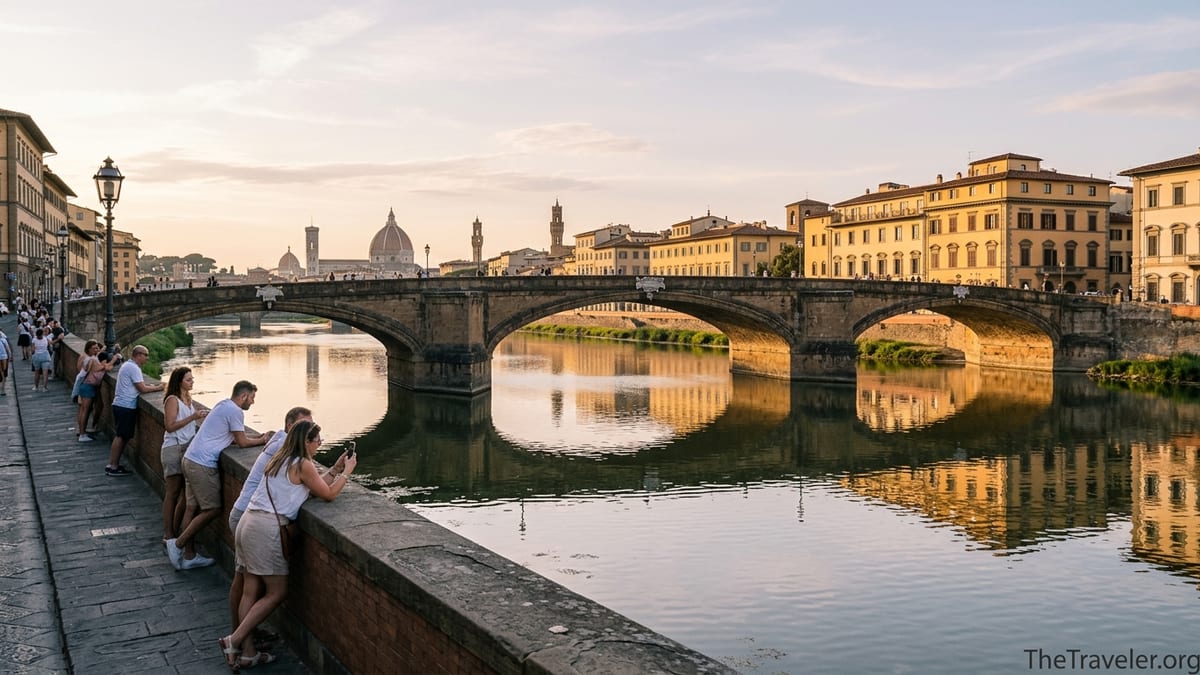
Ponte alla Carraia connects the historic center around Piazza Goldoni to the Oltrarno district, spanning the Arno with five low stone arches. It has been rebuilt multiple times since the Middle Ages, most recently after the Second World War, yet it remains unmistakably Florentine in profile, framed by ocher palazzi, church spires and the gentle curve of the river.
What makes this bridge special for visitors is not only its history but its perspective. Standing here, you look east toward Ponte Santa Trinita and Ponte Vecchio in one direction, and west toward the quieter stretch of river and Ponte Amerigo Vespucci in the other. Unlike the crowded, shop-lined Ponte Vecchio, the sidewalks on Ponte alla Carraia are broad enough to pause, adjust your camera, or simply lean on the stone parapet without feeling rushed.
Because the bridge is used by regular city traffic, many people simply cross it on their way from the train station to Oltrarno restaurants and never pause for the view. With cars rolling past and locals in a hurry, it is easy to think of it as “just another bridge.” The key to unlocking its best river views is knowing where to stand, when to come, and how to approach it so you are looking at Florence instead of dodging scooters.
Plan even a short, 20-minute detour around Ponte alla Carraia and you can watch the Arno turn to molten gold at sunset, see the facades of the Lungarno light up one by one, and frame both famous bridges and lesser-known corners of the city in a single sweep of your eyes.
Getting to Ponte alla Carraia Without Wasting Time
Ponte alla Carraia sits an easy 10 to 12 minute walk from Firenze Santa Maria Novella train station, which is also where the T1 and T2 tram lines terminate from the suburbs and Florence Airport. From the station’s main facade, walk straight down Via degli Avelli and Via della Scala toward the river, then continue along Via Curtatone until you reach Piazza Goldoni. The bridge is directly in front of you, crossing toward the Oltrarno side.
If you are arriving from Florence Airport on the T2 Vespucci tram, you will typically get off at the Unità or Alamanni stops by Santa Maria Novella. Tickets for the tram and city buses cost around 1.70 euros and are valid for 90 minutes from first validation. You can buy paper tickets from machines at the tram stops or use contactless payment on board, which is useful if you have just landed and do not yet have cash. From the tram stop, follow the same walking route to Piazza Goldoni and you will reach Ponte alla Carraia on foot.
Travelers staying in Oltrarno, for example near Piazza Santo Spirito or Piazza del Carmine, will likely encounter the bridge naturally. From Piazza Santo Spirito, it is about a 6 minute walk along Via Maffia and Borgo San Frediano to the river. This makes Ponte alla Carraia a handy reference point: if you can find the bridge, you are never more than 10 minutes from the station side, the historic center, or the lively San Frediano quarter.
Because Florence is compact, there is rarely a need to use a bus just to reach the bridge. A taxi from the station to a hotel near Ponte alla Carraia might cost around 10 to 15 euros depending on traffic, but once you have checked in, you can visit the bridge easily on foot at different times of day to compare the light and atmosphere.
The Best Times of Day for Ponte alla Carraia’s River Views
The Arno can look flat and gray at midday, especially in high summer, when light is harsh and reflections are blown out in photographs. To see Ponte alla Carraia at its best, plan your visit for early morning or late afternoon into sunset. These windows bring out the textures of the stone arches, the ripples on the water, and the subtle pastel tones of the facades along the Lungarno.
In summer months, sunrise in Florence is early, around 5:30 to 6:00 a.m. If you come to the bridge shortly after, you will often have it almost to yourself. Stand on the Oltrarno side, looking east toward Ponte Santa Trinita. The river is usually calmer, and you may see soft mist lifting off the water while first light brushes the dome of the Duomo and the bell towers in the distance. This is a good time for long exposures if you bring a small travel tripod, as the sidewalks are quieter.
Most travelers will find late afternoon and sunset easier to fit around sightseeing. From late spring to early autumn, sunset in Florence generally falls between 8:30 and 9:00 p.m., later at the peak of summer and earlier in September and October. Arrive on Ponte alla Carraia about 30 to 45 minutes before sunset. Position yourself on the upstream side of the bridge, closer to the Oltrarno bank, and look east. As the sun drops behind you toward the west, it lights up the facades running toward Ponte Vecchio and paints the river in bands of orange and pink.
After sunset, wait another 15 to 20 minutes for the “blue hour.” Street lamps along the Lungarno and around Ponte Santa Trinita switch on, casting warm pools of light that reflect in the Arno. At this time of day, even a smartphone can capture atmospheric shots with silky reflections, especially if you rest it on the stone parapet to keep your hands steady. It is also a particularly romantic time for a slow stroll across the bridge on your way to dinner on the Oltrarno side.
Exact Vantage Points You Should Not Miss
To make the most of Ponte alla Carraia’s position, treat it as the central platform in a small loop walk that uses both banks of the Arno. Starting on the Oltrarno side, walk along Lungarno Soderini just a few steps west of the bridge. From here, you can look back to frame Ponte alla Carraia with its reflection in the water, with the low weir at Pescaia di Santa Rosa further upstream creating a gentle cascade. This is a classic shot in calm conditions, when the arches and surrounding buildings mirror almost perfectly in the river.
Next, walk onto the bridge itself and stop about one third of the way from the Oltrarno end on the upstream side. Here you have a clear line of sight east toward Ponte Santa Trinita and, beyond it, the outline of Ponte Vecchio. By angling yourself slightly toward the right, you can include the bell towers of the historic center and the dome of the Duomo rising behind the roofline, a composition that feels very “Florence” at a glance.
After crossing, descend to the right-hand side onto Lungarno Corsini and then a little further to Lungarno degli Acciaiuoli. Look back toward the bridge from this north bank. The stone arches appear lower from this angle, which emphasizes the length of the bridge and the tight row of houses that back onto the river on the Oltrarno side. On a calm day, you will see the street lights and windows twinkling in the water, making this a good vantage point in the early evening around blue hour.
If you have more time and want a broader perspective, continue walking east along the north bank to Ponte Santa Trinita. From the center of that bridge, look back west toward Ponte alla Carraia. Now you can see both bridges in one view, with the Arno curving gently between them. This short circuit, easily done in 25 to 30 minutes at a slow pace, gives you multiple ways to capture the river without repeating the same angle.
Combining the Bridge With Food, Drinks, and Evening Strolls
Part of Ponte alla Carraia’s charm is how naturally it fits into a relaxed evening in Florence. Many visitors plan to eat in the Oltrarno, where trattorias and wine bars spill out around Piazza Santo Spirito and Via dei Serragli. A simple way to build the bridge into your night is to have an early evening drink on the north bank, watch the light change from Ponte alla Carraia, then cross over for dinner.
For example, you might start with an aperitivo at a café along Lungarno Corsini or Piazza Goldoni, where drinks like an Aperol spritz or a glass of Chianti Classico usually cost between 8 and 12 euros, often accompanied by small snacks. Time your drink so you can step out to the bridge 30 minutes before sunset, then slowly wander across, stopping for photos while the sky shifts color above Ponte Santa Trinita.
On the Oltrarno side, the streets just south of the bridge lead toward Borgo San Frediano and Piazza del Carmine, areas known for lively but more local-feeling nightlife than around the Duomo. Casual osterie in this quarter typically charge around 12 to 16 euros for a plate of fresh pasta and 5 to 7 euros for a glass of house wine. Booking a table around 8:30 p.m. works well with a sunset bridge visit in summer, giving you time to enjoy the views without rushing to dinner.
If you prefer a quieter atmosphere, consider an early morning loop. Grab a cappuccino and pastry from a bar near Santa Maria Novella station for around 3 to 4 euros total, then walk to Ponte alla Carraia before the city heats up. You will share the sidewalks mainly with locals walking dogs or commuting to work, and the reflections in the river are often more pronounced before boat traffic and wind disturb the surface.
Practical Tips for Safety, Comfort, and Photography
Ponte alla Carraia carries regular city traffic, including buses and scooters, so it is important to stay on the designated sidewalks and avoid stepping into the roadway for “just one more photo.” The parapet is high enough to feel secure, but if you are traveling with children, keep them on the inner side of the sidewalk, away from the edge, and hold hands in the narrowest sections near the middle of the bridge.
Pickpocketing is not as intense here as around Ponte Vecchio or the Duomo, but any scenic spot can attract opportunists, especially at dusk when crowds gather to watch the sky. Keep your camera bag zipped, avoid leaving gear unattended on the parapet, and use a cross-body bag or money belt if you are carrying passports or larger amounts of cash. If someone offers to take your photo unprompted and insists on handling your camera or phone, it is fine to decline politely.
For photography, even basic smartphones handle Ponte alla Carraia well. Use the built-in wide-angle lens to include more of the river and sky, but be cautious of distortion at the edges that can bend the bridge unnaturally. If you bring a dedicated camera, a standard zoom lens in the 24–70 mm range is versatile enough to capture both wide scenes and tighter details like reflections under the arches. In the evening, switch to night mode or increase ISO slightly to avoid motion blur from passing cars and pedestrians.
Comfort-wise, remember that the stone pavements absorb heat during summer days, making the bridge noticeably warm at sunset. Lightweight, breathable clothing and comfortable walking shoes are important, especially if you plan to wander further into Oltrarno afterwards. In cooler months, the river can feel several degrees colder than nearby streets, with damp air rising off the water, so a light jacket or scarf is handy even when the rest of the city feels mild.
Short Walk Itineraries That Center on Ponte alla Carraia
One of the easiest ways to ensure you do not miss Ponte alla Carraia’s best views is to build it explicitly into a short walk, either before dinner or between major sights. A popular 45 minute route starts at the Duomo, winds down toward the river, and then uses the bridge as a pivot point. From Piazza del Duomo, walk to Piazza della Repubblica, continue to the river at Lungarno degli Acciaiuoli, and follow it west toward Ponte alla Carraia, pausing for photos from the north bank before crossing the bridge into Oltrarno.
From there, you can continue straight to Piazza Santo Spirito for dinner or drinks, or turn east along the riverfront promenade on Lungarno Guicciardini, which eventually leads to Ponte Vecchio. This route lets you see the Arno from multiple angles, with Ponte alla Carraia providing some of the widest, least obstructed views of the water itself, compared with the busier, shop-lined Ponte Vecchio where river views are more restricted.
Another option is a sunset riverside stroll that focuses entirely on the Arno. Begin at Ponte Amerigo Vespucci, the modern bridge west of Ponte alla Carraia, and walk east along the north bank toward Piazza Goldoni. From the midpoint between the two bridges, you have long, leading lines of the river drawing your eye toward the historic center. Continue to Ponte alla Carraia, cross slowly while watching the sky, then follow the Oltrarno bank east toward Ponte Santa Trinita to complete a gentle loop.
If you are short on time, even a quick station-to-bridge detour works. After arriving at Santa Maria Novella by train or tram, instead of heading directly to your hotel, walk straight to Ponte alla Carraia with your daypack only, leaving larger luggage at station storage if needed. Within 15 minutes of stepping off the train, you can be leaning on the bridge parapet, letting the sight and sound of the Arno reset your sense of arrival in Florence before you dive into museums and queues.
The Takeaway
Ponte alla Carraia may not be the star of Florence postcards, but for travelers who seek authentic river views without jostling crowds, it is one of the city’s most rewarding vantage points. Its position between Ponte Santa Trinita and Ponte Amerigo Vespucci offers uninterrupted perspectives both upstream and downstream, perfect for sunrise calm, sunset color, or an unhurried evening stroll.
By approaching the bridge deliberately, choosing your time of day, and exploring a few key vantage points on both banks, you can turn an ordinary crossing into a highlight of your Florence stay. Combined with nearby cafés, Oltrarno trattorias, and easy walking routes from Santa Maria Novella, Ponte alla Carraia slots naturally into almost any itinerary.
Plan for at least one dedicated visit, whether in the soft light of early morning or the golden hue before dinner, and you will understand why many locals treat this as their preferred everyday bridge: a place to pause, breathe, and look out over the Arno while the city quietly carries on around them.
FAQ
Q1. Where exactly is Ponte alla Carraia in Florence?
Ponte alla Carraia spans the Arno River between Piazza Goldoni on the north bank and the Oltrarno district on the south bank, about a 10 to 12 minute walk from Santa Maria Novella station.
Q2. How do I get to Ponte alla Carraia from Florence Airport?
Take the T2 tram from the airport to the Unità or Alamanni stops near Santa Maria Novella station, then walk about 10 to 12 minutes along Via della Scala and Via Curtatone to reach Piazza Goldoni and the bridge.
Q3. What is the best time of day to visit Ponte alla Carraia for photos?
Early morning just after sunrise and late afternoon into sunset and blue hour are ideal, when the light is softer, colors are warmer and river reflections are more pronounced.
Q4. Is Ponte alla Carraia crowded like Ponte Vecchio?
No, it is busy with local traffic but usually far less crowded with tourists than Ponte Vecchio. You can normally find space along the parapet to stop and enjoy the view.
Q5. Are there good restaurants or bars near Ponte alla Carraia?
Yes. On the Oltrarno side, streets around Borgo San Frediano and Piazza Santo Spirito are filled with trattorias and wine bars, while the north bank near Piazza Goldoni has several cafés suitable for aperitivo.
Q6. Is it safe to visit Ponte alla Carraia at night?
In the early evening and around sunset it is generally safe, with locals walking and cars passing. As always, keep valuables secure, stay on the sidewalks and avoid poorly lit side streets late at night.
Q7. Can I see Ponte Vecchio from Ponte alla Carraia?
Yes. From the upstream side of Ponte alla Carraia, looking east toward Ponte Santa Trinita, you can see Ponte Vecchio further in the distance, especially in clear weather.
Q8. Do I need a tripod to photograph the views from the bridge?
You can get good images handheld with a smartphone or camera, especially in daylight. A small travel tripod helps in low light or if you want long-exposure shots of smooth water and light trails.
Q9. How long should I plan to spend at Ponte alla Carraia?
Set aside at least 20 to 30 minutes to walk both sides of the bridge, enjoy the views and take photos. If you combine it with a riverside stroll or dinner in Oltrarno, allow an hour or more.
Q10. Is Ponte alla Carraia accessible for visitors with limited mobility?
The bridge has sidewalks that are level but paved with traditional stone. Approaches from both sides involve standard city pavements; most wheelchair users can cross, though some may find the surfaces slightly uneven.