


Florence is a city of rooftops and domes, but for many visitors the most memorable views unfold right at river level, from the bridges that cross the Arno. So when you only have a couple of evenings in the city, a very practical question comes up: if you are looking for the best views, should you linger on the world‑famous Ponte Vecchio, or wander a few minutes west to the far less crowded Ponte alla Carraia? This comparison looks at what you actually see from each bridge, how they feel at different times of day, and how they fit into a real Florence itinerary, so you can decide which one deserves your sunset hour.
Get the latest updates straight to your inbox!
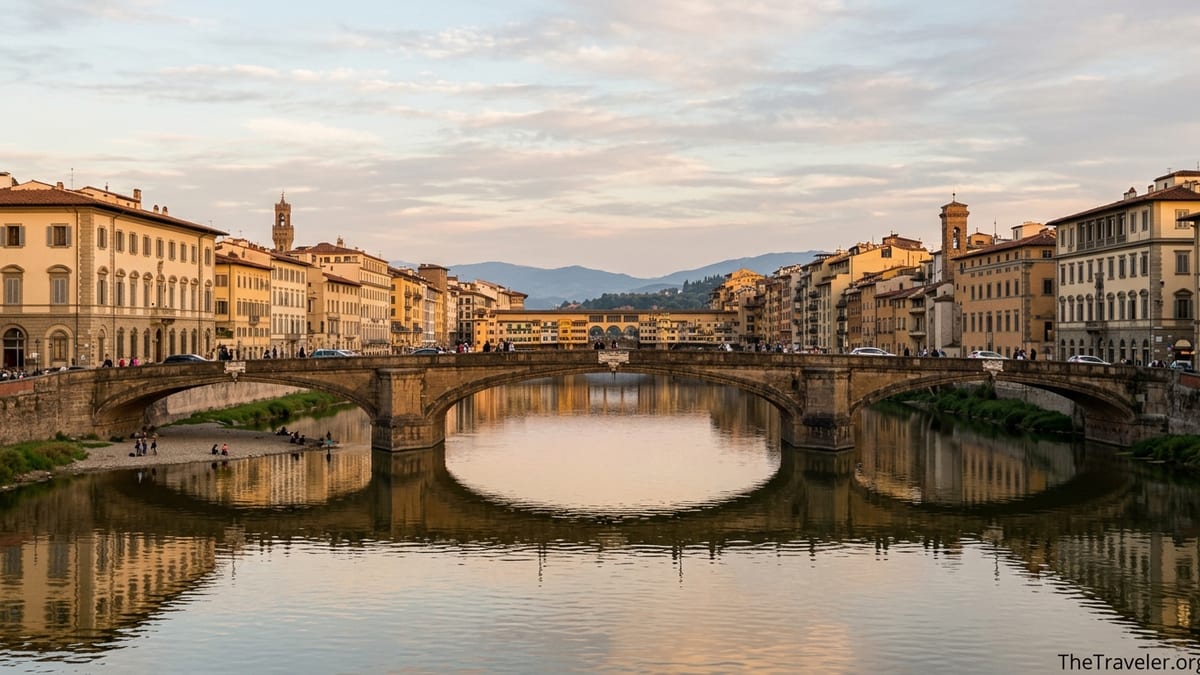
Two Very Different Bridges Over the Same River
Ponte Vecchio and Ponte alla Carraia sit on the same stretch of the Arno, only about a ten‑minute walk apart, yet they offer very different experiences. Ponte Vecchio is Florence’s oldest bridge, a medieval stone span lined with goldsmith and jewelry shops, and one of the city’s most recognizable silhouettes. It survived both historic floods and the Second World War and today functions almost like a narrow pedestrian street hanging over the river. By contrast, Ponte alla Carraia is a wide, open, five‑arched bridge linking Piazza Carlo Goldoni on the north bank with Piazza Nazario Sauro and the Oltrarno district on the south. Originally built in wood around 1218 as the “new bridge” for heavy cart traffic carrying wool and other goods, it has been rebuilt several times after floods and wartime destruction, and the current stone version dates from the late 1940s.
For a visitor today, the contrast is immediately visible. On Ponte Vecchio you walk between shopfronts, often shoulder to shoulder with other travelers, and you have to seek out the few open spots along the parapet to look at the water. At Ponte alla Carraia the entire length of the bridge is open to the river, with low stone balustrades on both sides and space to lean, photograph, and simply watch the light move over the water. Both are historic, both belong to the UNESCO‑listed historic center, but one behaves like an open‑air monument and the other like a viewing platform.
This difference in layout and use underpins almost every aspect of the views they offer: what you can frame in a photograph, how easily you can set up a tripod, how romantic or chaotic sunset feels, and whether you are likely to share your moment with a busker’s amplifier or with a handful of locals crossing town.
What You Actually See From Each Bridge
The first practical question is simple: what do your eyes and your camera lens actually capture from each place? Standing near the center of Ponte Vecchio and looking east, you see the Arno framed by more modern bridges like Ponte alle Grazie, pastel riverside palazzi, and the hills beyond the city. The river surface reflects late afternoon light beautifully, but you do not see Ponte Vecchio itself, and your field of view is limited by the bridge’s enclosed sides and buildings. Looking west from the same spot, you get a perspective toward Ponte Santa Trinita, whose three elegant arches create a pleasing focal point, though the tight stone parapets can make it tricky to find an unobstructed angle if the bridge is crowded.
From Ponte alla Carraia, the views are more open and panoramic. Looking east, you see a sequence of bridges: first Ponte Santa Trinita, then Ponte Vecchio beyond it, and, in the distance, the line of hills that ring Florence. At golden hour, the sun tends to drop behind you or slightly to the side, turning the water surface into shifting bands of gold and shadow while the bridges themselves catch warm side light. Looking west, your eyes run toward the low weir of the Pescaia di Santa Rosa and the more modern Ponte Amerigo Vespucci, with long reflections of apartment facades and trees in the calmer water above the weir. Because the deck of Ponte alla Carraia is wide and flat, you can easily step back to include more of the sky and riverbank in your frame.
In practice, if you want a postcard‑style photo where Ponte Vecchio appears as the star of the composition, the consensus among photographers is that the very best viewpoint is actually from the neighboring Ponte Santa Trinita, which gives a head‑on view of Ponte Vecchio with the river leading into it. Still, Ponte alla Carraia offers an attractive alternative angle: from its eastern side, zooming in with a moderate telephoto lens, you can compress Ponte Santa Trinita and Ponte Vecchio into a layered image, especially atmospheric when the river is low and reflects the bridges. Ponte Vecchio, by contrast, is about being on the icon rather than looking at it.
Light, Atmosphere, and the Sunset Question
Florence’s orientation means that sunsets along the Arno tend to play out in the southwest to west, which affects how the two bridges work at different times. In late spring and summer, a typical sequence might see the sky glowing pink behind the hills, the river gradually turning from pale blue to bronze, and the stone facades picking up a warm sheen for around 30 to 40 minutes before the sun drops fully out of sight. On Ponte Vecchio, this often coincides with peak foot traffic between about 7 and 8 pm, when tour groups, street musicians, and couples watching the sky all converge in the same confined space.
Because much of Ponte Vecchio is physically enclosed by the shop buildings that line both sides, the amount of sky you see is surprisingly limited until you find one of the central viewing cut‑outs. When you do, the effect can be magical: a narrow slice of river glowing orange, silhouettes of distant bridges, the dome of the Duomo hints in the background from some angles. Yet you may need to wait your turn to reach the parapet, especially in high season between May and September, and you should expect frequent jostling of elbows and camera lenses.
Ponte alla Carraia offers a softer, more relaxed sunset experience. The bridge’s open design and relatively low tourist profile mean you can usually claim a clear spot along the balustrade even in June or July. Locals often stop here on their way home, leaning on the stone with a takeaway coffee, chatting with friends, or simply scrolling on their phones while the sky changes color. When the river is low, the gravel bar and small island near the Pescaia di Santa Rosa sometimes emerge; on warm evenings young Florentines head down with beers or picnic supplies, adding a low‑key social buzz to the scene below your vantage point.
If your priority is dramatic color in the water and uninterrupted views of bridges layered against one another, Ponte alla Carraia generally has an edge at golden hour. If your dream is specifically “watching the sky change from Ponte Vecchio,” with buskers playing and shop windows glowing behind you, then the Old Bridge delivers something Ponte alla Carraia cannot replicate, albeit with far more people sharing the moment.
Crowds, Noise, and Overall Experience
Any evaluation of “better views” has to include how it feels to stand in the spot and wait for the light. Ponte Vecchio is among Florence’s busiest pedestrian spaces. Through much of the day it functions as a corridor linking major sights: on one side Piazza della Signoria and the Uffizi, on the other Palazzo Pitti and the Oltrarno streets. Coach tours, cruise excursions from Livorno, and independent visitors all funnel across the bridge. In peak times you may find yourself moving in slow shuffles, dodging selfie sticks and walking past jewelry shops whose window displays range from modest silver pieces to high‑end gold necklaces priced in the thousands of euros.
This density has side effects. For photographers, it is difficult to set up a tripod without blocking someone’s way, and long‑exposure shots at dusk are hard unless you are visiting in the off‑season months like January or February early in the morning. Noise levels can be high: multiple buskers sometimes perform simultaneously, and hawkers may try to sell you tripods, roses, or LED toys. None of this is necessarily negative if you want energy and spectacle, but it does make meditative sunset watching less likely.
Ponte alla Carraia, though used by cars and buses as well as pedestrians, usually feels calmer for the visitor on foot. The sidewalks on both sides are relatively wide, and most people crossing are heading somewhere rather than stopping. That creates pockets of stillness where you can stand for twenty minutes without feeling in the way. You are more likely to share the parapet with a student carrying groceries, a dog walker, or a couple of amateur photographers comparing angles than with a large tour group. Street noise here is more about traffic hum and the city’s daily life than performances.
For many travelers, that shift in atmosphere can be the deciding factor. If you are sensitive to crowds, Ponte alla Carraia’s combination of local rhythm and wide open view will feel like a relief after a lap across Ponte Vecchio. On the other hand, if you thrive on the sense of “being in the middle of it all,” the Old Bridge’s bustle may be precisely what you are seeking, even at the cost of some compositional freedom.
Photography: Framing the Classic Florence Shot
Photography often reveals the strengths and limitations of each bridge very clearly. On Ponte Vecchio, most compelling images focus on details rather than grand vistas: a close‑up of shuttered jewelry shops at dawn before opening time, reflections of arches in the water seen through a gap between buildings, or the play of light and shadow on the stonework. A 35 mm or 50 mm lens on a full‑frame camera works well for these intimate scenes. For river views from the bridge, you might step into one of the central openings and shoot up or downstream with a slightly wider lens, but framing is constrained by the architecture and the crowd.
By contrast, Ponte alla Carraia favors wide‑angle and medium‑telephoto work. With a 24 mm lens you can include the bridge’s own stone balustrade in the foreground, the curve of the Arno in the mid‑ground, and a chain of bridges and rooftops receding into soft evening haze. Switch to a 70 mm focal length and you can isolate Ponte Santa Trinita and Ponte Vecchio in one compressed line, with warm light catching the buildings on the north bank. Because there is usually space to step back, you can adjust your perspective without bumping into others, making it far easier to experiment with compositions.
Practical details matter here. If you plan to shoot at blue hour, roughly 20 to 40 minutes after sunset when streetlights and shop windows glow, it is more comfortable to work from Ponte alla Carraia, where you can bracket exposures or wait for a long exposure without constant jostling. Tripod use is still officially regulated in parts of central Florence, and you may attract attention if you set up a large rig anywhere, but on Ponte alla Carraia you are less likely to block foot traffic or be asked to move quickly. For travelers carrying only a smartphone, both bridges can produce strong images, but the cleaner sightlines and lack of visual clutter at Ponte alla Carraia usually yield more “instant” successes without extensive editing.
One more photographic consideration is the role of reflections. The section of the Arno around Ponte alla Carraia often appears calmer, especially on days without strong wind, which helps create crisp reflections of palazzi and bridges. Closer to Ponte Vecchio, boat traffic and subtle currents can break up the water surface. Around sunset in particular, a five‑minute glide up or downstream along the lungarni can show you how differently the light plays in each stretch; many photographers end up shooting from both bridges over consecutive evenings to build a small series.
How Each Bridge Fits Into a Florence Itinerary
Most visitors do not choose bridges in isolation; they fit them into days already packed with museums, churches, shopping, and meals. Ponte Vecchio naturally integrates with a classic first‑time route: you might leave the Duomo area in late afternoon, walk through Piazza della Signoria, glance at the Uffizi’s courtyard, and then cross Ponte Vecchio to reach the Oltrarno for dinner near Santo Spirito. In this scenario you are likely to cross around 6 or 7 pm, catching pre‑sunset light almost by default.
Ponte alla Carraia comes into its own if you are staying or spending time near Santa Maria Novella station or the western side of the center. A realistic example: after a day trip to Pisa or Lucca, you arrive back in Florence by late afternoon, drop your bag at a hotel near the station, and walk ten minutes along the river toward the Oltrarno for dinner. Crossing Ponte alla Carraia gives you a sunset moment with minimal detour. You can then continue a few minutes to the bars and trattorias along Borgo San Frediano and Via dei Serragli, or circle back along the north bank toward more central restaurant areas.
The area around Ponte alla Carraia also offers easy, concrete amenities at typical city prices. Within a two or three‑minute walk you will find gelaterie that locals line up for on warm evenings, casual wine bars offering glasses of Tuscan reds in the 6 to 9 euro range, and pizzerie and osterie where a main dish might cost between 12 and 20 euros. This makes it simple to build a low‑key evening: sunset over the river, then a short stroll to dinner. By comparison, the streets directly around Ponte Vecchio tilt more strongly toward jewelry boutiques and tourist‑oriented eateries; you may prefer to walk a little farther into the Oltrarno or back toward Piazza della Repubblica for better value and atmosphere.
Time of year matters too. In the height of summer, when Florence’s midday heat can be intense, you may want to reserve the busiest parts of the city, including Ponte Vecchio, for early morning or late night walks. In those shoulder hours, the bridge is quieter, and you can still enjoy river views without full crowds. During cooler months like November or February, even Ponte Vecchio can feel pleasantly uncrowded around sunset, narrowing the experiential gap with Ponte alla Carraia and making the choice more about your specific route than about avoiding people.
The Takeaway
So which bridge offers better views, Ponte alla Carraia or Ponte Vecchio? The answer largely depends on what “better” means for your trip. If you define it as unobstructed sightlines, layered perspectives of multiple bridges, room to breathe while the sky changes color, and a sense of local daily life rather than spectacle, Ponte alla Carraia quietly wins. Its open design, position slightly downstream from the historic core, and typically modest crowd levels make it a remarkably rewarding place to watch the Arno at work, especially around sunset and blue hour.
If, instead, your idea of the perfect view is inseparable from Florence’s most famous bridge itself, then you will likely want to experience Ponte Vecchio from on top at least once. The view may be narrower, the crowds thicker, and the photographic options more limited, but standing in the middle of that centuries‑old structure as the river glows below still carries emotional weight. In practice, many travelers find that a combination works best: one evening devoted to the classic walk across Ponte Vecchio, another reserved for a quieter sunset on Ponte alla Carraia, perhaps followed by dinner in the nearby Oltrarno streets.
Whether you choose one or both, remember that the Arno’s character shifts hourly and seasonally. A hazy spring evening will look very different from a crisp winter sunset, and a sudden shower can turn paving stones reflective in minutes. If your schedule allows, returning to the same bridge at different times of day can be one of the simplest and most satisfying ways to watch Florence reveal itself, one changing reflection at a time.
FAQ
Q1. Is Ponte alla Carraia or Ponte Vecchio better for sunset views?
Ponte alla Carraia is generally better for wide, open sunset views with multiple bridges in frame and more breathing room, while Ponte Vecchio offers a more iconic but crowded and confined experience.
Q2. Which bridge is less crowded for photos and quiet moments?
Ponte alla Carraia is usually far less crowded, with wide sidewalks and plenty of space along the balustrade, making it more comfortable for photography and relaxed river watching.
Q3. Can I see Ponte Vecchio itself from Ponte alla Carraia?
Yes. Looking east from Ponte alla Carraia you can see Ponte Santa Trinita in the foreground and Ponte Vecchio beyond; with a moderate zoom lens you can capture both in a single layered shot.
Q4. Is Ponte Vecchio worth visiting if the views are more limited?
Yes. Ponte Vecchio is a major historic and cultural landmark, and walking across it lets you experience its medieval atmosphere and jewelry shops, even if it is not the best place to see the bridge from the outside.
Q5. Which bridge fits better into a typical first‑time Florence itinerary?
Ponte Vecchio naturally fits a classic sightseeing route between the Uffizi, Piazza della Signoria, and the Oltrarno, while Ponte alla Carraia works especially well if you are staying near Santa Maria Novella or exploring the western Oltrarno.
Q6. Are there good dining options near Ponte alla Carraia?
Yes. Within a few minutes’ walk you will find local gelaterie, wine bars with glasses in the mid‑single‑digit euro range, and casual trattorias and pizzerias serving mains typically between about 12 and 20 euros.
Q7. Is it safe to visit these bridges after dark?
Both bridges sit within Florence’s central urban area, which is generally busy and feels safe in the evening, though you should take normal city precautions with bags, cameras, and valuables.
Q8. When is the best season to photograph the Arno from these bridges?
Spring and early autumn offer pleasant temperatures, softer light, and often calmer river conditions, though winter can bring clear air and crisp reflections with far fewer crowds.
Q9. Do I need special permission to use a tripod on the bridges?
Regulations can be strict for professional shoots, but casual tripod use for individual travelers is often tolerated if you keep gear compact, avoid blocking passage, and move on if asked by authorities.
Q10. If I only have one evening in Florence, which bridge should I choose?
If you want the classic “I was there” experience, choose Ponte Vecchio. If you prefer a calmer atmosphere and more expansive views of the city and river, head to Ponte alla Carraia instead.