


Travelers planning a first or even third visit to Florence tend to fixate on the Ponte Vecchio, Duomo, and Uffizi. Yet just a few minutes’ walk downstream along the Arno sits Ponte alla Carraia, a quieter bridge that often goes unnoticed on standard itineraries. Deciding whether it is worth your time depends on what kind of Florence experience you are seeking: iconic landmarks only, or a more everyday, local view of the city’s river life.
Get the latest updates straight to your inbox!
What & Where Is Ponte alla Carraia?
Ponte alla Carraia is a five-arched bridge that spans the Arno River, linking the historic center of Florence with the Oltrarno district. It sits between Ponte Santa Trinita to the east and Ponte Amerigo Vespucci to the west, providing a practical crossing point between Piazza Goldoni on the north bank and Piazza Nazario Sauro on the south. Although far less famous than Ponte Vecchio, it is actually one of the city’s oldest bridge locations, with a crossing here dating back to the early 13th century.
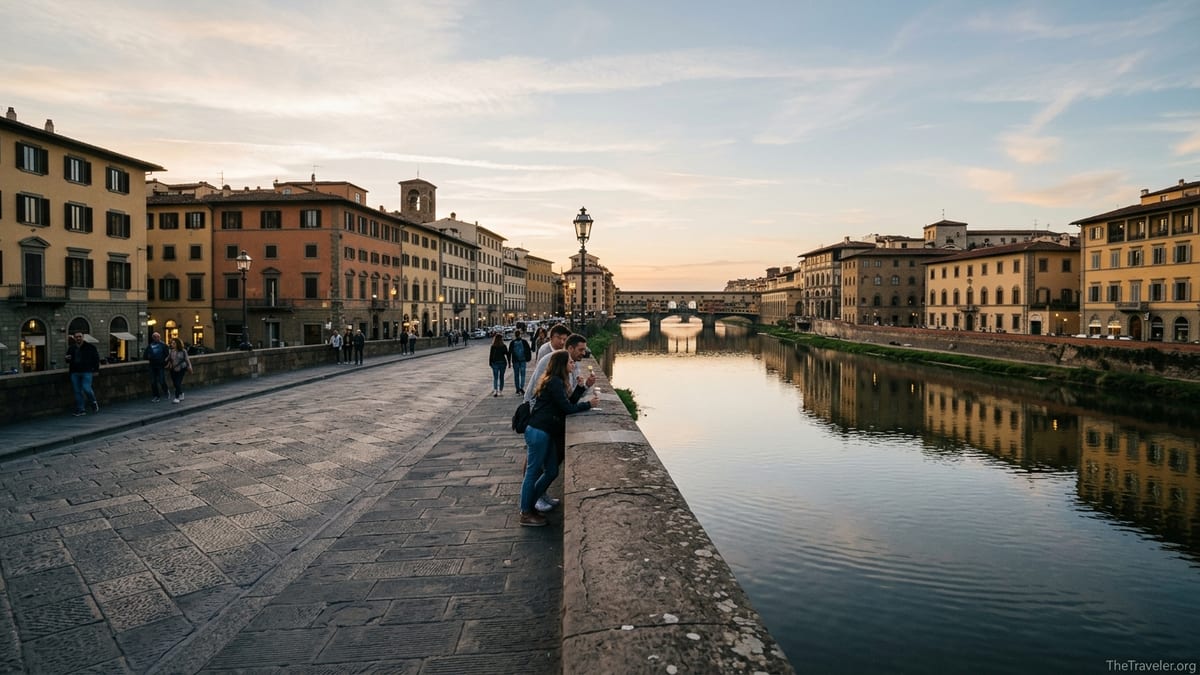
The name “Carraia” refers to the carts that once rumbled across it, taking heavy loads away from the more delicate Ponte Vecchio. Today, the bridge carries cars, buses, cyclists, and pedestrians, functioning as a busy everyday artery rather than a polished showpiece. Standing in the middle of the bridge and looking east, you see a classic Florentine tableau: the curve of the river, ochre buildings, and the silhouette of Ponte Vecchio in the distance.
The current structure was completed in the late 1940s after earlier versions were repeatedly damaged by floods and finally destroyed during the Second World War. What you see now is a sturdy stone bridge with low parapets and clean, simple lines. It does not compete in elegance with Ponte Santa Trinita, but its unadorned form means your eye is naturally drawn to the views up and down the Arno rather than to the architecture itself.
For practical purposes, Ponte alla Carraia is an anchor point on the river. If you are staying around Santa Maria Novella, the station area, or near Piazza Santa Trinita, it is often the most direct way to reach the quieter Oltrarno neighborhoods of Santo Spirito and San Frediano, where many travelers now look for more local bars, trattorias, and apartments.
A Brief History: From Wooden Span to Everyday Workhorse
The story of Ponte alla Carraia mirrors Florence’s long relationship with the Arno. A wooden bridge stood here by around 1218 and was known as the “new” bridge because only the Ponte Vecchio preceded it. It was intended to divert heavy wool and goods traffic away from the older crossing, which was already lined with shops even in medieval times. That practical role shaped both the name and character of the bridge.
Over the centuries, the bridge repeatedly suffered from disasters. It collapsed during a flood in the 1270s and again in 1304 when a crowd gathered on it to watch a water pageant, overloading the structure. Later stone versions were rebuilt after major floods in the 14th century and then modified in the 16th century under the Medici, when many of Florence’s bridges were reshaped to fit Renaissance tastes and growing traffic needs.
Like several other Florentine bridges, Ponte alla Carraia was blown up by retreating German forces in 1944 during the final stages of the Second World War. The bridge you cross today is the postwar reconstruction completed in 1948 to a design by Ettore Fagiuoli. Its practical, almost understated look reflects a city intent on restoring basic infrastructure quickly rather than creating a new monument.
For visitors, the history matters less for its architectural detail and more for understanding why the bridge feels so “everyday.” Unlike the theatrically picturesque Ponte Vecchio, Ponte alla Carraia exists primarily so Florentines can get groceries home, commute to work, or walk the dog along the river. If you enjoy places where a city reveals its ordinary rhythms, that background makes the bridge more appealing.
Is It Worth Adding to Your Itinerary?
Whether Ponte alla Carraia deserves a place in your travel plan depends largely on how much time you have in Florence and what you value. If you are in the city for a rushed single day focused on the Duomo, Uffizi, and Ponte Vecchio, you will not miss any essential “sight” by skipping it. Its architecture is modest and it does not offer a dramatically different skyline than what you can see from more famous spots.
However, for travelers staying at least two or three nights, especially those who like to walk the city rather than just tick off museums, Ponte alla Carraia begins to make more sense. It forms part of a very pleasant loop: for example, crossing Ponte Vecchio from the historic center into Oltrarno, wandering around Piazza Santo Spirito for an aperitivo, then heading west through San Frediano and returning across Ponte alla Carraia as the light softens over the river. That loop can be done in under an hour at a relaxed pace and feels much less crowded than the main tourist spine.
The bridge is also a convenient everyday waypoint. Many visitors now book apartments around Borgo San Frediano or Via dei Serragli, areas known for small wine bars and trattorias with a slightly more local clientele. From there, Ponte alla Carraia becomes your natural route to reach the central shopping streets or Santa Maria Novella. Even if you do not consciously “schedule” the bridge, you may find yourself crossing it several times a day.
In short, Ponte alla Carraia is not a stand-alone attraction worth detouring for if you are tight on time. It is, however, a very worthwhile addition if you enjoy riverside walks, want quieter photo angles of the Arno, or are curious about the more lived-in side of Florence just outside the heaviest tourist corridors.
Views, Atmosphere, and Best Time to Visit
The real reason to care about Ponte alla Carraia is the view. Stand in the middle and look east and you get a sweeping perspective that includes Ponte Santa Trinita, Ponte Vecchio beyond it, and the gentle curve of the Arno lined with pale yellow and terracotta facades. Because the bridge is slightly downstream from the densest concentration of landmarks, the cityscape breathes a bit more here, making for wide, clean compositions if you like photography.
At sunrise, the north bank often glows softly, with the water reflecting the first light and only a few locals walking dogs or jogging along the Lungarno. Travelers who have stayed nearby often describe early morning crossings here as some of their favorite Florence memories, precisely because the bridge is quiet and the city has not yet filled with tour groups. Around 6:30 or 7:00 in the morning in late spring or early autumn, you can usually expect very few people and gentle, low-angled light ideal for photos.
In the evening, especially from late spring through early autumn, the bridge becomes part of a laid-back local promenade. Office workers drift home, couples pause on the stone parapet to watch the sky change color, and small knots of students or friends gather along the river walls on the Oltrarno side. You might see people with takeaway pizza slices or plastic cups of wine, particularly on warm nights, but the atmosphere remains relaxed rather than raucous.
For photography, the sweet spot tends to be the hour before sunset through blue hour, when streetlights reflect in the river and the facades take on a warm, honeyed tone. A basic smartphone is more than enough to capture pleasing shots here. If you are using a camera with a standard zoom lens, something around 24 to 35 millimeters often works well to include both the river curve and one or two bridges in the frame without heavy distortion.
Gelato, Cafes, and Everyday Life Around the Bridge
One of the strongest arguments for including Ponte alla Carraia in your itinerary lives on its southern corner: Gelateria La Carraia. This long-standing gelato shop on Piazza Nazario Sauro is regularly recommended by both locals and guidebooks for offering generous portions at fair prices. A typical cone with two flavors usually costs roughly the same as at other central gelaterie, but visitors often remark that the texture and flavor feel closer to what you might find in a neighborhood shop than in a set-piece tourist location.
A common real-world routine goes like this: after dinner in Santo Spirito or San Frediano, you stroll down to Gelateria La Carraia, join the line that often snakes out the door on warm evenings, pick two or three flavors (pistachio and salted caramel are frequent favorites), then walk onto the bridge to eat your gelato while watching the reflections on the river. Ten or fifteen minutes later, you have not only had dessert but also enjoyed one of the calmer nighttime vantage points in the center.
The streets directly around the southern side of the bridge feel more residential than the lanes near Ponte Vecchio. Expect small bars, bakeries, and a few casual restaurants rather than designer boutiques. On the north side, near Piazza Goldoni, the character is slightly more formal, with offices, hotels, and classic Lungarno buildings that lead back toward Santa Maria Novella and Via Tornabuoni.
For travelers, this mix is useful. If you are staying near the station or Duomo and want to dip into Oltrarno for dinner without straying too far, crossing Ponte alla Carraia brings you quickly to options around Borgo San Frediano and Via dei Serragli. Conversely, if your base is in Oltrarno, this bridge is your fastest route back to the main train station, which can be walked in roughly 15 to 20 minutes at a normal pace.
Safety, Crowds, and Practical Tips
Florence in general has a reputation for being relatively safe, particularly in the central areas around the river. Like all city bridges, Ponte alla Carraia does require basic awareness, but there is nothing about this particular crossing that makes it especially problematic. The roadway is busy with cars and buses, so the main real-world concern is staying behind the low stone parapet and using the sidewalks rather than edging too close to the traffic.
At night, the Arno-side streets and bridges are usually well lit, and local advice often recommends them as sensible walking routes compared with darker back lanes or parks. Many solo travelers, including women, report feeling comfortable crossing Ponte alla Carraia in the evening as long as they stick to the main streets, avoid deserted stretches very late at night, and follow normal urban common sense such as keeping valuables zipped away and not lingering with phones or cameras held carelessly over the water.
Crowding is rarely a serious issue here, which is part of the appeal. Unlike Ponte Vecchio, where you can sometimes struggle to move through tour groups and souvenir stalls, Ponte alla Carraia retains space to breathe. Around rush hour, there is a steady flow of pedestrians commuting, and on warm evenings in high season, you may find more people stopping for photos, but it seldom reaches shoulder-to-shoulder density.
If you plan to walk along the river on either side, comfortable shoes are recommended. The pavements can be uneven in places, and some stretches of Lungarno have occasional construction or narrow sections. In wet weather, the stone can be slippery, so give yourself a bit of extra time and avoid rushing to catch a view at the last minute.
How to Fit Ponte alla Carraia Into Different Itineraries
For a first-time visitor with two or three days in Florence, the easiest way to include Ponte alla Carraia is by turning it into part of a loop that already includes more famous sights. One example: start near the Duomo, walk down to the river and cross Ponte Vecchio, explore the Oltrarno streets around Santo Spirito and Pitti Palace, then head west to San Frediano for dinner. Afterward, cross Ponte alla Carraia back toward the station area, pausing for a gelato or a few moments of people-watching over the water.
If you are staying near Santa Maria Novella, you might naturally use the bridge as your main access to Oltrarno. From Piazza Santa Maria Novella, you can walk down Via della Scala or Via degli Orti Oricellari to reach the river in about 10 minutes, then cross Ponte alla Carraia to find yourself steps from Borgo San Frediano. This makes it easy to incorporate the bridge into everyday movements, whether you are heading to a cooking class, a local wine bar, or simply exploring without a fixed plan.
Travelers on a tighter schedule who are trying to see Florence and perhaps fit in a day trip to Pisa, Siena, or the Chianti countryside may prefer to prioritize other viewpoints such as Piazzale Michelangelo, San Miniato al Monte, or the terraces of public gardens. In that case, Ponte alla Carraia can still serve as a pleasant shortcut if your hotel or apartment happens to be nearby, but it does not need to be a specific “stop” on your checklist.
For repeat visitors who have already seen the headline sights, the bridge can be a useful anchor for more relaxed days: jogging routes along the river that cross here, early-morning photography walks, or casual evenings where the main goal is simply to feel part of the city’s daily rhythm. In those scenarios, Ponte alla Carraia shifts from optional extra to low-key essential.
The Takeaway
Ponte alla Carraia will never rival Ponte Vecchio for legend or Ponte Santa Trinita for pure elegance. It is not the sort of place people dream about before coming to Florence. Yet that is precisely its charm: it is a working bridge in a living city, surrounded by gelato shops, small bars, apartments, and the quiet routines of local life along the Arno.
If your time in Florence is extremely limited and focused on headline museums and landmarks, you can safely treat Ponte alla Carraia as background. You will still come away with the essential impressions of the city. But if you have room in your schedule for an evening walk, an early-morning photo stroll, or a detour into Oltrarno’s more residential streets, including this bridge will give you a broader and more grounded sense of Florence.
In practical terms, think of Ponte alla Carraia not as a must-see attraction but as a useful and rewarding ingredient. Combine it with a bowl of gelato from the nearby gelateria, a simple dinner in San Frediano, or a slow walk along the Lungarno, and it becomes one of those small, vivid scenes that linger long after the grand monuments have blurred together.
FAQ
Q1. Is Ponte alla Carraia worth visiting if I only have one day in Florence?
If you have just one day and want to focus on the Duomo, Uffizi, and Ponte Vecchio, you will not miss any essential highlight by skipping Ponte alla Carraia. It is more of a pleasant extra than a core stop, best appreciated if you have at least two or three days in the city.
Q2. What makes Ponte alla Carraia different from Ponte Vecchio?
Ponte Vecchio is a medieval showpiece lined with jewelry shops and thick crowds, while Ponte alla Carraia is a practical, open bridge used mainly by locals. It offers clearer views up and down the Arno, more space to breathe, and an everyday atmosphere rather than a tourist-focused one.
Q3. Is the area around Ponte alla Carraia safe at night?
The central stretches of the Arno, including Ponte alla Carraia, are generally considered reasonably safe at night, with street lighting and regular foot traffic. Standard city precautions still apply: stay on main streets, avoid very late solitary walks down dark side alleys, and keep valuables out of sight.
Q4. When is the best time of day to go to Ponte alla Carraia?
Early morning offers peaceful, almost empty views and soft light, while the hour before and after sunset brings warm colors and reflections on the river. Evenings in spring and autumn are particularly pleasant, with a relaxed local crowd and cooler temperatures.
Q5. Can I get good photos from Ponte alla Carraia?
Yes. Facing east, you can frame Ponte Santa Trinita and Ponte Vecchio in the distance with the river curving through the city. The open parapets and relatively low crowds make it easy to set up both wide shots of the skyline and closer views of the river reflections.
Q6. Are there good places to eat or get gelato near the bridge?
On the Oltrarno side by Piazza Nazario Sauro there is a popular gelateria that many locals and visitors visit after dinner in Santo Spirito or San Frediano. The nearby streets also offer small trattorias, wine bars, and cafes that feel more neighborhood-focused than the venues around Ponte Vecchio.
Q7. How long should I plan to spend at Ponte alla Carraia?
Most travelers spend 10 to 20 minutes on the bridge itself, enough time for a few photos and to enjoy the view. If you combine it with a riverside walk or a stop for gelato or aperitivo nearby, it can easily become a relaxed hour-long outing.
Q8. Is Ponte alla Carraia suitable for families with children?
Families often enjoy the wide views and open feel of the bridge, but parents should pay attention to traffic and keep children on the inside of the sidewalk away from the road. The low stone walls are tempting for kids to climb, so a firm hand and clear boundaries are helpful.
Q9. How do I get to Ponte alla Carraia from the historic center?
From the Duomo area, walk toward the river via streets like Via dei Cerretani and Piazza Santa Maria Novella, then continue toward Piazza Goldoni. The walk usually takes around 15 minutes. Once at Piazza Goldoni, the bridge is directly ahead, connecting you to the Oltrarno side.
Q10. Is Ponte alla Carraia a good alternative if Ponte Vecchio is too crowded?
If you find Ponte Vecchio uncomfortably packed, walking a few minutes downstream to Ponte alla Carraia gives you more space and comparable river views. You still see the historic skyline and other bridges but with far fewer people and a more relaxed pace.