


Ponte alla Carraia is rarely the star of a Florence itinerary, yet many locals say it offers the most honest view of the Arno. Two bridges west of the Ponte Vecchio, this five-arch stone bridge quietly connects glamorous palaces on the north bank with artisan-filled streets in the Oltrarno to the south. For travelers exploring Florence on foot, it is one of the best places to slow down, watch the river light change and slip into neighborhoods that most tour groups miss. Here is how to make Ponte alla Carraia a highlight of your walking tour, rather than just another bridge you stride across on the way somewhere else.
Get the latest updates straight to your inbox!
Understanding Ponte alla Carraia’s Place in Florence
Ponte alla Carraia was originally built in the early 13th century as Florence’s “new bridge,” second only to the Ponte Vecchio. Its name comes from the carts that once rumbled across it, bringing bales of wool and other heavy goods toward the workshops and gates of the medieval city. Today’s structure, rebuilt after the Second World War, still follows the broad five-arch form that made it ideal for traffic and commerce, but its role has shifted from trade route to vantage point.
Standing on the bridge, it helps to imagine the layers of history under your feet. The wooden span that first crossed the Arno here was washed away by floods and even once collapsed during a crowded festival performance, a reminder that Florence’s river has always been both life source and threat. Later stone versions were damaged again by floods before the Medici ordered a more robust reconstruction. The current bridge, completed in the late 1940s after wartime destruction, is a sober, functional design, yet the views from its low arches remain among the most atmospheric in the city.
Geographically, Ponte alla Carraia links Piazza Carlo Goldoni on the north bank with Piazza Nazario Sauro in the Oltrarno on the south. To the east you can see the elegant curve of Ponte Santa Trinita and, beyond it, the crowd-thronged Ponte Vecchio. To the west, the river widens toward the low weir known as the Pescaia di Santa Rosa and the more modern Ponte Amerigo Vespucci. This position makes it a natural hinge in many self-guided walking routes between Santa Maria Novella, the historic center and the quieter Oltrarno quarter.
For a walking tour, what matters most is that Ponte alla Carraia is central yet rarely packed. Where Ponte Vecchio is lined with jewelry shops and selfie sticks, here you get the same soft Arno light, the same hills on the horizon, but space to breathe. Many residents deliberately choose this bridge for daily crossings or evening strolls because they can pause on the parapet, look upstream to the Duomo’s dome glowing at sunset, and still hear their own thoughts.
Planning Your Route: Reaching the Bridge on Foot
Most visitors encounter Ponte alla Carraia almost by accident, drifting down from Piazza Santa Maria Novella or the fashion streets around Via de’ Tornabuoni. With a bit of planning, you can make the bridge the spine of a very workable half-day walking tour. From the main railway station, it is about a 15-minute walk: head toward the basilica of Santa Maria Novella, continue along Via della Scala or Via dei Fossi, then follow signs for Piazza Goldoni. You will suddenly see the river open up with Ponte alla Carraia directly in front of you.
If you prefer to come from the busier heart of the city, start at Piazza della Repubblica, then walk down Via degli Strozzi and Via de’ Tornabuoni, a route lined with grand palaces and luxury boutiques. At the river you reach Lungarno Corsini, where honey-colored facades of historic palazzi catch the sun. Turning right, you are only a few minutes from the north end of Ponte alla Carraia. This approach lets you experience the contrast between the polished, upscale image of central Florence and the more relaxed, residential feel of the Oltrarno waiting across the river.
Public transport can shorten the walk if you are tired. Several local buses run along the lungarni and stop close to Piazza Goldoni on the north side or Piazza Nazario Sauro on the south. However, central Florence is compact, and for most travelers the streets around the bridge are easiest experienced on foot. Distances are short: from Ponte Vecchio it is roughly a 7-minute stroll west along the river, and from the Duomo area you can be at the bridge in about 15 to 20 minutes at a moderate pace.
When planning timing, consider the bridge’s light rather than just your museum reservations. Morning offers soft illumination on the Oltrarno facades, ideal if you are walking south into the neighborhood. Late afternoon and early evening are especially rewarding if you are facing east, watching the sky change color behind the Santa Trinita and Vecchio bridges. On hot summer days, many travelers schedule their Ponte alla Carraia segment just before dinner, when river breezes and lower sun angles make being outdoors more comfortable.
The Best Views and Photo Moments From Ponte alla Carraia
For many visitors, the main reason to build Ponte alla Carraia into a walking tour is the view. Photographers appreciate that the bridge offers an unobstructed, slightly lower perspective on the Arno, with enough distance from the Ponte Vecchio to capture it in full profile. Walk to the middle of the span and look upstream: you can frame Ponte Santa Trinita in the foreground, Ponte Vecchio beyond it and, if you step slightly toward the Oltrarno side, the dome of the cathedral peeking between rooftops.
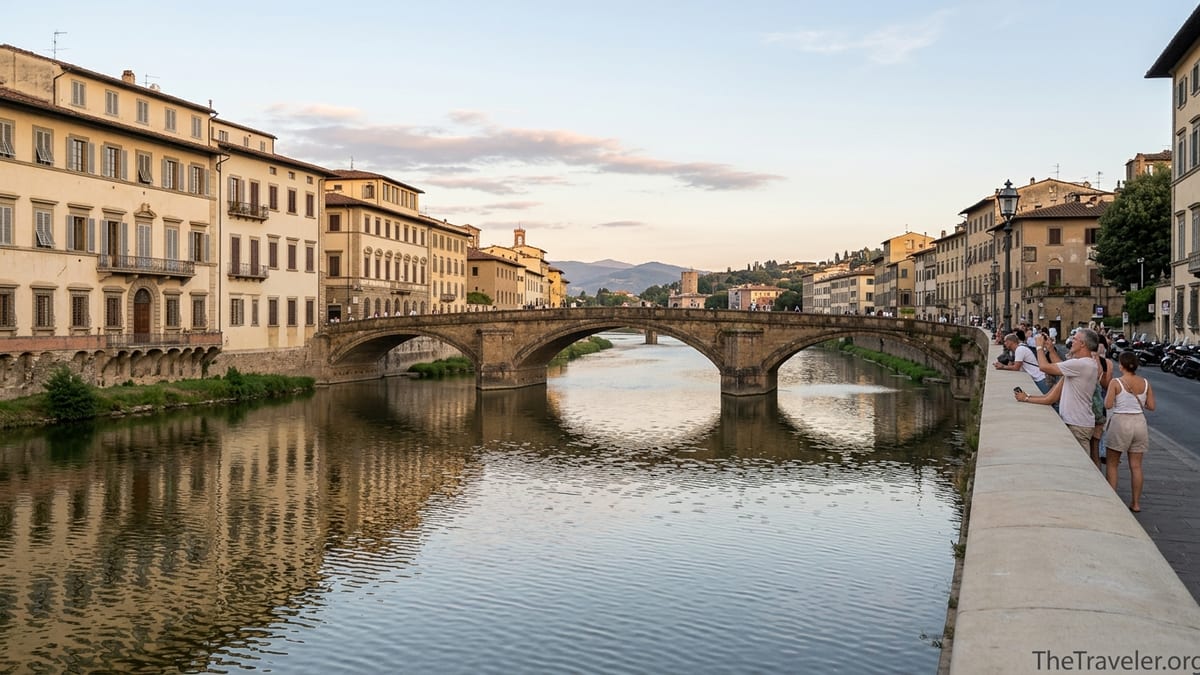
The opposite direction, looking west, delivers a more open, tranquil scene. Here the Arno widens and reflections of the sky stretch across the water. The modest curve of Ponte Amerigo Vespucci anchors the distance, while the low weir creates a subtle line of white water that adds texture to photographs. In the golden hour before sunset, the pastel facades along the north bank pick up warm tones, and the river turns copper or rose depending on the clouds. Amateur photographers using smartphones often find this easier to expose correctly than the high-contrast light on Ponte Vecchio itself.
If you are seeking a quieter alternative to the iconic Ponte Vecchio shot, consider stepping off the bridge entirely. From the south end of Ponte alla Carraia, walk a few meters along the riverside toward the west. Here you can photograph the bridge itself, its five arches reflected in the Arno with the north bank palaces as a backdrop. This spot is especially good shortly after rain, when subtle puddles on the pavement create layered reflections. At night, the low streetlights along the parapet and the illuminated windows of the palazzi make for moody long-exposure images.
Because the bridge is used by cars and buses as well as pedestrians, always be aware of your surroundings while taking photos. Stay on the sidewalks along the edges of the roadway and avoid backing up into traffic while framing your shot. If you are working with a tripod or larger camera setup, it is usually better to step down to the lungarno promenades on either bank, where you have more space and no need to dodge vehicles.
Connecting the Bridge With the Oltrarno Neighborhood
One of the pleasures of including Ponte alla Carraia in a walking tour is how easily it leads into the Oltrarno, often described by locals as the most authentically Florentine part of the city. As you leave the north bank and step into Piazza Nazario Sauro, the atmosphere shifts. Buildings are slightly lower, shopfronts less polished and street life more local. Within a few minutes’ walk you can be in the heart of the Santo Spirito quarter, where artisans, students and longtime residents share the small piazzas and narrow lanes.
A practical route from the bridge is to turn left after crossing into the Oltrarno and follow Via dei Serragli, a long, straight street that hints at the neighborhood’s past as a crafts and trade hub. Side streets lead to traditional workshops where carpenters, gilders and leatherworkers still operate behind unassuming doors. Several small galleries and contemporary studios welcome walk-in visitors during the day. This stretch makes a natural middle section of a walking tour that starts at Ponte alla Carraia and ends at the monumental Pitti Palace and the Boboli Gardens a little further east.
If you instead turn right from the south end of the bridge and navigate toward Piazza Santo Spirito, you will find one of Florence’s most lived-in squares. During the day, locals sit on the church steps and parents bring children to play around the central fountain. In the evenings, bars put out tables and the square fills with a mix of Florentines and international visitors who have wandered over from the river. Many travelers weave this into a loop: sunset on Ponte alla Carraia, an aperitivo in Santo Spirito, then a slow walk back across the Arno toward the Duomo by way of Ponte Santa Trinita or Ponte Vecchio.
Because the Oltrarno is residential, it is wise to keep your pace unhurried and observant. Notice the laundry strung across upper windows, the smell of bread from small bakeries and the sound of bicycles rattling over paving stones. Compared with the heavily trafficked streets between the Duomo and Uffizi, this side of the river is where Florence feels like a city that locals actually inhabit. Ponte alla Carraia functions as one of the most convenient gateways into this daily life, especially if you arrive from the Santa Maria Novella area.
Food, Gelato and Riverfront Breaks Near Ponte alla Carraia
Any walking tour will be more enjoyable if you plan pauses, and Ponte alla Carraia is surrounded by easy options for coffee, aperitivo and gelato. Many frequent visitors make a ritual of crossing the bridge at sunset, then detouring a few steps into the Oltrarno for ice cream from one of the small gelaterie tucked into the side streets. Prices for a basic cone are usually modest in this area compared with the most touristy zones, and portions are generous enough to justify the detour.
On the north side, the streets between Piazza Goldoni and Santa Maria Novella offer several classic cafés and wine bars that work well as mid-walk rest points. You might start with an espresso at the counter in a traditional bar near the station, then walk downhill to the river and cross the bridge before stopping again for an aperitivo spritz or a glass of Tuscan wine on the Oltrarno side. Many bars in this area pair drinks with small plates of crostini, olives or chips at no extra charge, which can be enough to tide you over until dinner.
Perhaps the simplest pleasure is to purchase takeaway food and enjoy it by the river. Supermarkets and delicatessens on both banks sell prepared salads, sandwiches and slices of schiacciata bread that are easy to carry. Once you have your provisions, head toward the low stone walls along the lungarno downstream from the bridge. Here you can sit above the water, watch rowers or tour boats move along the Arno and eat with a view. Be careful not to leave any litter and remember that consuming alcohol outdoors may be subject to local regulations in certain parts of the historic center, so discreet behavior is advisable.
For dinner, many travelers combine Ponte alla Carraia with nearby trattorie in the Oltrarno, where menus often feature Florentine steak, ribollita vegetable soup and simple grilled meats. It is a good idea to reserve a table if you are visiting during peak travel months, as dining rooms in this compact neighborhood fill quickly from around 8 pm. Ending your evening with a leisurely return walk across the bridge, when the riverfront lights are reflected in the Arno and the city has quieted, is one of the most memorable ways to close a day in Florence.
Timing, Safety and Practical Tips While Crossing
Although Ponte alla Carraia feels calmer than some of the city’s other landmarks, it is still part of Florence’s working infrastructure, carrying vehicles, cyclists and pedestrians at all hours. The sidewalks on both sides are reasonably wide, but during commuter times they can momentarily fill with locals in a hurry. If you are walking in a group, it helps to stay single-file when the pavement narrows and to keep photo stops brief, stepping aside where the walkway widens so others can pass.
Traffic flows in both directions across the bridge, which means there is a constant background of engines and bus brakes during the day. For visitors sensitive to noise, early morning and late evening are the most tranquil times to be here. Street lighting is adequate on the bridge itself and along both riverbanks, so most travelers feel comfortable crossing after dark, especially in pairs or groups. As in any city, it is still wise to stay aware of your surroundings and keep valuables secured, particularly when you are distracted by views or photographs.
Weather can change how you experience Ponte alla Carraia. After heavy rain, the Arno runs faster and higher, sometimes with visible tree branches and debris moving downstream. The spectacle from the bridge can be dramatic, but strong winds and spray make long stops less pleasant. In summer, midday heat reflecting off the river and the pavement can be intense, so a hat, water bottle and sunscreen are practical additions to your walking kit. In winter, cold air tends to settle along the river; gloves and a scarf can make the difference between a hasty crossing and a lingering look at the city’s winter light.
Because Florence’s historic center has many uneven cobbles and raised curbs, those with mobility concerns should take extra care near the approaches to the bridge. The slopes on either side are gentle, but small differences in paving height can be easy to miss when you are watching the scenery instead of your feet. If you are pushing a stroller or using a mobility aid, allow a little extra time so you can cross at a comfortable pace and still enjoy the views.
Combining Ponte alla Carraia With Other Bridges and Walks
One of the most satisfying ways to design a day on foot in Florence is to turn its bridges into natural stepping stones. Ponte alla Carraia sits near the center of this chain. You might start a loop at the more modern Ponte Amerigo Vespucci to the west, follow the north bank past the elegant Corsini and Ricasoli palaces, cross the river at Ponte alla Carraia, then return east along the Oltrarno side until you reach Ponte Santa Trinita or Ponte Vecchio.
This sequence gives you a sense of how each bridge has its own character. Ponte Amerigo Vespucci, with its simple, angular lines, feels like a mid-20th-century intervention. Ponte alla Carraia, while also rebuilt in the same era, still hints at its medieval origins through its arches and long, low profile. Ponte Santa Trinita offers a gracefully curved Renaissance design, and the Ponte Vecchio, with its stacked houses and shops, is almost a small village suspended above the water. Experiencing them in order makes it easier to read Florence’s history in the way it crosses its river.
If you prefer to focus on neighborhoods rather than architecture, you can use the bridges as connectors between themed walks. For example, a morning exploring artisan workshops and small galleries in the Oltrarno can naturally end with a crossing of Ponte alla Carraia, delivering you to the fashion streets around Via de’ Tornabuoni and the more formal piazzas of the north bank. Conversely, a day that begins among the churches and museums east of the Duomo can conclude with an evening stroll along the river to Ponte alla Carraia, then a relaxed dinner in Santo Spirito or San Frediano.
Travelers with limited time sometimes assume that if they have visited Ponte Vecchio, they have “done” the Arno. Using Ponte alla Carraia as part of a walking route challenges that notion. Its relatively modest profile, lack of shops and lighter foot traffic create a very different mood. When you compare sunset from Ponte Vecchio with sunset from Ponte alla Carraia, the second often feels more spacious and contemplative. Building both into a loop walk allows you to appreciate how Florence offers multiple versions of beauty along the same stretch of water.
The Takeaway
Ponte alla Carraia rarely appears on must-see lists, yet for travelers exploring Florence on foot it can quietly become a favorite place. Its location between the elegant north bank and the lived-in streets of the Oltrarno makes it an ideal hinge for walking tours that balance major sights with everyday life. From the middle of the bridge you can see both the postcard image of the city, with its domes and historic spans, and the workaday river that still shapes local routines.
Whether you use Ponte alla Carraia as a starting point for an Oltrarno neighborhood wander, a sunset photography stop, or a simple crossing on your way to dinner, planning it into your route pays off. The walk to reach it is short from almost anywhere in the historic center, the approaches are lined with real-world cafés and shops, and the views from its parapet capture Florence at its most unguarded. In a city where some corners can feel crowded from morning to night, this bridge offers space and perspective, both literal and figurative.
On a well-paced walking day, you might traverse Ponte alla Carraia more than once, seeing different light, different reflections and different slices of local life each time. That, more than any checklist of attractions, is what makes Florence memorable: the chance to encounter the same place repeatedly and watch it change hour by hour. Treat this unassuming bridge as a thread through your day, and you will experience the Arno and the city around it in a deeper, more grounded way.
FAQ
Q1. Is Ponte alla Carraia pedestrian-only or open to traffic?
It is a mixed-use bridge carrying cars, buses, cyclists and pedestrians. Sidewalks run along both edges, so stay on these and be mindful of passing vehicles.
Q2. What is the best time of day to visit Ponte alla Carraia on a walking tour?
Early morning and late afternoon to sunset are most rewarding, with softer light, fewer crowds and more comfortable temperatures along the river.
Q3. How long does it take to walk to Ponte alla Carraia from the Duomo area?
At a relaxed pace it usually takes about 15 to 20 minutes, depending on your exact starting point and how often you stop to look at shops or landmarks.
Q4. Can I combine Ponte alla Carraia with a visit to the Oltrarno in one walk?
Yes. Crossing the bridge into Piazza Nazario Sauro puts you within a 5 to 10 minute walk of key Oltrarno spots like Piazza Santo Spirito, artisan streets and the Pitti Palace area.
Q5. Are there good places to eat near Ponte alla Carraia?
Both banks offer options. The north side has classic cafés and wine bars near Santa Maria Novella, while the Oltrarno side leads quickly to trattorie, pizzerias and gelaterie popular with locals.
Q6. Is it safe to be on Ponte alla Carraia after dark?
The area is generally busy and well lit, and many travelers cross it at night without issues. As always, stay aware, keep valuables secure and walk with others when possible.
Q7. Can I take good photos of Ponte Vecchio from Ponte alla Carraia?
Yes. Looking upstream from the middle of the bridge, you can capture Ponte Santa Trinita in the foreground and Ponte Vecchio beyond, often with the Duomo dome in the distance.
Q8. Is Ponte alla Carraia accessible for travelers with limited mobility?
The slopes are gentle and sidewalks are generally smooth, but some paving irregularities and curbs near the approaches require attention. Allow extra time if you use a mobility aid or stroller.
Q9. How does Ponte alla Carraia compare to Ponte Vecchio for atmosphere?
Ponte Vecchio is busier and lined with shops, while Ponte alla Carraia feels more open and local. Many visitors find it better for quiet views and unhurried photography.
Q10. Can I include multiple Arno bridges, including Ponte alla Carraia, in a single walking loop?
Yes. A popular route links Ponte Amerigo Vespucci, Ponte alla Carraia, Ponte Santa Trinita and Ponte Vecchio, giving varied perspectives on the river and different neighborhoods on each bank.